When a 200-4R comes in with "it slips going into third" or "it revs up in overdrive", the 3-4 clutch is the first suspect, and on this transmission it is usually guilty. The 3-4 clutch is applied in third and stays applied in fourth, so any unit that cannot hold the 3-4 pack loses two gears at once. The part that wears out is the friction material. The reason it wears out is almost always pressure: not enough of it at the 3-4 piston, or not enough at the right time. Replace only the clutches without finding where the pressure went, and the new pack burns up like the old one.

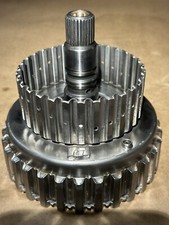

What the 3-4 clutch does in a 200-4R
The 200-4R is a fully hydraulic four-speed. The computer on these cars only switches the converter clutch on and off. Shift timing comes from governor pressure and throttle (TV) pressure, and TV pressure comes from a cable connected to the carburetor or throttle body. That cable is the only thing telling the transmission how hard the engine is working.
The 3-4 clutch pack lives in the input housing with the forward clutch, and it is applied by its own piston on the 2-3 upshift. In fourth, the 2-4 band applies as well and the 3-4 clutch keeps holding. That means the 3-4 pack is carrying torque in every mile you drive once the 2-3 shift happens, which at light throttle is usually somewhere around 25 to 30 mph. A clutch pack that sits applied that long is very sensitive to apply pressure. A few psi short and it does not lock solid, it slips a little, the friction surface glazes, and the slip gets worse until it flares on every 2-3 shift.
The 3-4 accumulator is the other piece of the circuit. It sits in the case under the valve body separator plate and cushions the 2-3 apply. B&M's 200-4R kit instructions have you set the 3-4 accumulator pin, spring and piston in the case before the separator plate goes on, and they note that some units come with the 3-4 accumulator spring installed above the piston instead of below it (B&M 35265 instructions). A damaged accumulator seal on that piston is a direct leak in the 3-4 apply circuit.
Symptoms of a burned 3-4 clutch
- Flare on the 2-3 shift. The engine rpm jumps up between second and third instead of dropping cleanly. Light throttle may still feel okay at first, heavier throttle flares worse.
- Slips in third and fourth. The tach climbs when you get into it at highway speed with no matching increase in road speed.
- Feels like neutral after the 2-3 shift. A fully burned pack gives you first and second, then nothing, or you get a delayed 2-3 that bangs in late.
- Overdrive goes away. Because fourth needs the 3-4 clutch too, a car that "won't shift into overdrive" or slips in overdrive often has the same root problem.
- Black, burnt-smelling fluid with fiber in the pan. Friction material in the pan and a dark, varnished filter tell you something cooked. It does not tell you which pack, but on a 200-4R with these road-test symptoms it is usually the 3-4.
First and second need the forward clutch, the 2-4 band and the roller clutch, not the 3-4 pack. If first and second are crisp and third and fourth slip, you have localized the problem to the 3-4 circuit or the pack itself.
Check before you pull it: level, cable, pressure
B&M's troubleshooting section lays out the order for any shift quality complaint on this unit: check the fluid level, check and adjust the TV cable, check the outside manual linkage, and then put a gauge on it (B&M 35265). Their "slips" list for the 200-4R includes low fluid, loose valve body bolts, damaged or missing 1-2 or 3-4 accumulator seals, an improperly assembled pressure regulator, incorrectly installed throttle valve linkage, a misset TV cable, a sticking throttle valve, a misaligned valve body gasket and damaged filter O-rings. Most of those are pressure problems, not clutch problems.
Fluid level
Check it hot, engine running, in park, on level ground. A unit that has been low for a while pulls air at the filter on turns and stops, and every time it does line pressure drops. That alone will glaze a 3-4 pack.
TV cable
The TV cable is the most common reason a 200-4R burns a 3-4 clutch, especially on a car that has had a carburetor, intake or throttle body swap. If the cable is too loose or the throttle lever geometry is wrong, TV pressure stays low, line pressure stays low, and the clutches slip under load. Sonnax's TV cable corrector kit page explains a related failure: the cable "pulls out of adjustment at wide-open throttle," typically because the throttle shaft lever geometry is wrong, and when the travel or pivot distance is greater than spec the self-adjuster gets pulled out of adjustment (Sonnax AS1-01K). After that, the cable is effectively too long and pressure is low everywhere. B&M is blunt about it: failure to reset the TV cable results in poor shift quality and or transmission failure.
Reset the cable any time it has been disconnected, then confirm the cable reaches full travel at wide open throttle without being dragged out of adjustment. On an aftermarket carburetor, use a bracket and lever designed for the 200-4R TV cable rather than a universal throttle cable bracket.
Line pressure test
This is the test that separates "bad clutch" from "bad hydraulics." Install a 0-300 psi gauge at the line pressure tap, which B&M places just above the outside manual linkage on the left side of the case. Test at 1000 rpm with the brakes applied, first with the TV cable at its normal setting (minimum TV) and then with the cable pulled to full travel by hand. Do not open the throttle wide during this test; only pull the cable.
| Range @ 1000 rpm | Minimum TV | Full TV |
|---|---|---|
| Park and Neutral | 75 psi (517 kPa) | 110 psi (758 kPa) |
| Reverse | 92 psi (634 kPa) | 200 psi (1380 kPa) |
| Drive (D4) and Manual Third (D3) | 75 psi (517 kPa) | 110 psi (758 kPa) |
| Manual Second (D2) and Low (D1) | 112 psi (772 kPa) | 112 psi (772 kPa) |
Those are B&M's published 200-4R minimums. B&M notes that because of the many pressure regulator combinations GM used, these are minimum values and most units read substantially higher, so check the factory service manual for your exact model and year. What matters most for a 3-4 complaint is the pattern:
- Low in every range, does not rise with the cable pulled: pressure regulator, pump, or TV system. Look at the regulator valve train, the boost valve, and the pump.
- Normal in park, but low when the cable is pulled: TV system. Cable, TV plunger and valve, or the TV boost valve leaking.
- Normal on the gauge, but it still flares 2-3: the leak is after the line pressure tap, in the 3-4 apply circuit itself. Think 3-4 accumulator seal, input shaft sealing rings, or the 3-4 piston seals. That points to teardown.
The hydraulic causes that kill 3-4 clutches
TV boost valve leakage
Sonnax describes this one directly: "A common problem in GM 200-4R and 4L60 transmissions is burned bands and/or 3-4 clutches," and that failure can be reduced by eliminating throttle boost oil leakage (Sonnax 77917-500). The TV boost valve sits in the pump with the pressure regulator. When the sleeve leaks at its outside diameter, throttle pressure that should be raising line pressure bleeds off instead. Sonnax's replacement uses O-rings on the sleeve to stop that leak and to keep TV and reverse boost oil from crossing. Sonnax offers it in .423", .471" and .500" sizes. Their guidance is the .423" for minimum line pressure in V8 applications, the .471" for towing and off-road, and the .500" for maximum line pressure on high performance builds. Pick the size for the use, not the biggest one in the box.
Pressure regulator bore wear
The pressure regulator valve rides in an aluminum bore in the pump cover, and after enough miles that bore wears oval. Sonnax lists "3-4 clutch failure" among the symptoms of that wear, along with erratic line pressure, low line rise, clutch slippage and excess pump noise. Their diagnostic marker is a dyno test showing line pressure 50 to 100 psi below spec in reverse under boost, or a failed vacuum test at the bore (Sonnax 77917-06). The fix is an oversized valve with the bore reamed to match. Sonnax also recommends checking the boost valves for leakage while you are in there and moving up one boost ratio when you oversize the regulator.
B&M adds a warning that matters on every rebuild: the pressure regulator boost valve train can be put together several ways, and only the correct orientation works. Assemble it wrong and you get low line pressure, slipping clutches and burned friction elements.
3-4 accumulator leaks
The accumulator piston rides on a pin, and the pin bore wears from thousands of strokes. Sonnax lists poor shift quality and burnt clutches and bands as the symptoms, explaining that at severe wear the circuit loses fluid through the pin bore faster than the pump can make up for it. The piston can also cock in the bore and gall it (Sonnax 77998-03K). Sonnax's pinless piston eliminates the pin bore entirely. On a 200-4R it fits the 3-4 accumulator location only, not the 1-2. At minimum, replace the accumulator piston seal on every rebuild and inspect the bore for scoring.
Internal sealing
If the gauge reads right and the accumulator is good, the oil is getting lost on its way into the input housing. The sealing rings on the input shaft and the inner and outer lip seals on the 3-4 piston are the candidates. Air check the 3-4 circuit with the input housing assembled. A good pack applies with a solid thump and holds. A hiss, or a piston you can hear but not feel apply, tells you where the leak is. Inspect the input housing for cracks around the piston bore and for a worn sealing-ring land on the shaft.
The rebuild: what to replace and inspect
- 3-4 frictions and steels. Replace all of them. Check the steels for blueing and heat checks. Do not reuse glazed steels.
- 3-4 piston seals and input shaft sealing rings. These are in any good overhaul kit and are the cheapest insurance in the unit.
- Input housing. Inspect the piston bore, the sealing-ring lands and the clutch drum splines. A housing with worn lands or a cracked piston area needs to be replaced, not resealed.
- Pump. Check the pressure regulator bore and the TV boost sleeve. Address bore wear with an oversized valve or a known-good pump.
- Accumulators. New seals, correct spring orientation, and a pinless piston if the pin bore is worn.
- Valve body. Clean it, check the throttle valve and plunger for sticking, and put every checkball back in its correct location. Sketch the locations before teardown, because a missing or misplaced ball is on B&M's list for no-shift and no-move complaints. Torque the valve body and accumulator bolts to 11 N·m (8 ft-lb) per B&M. Over-tightening distorts the bores and can make valves stick.
- Clutch clearance. Set 3-4 pack clearance to the factory or kit spec with the correct selective backing plate. A pack that is too loose takes longer to apply and slips during the shift, and a pack that is too tight drags.
Fluid and prevention
The 200-4R was built for DEXRON II-era fluid, which is no longer licensed. GM's current guidance lists DEXRON VI for GM automatic transmissions where DEXRON VI, an earlier DEXRON or AW-1 is specified, and says DEXRON ULV is not a suitable replacement for DEXRON III or DEXRON VI (GM Service Insights). Use a licensed DEXRON VI.
To keep the new 3-4 pack alive:
- Set the TV cable and verify it with a gauge. The road test can feel fine and pressure can still be low under part throttle.
- Fix the geometry on any carburetor or EFI swap. Use the correct TV bracket and lever, and confirm the cable is not pulled out of adjustment at wide open throttle.
- Add a cooler and a temperature gauge on anything that tows or makes real power. B&M points out that most transmission and converter failures trace back to excessive heat.
Master rebuild kits, input drums, pumps, TV cables and the rest of the 200-4R catalog for a 3-4 clutch job done right.
Shop 200-4R parts →Shop the part for this fix: Sonnax Heavy Duty 3-4 Clutch Backing Plate Kit 74140-01K
If you are rebuilding the 3-4 pack on a 200-4R that sees real power or towing, this is the heavy duty backing plate for that pack. CoreTransmissionParts also carries the Sonnax pressure regulator, accumulator and TV parts covered above.
Shop the backing plate kit at CTP → All 200-4R parts at CTP →FAQ
What are the symptoms of a burned 3-4 clutch in a 200-4R?
The classic signs are an engine flare on the 2-3 shift, slipping in third and overdrive under load, and in a bad case a neutral feeling after second gear. First and second usually still work because they do not use the 3-4 pack. Dark, burnt-smelling fluid with friction material in the pan backs up the diagnosis.
What causes 200-4R 3-4 clutch failure?
Low apply pressure is the usual cause. A loose or misadjusted TV cable, wrong throttle lever geometry after a carburetor swap, TV boost valve leakage, a worn pressure regulator bore and leaking 3-4 accumulator seals all lower the pressure holding the pack. Sonnax lists burned 3-4 clutches as a common 200-4R problem tied to TV boost oil leakage.
What should 200-4R line pressure be?
B&M's published minimums at 1000 rpm are 75 psi in Park, Neutral and Drive at minimum TV, rising to 110 psi with the TV cable pulled to full travel. Reverse is 92 psi minimum and 200 psi at full TV, and manual Second and Low hold 112 psi. Most units read higher, so confirm the spec in the factory manual for your year.
Can a TV cable adjustment fix a slipping 200-4R?
It can fix low pressure, but it cannot repair a pack that is already burned. If the clutch is glazed or worn through, the transmission needs the 3-4 clutches replaced along with whatever caused the low pressure. Reset and verify the cable on every 200-4R that slips before deciding it needs a rebuild.
Sources
- B&M Racing & Performance, Shift Improver Kit 35265 for 1981-90 THM200-4R, installation instructions — TH200-4R line pressure chart at minimum and full TV; slips troubleshooting list (accumulator seals, pressure regulator assembly, TV cable); 3-4 accumulator spring orientation; TV cable reset warning; valve body bolts 11 N-m, pan bolts 14 N-m; about 6 quarts. B&M instructions (PDF)
- Sonnax, TV Boost Valve Kit 77917-500 (200-4R and 4L60) — burned bands and 3-4 clutches as a common 200-4R problem; reduced by eliminating throttle boost oil leakage; O-ring sleeve; .423/.471/.500 sizing guidance. sonnax.com
- Sonnax, Oversized Pressure Regulator Valve 77917-06 — pressure regulator bore wear causes erratic line pressure, low line rise, clutch slippage, pump noise and 3-4 clutch failure; line pressure 50-100 psi low in reverse under boost as a diagnostic marker. sonnax.com
- Sonnax, Pinless Accumulator Piston Kit 77998-03K — pin bore wear lets the circuit lose fluid, piston cocking, burnt clutches and bands; 200-4R use limited to the 3-4 accumulator location. sonnax.com
- Sonnax, TV Cable Corrector Kit AS1-01K — TV cable pulled out of adjustment at wide open throttle by incorrect throttle shaft lever geometry. sonnax.com
- GM Service Insights, "Use the Right Transmission Fluid" — DEXRON VI covers GM transmissions that specify earlier DEXRON fluids; DEXRON ULV is not a replacement for DEXRON III or VI. gmserviceinsights.com