
A bare core shows up with no paperwork, maybe a partial tag, and someone wants to know what it is before they spend money on it. The 200-4R gets confused with three different units constantly: the TH350 it shares a case length with, the 700R4 it shares a bellhousing family and a TV cable system with, and the generic "GM overdrive" label that gets slapped on anything with four forward gears from this era. None of that confusion survives five minutes on the bench once you know what to look at.
Start with the pan: shape and bolt count
Pull the pan, or just look at its outline before you do. The 200-4R pan is a two-level casting, a main rectangular section with a shallower step toward the tailshaft end, and it runs 16 bolts around the perimeter. That is the same bolt count as a 700R4 pan, so bolt count alone does not separate those two, but it instantly rules out a TH350, which uses a 13-bolt pan. The stepped, two-tier shape is the giveaway against the 700R4, whose pan is close to a uniform square from corner to corner.
Case and tailhousing: the fastest check in the shop
Before you even look at the pan, look at the back of the unit. The 200-4R case and tailhousing are cast as one piece, exactly like a TH350. The 700R4 has a separate, bolted-on tailhousing with a few different length options depending on application. If you can see a seam and bolt circle where the tailshaft housing meets the main case, you are not looking at a 200-4R. This single check is faster than counting pan bolts or finding the tag, and it works from across the bench.
Overall case dimensions line up with the TH350 as well, which is exactly why 200-4R swaps into TH350-based cars are common: similar case length, similar bellhousing footprint, and a drivetrain that already expects a unit this size.
The bellhousing pattern tells you what it bolted to
Most 200-4R cases were cast with a dual bellhousing bolt pattern that covers both the Chevrolet pattern and the Buick-Oldsmobile-Pontiac (B-O-P) pattern on the same case. That is not true of the 700R4, which is a Chevrolet-pattern unit with only a small number of B-O-P exceptions. If your core has the extra bolt holes positioned to accept a B-O-P bellhousing in addition to a Chevy one, that is a 200-4R trait, not a 700R4 one, and it is a big part of why clean 200-4R cores built for Buick, Olds or Pontiac applications hold their value.
Find the ID tag, but don't expect a magic decoder
Every 200-4R has an identification tag or stamped code on the case, typically on the passenger side of the unit near the tailshaft. It carries a short alphanumeric code specific to that production run. Treat it as a confirmation reference, not a lookup table you can decode from a forum post: GM's internal code assignments changed across the 1981-1990 production run and were never published as a single public reference. If you need to confirm exactly what car a specific core came out of, cross-check the physical traits here (case, bellhousing pattern, pan) against the vehicle's own build sheet or parts-fitment data rather than trying to reverse-engineer the tag alone.
What cars it actually came in
This is where "identification" matters most in practice, because a lot of 200-4R demand is driven by swap builders trying to confirm a core will work in a specific car. ATSG's service documentation for the unit places it across several GM platforms and body codes:
- 1981-90 B-body: Chevrolet Caprice, Buick LeSabre, Oldsmobile Delta 88, Pontiac Bonneville
- 1981-84 C-body: Cadillac DeVille, Oldsmobile 98, Buick Electra
- 1984-88 G-body: Chevrolet Monte Carlo, Buick Regal (including the turbocharged Grand National), Oldsmobile Cutlass Supreme, Pontiac Grand Prix
- 1985-90 D-body: Cadillac Fleetwood and Brougham
- Select Pontiac Firebird applications, including the 1989 20th Anniversary Trans Am Indy 500 Pace Car
A broader parts-fitment check from Transtar's own vehicle application data corroborates that spread and adds model-year detail inside each platform, for example narrowing the Buick Regal application to 1982-87 and the Pontiac Firebird's 200-4R application specifically to the 1989 model year. If you are trying to confirm a core against a particular car, match the model year ranges, not just the nameplate, since several of these platforms ran more than one transmission across the decade.
Decoding the accumulator valve letter codes
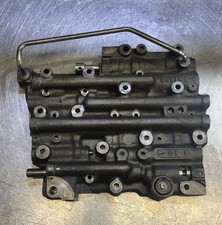
Once you are inside the valve body, there is a second identification layer that matters more to how the transmission shifts than the VIN tag ever will: the letter code stamped on the accumulator valve sleeve. Sonnax's own breakdown of this system describes it as an "alphabet soup" that confuses a lot of rebuilders, but the logic is straightforward once you see it laid out. Each letter corresponds to a specific valve spool size and spring combination that sets the accumulator pressure curve, and that curve determines how light or firm the 1-2 and 3-4 shifts feel. Lower-pressure codes (K, N, A) give a lighter apply rate, while higher-pressure codes (B, M, L) firm the shift up.
The 200-4R specifically uses the L and M version valve trains from that family: the L kit at .330 inch bore for light and medium-weight vehicles, and the M kit at .341 inch bore for heavier vehicles. Both are cataloged by Sonnax as direct fixes for a 1-2 bang at light throttle or reduced 2-4 band life, which tells you something useful during identification: if a core came out of a heavier D-body Cadillac versus a lighter G-body Monte Carlo, it may carry a different accumulator valve train even though the case and tag look otherwise identical. Pull the valve body and read the stamp before you assume two "200-4R" cores are calibrated the same way.
200-4R Speedometer Gear Kits at CoreTransmissionParts
Speedometer driven gear tooth count is another identification point worth checking once you have confirmed the case: GM used multiple tooth counts across 200-4R applications to match different axle ratios, and running the wrong one throws the speedometer off even on a correctly identified unit. CoreTransmissionParts stocks complete speedometer kits with gasket, gears and housing for the common tooth counts.
View the 10 & 27-tooth speedometer kit at CoreTransmissionParts →Fluid: what it actually takes today
The 200-4R was built entirely within the DEXRON-II era, 1981 through 1990, years before DEXRON-III or DEXRON-VI existed. That does not mean you need to hunt down discontinued fluid. Valvoline's own DEXRON-VI product data sheet states the fluid is officially licensed with GM, fully back-serviceable, and can be used wherever DEXRON-II or DEXRON-III were originally specified. For a transmission this age, DEXRON-VI from a reputable brand is the correct modern fill, not a compromise.
Quick identification checklist
- One-piece case and tailhousing: 200-4R or TH350, not a 700R4 with its bolt-on tailhousing.
- 16-bolt, two-level pan: 200-4R or 700R4, not a TH350's 13-bolt square pan.
- Dual Chevy/B-O-P bellhousing pattern: strong 200-4R indicator; 700R4 is almost always Chevy-only.
- Case length and width matching a TH350: confirms 200-4R family over the longer 700R4 case.
- ID tag on the passenger side near the tailshaft: confirms production info, but cross-check fitment by model year rather than decoding the code alone.
- Accumulator valve letter stamp inside the valve body: tells you which pressure curve and vehicle-weight class the unit was calibrated for.
Need parts for this job?
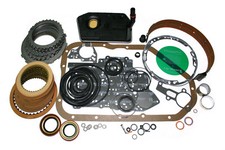
Once you've confirmed what you've got, master rebuild kits, valve bodies, TV cables and the bench tools for the 200-4R, shipped from the USA.
Shop 200-4R parts →FAQ
How many bolts does a 200-4R oil pan have?
Sixteen. The pan is a two-level casting, a main square section plus a shallower step toward the tail, and it uses 16 bolts around the perimeter. A TH350, which shares the same case length, uses a 13-bolt pan instead, so the bolt count alone separates the two units in about five seconds without pulling anything apart.
Does the 200-4R have a removable tailhousing like the 700R4?
No. The 200-4R case and tailhousing are one piece, the same as a TH350. The 700R4 has a separate, bolt-on tailhousing, which is one of the fastest ways to tell the two apart from across the shop without checking a tag or counting pan bolts.
What vehicles came with a factory 200-4R?
ATSG's service documentation lists it across GM's 1981-90 B-body (Caprice, LeSabre, Delta 88, Bonneville), 1981-84 C-body (DeVille, 98, Electra), 1984-88 G-body (Monte Carlo, Regal including the Grand National, Cutlass Supreme, Grand Prix) and 1985-90 D-body (Fleetwood, Brougham), plus select Pontiac Firebird applications including the 1989 Trans Am. A parts-fitment check by model year is still the reliable way to confirm a specific car, since GM swapped transmissions across these platforms more than once in that decade.
What do the letter codes on the 200-4R accumulator valve mean?
They identify which valve train and spring combination is installed, which sets how firm the 1-2 and 3-4 shifts feel. Sonnax's own breakdown of this system shows lower-pressure codes like K, N and A giving a lighter apply, while higher-pressure codes like B, M and L firm the shift up. The 200-4R specifically uses the L (.330 in., light/medium vehicles) and M (.341 in., heavy vehicles) accumulator valve train kits, the same letter system shared with the 4L60/700R4 of that era.
What fluid does a 200-4R actually need?
It was built in the DEXRON-II era, and current DEXRON-VI fluid is the correct modern fill. Valvoline's own DEXRON-VI product sheet states the fluid is fully back-serviceable and can be used wherever DEXRON-II or DEXRON-III were originally specified, which covers every 200-4R built from 1981 to 1990.
Related guides
- 200-4R vs 700R4: differences, interchange and which is stronger
- 200-4R valve body symptoms
- 200-4R common problems and fixes
- 200-4R harsh and delayed shifts: causes and fixes
- 200-4R overheating prevention
- 200-4R rebuild cost
Shop the part for this fix
Full 200-4R catalog at CoreTransmissionParts: valve body kits, accumulator valve trains, speedometer gear kits and hard parts.
Shop 200-4R parts at CoreTransmissionParts →Sources
- ATSG (Automatic Transmission Service Group), THM200-4R Technical Manual listing — backs the 1981-1990 production span and the GM body-style/platform applications (B-body, C-body, G-body including the Buick Grand National, D-body, select Pontiac Firebird including the 1989 Trans Am). transend.us/products/.../technical-manuals/54400b
- Sonnax, "GM 200-4R Transmission" unit/parts page — backs the 77777L-K (.330 in.) and 77777M-K (.341 in.) accumulator valve train kits as 200-4R-specific parts and their listed symptoms (1-2 bang at light throttle, reduced 2-4 band life). sonnax.com/units/437-200-4r
- Sonnax, "GM 4L60 (700-R4), 4L60-E Accumulator Valve Codes — Deciphering the Alphabet Soup of Shift Feel" by Maura Stafford — backs the letter-code system (K, N, A for lighter apply; B, M, L for firmer apply) used across this valve train family, shared by the 200-4R's L and M kits. sonnax.com/tech_resources/1061
- Valvoline, DEXRON-VI ATF product information sheet — backs that DEXRON-VI is officially licensed with GM, fully back-serviceable, and can be used wherever DEXRON-II or DEXRON-III were originally specified. Valvoline DEXRON-VI PI sheet (PDF)
- Transtar (Transend), THM200-4R vehicle fitment data — backs the model-year detail within each platform, including the Buick Regal's 1982-87 span and the Pontiac Firebird's 1989-only 200-4R application. transend.us/products/.../master-kits/a54006b
- Transmission Digest, "Adjusting Infamous THM700-R4 Throttle Valve Cable" by Paul Townsend — backs that the 200-4R shares the same mechanical TV cable pressure-control system (no electronic pressure control solenoid) as the 700R4, relevant context for identifying how this unit's line pressure is actually controlled. transmissiondigest.com