A 45RFE cooler line job looks like a parts-store afternoon: two steel lines, a couple of rubber sections, some fittings at the radiator. In practice it is one of the jobs where a small mistake at the fitting turns into a cooked transmission three weeks later. A line that seeps slowly drops the level until the pump starts pulling air. A kinked or collapsed line cuts flow to the cooler and the lube circuit at the same time. A quick-connect that looks seated but is not will let go under pressure on the highway.
This guide covers what the lines do on the 45RFE and 545RFE, how to confirm a line is actually the problem, the factory torque at the case fitting, how the quick-connects come apart and go back together, why you flow-check the cooler before you call it done, and the codes and symptoms that tell you the transmission already took heat damage.
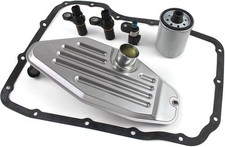
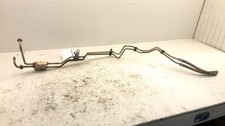

What the Cooler Lines Actually Feed
On the RFE family the cooler circuit is not a side loop you can ignore. Fluid leaves the pump through the to-cooler circuit, goes out the case fitting, through the steel lines to the cooler in the radiator tank and, on many trucks, an auxiliary air-to-oil cooler, then comes back to the case where it feeds lube to the geartrain. Restrict the lines and you starve the planetaries, not just the cooler.
That connection is why Transmission Digest's August 2012 tech piece on the 45RFE, 545RFE and 68RFE pump spends pages on the to-cooler circuit. The pump cover and spacer plate went through three designs. The first-design cover had a 0.077-inch orifice bleeding the to-cooler circuit to the sump, the second design cast that passage shut, and the third design closed the "hatchet hole" in the plate entirely. Mismatch them, for example a first-design plate on a third-design cover, and to-cooler pressure is connected to a 0.101-inch orifice that dumps into the sump. Transmission Digest ties these mismatches to overheating and planetary failures. If a rebuilt 45RFE runs hot with brand-new lines and a clean cooler, the pump parts are the next place to look.
Confirm It Is the Line Before You Buy Lines
Most 45RFE trucks are well past the age where the rubber sections and the crimp joints between rubber and steel start weeping. But fluid on the bottom of the truck travels. Before you order anything:
- Clean it and dye it. Degrease the lines, the case fittings, the radiator fittings and the pan rail. Drive it, then look. A crimp joint that is wet on top is the leak. A line that is only wet on the bottom is usually catching drips from above.
- Check the case fittings first. The fittings threaded into the transmission case are a common seep point and are often mistaken for a pan leak because the fluid runs straight down onto the pan rail.
- Look at the cooler return filter on trucks that have one. A loose or double-gasketed spin-on cooler return filter drips onto the same area.
- Look for rubs and kinks. Lines that ride against the frame, a crossmember or the exhaust wear through, and lines that were bent during an earlier transmission R&R can be partially collapsed without leaking at all. A flattened line causes heat problems, not puddles.
Also check the fluid level hot before you condemn anything. An overfilled 45RFE foams and pushes fluid out the vent, and that overflow is easy to mistake for a line leak.
Factory Torque and Fitting Specs
Chrysler's 45RFE/545RFE torque table lists the cooler line fitting at the transmission at 17.5 N·m (155 in-lb). That is about 13 ft-lb, which surprises people who reach for a 3/8 ratchet and lean on it. The fitting threads into an aluminum case. Over-torque it and you pull threads or crack the boss, and now the cooler line job is a case repair.
| Fastener | N·m | Spec |
|---|---|---|
| Cooler line fitting at transmission | 17.5 | 155 in-lb |
| Cooler return filter (spin-on) | 9.5 | 84 in-lb |
| Oil pan bolts | 12 | 105 in-lb |
If you are replacing the case fitting itself, clean the threads in the case, use a new fitting with the correct seal, start it by hand, and finish with an inch-pound wrench. If the old fitting comes out with aluminum on the threads, stop and inspect the case threads before going further.
Quick-Connect Fittings: Apart and Back Together
Chrysler uses quick-connect fittings on the transmission cooler lines and publishes a dedicated disassembly/assembly procedure for them. The fitting is a push-on connection held by an internal retainer, with a plastic dust cap over the joint. The factory procedure ends with a check that tells you everything about how these fail: if the dust cap will not snap into place, the fitting is not fully assembled and you repeat the connect step.
How we handle them on the bench:
- Clean before you disconnect. Blow and wipe the joint clean. Dirt that falls into an open quick-connect ends up on the O-ring when you reassemble it.
- Release, do not pry. Use the correct release method for the fitting style. Prying with a screwdriver cuts the retainer and scores the tube end, and a scored tube end will not seal.
- Inspect the tube end. The bead or flare on the steel line is what the retainer locks behind. If it is corroded, nicked or bent, replace the line section rather than hoping the O-ring covers it.
- Lube and push home. Lightly lube the tube end and O-ring with clean ATF+4 and push straight in until it locks. You should feel and hear it seat.
- Pull test and cap. Pull back on the line firmly to prove the retainer caught, then install the dust cap. If the cap will not snap on, the line is not all the way in. Do it again.
A quick-connect that is held only by friction will often pass a parking-lot test and then pop off under pressure and heat. When it does, the pump empties the transmission onto the road in seconds. The pull test is not optional.
Replacing the Lines: Shop Notes
- Route new lines exactly like the old ones. Use every original clip and isolator. Lines that are left to float will rub through on the frame.
- Do not bend the steel by hand around a tight radius. A kink you cannot see from above can cut the inside diameter in half. If a line has to be reshaped, use a tubing bender.
- Rubber sections get transmission-rated hose and proper clamps. Heater hose and worm clamps on a pressure-side line do not last.
- Cap everything while it is open. Debris in an open line goes straight into the lube circuit.
Flow-Check Before You Call It Done
New lines do not prove the circuit flows. If the lines were replaced because the transmission was already overheating, or the unit just came back from a rebuild, check flow through the cooler before the truck leaves.
The basic shop method: disconnect the return line, route it into a clean measuring container, make sure the level is full, and run the engine at idle in Park or Neutral for a short, timed interval while someone watches the level. Shut it down before the level drops low, then refill. You are looking for a strong, steady stream with no air and no debris. A weak, pulsing or foamy stream points to a restriction or an aerated circuit.
For a reference number, Sonnax measured RFE cooler flow on a Ram 2500 6.7L Cummins with a 68RFE: about 1.3 GPM at idle on stock programming, dropping to 0.5 GPM or lower when an aftermarket tune raised the desired line pressure in Drive at a stop from 60–70 psi to 100–105 psi. At that pressure, Sonnax explains, the pressure regulator valve sits in a position where only a small undercut connects line pressure to the lube and converter circuits, so converter and cooler flow collapse at idle. Sonnax's Lube Regulated PR Valve (44912-17K) is their fix for that condition and is listed for the RFE family. That data is from the 68RFE, but the 45RFE shares the same basic pump and regulator layout, and the lesson carries over: low cooler flow at idle is not always a line problem, and a tuned truck with a heat complaint needs the program checked before you start buying coolers.
If flow is low, isolate it. Test flow at the case fitting with the lines disconnected. Strong flow at the case and weak flow at the return means a restriction in the lines or cooler. Weak flow at the case means the problem is inside the transmission: pump, pressure regulator, or the pump plate and cover mismatch Transmission Digest describes.
Flush the Cooler After Any Internal Failure
If the lines are coming off because the transmission failed, the cooler is full of the old transmission. Friction material, metal and varnish settle in the cooler passages, and the first heavy pull after the rebuild sends that debris back into the new unit. Back-flush the cooler and lines with a dedicated cooler flusher, then flow-test. If the cooler will not flow clean, or the failure put metal through it, replace the cooler.
On 2005–2006 trucks, also keep the cooler return filter in mind. Chrysler bulletin 21-016-05 covered 45RFE and 545RFE units in 2005–2006 Ram, Durango, Liberty, Dakota, Grand Cherokee and 2006 Commander, with a complaint of delayed engagement after the vehicle sat overnight. The suspect cooler return filter, part number 04799662AB, could let fluid drain back out of the torque converter with the engine off. If you have a delayed-engagement complaint on one of those trucks after a cooler line job, the cooler return filter is part of the diagnosis, not just the lines.
Refill and Level Check
The fluid is ATF+4 only. Chrysler's 2008 Ram fluid capacity chart lists the 45RFE and 545RFE service fill at 5.2 L (11 pints) for 4x2 and 6.2 L (13 pints) for 4x4, with a 14–16 L (29–33 pint) overhaul fill. A line job usually loses far less than a service fill, so add what you caught, start it, and set the final level hot, in Park, on level ground, with the engine idling. Do not overfill. Too much fluid foams in the geartrain and causes the same low-pressure and overheating problems as too little.
Heat Codes That Say the Damage Is Already Done
If the truck came in with a leaking or restricted line, pull codes before you hand it back. Chrysler's diagnostic for P0218 – High Temperature Operation Activated sets immediately after the overheat shift schedule activates when transmission temperature exceeds 127°C (260°F). Chrysler lists the possible causes as a cooling system malfunction, a slipping or non-applying converter clutch, extended operation in limp-in, and excessive time idling in gear, and notes the code is also meant to tell the technician whether an additional air-to-oil cooler is needed for how the truck is driven.
A P0218 in history on a truck with a bad cooler line means the fluid was cooked at least once. Smell it, look at the pan and magnet, and ask the driver about slipping or flare on the 2-3 and 4-5. If the fluid is burnt and the pan has friction material in it, new lines are only the first part of the repair.
45RFE master rebuild kit at Core Transmission Parts
If a leaking or restricted cooler line already cooked the clutches, Core Transmission Parts carries a 45RFE master rebuild kit for the overhaul, plus RFE-family coolers and filters.
View the 45RFE master rebuild kit → Browse RFE-family parts →45RFE coolers, filters, ATF+4 and rebuild kits, shipped fast from the USA.
Shop 45RFE parts →Related guides
- 45RFE Fluid Leak: Common Spots and Fixes
- 45RFE Pan Bolt Torque Spec and Service
- How to Flush a Transmission Cooler After a Failure
- 545RFE Overheating Prevention
- 45RFE Delayed Engagement Fix
- 68RFE Cooler Line Replacement Guide
FAQ
What is the torque spec for the 45RFE cooler line fitting at the transmission?
Chrysler specifies 17.5 N-m, or 155 inch-pounds, for the cooler line fitting at the 45RFE and 545RFE case. That is only about 13 foot-pounds, and the fitting threads into aluminum, so use an inch-pound torque wrench rather than feel.
How do I know a 45RFE cooler line quick-connect is fully seated?
Push the line straight in until it locks, then pull back on it firmly to prove the retainer caught. Chrysler's procedure uses the dust cap as the final check: if the cap will not snap into place, the fitting is not fully assembled and the connect step has to be repeated.
Should I flush the transmission cooler when replacing 45RFE cooler lines?
If the lines are being replaced after an internal failure or an overheating event, yes. Debris and varnish in the cooler go straight back into the transmission's lube circuit, so back-flush the cooler and lines, then flow-test before releasing the truck. Replace the cooler if it will not flow clean.
What does P0218 mean on a 45RFE?
P0218 is High Temperature Operation Activated. Chrysler sets it as soon as the overheat shift schedule activates with transmission temperature above 127 C (260 F). Causes include a cooling system problem, a slipping or non-applying converter clutch, extended limp-in driving and long idling in gear.
How much fluid does a 45RFE hold?
Chrysler lists the 45RFE and 545RFE service fill at 5.2 L (11 pints) for 4x2 and 6.2 L (13 pints) for 4x4, and an overhaul fill of 14 to 16 L (29 to 33 pints). A cooler line job usually loses less than a service fill, so add what drained and set the final level hot in Park.
Sources
- Chrysler 45RFE/545RFE Specifications (torque table). Cooler line fitting at transmission 17.5 N·m (155 in-lb), cooler return filter 9.5 N·m (84 in-lb), oil pan bolts 12 N·m (105 in-lb). Specifications
- Chrysler service information: Transmission Cooler Line Quick Connect Fitting Disassembly/Assembly. Quick-connect cooler line fittings and the check that a dust cap which will not snap into place means the fitting is not fully assembled. Quick Connect Fitting
- Chrysler 45RFE/545RFE diagnostic procedure: P0218 High Temperature Operation Activated. Set condition at transmission temperature above 127°C (260°F), possible causes, and use of the code to judge whether an auxiliary cooler is needed. P0218
- Sonnax, Resolving Stalling & Overheat Issues After Performance Tuning on RFE Transmissions (March 11, 2021). RFE cooler flow of about 1.3 GPM at idle on stock programming versus 0.5 GPM or lower when tuned, line pressure figures, PR valve regulating points and the 44912-17K Lube Regulated PR Valve. sonnax.com
- Transmission Digest, Dodge 45/545/68RFE: Design Changes in Lube Circuit and Pump Casting (August 2012). Three pump cover and spacer plate designs in the to-cooler circuit, the 0.077-inch and 0.101-inch orifices, and the overheating and planetary failures from mismatched parts. transmissiondigest.com
- Chrysler 2008 Ram Body Builder Guide, Fluid Capacities. 45RFE and 545RFE service fill 5.2 L (11 pints) 4x2 and 6.2 L (13 pints) 4x4; overhaul fill 14 to 16 L (29 to 33 pints). rambodybuilder.com