A fluid change on a 2003-2007 Ram 2500 Cummins with the 48RE is not complicated, but most of them are done halfway. The pan comes off, a filter goes in, four quarts go back, and the truck leaves with roughly three quarters of the old fluid still in the converter and cooler. On a truck that tows, that is the difference between a 48RE that reaches 250,000 miles and one that comes back slipping in 2nd at 140,000.
This guide covers the job the way we do it on the bench: which fluid, how much the truck actually holds, when a towing truck needs it, the pan, filter and band adjustment specs, how to get most of the old fluid out through the cooler line, and what the job costs. If you only want the spec sheet, our 48RE fluid type and capacity guide has it. This page is about doing the service right on the diesel 2500.


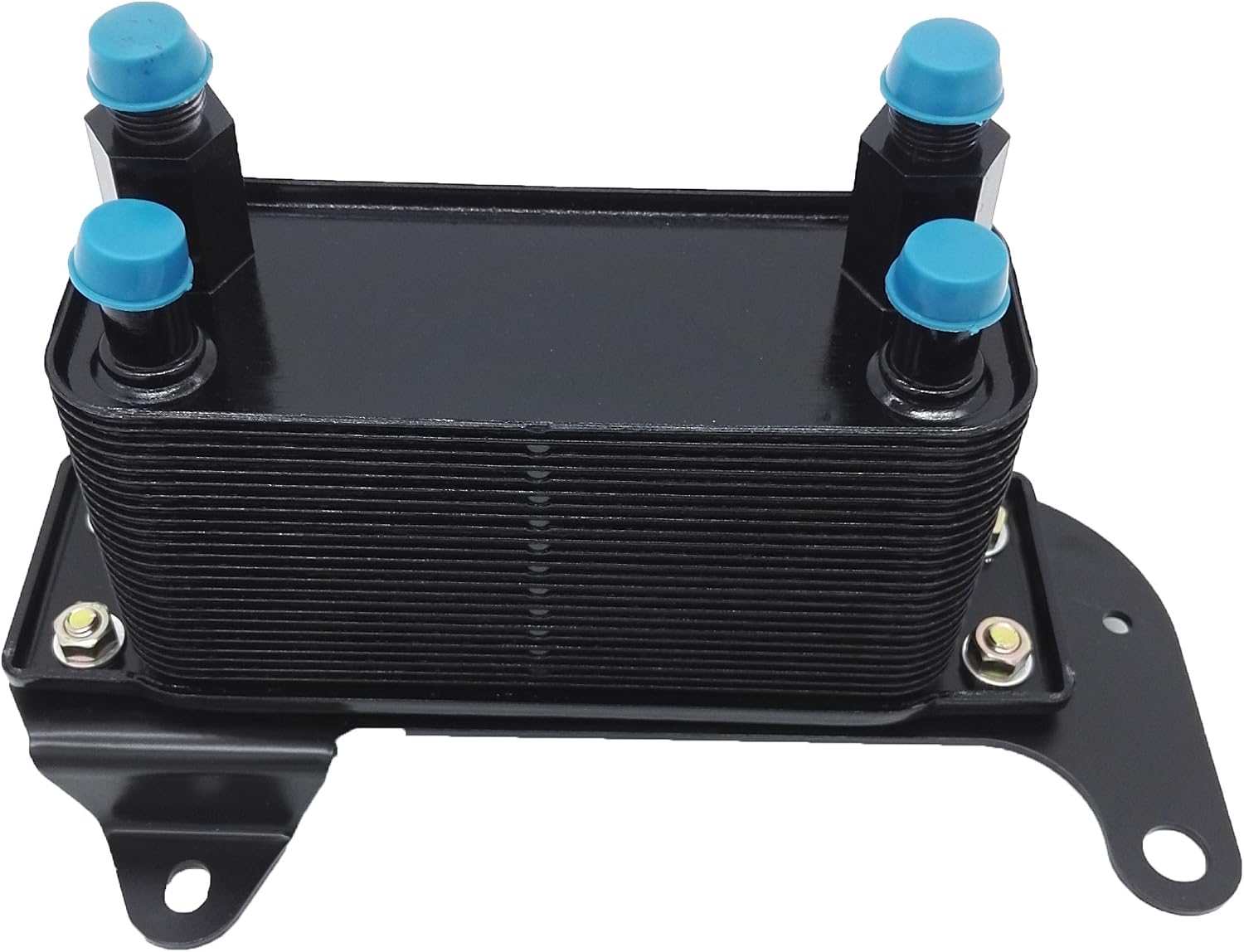
Which Ram 2500s have the 48RE
Chrysler's 2006 Ram Body Builder fluid chart lists one automatic for the 2500/3500 pickup with the 5.9L diesel: the 48RE four-speed.[1] ATSG's application chart puts the 48RE in 2003-2007 Ram pickups behind the 5.9L diesel and the 8.0L V10.[2] The 6.7L Cummins trucks that started mid-2007 got the 68RFE instead, which has a different filter setup and a different fill procedure, so confirm which engine you have before buying parts. A 5.9L truck with an automatic is a 48RE.
ATSG also notes that, starting with the 2005 model year, diesel trucks with the 48RE got an electronic Transmission Throttle Valve Actuator (TTVA) in place of the throttle valve cable.[2] That changes nothing about the fluid itself, but it does mean you have one more electrical connector on the left side of the case to keep clear of while the pan is down.
Fluid type: ATF+4 and nothing else
The 48RE takes ATF+4, the fluid built to Chrysler material standard MS-9602. Buy a fluid that says it is approved or licensed to MS-9602, not one that says "suitable for" a list of twenty specs. Pennzoil's technical data sheet for its ATF+4 is a good example of what an approved fluid states: it is approved against Chrysler MS-9602, it is intended for Chrysler automatics that originally called for ATF+, ATF+2 or ATF+3, and it is not to be used in transmissions that require Dexron III, Mercon, Mercon V, Mercon LV or Mercon SP fluid.[5] That last line cuts both ways. A Dexron or Mercon fluid has different friction behavior, and the 48RE's kickdown band and converter clutch notice it.
Why it matters more on a diesel: Sonnax points out that the 48RE's pressure regulator raises line pressure about 22-28 psi when lockup is on or the unit is in 4th, compared with 10-15 psi on a 46/47RE, specifically to give the converter clutch and overdrive clutch more clamping force.[3] The unit was designed to hold Cummins torque with that pressure and that friction chemistry. Change the fluid to something that slips differently and you have taken away part of the margin the engineers built in. On trucks with an unknown history and a lockup shudder, a full exchange to real ATF+4 is the first step before anyone condemns the converter.
How much it holds, and why a pan drop is not a fluid change
Chrysler's capacity chart lists two numbers for the 48RE:[1]
| Fill | Liters | Pints | Quarts (approx.) |
|---|---|---|---|
| Service fill (pan and filter) | 3.8 | 8 | 4 |
| Overhaul (dry) fill | 14.0-16.0 | 29-33 | 14.5-16.5 |
Chrysler's footnote says the dry fill varies with the type and size of the internal cooler, the length and inside diameter of the cooler lines, and whether an auxiliary cooler is fitted.[1] Plenty of 2500s now have a deep aftermarket pan or a second cooler, so treat every number above as a starting point and finish on the dipstick.
The math is the important part. Eight pints out of a system that holds around 31 is about a quarter of the fluid. The rest is in the converter, the cooler and the lines, and it mixes right back in the moment the engine starts. On a truck with dark fluid, one pan service makes it look better on the stick without making it much better in the transmission. That is why we do the cooler-line exchange described below.
When a towing truck needs it
Chrysler's owner's manuals for these years split maintenance into a normal schedule and a severe one, and towing, plowing, heavy hauling and long idling all put a truck on the severe side. Check the manual for your model year, because the intervals moved around over the years. Our shop rule for a 48RE that pulls a camper or a gooseneck regularly is simpler: fluid, filter and both bands every 30,000 miles, and sooner if the fluid smells burnt or the truck has seen a hard summer of towing.
The reason is heat. GEARS magazine, published by ATRA, puts the ideal maximum transmission temperature at 200 F and notes that every 20 F above that roughly halves fluid life: half at 220 F, a quarter at 240 F, an eighth at 260 F.[4] A Cummins pulling a heavy trailer up a long grade can live above 220 F for an hour. The odometer says 15,000 miles since the last service. The fluid has really been through a lot more than that.
The pan, filter and band service, step by step
Parts for the job: 6 quarts of ATF+4 (8 if you are doing a partial exchange too, more for a full cooler-line exchange), a 48RE filter, and a pan gasket. Specs below are from the Chrysler service manual for the 48RE.
- Warm it up, then let it cool enough to handle. Warm fluid carries more debris out with it. Most stock 48RE pans have no drain plug, so loosen the pan bolts on one side first and let it tip and drain into a wide pan.
- Read the pan before you clean it. A light gray paste on the magnet is normal wear. Brass or bronze flakes point at bushings or thrust washers; black friction material that you can feel between your fingers means a clutch or band has been slipping. Take a picture. It is the best record you will have of what this transmission looked like.
- Replace the filter. Filter screws torque to 4 N·m (35 in-lb). Make sure the old filter's seal did not stay behind in the valve body.
- Adjust the rear (low/reverse) band while the pan is off. Loosen the locknut, torque the adjusting screw to 72 in-lb, back it off exactly 3 turns, and hold it while you torque the locknut to 25 ft-lb. The pan has to be down for this one, which is why it gets skipped.
- Install the pan. Pan bolts are 13.6 N·m (125 in-lb), about 10 ft-lb. Going past that bends the pan rail and gives you a weep that never stops. The factory-style gasket can be reused if its sealing beads are intact; on a truck this age, use a new one.
- Adjust the front (kickdown) band. The adjuster is on the left side of the case. Loosen the locknut, torque the screw to 72 in-lb, back it off 1-3/4 turns on the diesel (1-1/2 on the V10), hold it, and torque the locknut to about 30 ft-lb. Use an inch-pound wrench for the 72 in-lb step. If the screw has to travel a long way before it gets to 72 in-lb, the lining is worn, and that is worth writing down.
- Initial fill. Add 3 pints of ATF+4, start the engine, run it through the ranges, and bring it up to the MIN mark. Then drive it to full operating temperature.
- Hot check, engine running, in Neutral. The 48RE is checked in Neutral, not Park, at about 180 F. Level on firm ground, parking brake on, shift through every range and back to Neutral, then read the stick. Add only what it needs and wait two minutes for fluid to drain down the tube before reading again. Most overfilled 48REs got that way because nobody waited.
Getting the rest of the old fluid out
After the pan and filter are done, the cooler-line exchange is how you replace most of the fluid without a machine. With the engine off, disconnect the cooler return line, the one that brings fluid back to the transmission, and route it into a marked bucket. You can identify it by running the engine for a few seconds and watching which line flows. Start the engine in Park and add fresh ATF+4 to the fill tube as fast as it comes out, about one quart for every quart in the bucket. Shut it down when the fluid at the hose runs clean, reconnect, and set the level hot. On a typical truck that is 12-14 quarts. Plan on 16-18 if it has an auxiliary cooler.
While the line is open, check the flow. GEARS gives a minimum of about one gallon per minute of cooler flow, measured with a flow meter or into a bucket, and lists plugged cooler lines, a plugged cooler and a plugged filter among the common causes of overheating on these heavy-duty Dodge units.[4] If the return stream is a dribble, fresh fluid alone will not keep this transmission cool. Find the restriction before the next trip.
If the old fluid was full of friction material, think before you push it around. Pat Barrow's Transmission Digest article on cooler flushing explains how a contaminated cooler kills a replacement transmission early: debris trapped in the cooler and lines works loose and goes straight into the new unit.[6] His guidance is to flush the cooler and lines, judge the contamination by catching the flush in a clear container, replace the cooler if there is a lot of metal, and add an inline filter on the low-pressure return line for extra protection.[6] On a truck whose pan shows heavy wear material, that order of operations protects the 48RE you are about to rebuild or replace.
What the job costs
- DIY pan, filter and bands: a filter and gasket kit plus a case of ATF+4. Figure $90-$160 in parts, depending on whether you go full synthetic and whether you add a drain-plug pan so the next service is cleaner.
- DIY with cooler-line exchange: add another 8-12 quarts of ATF+4.
- Independent shop: a pan service with band adjustment is typically about an hour to an hour and a half of labor plus parts. A machine exchange costs more. Ask whether the band adjustment is included, because many quick-service places do not do it on a 48RE.
Compare that to a 48RE overhaul, and an extra service every 30,000 miles on a towing truck is the cheapest insurance you can buy.
When a fluid change will not help
New fluid does not fix worn parts. If the truck already flares on the 1-2 shift, drops out of overdrive on a grade, or shudders at lockup with fresh ATF+4 in it, the fluid change was a diagnostic step, not the repair. Our 48RE Ram 2500 Cummins slipping guide walks through naming the gear, checking line pressure and the TTVA, and deciding between a valve body and an overhaul. Keep the transmission fluid spec chart handy for the rest of the fleet.
48RE filters, pans, ATF+4, coolers and cooler lines for the 2003-2007 Ram 2500 Cummins — shipped fast from the USA.
Shop 48RE parts →Shop the 48RE filter kit → All 48RE parts
FAQ
What fluid does a 48RE in a Ram 2500 Cummins take?
It takes ATF+4, the fluid built to Chrysler material standard MS-9602. Use a fluid that states it is approved or licensed to MS-9602, not a multi-vehicle fluid, and never a Dexron or Mercon fluid.
How many quarts does a 48RE take for a fluid change?
Chrysler lists a 3.8 liter (8 pint, about 4 quart) service fill for a pan and filter change and 14 to 16 liters (29 to 33 pints) dry after an overhaul. Buy at least 6 quarts for a pan service and 12 to 18 for a cooler-line exchange, then set the final level on the dipstick hot in Neutral.
How often should a towing 48RE get a fluid change?
Towing puts the truck on the severe-service schedule in the owner's manual. Our shop rule for a 48RE that tows regularly is fluid, filter and both band adjustments every 30,000 miles, sooner if the fluid smells burnt, because fluid life roughly halves for every 20 F above 200 F.
Do you need to adjust the bands when changing 48RE fluid?
Yes. The rear band adjuster is only reachable with the pan off, so a fluid service is the natural time. Front band: 72 in-lb, back off 1-3/4 turns on the diesel, locknut about 30 ft-lb. Rear band: 72 in-lb, back off 3 turns, locknut 25 ft-lb.
Related 48RE guides
Sources
- Chrysler / Ram Body Builder Guide 2006 — Ram Fluid Capacities. Backs the 48RE as the automatic for the 5.9L diesel 2500/3500, the 3.8 L (8 pint) service fill, the 14-16 L (29-33 pint) overhaul fill, and the cooler and line footnote. rambodybuilder.com (PDF)
- ATSG — 46RE/47RE/48RE Technical Service Information (introduction and application chart), 2011. Backs the 2003-07 Ram pickup 5.9L diesel / 8.0L V10 application and the 2005-up diesel TTVA. atsg.biz (PDF)
- Sonnax Tech Resources — "Dodge 48RE Hydraulic Features Revealed," Jim Dial. Backs the 22-28 psi (48RE) versus 10-15 psi (46/47RE) line rise in 4th and lockup and the added converter and overdrive clutch clamping force. sonnax.com
- GEARS Magazine (ATRA) — "48RE/68RFE/AS68RC Transmission Overheating," August 2019. Backs the 200 F ideal maximum temperature, the life-halving every 20 F above it, the one-gallon-per-minute cooler flow minimum, and the list of overheating causes. gearsmagazine.com
- Shell / Pennzoil — Pennzoil Platinum ATF+4 Technical Data Sheet. Backs MS-9602 approval, the ATF+/ATF+2/ATF+3 backward application, and the "do not use in Dexron/Mercon" exclusions. shell-livedocs.com (PDF)
- Transmission Digest — "To Flush or Not to Flush," Pat Barrow, June 2019. Backs the contaminated-cooler failure mechanism, judging contamination in a clear container, cooler replacement for heavy metal, and the inline filter on the low-pressure return line. transmissiondigest.com