Most people reach for cooler lines because they found a drip at a fitting or because the truck is running hot while towing, and either reason can send you down the wrong repair if you skip the flow check first. The 48RE sits behind the 5.9L Cummins in 2003-2007 Ram 2500/3500 trucks, a heavy-duty application that moves a lot of fluid through a pair of steel lines running from the transmission case, forward along the frame rail, to the cooler mounted ahead of the radiator. Those lines take road salt, rock chips, and heat cycling for 20-plus years on a lot of these trucks, and the factory plastic quick-connect fittings at each end have an internal O-ring that is exactly the kind of part that hardens and fails quietly over that much time.
The job itself is not complicated. Disconnect, replace, reconnect, refill. What trips people up is replacing the lines for a problem that was never in the lines, or reconnecting them without checking the thing feeding them in the first place. This guide covers how to tell the difference, what you are actually working with, and how to do the swap so it stays fixed.
Flow-Test Before You Start Swapping Parts
ATRA's Gears Magazine covers 48RE, 68RFE, and AS68RC overheating as one of the more common diagnostic calls these trucks generate, and its starting point is the same every time: check flow before you touch a wrench. Flow through the cooler circuit should run at least about a gallon per minute, checked either with a flow meter or by routing the return line into a bucket for a timed count while the engine idles warm. If flow comes back under that with no visible leak anywhere in the circuit, the restriction is somewhere other than a leaking fitting, and new lines will not fix it.
Two quick checks narrow it down further. Mike Brown's 47RE writeup in GEARS uses the same family's circuit: loop the cooler lines together to take the cooler out of the picture, and blow air into the rear cooler fitting at no more than 40 psi, which should enter the unit with minimal resistance. If the looped circuit flows and the full circuit does not, the restriction is in the cooler or lines.
The same source is blunt about why this matters on a diesel tow rig specifically: heat is the transmission's main enemy, the article lists 200°F as the ideal maximum fluid temperature, and it states that life expectancy for the fluid and the clutches roughly halves for every 20°F above that. A 48RE that is running hot while towing is burning through its service life every mile it stays there, so a flow problem is not cosmetic, it is the difference between a transmission that lasts and one that does not.
Trace the whole circuit while you are at it, not just the two lines you can see easily. Gears Magazine's inspection procedure calls for following the full cooling path, since some trucks have an auxiliary cooler tapped into the system in addition to the factory unit, and missing one means you clear half the restriction and still run hot. Visually check every foot of line for pinches, kinks, and road damage like dents or crush marks from a rock strike, since a line can look intact from three feet away and still be collapsed on the inside.
The Fittings Are Usually the Real Failure Point
The stock 2003-2007 48RE uses plastic quick-connect fittings at both ends of each cooler line, one where the line meets the transmission case and one where it meets the cooler or radiator. Each fitting seals with an internal O-ring, and that O-ring is the part that actually fails, not the fitting body itself. Heat cycling against the exhaust and years of road salt harden the rubber until it either seeps a slow drip right at the connection or loses enough grip that the line can walk its way loose under vibration. Either way, the fix at that specific point is a new fitting or O-ring, not a full line replacement, if that is genuinely the only thing wrong.
Where it gets more expensive is when a line itself is compromised rather than just a fitting: a kinked section from being bent during a prior repair, a corroded steel line with a pinhole starting at a rust spot along the frame rail, or a section crushed by road debris. None of those are repairable in place, and on a truck that has towed for 150,000-plus miles, replacing both lines as a set rather than patching one spot is usually the better use of your time, since the other line has seen the same mileage and the same road salt.
The Bypass Valve Problem Lines Alone Won't Fix
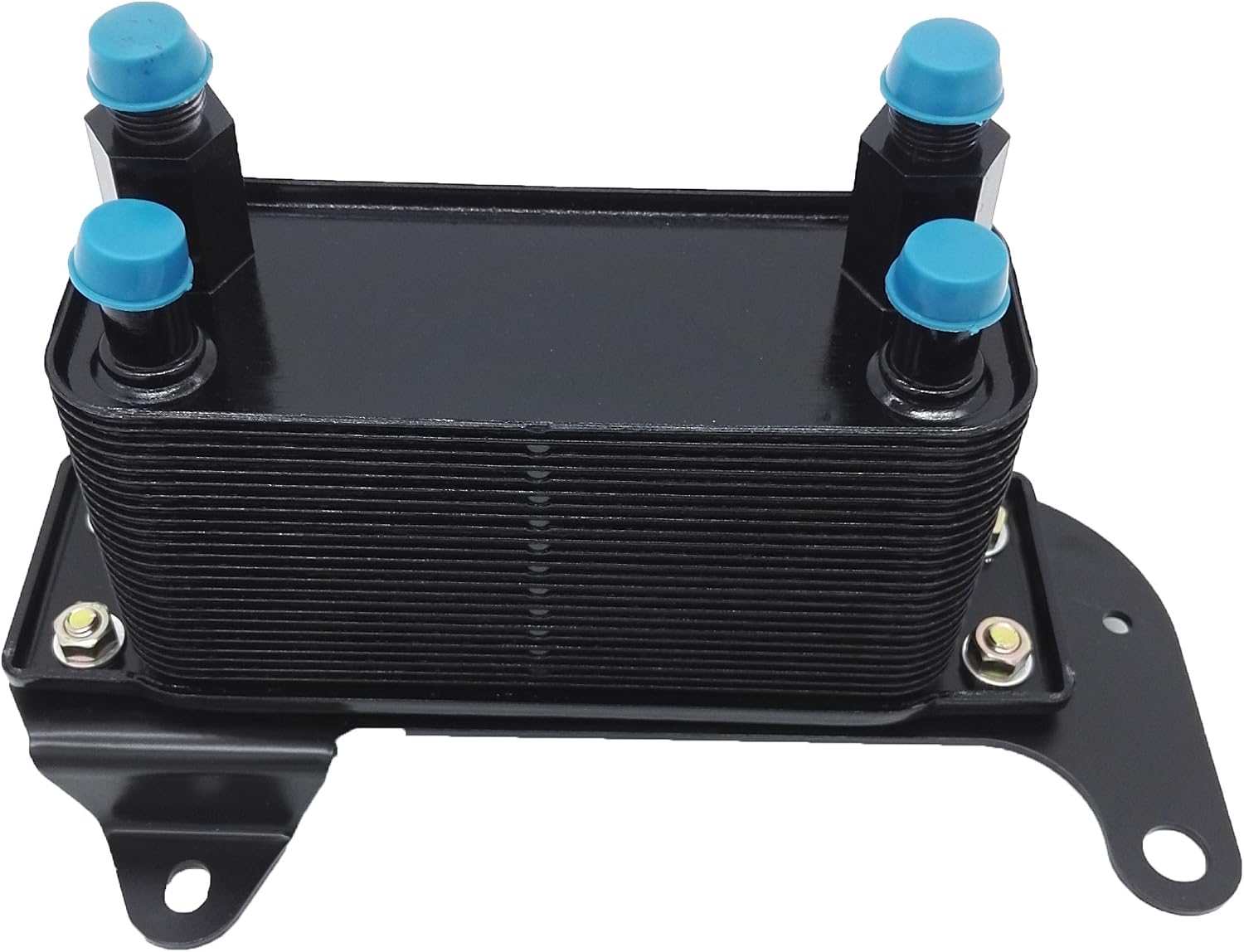
Before you order parts, rule out the one failure on this platform that looks exactly like a line problem but is not. Gears Magazine's overheating writeup specifically flags a stuck thermostatic bypass valve inside the factory heat exchanger on these trucks, and it is a genuinely difficult part to even get to: access requires pulling the grille, the intercooler, and the A/C condenser just to reach it. If that valve is stuck, flushing the cooler will not clear it, because flushing moves fluid around a stuck mechanical valve, it does not free it. The article's guidance is direct on this point: if the valve is bad, the cooler gets replaced as an assembly, not repaired. A full flow test before you start tells you whether you are looking at a line, a fitting, or this valve, and that fifteen minutes with a flow meter is cheaper than buying lines twice.
Replacing the Lines, Step by Step
- Confirm the diagnosis first. Flow-test the circuit warm. Only move to replacement once you know the restriction or leak is in the line or fitting itself, not the cooler's internal valve.
- Relieve pressure and position a drain pan. Fluid will run from both the transmission side and the cooler side the instant a quick-connect releases, so have containment under both ends before you pull anything apart.
- Release the quick-connect fittings with the correct tool. A quick-connect release tool sized to the fitting lets the internal retaining tabs disengage without prying or cutting, which keeps the transmission-side port undamaged for the new line.
- Inspect the ports themselves. Check the case fitting and the cooler fitting for corrosion or thread damage before installing new lines; a good new line against a damaged port will leak again regardless of how carefully it was installed. Look hard at the aluminum around the case fittings too. Sonnax notes that on Chrysler RWD units including the 48RE, the OE cooler fittings use tapered threads with no stop, and overtightening them cracks the case. A hairline crack at the boss can be saved in the truck with Sonnax's straight-thread cooler line repair kit (22000-01K), which seals on the adapter's leading edge so fluid never reaches the threads.
- Route and secure the new lines following the factory path if you are replacing with OEM-routing lines, or the kit's routing diagram if you are installing a braided aftermarket set, keeping clearance from the exhaust and any moving suspension or driveshaft components.
- Reconnect and pressure-check. Push each quick-connect until it clicks fully home, then tug on it by hand to confirm it is seated before you ever start the engine.
- Refill with the correct fluid, run it through every gear, and recheck hot. Top off with Chrysler ATF+4 meeting the MS-9602 specification, cycle the shifter through each range with the engine running, then check the level hot on level ground once it has stabilized. Do not refill by a capacity number: Chrysler's Ram fluid chart lists the 48RE at 8 pints for a pan service but 29 to 33 pints overall, so the amount lost from a line job depends on how much drained from the cooler and lines.
Factory-Style Steel Versus Braided Aftermarket Lines
A factory-routing replacement line gets you back to stock in the fewest steps and keeps the original quick-connect fittings, which matters if you want the truck to look and service exactly like it did from the dealer. The tradeoff is that you are installing the same steel line material that corroded the first time, on the same frame rail exposed to the same salt and debris.
A braided stainless replacement kit swaps that steel line for a line that will not rust through from the outside and resists kinking far better if it ever gets bumped by a rock or a trailer chain. For a truck that tows regularly or sees winter road salt, that tradeoff is usually worth it even though the fittings on each end may differ slightly from the factory quick-connect, which is why it is worth confirming a kit's included fitting style matches your model year before ordering.
Check for Contamination Before You Call It Done
A cooler line splitting or a fitting leaking loses ATF to the outside of the truck, it does not put anything into the fluid. Contamination works the other direction, and it comes from the cooler core itself, not the lines: cooling system pressure runs higher than ATF pressure, so a crack in the cooler lets coolant push into the transmission fluid rather than the other way around. ATRA's Gears Magazine lays out why this is easy to miss on a visual check alone, noting that contamination can be too small to turn the fluid visibly milky while it still ruins the clutches, since clutch material is hygroscopic and absorbs water, which pushes out the ATF and its friction modifiers and shows up as chatter and harsh shifts with no obvious warning first.
The article's fix for catching this is cheap enough to do every time you have the pan open or the lines apart anyway: dip an antifreeze test strip and a water test strip into a fluid sample. Both reacting points to a coolant leak, since coolant carries enough water to trigger both. Only the water strip reacting points away from the cooling system and toward water entering some other way. If you replaced lines because of suspected contamination and the strips come back clean, look elsewhere before you condemn the cooler itself.
When Flow Still Reads Low After New Lines
Occasionally a truck gets new lines, a flushed cooler, and still comes back with a low-flow complaint, usually showing up as sluggish engagement or no flow specifically in Park. Sonnax's Sure Cure Kit for the 48RE exists for exactly this scenario: it addresses low cooler flow and no-cooler-flow-in-Park symptoms that trace back to worn components inside the valve body's oil circuits, not the external plumbing at all. If your flow test still fails after the lines, fittings, and cooler are all confirmed good, the restriction has moved inboard to the valve body, and that is a different repair than anything covered above.
Fixing It, In Order
- Flow-test warm before replacing anything, so you are not swapping good lines for a bypass valve or valve body problem.
- Trace the whole circuit, including any auxiliary cooler, and inspect every foot of line for pinches, kinks, and road damage.
- Replace the specific fitting or O-ring if a quick-connect is the only thing seeping.
- Replace the line itself if it is corroded, kinked, or crushed, and consider doing both sides as a set on a high-mileage truck.
- Rule out the heat exchanger's bypass valve separately; a stuck valve means replacing the cooler assembly, not flushing it.
- Test-strip the fluid for coolant contamination any time you have it apart, since a small leak will not always look milky.
- Refill with ATF+4 meeting MS-9602, cycle every gear, and recheck the level hot before you call the job finished.
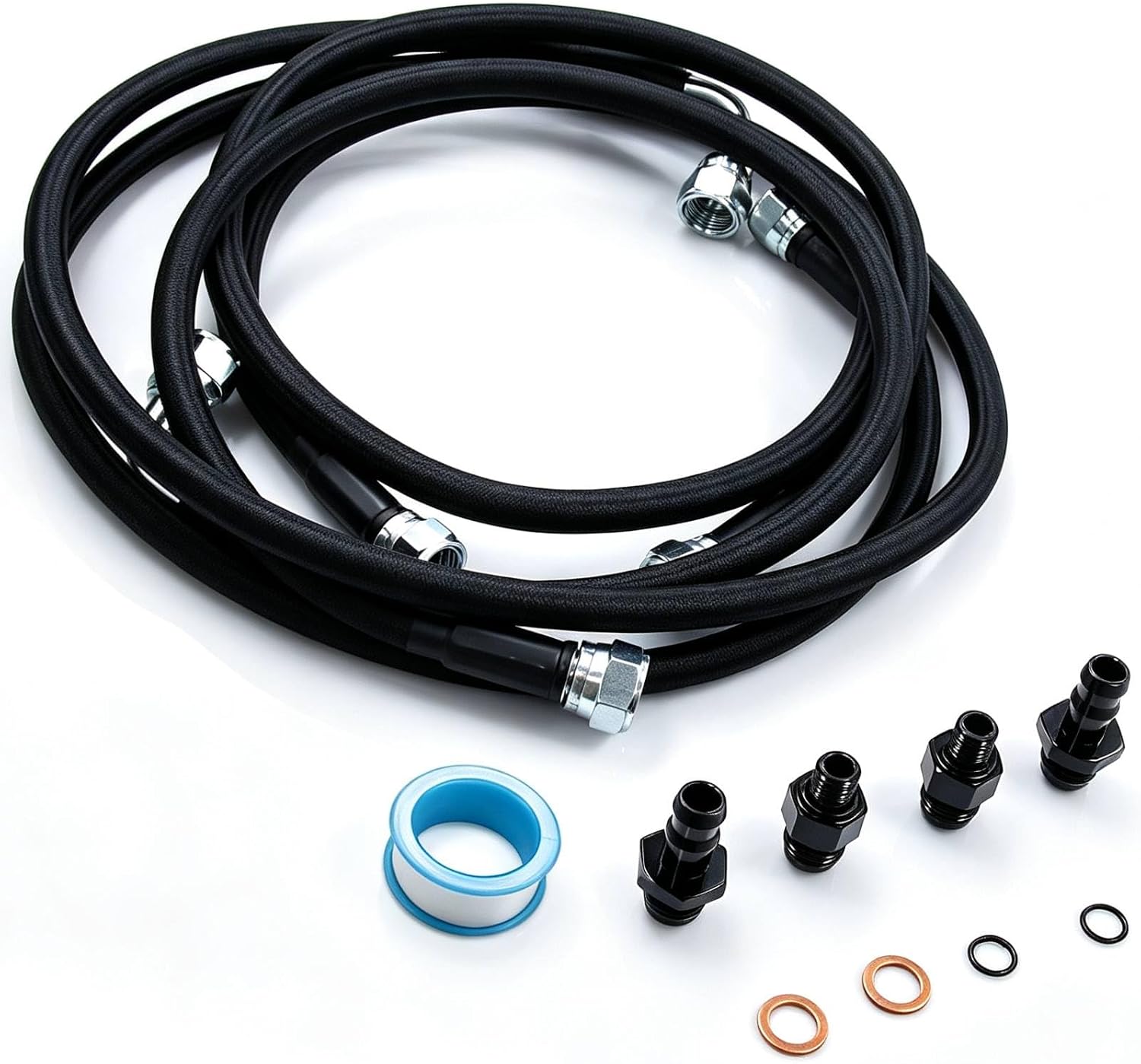
48RE Stainless Braided Cooler Line Kit
If the factory steel lines are corroded or kinked and you want a line that resists rusting through on a truck that tows, this is the direct braided replacement for the 2003-2007 48RE.
View the 48RE braided cooler line kit →Shop 48RE transmission parts →
Frequently Asked Questions
How do I know if my 48RE cooler lines are actually the problem?
Look for a wet quick-connect fitting, a visibly pinched or crushed section of line, or a transmission that runs hot under load even with good fluid level. Per ATRA's Gears Magazine, a 48RE cooler circuit should flow at least about a gallon per minute; if a flow check comes back below that with the engine warm and no external leak, the restriction is in the line, the cooler, or the case passages feeding it, not just a bad fitting.
What size are the 48RE cooler line fittings?
The stock 2003-2007 48RE uses plastic quick-connect fittings with an internal O-ring at both the transmission case and the radiator or auxiliary cooler. They are not a universal size across model years, so match the replacement line or connector to your truck's specific routing rather than assuming one fitting fits every 48RE application.
Will replacing the cooler lines fix a transmission that overheats while towing?
Only if the lines themselves are the restriction. Gears Magazine's overheating diagnosis for the 48RE and 68RFE lists plugged or restricted cooler lines as one leading cause, but a stuck bypass valve inside the factory heat exchanger is a separate failure that lines alone will not fix, and that valve requires replacing the cooler as an assembly. Flow-test before you replace parts so you are not guessing.
Can a bad cooler line let coolant get into my transmission fluid?
A cooler line itself splitting open loses ATF, it does not introduce coolant. Coolant contamination instead comes from a cracked cooler core or a failed heat-exchanger bypass valve, where cooling system pressure is higher than ATF pressure and pushes coolant into the fluid. ATRA's contamination testing method uses a water strip and an antifreeze strip dipped in the fluid, since contamination can be too small to turn the ATF visibly milky while it still ruins the clutches.
Do I need anything special to replace the factory quick-connect cooler lines?
A quick-connect release tool sized for the fitting makes removal clean without cutting the line, and you want a drain pan ready since fluid runs out of both ends the moment the connection breaks. After the new lines or fittings are in, refill with Chrysler ATF+4 meeting the MS-9602 specification, run the truck through all gears, and recheck the level hot before calling it done.
Sources
- Gears Magazine (ATRA) — "48RE, 68RFE, AS68RC: Transmission Overheating." Backs the roughly 1 GPM minimum cooler flow spec, the full-circuit inspection method, the 200°F ideal maximum fluid temperature with service life halving per 20°F above that, and the factory heat exchanger's stuck bypass valve as a separate failure requiring cooler-assembly replacement. gearsmagazine.com
- Gears Magazine (ATRA) — "Identifying ATF Contamination." Backs the water/antifreeze test-strip method for catching coolant contamination too small to visibly discolor the fluid, the pressure-direction reason coolant pushes into ATF rather than the reverse, and the hygroscopic clutch damage that follows. gearsmagazine.com
- Sonnax — Sure Cure Kit (SC-48RE) product listing. Backs low cooler flow and no-flow-in-Park as documented 48RE valve body symptoms, separate from an external line or fitting restriction, addressed by this kit's internal components. sonnax.com
- AMALIE — Chrysler ATF+4 Sell Sheet. Backs the Chrysler MS-9602 specification the 48RE's ATF+4 refill must meet. amalie.com
- Sonnax — Cooler Line Repair Kit 22000-01K. Backs cracked or leaking cases from tapered, stopless OE cooler fittings on Chrysler RWD units including the 48RE, and the straight-thread, leading-edge-seal in-vehicle repair. sonnax.com
- Mike Brown, Gears Magazine (ATRA) — "A Dead Stop! A Typical Dodge 47RE Problem With an Unexpected Solution" (August 2022). Backs looping the cooler lines to rule out the cooler and the 40 psi maximum air test at the rear cooler fitting. gearsmagazine.com
- DaimlerChrysler / Ram Body Builder — 2004 Ram Truck (DR) fluid capacities chart. Backs the 48RE 8-pint service fill and 29-33 pint overhaul fill. rambodybuilder.com (PDF)