You top off the ATF+4 every couple months, the dipstick keeps coming back low, and there is never a puddle on the garage floor to point you at the problem. That is the normal way a 48RE loses fluid. Unlike a lot of transmissions where a leak drips straight down and announces itself, several of the 48RE's worst leak points are tucked behind the bell housing or up inside the tail housing, where fluid gets flung off a spinning part or wicks along a crossmember long before it ever lands where you are looking.
The good news is the list of real leak sources on this transmission is short and repeatable. The 48RE is Chrysler's heavy-duty four-speed behind the 5.9L Cummins in 2003-2007 Ram 2500/3500 trucks, and it shares most of its case and seals with the 46RE and 47RE it descended from. Where it differs is line pressure: Sonnax's own breakdown of the 48RE's hydraulics documents a line pressure rise of 22-28 psi at lockup and in fourth gear, versus 10-15 psi on the 46/47RE, because the valve body exhausts two reduction points at the boost valve instead of one. That extra clamping force is there to hold the overdrive and torque converter clutches against diesel torque, and it also means every seal downstream of that pressure spike works harder on a 48RE than it would on its lighter-duty siblings. Keep that in mind as you go through the actual leak points below, because it explains why some of these seals fail sooner on a 48RE than the parts-store catalog would suggest.


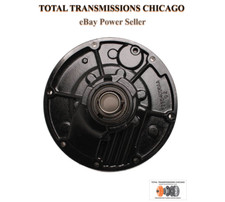
Find the Source Before You Replace Anything
Chasing a 48RE leak by guessing wastes gaskets and your weekend. Clean the transmission and the area around it with degreaser, let it dry, then drive the truck normally for a day or two, including some time at highway speed so the converter and governor circuit are actually under load. Fluid thrown off a spinning part shows up differently from fluid that drips while parked, so note whether the mess appears only after driving or whether it is there first thing in the morning too. A squeeze bottle of UV dye in the fill, followed by a black light under the truck, will find a seep in minutes that a flashlight alone can miss, especially up inside the bell housing where road grime hides a slow leak for months.
Work from the top of the transmission down. Fluid runs downhill along the case and the crossmember before it drips off the lowest point it can reach, which is almost never where the leak actually started. A wet spot at the back of the oil pan can just as easily be fluid that ran there from the pan rail two inches higher, from the dipstick tube, or from the governor pressure transducer up on the side of the case.
Chrysler's own factory procedure for converter housing leaks says three things must happen before any repair: verify the fluid level, verify the leak is transmission fluid that starts in the converter housing area (factory-fill ATF is red, so it can be told from engine oil), and find the true source. It also warns that some suspected leaks are only residual fluid in the housing or fluid spilled during a fill. Then pull the inspection cover and read the trail: per Chrysler, pump seal, pump O-ring and pump body leaks follow the converter drive hub onto the rear of the converter, pump bolt leaks deposit on the inside of the converter housing and not on the converter, and pump gasket leaks run down the inside of the housing. The only converter leak points Chrysler lists are the outside-diameter weld and the hub weld. Our 47RE leak guide lays that trail out as a table with the torque spec for each joint.
The Real Leak Points on a 48RE
1. Pan gasket and pan rail
This is the one everybody finds first because the factory pan gets dropped for every fluid and filter service, and it has no drain plug of its own, so it gets wrestled off and torqued back down a lot over the life of the truck. A warped rail from over-torquing, a reused gasket, or bolts snugged unevenly in no particular pattern will all weep at the seam. The fix is a new gasket, bolts torqued evenly in a crossing pattern rather than straight around the perimeter, and a check that the pan rail itself is not bent from being pried on with a screwdriver. A pan that already has an integrated drain plug and filter, like the kit linked above, turns future services into a five-minute drain instead of another chance to warp the rail.
2. Front pump seal and O-ring
This is the leak that never leaves a puddle. The front pump seal rides on the torque converter hub, right behind the bell housing, and when it starts to seep the spinning converter flings that fluid outward instead of letting it drip straight down. It ends up as an oily film on the pan, the crossmember, and sometimes the exhaust, where it burns off before it ever reaches the driveway. If you are topping off fluid regularly but the garage floor stays clean, pull the dust cover or get a light up into the bell housing area while the engine idles in gear and look for a wet ring around the converter hub. The fix is the pump O-ring or seal if the leak is purely external; if the pump bushing itself is worn enough that the input shaft has play, the seal will keep failing until the pump is replaced rather than just resealed. Sonnax documents the mechanism on Chrysler pumps: excessive converter hub-to-pump bushing clearance is a root cause of front seal leakage, TCC slip codes and pump noise, and a standard replacement bushing can end up with .008 in. or more of clearance and roughly 10 times the oil loss of a correctly fitted one. When the pump does come out, ATSG's RE-family procedure calls for new sealing washers on all seven pump bolts and 20 N·m (15 ft-lb), tightened alternately and evenly.
3. Governor pressure transducer
The electronic governor pressure transducer threads into the transmission case with its own O-ring, and on the 47RE and 48RE it is a well-known weak point. ATS Diesel, which builds and sells replacement transducers for these trucks, states plainly that a failed governor pressure transducer is one of the major factors behind transmission trouble on 47RE and 48RE units, and that the problem shows up more on transmissions running higher line pressure. The 48RE is exactly that transmission, per the 22-28 psi line rise Sonnax documents above, so the seal on this sensor sees more pressure cycling than it would on a 46RE. A seeping transducer is a separate failure from a contaminated governor pressure solenoid, which is the more common cause of wrong-gear starts and performance codes according to TransGo's listing for its solenoid repair kit (which covers 42RE through 48RE units from 1995 on). One is a wet spot with no shift complaint, the other is a shift complaint that may or may not come with a leak. Diagnose them separately: wipe the transducer and its gasket dry, drive it, and recheck before you replace either part.
4. Overdrive extension housing
The tail housing bolts to the back of the case and carries the output shaft seal where the driveshaft, or the transfer case input on a 4x4, exits the transmission. Two different failures show up here. The gasket at the housing-to-case joint can simply age and weep, which is a straightforward gasket replacement. The housing itself can also crack, usually from vibration transmitted up through a failing driveshaft U-joint over months of driving. This is common enough on 48RE trucks that reinforced aftermarket replacement housings exist specifically to address it. If you find a crack, replace the housing, but also pull the driveshaft and check the U-joints, because whatever cracked the first housing will crack the replacement too if it is not fixed.
5. Cooler line fittings
The quick-connect fittings where the cooler lines meet the transmission and the radiator or auxiliary cooler each seal with an O-ring that hardens with age and heat cycling. A seeping fitting usually shows as a small drip right where the line connects, easy to find once you know to look there, and the fix is a new O-ring or fitting rather than the whole line. While you are in there, check the cooler itself for any sign of ATF in the coolant or coolant in the ATF; a cracked cooler core is a different and more serious repair, and the transmission needs a full flush before anything runs through that cooler again.
6. Dipstick tube and vent
The smallest and easiest-to-miss leak point is the dipstick tube O-ring where the tube meets the pan, which weeps a thin film down the tube itself. The vent is worth a mention too, not because it usually leaks on its own, but because an overfilled or foamed transmission will push fluid out the vent under load and mimic a seal failure. Chrysler's factory service manual for the 47RE, the unit the 48RE was developed from, lists a dry fill of 14-16 L (29-33 pints), with the note that cooler size and line length change the figure, while a pan-and-filter service takes only about 3.8 L (4 quarts) (1998 Ram Truck Service Manual, p. 0-3 and Group 21). The same manual sets the hot level check at 82°C (180°F) and documents the thermal protection this family shares: above 126°C (260°F) the PCM forces a 4-3 downshift and applies the converter clutch, and fourth gear is locked out until the fluid falls to about 110°C (230°F). Overfilled fluid aerates faster and runs hotter under those conditions, which is one more way a level mistake can look exactly like a bad seal. Check the level hot, in Neutral, on level ground, before you condemn anything. ATSG president Wayne Colonna lists the usual reasons fluid comes out a vent or fill tube: overfill (often just one or two extra quarts, sometimes from a dipstick from another vehicle), the pump drawing air past the filter seal, a distorted pump, overheated fluid and, more rarely, cross leaks. Rule those out before replacing a pump.
It Is Not Always a Seal
Worth knowing even though it will not show up as a drip: pump gear wear inside the 48RE causes pressure and volume loss rather than an external leak. Sonnax markets a pump gear set specifically to repair and prevent that failure in the 48RE, and Gears Magazine, ATRA's trade publication, describes the replacement gears as machined from 4340 billet steel with tight tolerances meant to minimize pressure and volume loss. A pump losing internal volume will not put fluid on your driveway, but it starves the rest of the circuit, including the seals downstream, of the flow and pressure they were designed around, and that accelerates wear on everything from the front pump seal to the clutches. If you have chased every external leak point above and the fluid is still disappearing faster than it should, a pressure test at the line pressure tap will tell you whether the pump itself is the problem.
Fixing It, In Order
- Clean and dye-test before replacing anything, so you fix the actual source instead of the first thing you can reach.
- Pan gasket first if the leak is at the bottom rear of the case; torque evenly, do not reuse a gasket.
- Front pump O-ring or seal if there is an oily film with no puddle, confirmed by a light check inside the bell housing.
- Governor pressure transducer and its gasket if the seep is on the side of the case near the governor body, separate from any shift complaint.
- Overdrive housing gasket or housing replacement at the tail, paired with a driveshaft U-joint inspection if the housing itself was cracked.
- Cooler line O-rings at the quick-connect fittings, with a check for cross-contamination at the cooler core.
- Dipstick tube O-ring and a correct hot-level check last, since overfilling can be mistaken for any of the above.
48RE Front Pump O-Ring
If you traced an oily film in the bell housing to the pump area with no puddle under the truck, this is the direct replacement O-ring for the 48RE front pump seal.
View the 48RE front pump O-ring →Shop 48RE transmission parts →
Frequently Asked Questions
What is the most common place a 48RE leaks fluid?
In practice it is the pan gasket, because the factory pan gets dropped for every fluid service and the rail is easy to over-torque or warp. The front pump seal and the governor pressure transducer are close behind, and both are harder to spot because they rarely leave a puddle under the truck.
Why does my 48RE leak fluid but I never see a puddle?
A leak at the front pump, behind the bell housing, gets flung outward by the spinning converter instead of dripping straight down. It coats the pan, crossmember and exhaust with an oily film and burns off before it ever reaches the driveway, so you lose fluid without ever seeing a spot on the garage floor.
How much ATF+4 does a 48RE hold, and can overfilling cause a leak?
The 48RE holds roughly 14.5 to 16.5 quarts dry, but a routine pan-and-filter service only replaces about 4 quarts. Overfilling past the hot dipstick mark lets the spinning internals aerate the fluid and push it out the vent or past seals under power, which looks exactly like a seal failure until you check the level.
Can a leaking governor pressure transducer also cause shifting problems?
Yes, but they are two different failure paths from the same part. A worn transducer O-ring or governor body gasket leaks fluid externally without affecting shift quality. A transducer that fails internally, or a contaminated governor pressure solenoid behind it, instead throws off the pressure signal the PCM uses for shift points, which shows up as wrong-gear starts or a performance code rather than a wet spot.
Is a cracked overdrive extension housing a common 48RE problem?
It is common enough that aftermarket reinforced replacement housings exist specifically for this transmission. The usual cause is vibration from a failing driveshaft U-joint transmitted into the housing over time, so a crack there is worth a U-joint and driveshaft inspection, not just a new housing, or the replacement will eventually crack too.
Sources
- Sonnax — "Dodge 48RE Hydraulic Features Revealed." Backs the 22-28 psi line pressure rise at lockup and in fourth gear on the 48RE, versus 10-15 psi on the 46/47RE, and the resulting higher clamping force on the overdrive and converter clutches that stresses downstream seals more on a 48RE. sonnax.com
- ATS Diesel — 47RE/48RE Governor Pressure Sensor/Switch (Transducer) product listing. Backs the governor pressure transducer as one of the major factors behind 47RE/48RE transmission trouble, worse on transmissions running higher line pressure. atsdiesel.com
- TransGo — OEM Governor Pressure Solenoid Repair Kit (TF-GOV-SOL) product listing. Backs the governor pressure solenoid contamination issue on 42RE-48RE units from 1995 on, and the resulting wrong-gear-start and performance-code symptoms, as distinct from a transducer O-ring leak. transgo.com
- Gears Magazine (ATRA) — "Sonnax Chrysler 48RE Pump Gear Set." Backs the pump gear set as addressing pump gear failure in the 48RE, with 4340 billet steel gears built to minimize internal pressure and volume loss. gearsmagazine.com
- AMALIE — Chrysler ATF+4 Sell Sheet. Backs the Chrysler MS-9602 specification that the 48RE's ATF+4 fill must meet, and the fluid's viscosity data. amalie.com
- Chrysler — Service Manual, Automatic Transmission, "Diagnosis and Testing - Fluid Leakage - Torque Converter Housing Area" (2005 Jeep TJ edition, pages 21-50 to 21-51). Backs the three required steps before a leak repair, the red factory fill versus engine oil, residual and spilled fluid that is not a leak, the pump seal, O-ring, bolt and gasket leak paths, and the two converter weld leak points. Chrysler service manual section (PDF)
- Sonnax — Pump Bushing 12502-01 technical description. Backs excessive converter hub-to-pump bushing clearance as a root cause of front seal leakage, TCC slip codes and pump noise in Chrysler units, and the .008 in. clearance and 10x oil loss of standard replacement bushings. sonnax.com
- Wayne Colonna, ATSG president — "A whale of a transmission problem," Vehicle Service Pros. Backs overfill, pump cavitation past the filter seal, distorted pumps, overheating and cross leaks as causes of fluid out the vent or fill tube. vehicleservicepros.com
- ATSG — 46RE, 47RE, 48RE Technical Service Information manual (2011, print). Backs new sealing washers on all seven pump bolts and the 20 N·m (15 ft-lb) pump bolt torque. Print publication; no public link.
- Chrysler Corporation — 1998 Dodge Ram Truck Service Manual (Group 0, Lubrication and Maintenance, p. 0-3; Group 21, 46/47RE Automatic Transmission), full text at the Internet Archive. Backs the 47RE dry fill of 14-16 L (29-33 pints) with its cooler-size note, the roughly 3.8 L (4 quart) service refill, the 82°C (180°F) hot level check, and the thermal logic: forced 4-3 downshift with converter clutch apply above 126°C (260°F) and no fourth gear until about 110°C (230°F). The 48RE is a development of the 47RE and shares this hydraulic and thermal strategy. archive.org