A 47RE that leaves a red spot under a 1996-2002 Ram 2500 or 3500 is rarely leaking where the drip lands. Fluid runs along the case, the crossmember and the exhaust before it falls, and the bell housing hides the worst of it. The fix is cheap when you find the true source and expensive when you guess: a new front seal on a worn pump bushing will be wet again in a month.
This guide walks the case from the front of the bell housing to the tail, in the order Chrysler and ATSG want you to look, with the torque specs for every external joint. Specs come from Chrysler factory service information, ATSG's 46RE/47RE/48RE manual, Sonnax and ATRA's GEARS magazine. Sources are listed at the end.

Three Things Chrysler Wants Done Before Any Leak Repair
Chrysler's factory procedure for converter housing leaks on its rear-drive automatics opens with three steps that must happen before you touch a wrench (per the Chrysler service manual section "Fluid Leakage - Torque Converter Housing Area"):
- Verify the fluid level. A 47RE that is overfilled will push fluid out places that are not leaking.
- Verify the leak is transmission fluid and that it starts where you think it does. The manual warns that fluid at or around the converter area may be engine oil, and notes that factory-fill ATF is red, so it can be told apart from oil.
- Find the true source. Through careful observation, Chrysler says, the source can be identified before the transmission comes out.
The same section makes a point that saves a lot of comebacks: some suspected converter housing leaks are not leaks at all. They can be residual fluid left in the housing, or fluid spilled during the factory fill or the fill after a repair. If the truck was just serviced, clean it and drive it before you condemn anything.
On a Cummins truck, the rear main seal is the first thing to rule out. Chrysler's leak-path figure shows the rear main seal leak in the same drawing as the pump seal, pump vent, pump bolt and pump gasket leaks, because they all end up in the same place: the bottom of the bell housing. Look at the color and smell. Diesel oil is black; ATF+4 is red until it is burnt, and burnt ATF smells unlike engine oil.
Step 1: Get the Level Right First
Check a 47RE hot, engine idling, in Neutral with the parking brake set, not in Park. Our 47RE fluid type and capacity guide has Chrysler's full procedure, including the 2-minute wait for oil to drain down the fill tube before rechecking. Skipping that wait is the most common way these get overfilled.
Too much fluid matters for leaks because the geartrain whips it into foam, and foam takes up more room than oil. ATSG president Wayne Colonna lists the usual reasons fluid comes out a vent or fill tube: overfill (often just one or two extra quarts, sometimes from a dipstick that belongs to a different vehicle), the pump drawing air past the filter seal so the fluid aerates and rises, a distorted pump, overheated fluid, and, more rarely, cross leaks that push pressure into the vent circuit. His advice is to confirm those before replacing anything. A shop he describes replaced both a pump and a transmission without fixing a vent problem.
So if the wet spot is on top of the transmission or around the vent, and the level was high, correct the level, clean it, and drive it before you go further. If the fluid is dark and smells burnt, the leak is a symptom. Read our 47RE overheating guide first.
Step 2: Clean, Dye and Drive
Degrease the case, the bell housing area and the pan, let it dry, and add a fluorescent dye made for ATF. Drive the truck long enough to get it fully hot, including some time in lockup at highway speed, then put it on the lift and go over it with a UV light. Then check it again after it sits overnight. A seep that only appears after driving is usually a rotating seal or a pressurized joint; a drip that is there first thing in the morning is gravity at a static seal, like the pan or a sensor.
Pull the converter inspection cover so you can see the bottom of the bell housing. That is where the next step happens.
Step 3: Read the Leak Path in the Bell Housing
This is the most useful part of the factory procedure, and the one most people skip. Chrysler describes how each front leak leaves a different trail:
| Where the fluid is | What it usually is |
|---|---|
| Trailing along the converter drive hub and onto the rear face of the converter | Pump seal. A pump O-ring or pump body leak follows the same path. |
| Deposited on the inside of the converter housing, not on the converter | Pump attaching bolts |
| Running down the inside of the converter housing | Pump gasket (or seal) |
| At the converter's outside-diameter weld or its hub weld | The converter itself |
| Black oil at the top of the housing, running down | Engine rear main seal |
Chrysler lists only two converter leak points: the outside-diameter weld and the hub weld. If the dye trail comes from either, no amount of pump work will fix it. The converter has to be replaced.
Step 4: The Front Pump Seal Is Usually a Bushing Problem
The pump seal rides on the converter hub, and the hub is held in place by the pump bushing. When the bushing wears, the hub moves around and the seal lip cannot follow it. That is why a front seal replaced by itself on a high-mileage 47RE often leaks again.
Sonnax documents this on the smaller Chrysler units it makes an improved-fit bushing for (the 42RE, A904 family and the front-drive units): excessive converter hub-to-pump bushing clearance is a root cause of front seal leakage, along with TCC slip codes and pump noise. Sonnax says standard replacement bushings often end up with .008 in. or more of hub clearance and about 10 times the oil loss of a correctly fitted one, because the OE bushing is machined in place and pump bores can vary by more than .003 in. That part does not fit a 47RE, but the mechanism is the same in the bigger pump.
What that means on the bench:
- Grab the converter hub through the pump with the transmission out, or check the old converter hub for a polished or grooved wear band. A hub with a ridge where the seal rides will cut a new seal.
- Measure the hub-to-bushing clearance before ordering a seal. If the bushing is worn, the job is a bushing or a pump, not a seal.
- Inspect the hub for burrs. A burr will cut the new seal lip the first time the converter goes in.
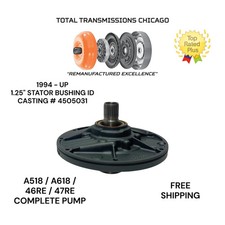
If the pump body is scored, the gears are worn or the bushing bore is damaged, a remanufactured pump is usually the faster fix than reworking the old one. GEARS magazine's 47RE case study is a reminder to check the stator support for flatness at the same time: Mike Brown found a warped stator support near the feed holes causing a cross leak inside the pump.
Step 5: Pump Bolts, Pump O-Ring and Pump Gasket
If the leak path points at the bolts or the gasket, the pump has to come out anyway. ATSG's 46RE/47RE/48RE manual lists the assembly details that keep it dry:
- New oil pump gasket installed over pilot studs.
- The pump-to-case O-ring bore lubed with a small amount of Trans-Jel before the pump goes in.
- New sealing washers on all seven pump bolts. Reusing the old washers is the classic cause of a bolt-path leak after a rebuild.
- Bolts tightened alternately and evenly to pull the pump in square, then torqued to 20 N·m (15 ft-lb).
- Pump cover-to-body bolts also 20 N·m (15 ft-lb).
Do not try to draw a cocked pump into the case with the bolts. That distorts the pump and creates exactly the leak you are trying to fix.
Step 6: The Rest of the Case, Front to Back
Once the bell housing is ruled out, work along the case. These are the external seals and joints on a 47RE, with ATSG's torque values. Snug is not a spec on aluminum threads.
| Leak point | Seal | Torque (ATSG) |
|---|---|---|
| Cooler line fittings at the case | Fitting / line flare | 17 N·m (13 ft-lb) |
| Line pressure and governor pressure test plugs | Plug threads | 14 N·m (10 ft-lb) |
| Front band adjusting screw locknut | Locknut | 41 N·m (30 ft-lb) |
| Front band lever pivot pin access plug | Plug | 17 N·m (13 ft-lb) |
| Screw-in park/neutral switch (1995-2001) | O-ring | 34 N·m (25 ft-lb) |
| Push-in transmission range sensor (later units) | O-ring | 5 N·m (45 in-lb) screws |
| Manual and throttle lever shafts | Throttle lever shaft seal | — |
| Solenoid case connector | O-rings | — |
| Oil pan to case | Pan gasket | 13.6 N·m (120 in-lb) |
| Overdrive housing to case | Gasket | 34 N·m (25 ft-lb) |
| Output shaft speed sensor | O-ring | 27 N·m (20 ft-lb) |
| 2WD speedometer adapter bracket | Adapter seal | 10-12 N·m (90-100 in-lb) |
| 2WD vehicle speed sensor to adapter | O-ring | 2-3 N·m (15-27 in-lb) |
A note on the pan: ATSG lists 120 in-lb, while Chrysler's 2001 Ram manual quoted in our fluid guide gives 13 ft-lb (17 N·m). Either way it is a light torque on a stamped pan. Over-tightening dimples the pan rail around each bolt hole, and a dimpled rail will leak with a new gasket. Straighten the rail on a flat surface and use a new gasket every time.
A few of these deserve more detail.
Case connector and park/neutral switch
The solenoid case connector passes through the case and seals with O-rings that ATSG says to replace and lube with Trans-Jel on reassembly. When those O-rings harden, ATF wicks into the connector itself. If you find ATF on the connector or its pins, replace the O-rings and clean the connector, and check it again before you chase any solenoid circuit code. The screw-in park/neutral switch on 1995-2001 units seals with its own O-ring and torques to 25 ft-lb. A seep there runs straight down the case and looks like a pan leak.
Tail end: overdrive housing, output seal and speed sensors
The overdrive unit bolts to the back of the main case with a gasket and 25 ft-lb bolts, and carries the output shaft seal (ATSG drives a new overdrive housing seal in on every rebuild). On a 2WD truck, the speedometer adapter and vehicle speed sensor sit in the tail and add two more sealed joints. Fluid at the yoke on a 2WD truck is either the rear seal or the adapter; dye will tell you which. A worn driveshaft slip yoke or a bad U-joint will wear the rear seal out repeatedly, so check the yoke surface and the U-joints when you replace it.
Cooler lines
Cooler line leaks are usually at the case fittings or the rubber hose sections near the radiator. Sonnax calls cooler restriction the most common issue in the 46/47RH-RE family and says it can start to cause trouble as cooler head pressure approaches 80 psi. A restricted cooler or line raises the pressure the hoses and fittings see, so a cooler line that keeps weeping may be telling you the cooler is plugged. GEARS' test is to loop the lines to bypass the cooler, and to blow no more than 40 psi of air into the rear cooler fitting to check the return path inside the transmission. Fittings at the case torque to 13 ft-lb. If the lines are rusted or the hose sections are hard and cracked, replace the line set instead of patching one joint. Our RE-family cooler line guide covers the job.
On 1996-1997 trucks there is one more reason to look hard at the case fittings. NHTSA recall 97V084000 covers 1994-1997 Dodge Ram trucks, about 960,000 units, because under high-load conditions the fluid temperature could exceed the melting point of the connector material that retains the cooler line. The line could then come loose and spray fluid onto the exhaust manifold. The remedy replaced the high-temperature side connector fittings with ones that use a stainless steel retainer, per the NHTSA campaign record. A wet fitting at the case on an early towing truck is a fire risk, not just a drip; confirm the retainers are there and check the VIN for open campaigns.
Leaks That Mean the Transmission Needs More Than Seals
- Burnt fluid with the leak. Chrysler says burnt, contaminated fluid with metal or friction material means a full recondition, not a fluid change. Sealing the case does not fix the clutches.
- Converter weld leak. Replace the converter, and flush the cooler before the new one goes in.
- Front seal leak with pump noise or TCC slip. That combination points at bushing clearance, the root cause Sonnax ties to all three symptoms.
- Fluid out the vent with correct level. Look for overheating, a cooler restriction, or pump problems, the causes ATSG lists after overfill.
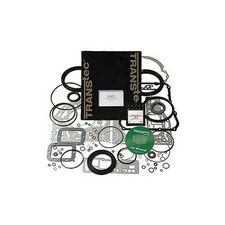
If the transmission is coming out anyway for a pump or converter leak, it is the right time to do a full overhaul gasket and seal kit. All the case seals listed above are in it, and the labor to get to them is already done.
RE-Family Overhaul Gasket and Seal Kit, 1990-2002
If the transmission is coming out for a pump or converter leak, this kit covers the pump gasket, case seals and O-rings in one box for the 1990-2002 RE units, which includes the 47RE. Confirm your year before ordering.
See the gasket and seal kit →Shop RE-family transmission parts →
Frequently Asked Questions
Where does a 47RE usually leak?
The most common spots are the front pump seal and pump O-ring in the bell housing, the pan gasket, the cooler line fittings, and the overdrive housing and rear output seal. Smaller seeps come from the park/neutral switch O-ring, the solenoid case connector O-rings, the pressure test plugs and, on 2WD trucks, the speedometer adapter. Clean the case and use ATF dye to find which one is actually wet.
How do I tell a 47RE front pump seal leak from a rear main seal leak?
Pull the converter inspection cover and look at the trail. Chrysler says pump seal leaks follow the converter drive hub onto the rear face of the converter, while pump bolt leaks deposit fluid on the inside of the housing and not on the converter. Engine oil from the rear main seal is black and runs down from the top of the housing; ATF+4 is red unless it is burnt.
Why does my 47RE front seal keep leaking after replacement?
Usually because the pump bushing is worn. When the converter hub has too much clearance in the bushing, it moves around and the seal lip cannot follow it. Sonnax identifies excessive hub-to-bushing clearance as a root cause of front seal leakage in Chrysler transmissions. Check the bushing clearance and the hub surface, and replace the bushing or the pump if they are worn.
Can overfilling a 47RE cause a leak?
Yes. An overfilled transmission churns the fluid into foam, which pushes out the vent and fill tube and looks like a seal leak. ATSG lists overfill, even by one or two quarts, as a leading cause of fluid out the vent. Check the level hot, in Neutral, and wait 2 minutes for the fill tube to drain down before you read the dipstick.
What is the torque on 47RE pump bolts?
ATSG's 46RE/47RE/48RE manual gives 20 N-m (15 ft-lb) for the oil pump to case bolts, tightened alternately and evenly to seat the pump square. Use new sealing washers on all seven pump bolts; reused washers are a common cause of a leak along the bolt path after a rebuild.
Sources
- Chrysler — 2005 Jeep Wrangler (TJ) Service Manual, Automatic Transmission, "Diagnosis and Testing - Fluid Leakage - Torque Converter Housing Area" (pages 21-50 to 21-51). Chrysler factory service information for its rear-drive automatics. Backs the three steps before repair, the engine-oil and red factory-fill check, residual and spilled fluid that is not a leak, the leak paths for the pump seal, pump O-ring, pump body, pump bolts and pump gasket, the leak-path figure (pump seal, pump vent, pump bolt, pump gasket, rear main seal), and the two converter leak points (outside-diameter weld and hub weld). Chrysler service manual section (PDF)
- Wayne Colonna, ATSG president — "A whale of a transmission problem," Vehicle Service Pros. Backs the causes of fluid exiting the vent or fill tube: overfill (one or two quarts, wrong dipstick), pump cavitation drawing air past the filter seal, distorted pumps, overheated fluid and cross leaks, and the advice to confirm these before replacing parts. vehicleservicepros.com
- Sonnax — Pump Bushing 12502-01 technical description. Backs excessive converter hub-to-pump bushing clearance as a root cause of front seal leakage, TCC slip codes and pump noise in the listed Chrysler units, the .008 in. clearance and 10x oil loss of standard replacement bushings, and pump bores varying by more than .003 in. because the OE bushing is machined in place. sonnax.com
- Sonnax — "46-47RH/RE Cooler and Converter Flow." Backs cooler restriction as the most common issue in this family, problems as cooler head pressure approaches 80 psi, and bypassing the cooler circuit as the verification test. sonnax.com
- ATRA GEARS Magazine — Mike Brown, "A Dead Stop! A Typical Dodge 47RE Problem With an Unexpected Solution" (August/September 2022). Backs the cooler bypass, the no-more-than-40 psi air check at the rear cooler fitting for a restricted internal return, and the warped stator support causing a cross leak in the pump. gearsmagazine.com
- ATSG — 46RE, 47RE, 48RE Technical Service Information manual (2011, print). Backs the pump assembly procedure (new gasket, Trans-Jel on the O-ring bore, new sealing washers on all seven pump bolts, 20 N·m / 15 ft-lb), the case connector, governor sensor, range sensor and park/neutral switch O-rings, the throttle lever shaft seal, the overdrive housing seal, and the torque specification table used above. Print publication; no public link.
- NHTSA — Recall campaign 97V084000 (Chrysler, 1994-1997 Dodge Ram, automatic transmission cooling unit and lines). Backs the cooler line connector melting under high-load fluid temperatures, the fluid spray onto the exhaust manifold, the roughly 960,000 units affected and the stainless steel retainer remedy. api.nhtsa.gov
The level-check procedure, the 13 ft-lb pan figure and the burnt-fluid guidance are from Chrysler's 2001 Dodge Ram Truck Service Manual, cited in detail in our 47RE fluid guide.
Shop 47RE pumps, overhaul gasket and seal kits, pans and coolers — shipped fast from the USA.
Shop 47RE parts →