The 4L60E is the four-speed automatic behind an enormous swath of GM rear-drive iron — Silverado and Sierra 1500, Tahoe, Yukon, Suburban, Express and Savana vans, S-10, Blazer, Camaro, Firebird, and the Corvette. It is one of the most common transmissions on the planet, which means one of its most common codes lands in front of a lot of people who then buy the wrong part. That code is P0785, and it points at the 3-2 shift solenoid — often called the 3-2 downshift or 3-2 timing solenoid.
Here is the problem with P0785: the code has the word "solenoid" right in the description, so the instinct is to throw a solenoid at it. Sometimes that is the fix. Often it is not. A broken spring in the valve body, a chafed white control wire, or a solenoid that only misbehaves once it gets hot will all set the same code. This is what the 3-2 solenoid actually does, what P0785 is really telling you, and how to sort the cheap fix from the expensive one before you spend a dime.
The short version: P0785 on a 4L60E is a 3-2 shift solenoid circuit code, and it is frequently mechanical or electrical, not the solenoid itself. A broken 3-2 control valve spring in the valve body can produce a 3-2 bind and cook the 2-4 band, and a break in the solenoid's white control wire — either from the PCM or inside the pan — sets the same code. Confirm the wiring and the valve body before you condemn a $30 solenoid or a whole valve body. Test, don't guess.
What the 3-2 Downshift Solenoid Actually Does
The 4L60E's 3-2 shift solenoid (SS) is a normally-closed, three-port, on/off device that bolts to the control valve body inside the transmission. It is not one of the two main shift solenoids that pick the gear ranges (those are Shift Solenoid A and B, the 1-2 and 2-3 solenoids). The 3-2 solenoid does one job: it manages the timing and feel of the 3-2 downshift.
On a 3-2 downshift the 2-4 band has to apply as the 3-4 clutch releases. If those two events overlap wrong, you get a bind, a flare, or a clunk. The PCM varies the timing between the 3-4 clutch releasing and the 2-4 band applying based on vehicle speed and throttle position, and the 3-2 solenoid is the tool it uses to do it. The solenoid gets ignition voltage on one circuit and the PCM pulses it to ground on another; on many 4L60E harnesses that is a distinctive white control wire that runs from the PCM to the case connector and then, inside the pan, from the connector to the solenoid itself.
Because the solenoid only trims downshift timing, a transmission with a bad 3-2 solenoid usually still drives. It shifts through all its gears. What you notice is the quality of the 3-2 change: a harsh or bang downshift, an inconsistent one, or a mushy delayed one. That is a useful clue, because it tells you the failure is in the 3-2 circuit and not in a range-holding clutch or a main shift solenoid.
What P0785 Really Means
P0785 is a generic transmission code — "Shift/Timing Solenoid 'A' Malfunction" in the OBD-II dictionary — but on a GM 4L60E it maps specifically to the 3-2 shift solenoid circuit. ATRA lists it plainly in its 4L60E/4L80E solenoid-code bulletin as "P0785 — 3-2 KD Solenoid circuit," alongside P0740, P1860, P0753 and P0758 (the Hummer and Saab equivalent is P0787). The PCM sets it when it monitors an electrical problem in that circuit: the current it commands does not match what it sees, the circuit reads open or shorted, or the solenoid does not respond the way the strategy expects.
Symptoms that ride along with P0785 typically include harsh or erratic shifting, a rough 3-2 downshift, and in some cases the transmission dropping into a fail-safe pattern. The generic causes the code books list are worth keeping in mind because they widen the search past the solenoid:
- A damaged or defective 3-2 shift solenoid.
- Wiring or connector problems — corrosion, chafing, a melted or spread pin at the case connector.
- Dirty or low ATF feeding the circuit and the valve it controls.
- A PCM or internal harness fault on the control side.
Notice what that list does not prove: it does not prove the solenoid is bad. "3-2 shift solenoid circuit" is a circuit, and a circuit includes the wire, the connector, the pan harness, and the valve the solenoid feeds. Any one of them can set P0785 with a perfectly good solenoid hanging on the end.
The Three Real Causes of P0785 on a 4L60E
When a 4L60E lands on the bench with P0785 and a lousy 3-2 downshift, the cause is almost always one of three things. They overlap in how they drive, so you diagnose to tell them apart instead of guessing.
1. The 3-2 solenoid itself — especially when hot
The solenoid does genuinely fail. The tell that points squarely at the solenoid is a fault that only shows up hot: the truck drives fine cold, then sets P0785 and shifts badly once it is up to temperature. That pattern usually means the solenoid's coil is opening as its internal resistance climbs with heat, or a hairline break in the winding spreads as the part expands. A solenoid is the cheapest of the real fixes, but confirm it electrically before you buy — a hot-only fault can also be a hairline crack in the wiring doing exactly the same thing.
2. A broken 3-2 control valve spring (valve body)
This is the mechanical cause people miss. Per Sonnax, the 3-2 control valve spring in late-model 4L60-E, 4L65-E and 4L70-E valve bodies often breaks, and when it does it can cause a 3-2 bind and/or overheat the 2-4 band. The solenoid can be fine while the valve it works against no longer regulates correctly, so the downshift feel goes wrong and the code can follow. This is a valve-body repair, not a solenoid, and it is far cheaper than the burnt 2-4 band it will eventually cause if it is ignored. If the band is already cooked (dark fluid, a burnt smell, debris), the job grew from a spring into a rebuild.
3. Wiring, the case connector, and the pan harness
The 3-2 circuit runs from the PCM, through the case connector, and down into the pan to the solenoid — but it also runs upstream, through a fuse and the ignition switch, on the solenoid power supply side. A break or a voltage drop anywhere on that path sets P0785. Per ATRA technical bulletin 1244, the most likely cause of limp mode with solenoid codes on these units is a loss of voltage on the solenoid power supply circuit, and the ignition switch commonly fails by adding resistance rather than cutting power outright — which means the dash can look perfectly normal while the transmission sets codes. ATRA bulletin 583 documents a second version of the same fault: a poor crimp on a terminal for circuit 1020 producing P0740, P0753, P0758, P0785 and P1860 along with no-shift and stuck-in-3rd complaints. Common failure points are the white control wire chafing through where it passes the case connector, a corroded or spread terminal at the 12-pin connector, and the internal harness rubbing on the valve body. This is the cause to rule out first because it costs nothing but time, and swapping a solenoid will never fix a broken wire feeding it.
Diagnose Before You Condemn Anything
The order matters because the price runs from a $10 terminal repair to a valve body to a full rebuild. Work it from cheap to expensive:
- Pull the code and read the freeze-frame. Confirm P0785 and note whether it set hot or cold, and at what speed. A hot-only set leans toward the solenoid or a marginal wire; a bind or a burnt smell leans toward the valve body and band.
- Check the fluid. The 4L60E uses Dexron VI. Dark, burnt fluid with debris says the 2-4 band is already suffering — think broken 3-2 control valve spring and a mechanical repair, not just a solenoid. Clean fluid with a bad downshift leans electrical.
- Check solenoid supply voltage before you touch the pan. ATRA's procedure for these codes is specific: with the key on and engine off, measure battery voltage, then measure at the transmission fuse. The two readings must match exactly. If the fuse is down 0.5 volt or more from battery, the ignition switch is the suspect, not the solenoid. On 1999-and-up applications the Underhood Bussed Electrical Center sits in that path too and can interrupt voltage to the switch.
- Inspect the connector and wiring. Check the case connector for corroded or spread pins and the white control wire for chafe-through, at the connector and inside the pan. Wiggle-test with the harness live if you have a hot-only complaint.
- Test the solenoid electrically. Measure coil resistance and command the solenoid on and off with a bidirectional scan tool. A solenoid that will not respond to command, with good wiring, earns replacement. Test it hot if the complaint is hot.
- Check line pressure. Tie a gauge to the line-pressure port to confirm the hydraulic side is healthy — roughly 55–65 psi at idle in Drive and 64–75 psi in Reverse on a 4L60E. A pressure problem changes shift feel and can muddy the diagnosis.
- Inspect the valve body. With electrical ruled out, pull the pan and check the 3-2 control valve and its spring. A broken spring is your mechanical answer.
Follow that order and P0785 stops being a parts-cannon exercise. A large share of these codes are a broken wire, a bad connector, or a broken 3-2 control valve spring — all a fraction of the cost of a reman valve body or a rebuild that a shotgun approach would have charged for. The solenoids that are genuinely dead reveal themselves clearly once the wiring and the valve body are ruled out.
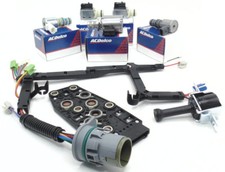
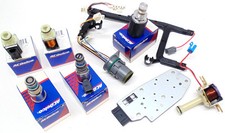
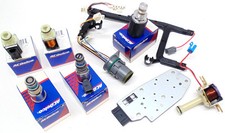
4L60E Master Solenoid Kit (EPC, Shift, TCC, 3-2, PWM) 1996-Up
When the 3-2 solenoid is confirmed bad, replace the set rather than one aging piece. This kit includes the 3-2 solenoid along with the EPC (pressure control), shift, TCC, and PWM solenoids — built to OEM spec as a direct-fit replacement for a 1996-up 4L60E, so you are not back in the pan next month for a different solenoid. Shipped fast from the USA.
View the 4L60E Master Solenoid Kit →Doing the job? Our line pressure testing walkthrough covers the pressure check above step by step, and the 4L60E common failure codes guide maps the rest of the solenoid and shift codes you may see alongside P0785. If the 2-4 band is already burnt, the full 4L60E service guide covers the teardown.
Sources
- ATRA — Technical Bulletin 1244, "4L60E/4L80E Limp Mode, Instrument Cluster Inop, or Solenoid codes," March 2009 (PDF). Backs the identification of P0785 as the 3-2 KD solenoid circuit code (P0787 on Hummer and Saab applications); the finding that the most likely cause of limp mode with these codes is loss of voltage on the solenoid power supply circuit; the warning that an ignition switch can add resistance without affecting the instrument cluster; the test procedure requiring voltage at the transmission fuse to match battery voltage exactly, with a 0.5 volt or greater drop pointing at the key switch; and the note that 1999-and-up applications have an Underhood Bussed Electrical Center in that circuit. atracom.blob.core.windows.net
- ATRA — Technical Bulletin 583, "4L60E, 4L80E: Possible no shifts or codes P0740, P0753, P0758, P0785, P1860," December 2000 (PDF). Backs the wiring-fault cause described above: a poor crimp on one of the terminals for circuit 1020 setting any or all of those solenoid codes, with 4L60E units failing to shift or staying in 3rd gear with the lever in overdrive, and the note that an intermittent version of the fault may set no code at all. atracom.blob.core.windows.net
- Sonnax — GM 4L60-E, 4L65-E, 4L70-E Vacuum Test Guide. Backs the recommendation to vacuum test the valve body bores rather than guess once the electrical side is ruled out, and Sonnax's position that bore wear is common in this family and that vacuum testing identifies the root cause and verifies the repair. sonnax.com
- Sonnax — 3-2 Control Valve Spring (77754-23). Backs the statement that the 3-2 control valve spring in late-model GM 4L60-E, 4L65-E and 4L70-E valve bodies often breaks, and that when it does it can cause a 3-2 bind and/or overheat the 2-4 band. sonnax.com
- Sonnax — Sure Cure Kit (SC-4L60E). Reference for the valve-body wear points behind shift-feel and solenoid-circuit complaints on GM 4L60-E, 4L65-E and 4L70-E PWM units. sonnax.com
- Sonnax — Heavy Duty Remanufactured Valve Body (GM054-HD). Reference for the corrected 4L60E valve body used when bores and valves are worn past repair. sonnax.com