Most 4L60E conversations treat "the sprag" as one part. It isn't. This unit carries two separate one-way clutches, built two different ways, at opposite ends of the case, and each produces a completely different complaint when it quits. The input sprag lives up front in the input housing stack. The low roller clutch lives at the back, inside the center support. Call the wrong one and you either tear down a unit that did not need it or hand back a truck that fails again in two weeks.
The five-minute version: One-way clutches can be bypassed by applying a friction element that holds the same member. In the 4L60E, manual low backs up the low roller clutch and the overrun clutch (D or 3 range) backs up the input sprag. A no-move complaint that disappears in manual low points at the low roller clutch. A launch shudder or 2-3 flare that disappears in D or 3 but is present in Overdrive points at the input one-way clutch. Both sort out before the unit comes out.
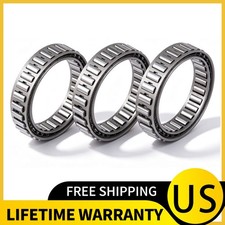
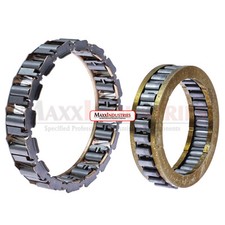
Sprag Versus Roller: What Actually Differs
Both devices lock in one direction of relative rotation and freewheel in the other. They get there through different geometry, and that geometry is why they fail differently.
A roller clutch uses cylindrical rollers held in a cage, riding in wedging pockets formed between a plain cylindrical race on one side and a machined cam ramp on the other. Rotate the races one way and the rollers climb the ramps and wedge; rotate the other way and they roll down into the deep part of the pocket and release. Accordion springs in the cage keep each roller lightly loaded against its ramp so it engages immediately instead of skipping.
A sprag clutch has no ramps. It uses a ring of dog-bone shaped elements, called sprags, standing between two plain cylindrical races. Each sprag is taller across one diagonal than the other, so tipping them one way jams them between the races and tipping them back lets them lie down and freewheel. As SAE technical paper 981092 describes it, a sprag one-way clutch freewheels in one direction but transmits torque due to the geometry of the sprag when the races are rotated in the opposite relative direction (6). That paper, by Chesney and Kremer, is the companion to their earlier analysis of roller one-way clutches.
The practical consequences for a rebuilder:
- Sprags pack more holding capacity into the same diameter. That is why GM used a sprag at the input, where torque multiplication through the front planetary is highest and there is no room to grow the diameter.
- Roller clutches tolerate more race eccentricity and cost less to build. A roller still finds its ramp if the races are not perfectly concentric. A sprag tolerates much less before some elements carry the whole load and the rest carry nothing.
- Sprags tend to fail suddenly, rollers gradually. A sprag rolls or shatters elements at once and the drive path is gone. A roller wears its cage first and gives you weeks of odd symptoms before it stops holding.
Where Each One Lives in a 4L60E
The input sprag is part of the front stack. In the factory build order it goes in as an input sprag assembly with its bearing facing the input drum, sitting on the front planetary and under the input housing (2). It ties the forward clutch drum to the input housing and carries the vehicle off the line in Drive and Overdrive.
The low roller clutch sits at the other end, and its packaging explains a spec later in this article. In the 4L60/E family the center support is the low/reverse one-way clutch outer housing, snap-ringed into the case (2). The inner race is not fixed. As Sonnax technical specialist Randall Schroeder points out, the center support does not separate front endplay from rear endplay the way a TH400 center support does, because the one-way clutch inner race floats up and down with gear set movement (2). That is why a 4L60E has one total endplay measurement instead of two, and why sloppy endplay works this roller clutch directly.
| One-way clutch | Type | Location | Backed up by |
|---|---|---|---|
| Input (forward) sprag | Sprag | Front stack, under the input housing | Overrun clutch (D3 / D range) |
| Low roller clutch | Roller and cam ramp | Center support, snap-ringed to the case | Low/reverse clutch (Manual 1st, Reverse) |
The Bypass Test: Isolating Either One From the Driver Seat
This is the most useful diagnostic idea in the subject, and it comes from Ed Lee, a Sonnax technical specialist and TASC Force member, writing in Transmission Digest: you can bypass a one-way clutch by engaging a clutch or band that holds the same member the one-way clutch holds (1). Move the range selector, change which element carries the load, and watch whether the complaint survives.
Testing the low roller clutch
Put it in manual low, where the low/reverse clutch applies and holds the same member the low roller clutch was holding by itself in the other forward ranges. Lee's rule: if the vehicle moves in manual low but did not move in the other forward ranges, the low roller clutch was not holding (1). No scan tool, no lift, no teardown.
Testing the input sprag
Same logic, opposite end of the unit. Selecting D or 3 applies the overrun clutch, which backs up the input one-way clutch. Lee describes isolating a launch shudder in a 700-family unit exactly this way: if the shudder is not present in D or 3 but is present in the Overdrive range, the input one-way clutch was not holding (1). The same test catches a 2-3 flare — if the flare goes away once the overrun clutch is engaged, stop chasing the 2-3 shift valve.
That 2-3 flare gets misdiagnosed constantly. It looks and feels like a shift-timing fault. It is a one-way clutch fault, and the range selector proves it in one drive. For the pressure-side checks that rule out the other half of that split, our line pressure testing walkthrough covers the procedure.
The Failure Nobody Codes: A Worn Roller Cage
A roller clutch does not have to stop holding to ruin the way a truck drives. Long before it fails outright, the cage that carries the rollers and springs wears and the rollers get sloppy in their pockets. The clutch still locks. It just takes more rotation to get there, and it arrives hard.
Lee documents a 700-family unit with exactly this: the customer complained of harsh forward engagements and a 2-1 downshift that felt like being rear-ended by a tractor-trailer (1). The cage was worn out. On a Chrysler 518 with a similar worn cage, the complaint was an intermittent 3-4 flare (1). Neither complaint says "one-way clutch" to most technicians, and no monitor sets a code for it.
There is a bench check for it that takes about a minute. Per Lee: install the cage into the housing without the inner race, then measure how far the worn cage rotates and compare that to the rotation distance of a new cage (1). If the worn one swings noticeably farther before it picks up, the cage is done. A good-looking roller clutch with a stretched cage goes straight back into the truck and keeps delivering the same harsh engagement the customer paid you to fix.
While you are in there, inspect the rollers for flats and the cam ramps for brinelling, and watch which way the assembly goes back in. Lee flags a trap that has caught experienced builders: some later one-way clutches are machined on both faces, where the old convention was one machined face and one raw-casting face used to orient the part. Shiny side up no longer means installed correctly (1).
Why a One-Way Clutch Failure Costs So Much
These failures hurt because the races are usually not separate parts you can replace. Sonnax technical specialist Jim Dial lays this out for the 4L80E overdrive roller clutch, and the principle carries over: once the roller clutch goes, it takes a number of other parts out along with it — the overrun clutch drum, because the drum is the inner race, and the overdrive planetary, because the outer race is on that planetary's inner diameter. Ground-up roller material then chips the planetary gears, which can take the ring gear with it (5).
Same story in a 4L60E. Metal does not stay put; it goes through the pump, into the cooler, and into the converter. A sprag or roller failure is never a replace-the-sprag job. It is the one-way clutch, a cooler flush, and a converter decision.
4L60E Thrust Bearing Kit, 1982-Up
Endplay is the lever that decides how long the low roller clutch and the input sprag last, and you cannot set it honestly on flattened, brinelled bearings. Fresh thrust bearings through the stack are the cheapest insurance in the build.
Get the 4L60E thrust bearing kit →Browse the full 4L60E parts catalog at CoreTransmissionParts
The Hydraulic Side: Losing the Backup
Both one-way clutches are supposed to have a friction element standing behind them. When the hydraulics stop delivering that backup, the one-way clutch carries load alone that it was never sized for.
On the low roller clutch, the part to know is the low overrun valve, which directs line pressure to the reverse input and low/reverse clutches. Sonnax documents the wear pattern: as the bore deteriorates, line pressure at the inboard location cross-leaks into the low/overrun circuit and to exhaust, and it can also cross-leak to exhaust at the outer spool location. Either way, clutch apply pressure in Reverse and Manual 1st drops and the clutches burn. Let the wear go far enough and the valve sticks in the bore, and you lose Reverse or Manual 1st entirely (4). A stuck low overrun valve also removes the backup you would use to bypass-test the low roller clutch, so check the bore before you trust that test.
On the input sprag, the backup is the overrun clutch, and the factory calibration does not apply it in every range where the sprag could use it. Sonnax addresses this with two heavy-duty remanufactured valve bodies for 1996 to 2008 4L60-E and 4L65-E units. GM053-HD engages the overrun clutch in D3 1st and 2nd gears for enhanced input sprag and forward clutch durability, and needs a manual downshift to D3 on a 4-3 at cruising speed for the full benefit. GM054-HD engages it in D4 1st, 2nd and 3rd gears as well as D3 1st and 2nd, with fluid rerouting for additional D4 protection and a servo cushion spring to reduce downshift clunk, and needs no manual downshift (3). If a unit has eaten an input sprag once, that is the correction that stops it happening twice.
The same idea shows up on the 4L80E, where Dial notes the factory overdrive roller clutch holds by itself in the OD range because the overrun clutch only comes on in the manual ranges (5). Whatever the unit, the cure for a chronically overloaded one-way clutch is to give it a friction element to share the load.
Prevention: Set the Endplay Right
Here is where the floating inner race comes back. Because that race moves with the gear set, total endplay controls how squarely the low roller clutch gets loaded. Too much play and the race walks under load, cocking the rollers in their ramps. Schroeder's procedure for the 4L60/E family gives real numbers (2):
- Gear set endplay: assemble the gear set, hubs and inner one-way clutch race from the rear hub up to the snap ring on top of the front planetary, then check movement between the output shaft and rear hub. No published factory spec here, but you want no more than.030 in.
- Total transmission endplay: .005 to.036 in. Schroeder's own working preference is .020 to.025 in. Measure with a dial indicator, not by feel.
- Pump cover gasket correction: with a new gasket, subtract.005 in. With no gasket, add.005 in. Miss this and a correct-looking number puts you out of spec.
- Adjusting without the right factory shim: shim stock can go under the factory shim in the input drum, typically in.015 in. increments, or under the rear-hub-to-case bearing at the bottom of the case, typically in.010 in. increments.
Take a reference measurement before you disassemble. It costs two minutes and tells you whether the unit came in already out of spec, which is often the real reason the one-way clutch on your bench is scrap.
Bench checklist for any 4L60E one-way clutch job: reference endplay before teardown; cage rotation check against a new cage; rollers for flats and cam ramps for brinelling; both races for scoring and out-of-round; low overrun valve bore for wear; overrun clutch piston and seals for leakage; total endplay set to.020 to.025 in. with the gasket correction applied; cooler and converter addressed if there was metal in the pan.
Two one-way clutches, two designs, two failure signatures, and one range selector that tells them apart before you pull the unit. Our input housing and sprag failure guide, low/reverse clutch failure guide and overrun clutch guide pick up where this one leaves off. If you turn up a leaking overrun piston along the way, the molded forward, 3-4 and overrun bonded piston set replaces all three in one shot.
Sources
- Transmission Digest, "Troubleshooting One-Way Clutches," Ed Lee, Sonnax TASC Force. Backs the bypass principle (engage a clutch or band that holds the same member the one-way clutch holds), the manual-low test for the low roller clutch, the D/3 overrun-clutch test for the input one-way clutch and the 2-3 flare, the worn-cage complaints (harsh forward engagement, violent 2-1 downshift, and the Chrysler 518 intermittent 3-4 flare), the cage rotation bench check performed without the inner race, and the both-faces-machined installation trap. transmissiondigest.com/troubleshooting-one-way-clutches
- Transmission Digest, "All Work and No Play: Setting Endplay to Prevent 4L60/E Gear Train Failure," Randall Schroeder, Sonnax TASC Force. Backs the center support being the low/reverse one-way clutch outer housing snap-ringed into the case, the floating one-way clutch inner race and why the 4L60/E has one total endplay rather than two, the input sprag assembly position in the build stack, gear set endplay of.030 in. maximum, total endplay of.005 to.036 in. with a.020 to.025 in. preference, the plus/minus.005 in. pump cover gasket correction, and the shim-stock increments. transmissiondigest.com/all-work-and-no-play-setting-endplay-to-prevent-4l60-e-gear-train-failure
- Sonnax, 4L60E Performance and Heavy Duty Transmission Build Guides. Backs the GM053-HD and GM054-HD heavy-duty valve body specifications for 1996 to 2008 4L60-E and 4L65-E units, including which gears each one engages the overrun clutch in, the manual-downshift requirement on GM053-HD, and the stated purpose of preventing input sprag and forward clutch failure. sonnax.com/tech_resources/617-4l60e-performance-heavy-duty-transmission-build-guides
- Sonnax, Oversized Low Overrun Valve Kit 77754-62K. Backs the low overrun valve function (line pressure to the reverse input and low/reverse clutches), the cross-leak wear pattern at the inboard and outer spool locations, burnt clutches from reduced apply pressure in Reverse and Manual 1st, and loss of Reverse or Manual 1st when the valve sticks in a worn bore. sonnax.com/parts/5621-oversized-low-overrun-valve-kit
- Sonnax, "Outsmarting 4L80-E Overdrive Roller Clutch Failure," Jim Dial, Sonnax TASC Force. Backs the collateral-damage mechanism (the overrun clutch drum is the inner race, the outer race is on the inner diameter of the overdrive planetary, and ground roller material chips the planetary gears and ring gear) and the point that the factory overdrive roller clutch holds alone in the OD range while the overrun clutch only applies in the manual ranges. sonnax.com/tech_resources/625-outsmarting-4l80-e-overdrive-roller-clutch-failure
- SAE International, Technical Paper 981092, "Generalized Equations for Sprag One-Way Clutch Analysis and Design," D. Chesney and J. Kremer, February 23, 1998. Backs the sprag operating principle: freewheeling in one direction while transmitting torque due to the geometry of the sprag when the races are rotated in the opposite relative direction, plus the existence of the companion roller one-way clutch analysis. saemobilus.sae.org/papers/generalized-equations-sprag-one-way-clutch-analysis-design-981092