Pull a 700R4 and a 4L60E apart side by side on the bench and most of what you see is the same transmission. Same 3.06 first gear, same 2-4 band, same input drum family, same case shape. Sonnax puts it plainly in its 700R4 build guide: most of the unit's internal components are shared with the 1993-and-later 4L60E, which is why so many Sonnax parts developed for the 4L60E drop straight into a 700R4. The big difference is the valve body — the 700R4 runs a cast-iron valve body with a throttle cable and a mechanical governor deciding shift points, while the 4L60E runs an aluminum valve body with computer-controlled solenoids actuating the shifts.
That one sentence hides the most important thing about these two units. Both have to answer the same question every second the engine runs: how hard is this engine working, and how much clamping force do the clutches need? The 700R4 answers with a steel cable. The 4L60E answers with a current-controlled solenoid. They fail in opposite ways, and the diagnostic tools are completely different.
The short version: The 700R4's TV cable is not a kickdown cable. It sets line pressure. Lose it, adjust it loose, or wear the TV plunger sleeve and line pressure collapses at exactly the moment the clutches need it — the transmission burns. The 4L60E deleted that cable and handed the job to the EPC (pressure control) solenoid, which the PCM commands in amps, inversely: about 0.9–1.1 A at idle, dropping toward 0.2–0 A at wide-open throttle. Lose that command and pressure goes to maximum, not minimum. The 4L60E fails harsh; the 700R4 fails slipping. There is no TV cable on a 4L60E — stop looking for one.
Both Systems Are Talking to the Same Valve
Before the two paths split, understand where they converge. Line pressure in either unit is set by the pressure regulator valve in the pump, held by a spring, and helped along by a boost valve sitting on the end of that lineup. The spring sets the base pressure floor. The boost valve is what makes pressure rise with load.
Sonnax describes the mechanism generically because it is generic: in typical applications, oil pressure from the EPC solenoid, the vacuum modulator, or the TV valve is directed to the end of the boost valve, and as that pressure changes, so does the force assisting the pressure regulator spring — which raises line pressure. Three different technologies, one job. A vacuum modulator reads manifold vacuum. A TV valve reads throttle cable position. An EPC solenoid reads a number the computer sends it.
So when a 700R4 has no line rise and a 4L60E has no line rise, the symptom at the clutch pack is identical: burnt frictions, slipping under load, glazed 2-4 band. Only the input side differs.
The 700R4 Side: A Cable That Can Kill the Unit in Minutes
The most common misconception in the hobby is that the 700R4's TV cable is a kickdown or detent cable. It is not. Per the TCI/Summit 700R4 and 2004R cable instructions, the TV cable controls line pressures, shift points, part-throttle downshifts and detent downshifts — the document notes it functions much like the combination vacuum-modulator and cable systems on other automatics, and it opens with a blunt warning that improper adjustment after installation will damage the transmission and void the warranty.
Here is the path. The cable pulls a lever at the transmission, which strokes the TV plunger. The plunger reciprocates inside a sleeve and meters TV feed oil into the throttle valve. TV pressure then reaches the boost valve, and line pressure rises with throttle. No cable pull means no TV pressure, which means no line rise. At wide-open throttle, with the clutches trying to hold a full-torque shift on minimum pressure, the frictions cook. That is where the shop-floor line about ruining a 700R4 in ten minutes comes from — it is what happens when full engine torque meets idle-level clamping force.
Adjustment, with the numbers that actually matter
Self-adjusting the cable is the easy half. With the engine off, press the adjust tab, push the slider back, release the tab, then rotate the throttle lever to wide-open throttle — the cable ratchets itself into position with a few audible clicks. Then check it for binding or sticking.
The half people skip is the bracket geometry, and that is where retrofits go wrong. Per the same instruction sheet, the distance from the throttle shaft to the cable end must fall between 1-7/64 in. and 1-1/8 in., and the cable end mounting point should sweep a 78-degree arc between closed throttle and WOT to get the right amount of pull. To find your adjuster mounting point: retract the slider without letting it move, pull the cable until it stops, measure from the mounting bracket to the cable end, and add 3/16 in. That is the correct distance at WOT.
Sonnax makes the same point from the failure side. On GM TH200, 200-4R, TH200C and 4L60/700R4 units (and Ford AOD and AXOD), the throttle valve cable gets pulled out of adjustment at wide-open throttle, and the cause is inaccurate throttle-shaft lever geometry — either too much pivot movement between closed and open throttle, or too much distance between the pivot points. When either exceeds spec, the cable walks out of adjustment on its own. Their corrector kit AS1-01K absorbs that excess pull with a spring so the cable stops migrating.
Road-test targets
After adjustment, under moderate acceleration the shift points should land close to these:
| Shift | Target speed (moderate throttle) |
|---|---|
| 1-2 | 15–20 MPH |
| 2-3 | 25–30 MPH |
| 3-4 | 40–45 MPH |
If the shifts come out soft and stacked together instead of spread out, the cable is too loose. The instruction sheet is emphatic about this: stop driving and readjust immediately. Soft stacked shifts are the audible signature of low line pressure, and every mile driven that way is grinding the frictions.
The wear item nobody inspects
Even a perfectly adjusted cable will not save a worn valve body. The steel TV plunger continuously reciprocates inside an aluminum sleeve, and it wears that sleeve out. Sonnax documents the consequence directly: the wear lets throttle-valve feed oil leak past the plunger and exhaust, which produces poor line rise and problematic detent downshifts — and the OE spring is weak on top of it, which can result in low line rise, insufficient throttle pressure and, ultimately, 3-4 clutch failure.
That is the tell on a high-mileage 700R4: acceptable line pressure at idle, but pressure that will not climb the way it should at stall or under hard acceleration. Gauge a unit, see decent idle pressure with maximum line rise stuck down in the 90–125 psi neighborhood, and you stop chasing the cable and pull the plunger and sleeve. The cable can only command what the valve can deliver.
The 4L60E Side: Amps Instead of Inches
When GM went electronic for 1993 on most models — the same year that was the last for the 4L60/700R4 in most applications — the cable, its bracket, its geometry and its adjustment all went in the trash. In their place: a pressure control (EPC) solenoid, sometimes called the force motor, that the PCM drives with a variable current.
The feed side matters first. The solenoids do not run on raw line pressure. An actuator feed limit (AFL) valve takes line pressure and regulates it down to a steady supply for the solenoid circuit. Per the Sonnax TASC Force writeup in Transmission Digest, in the GM 4L60E and 4L80E that AFL pressure is regulated to approximately 115 psi and fed to the shift solenoids, the pressure control solenoid, the TCC solenoid, the 3-2 control solenoid and the 2-3 shift valve lineup. The AFL valve's large reaction area side-loads its bore, and worn AFL bores in the 4L60E and 4L80E commonly produce low actuator feed and low line pressure — and because of the hydraulic circuitry, they can throw P1870 and TCC codes as a side effect. That matters here because a worn AFL bore mimics a dead EPC solenoid on a gauge. Feed the solenoid badly and it cannot control anything, whatever the PCM commands.
The inverse relationship, and why it saves transmissions
This is the part that trips up techs coming off cable units. On GM's electronic pressure control, more current equals less pressure. Per ATRA's Gears Magazine, at idle you should see roughly 10% engine load and 0.9–1.1 amps commanded to the pressure control solenoid. Run a stall or watch a wide-open-throttle pull just before the 1-2 shift and engine load should climb to 90–100% while the solenoid command drops to 0.2–0 amps. As load goes up, amperage goes down, and line pressure rises.
GM did that on purpose. Wire it that way and any electrical failure — a broken wire, a dead PCM driver, an unplugged connector — results in zero current, which means maximum line pressure. The customer gets brutal engagements and slam shifts and comes to you annoyed. On a TV-cable unit the equivalent failure gives you minimum pressure and a slipping transmission that destroys itself on the way to the shop. Harsh is a complaint. Slipping is a rebuild.
Transmission Digest documents the real-world version of that failure: a complaint of harsh engagements and shifts where the scan data shows no amperage command to the EPC solenoid, so line pressure sits at maximum, with no transmission codes stored but lean codes in the ECM and sometimes ABS or stability control lights on. That case pattern shows up regularly on Chevrolet Silverados with the 5.3 non-flex-fuel engine. Note the trap in it: a tech who only pulls transmission codes finds nothing at all.
Do not trust the scan tool PID
The single most valuable warning in this whole subject: on a 4L60E, diagnosing line pressure requires a pressure gauge plus a meter or amp clamp to measure the actual commanded EPC amperage. Per Transmission Digest, it is not advisable to rely on the EPC commanded-amperage PID on the scan tool, because the PID will frequently display the correct commanded value when the reality is wrong. This happens when the ECM EPC solenoid driver has failed, especially on 1993–1997 models. The computer reports what it intended to send, not what actually reached the solenoid.
So the 4L60E procedure is: gauge on the line-pressure tap, amp clamp on the EPC solenoid feed wire, and watch both while you sweep load. Smooth, progressive pressure rise with amperage falling from around 1.0 A toward 0 is a healthy system. Erratic pressure swinging between roughly 90 and 150 psi at stall — the case Gears describes — is a pressure control problem, not a clutch problem.
Before you condemn the solenoid, though: many 4L60E harsh 1-2 complaints are not a pressure control fault at all. Transmission Digest notes that a large share of them come from TCC slippage setting P1870 and P0894, which puts the transmission into high line pressure mode deliberately. The pressure is high because the computer decided it should be. Fix the converter clutch slip and the harsh shift goes with it.
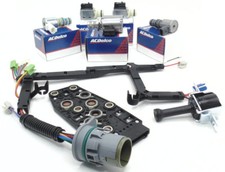
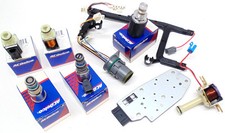
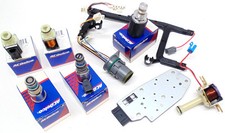
4L60E EPC Pressure Control Solenoid, 1992–2002
The part that replaced the TV cable. When the amp clamp confirms the command is reaching the solenoid but pressure will not follow it, this is the piece. Direct-fit OE-spec replacement for 92–02 4L60E units in GM, Chevrolet, GMC and Cadillac applications. Confirm your year first — 2003-up units take a different solenoid.
View the 4L60E EPC solenoid →Different year, or need the whole solenoid set? Browse the full 4L60E parts collection.
Side by Side
| 700R4 / 4L60 (1982–1993) | 4L60E (1993–up) | |
|---|---|---|
| Valve body | Cast iron | Aluminum |
| Load input | TV cable to TV plunger and throttle valve | PCM to EPC / pressure control solenoid |
| Shift point control | Mechanical governor | Shift solenoids A and B, PCM strategy |
| Adjustment | Cable self-adjust plus bracket geometry (1-7/64 to 1-1/8 in., 78-degree arc) | None — the calibration lives in the PCM |
| Solenoid feed | Not applicable | AFL valve, regulated to roughly 115 psi |
| Command at idle | Cable slack, minimum TV pressure | About 0.9–1.1 A |
| Command at WOT | Full cable pull, maximum TV pressure | About 0.2–0 A |
| Failure default | Low pressure — slips and burns | Maximum pressure — harsh but survivable |
| Primary test tool | Pressure gauge, line rise at stall | Pressure gauge plus amp clamp on the EPC wire |
| Classic wear item | TV plunger sleeve, cable geometry | AFL valve bore, EPC driver in the ECM |
What This Means for Swaps
Two directions, two different headaches.
Putting a 700R4 behind a carbureted or older engine: the cable is the whole job. You need a cable actually built for a 700R4 or 2004R — TH350 and older TH200 cables are designed differently and will not work — and there are roughly 30 different stock cable lengths out there, so a salvage-yard cable that is too short is a dead end before you start. You also need a bracket that puts the cable end inside the geometry window above. Aftermarket carburetor throttle levers are the usual culprit behind a cable that keeps walking out of adjustment at WOT.
Putting a 4L60E behind an older engine: there is nothing to hook a cable to, and no amount of searching will produce a TV port on the case. The transmission needs a controller — either the factory PCM with a matching calibration or a standalone unit — and it needs a throttle position signal. On a carbureted engine that means adding a TPS to the throttle body or carb. Without a valid load signal the controller has no basis for varying EPC current, and the pressure schedule becomes a guess. Sonnax makes the trade-off explicit: fine-tuning shift characteristics through the 700R4's old-school mechanical controls is challenging given the variety of OE core calibrations out there, while a 4L60E-series unit supports easier and more predictable adjustment through aftermarket tuning.
That is the honest summary. The cable is simple, cheap and unforgiving. The solenoid is more parts and more diagnosis, but it fails toward safety and it is tunable. Neither one is the excuse for a burnt 3-4 clutch pack. The excuse is always someone who never put a gauge on the line tap.
Working on one of these? Our 4L60E line pressure specs and testing guide covers the gauge procedure and the numbers, and the 4L60E vs 700R4 differences and interchange guide covers what physically swaps between the two families. If you are chasing pressure regulator or boost valve wear, start with the pressure regulator and boost valve writeup.
Sources
- Sonnax (Gregg Nader, TASC Force) — 700-R4 (4L60) Performance Transmission Build Guide. Backs the shared internals between the 700R4 and 1993-later 4L60E, the cast-iron versus aluminum valve body distinction, throttle cable plus mechanical governor versus computer-controlled solenoids, the 1982/1989/1993 timeline, and the tuning trade-off between mechanical and electronic control. sonnax.com/tech_resources/943-700-r4-4l60-performance-transmission-build-guide
- Sonnax — The Prescription for Optimum Pressure. Backs how the boost valve works and the statement that oil pressure from the EPC solenoid, vacuum modulator or TV valve is directed to the end of the boost valve to assist the pressure regulator spring. sonnax.com/tech_resources/100-the-prescription-for-optimum-pressure
- Sonnax — Throttle Valve Plunger Valve Kit 77966-94K. Backs the steel TV plunger wearing the aluminum sleeve, TV feed oil leaking past the plunger and exhausting, the resulting poor line rise and detent downshift problems, the weak OE spring, and 3-4 clutch failure as the end result. sonnax.com/parts/2512-throttle-valve-plunger-valve-kit
- Sonnax — TV Cable Corrector Kit AS1-01K. Backs the TV cable being pulled out of adjustment at wide-open throttle on GM TH200, 200-4R, TH200C and 4L60/700R4 units (and Ford AOD/AXOD) due to inaccurate throttle shaft lever geometry, and the pivot-movement and pivot-distance specs behind it. sonnax.com/parts/2765-tv-cable-corrector-kit
- Transmission Digest (Sonnax TASC Force Tips) — Hydraulic Fundamentals: AFL/Solenoid Modulator Valves. Backs the 4L60E and 4L80E actuator feed limit valve regulating line pressure to approximately 115 psi for the shift solenoids, pressure control solenoid, TCC solenoid, 3-2 control solenoid and 2-3 shift valve lineup, plus AFL bore wear causing low actuator feed and low line pressure and contributing to 1870 and TCC codes. transmissiondigest.com/tasc-force-tips-3
- Transmission Digest — 4L60E Harsh 1-2 Shift. Backs the warning that diagnosing 4L60E line pressure requires a pressure gauge and DVOM to measure commanded EPC amperage rather than trusting the scan tool PID, the failed ECM EPC solenoid driver on 1993–1997 models, and P1870/P0894 TCC slippage putting the unit into high line pressure mode. transmissiondigest.com/4l60e-harsh-1-2-shift
- Transmission Digest — Avoiding 4L60-E Harsh Shifts and Engagements. Backs the no-amperage-command-to-EPC case producing maximum line pressure with harsh engagements, no transmission codes but lean ECM codes stored, and the Chevrolet Silverado 5.3 non-flex-fuel pattern. transmissiondigest.com/avoiding-4l60e-harsh-shifts-engagement
- ATRA Gears Magazine — Controlling Pressure: General Motors. Backs the EPC amperage ranges (roughly 0.9–1.1 A at idle at about 10% load, dropping to 0.2–0 A at 90–100% load before the 1-2 shift), the inverse amperage-to-pressure relationship, the erratic 90–150 psi stall case, and the amp clamp plus pressure gauge method. gearsmagazine.com/magazine/controlling-pressure-general-motors
- TCI / Summit Racing — 700R4 and 2004R TV Cable Adjustment Instructions (manufacturer instruction sheet). Backs the TV cable controlling line pressures, shift points, part-throttle and detent downshifts, the damage warning, the 1-7/64 to 1-1/8 in. throttle-shaft-to-cable-end spec, the 78-degree arc, the plus-3/16 in. adjuster mounting point method, the 15–20 / 25–30 / 40–45 MPH shift targets, the TH350/TH200 cable incompatibility and roughly 30 stock cable lengths, and the stop-driving warning on soft stacked shifts. static.summitracing.com/global/images/instructions/700r4 cable adjustment instructions.pdf