The 4L60E is the default automatic behind an LS swap, and for good reason: it bolts to every Gen III and Gen IV small-block, parts are everywhere, and a healthy one handles a mild LS all day. But unlike the old TH350 or 700-R4 it grew out of, the 4L60E has no governor, no throttle valve cable, and no vacuum modulator. Everything it does is decided by a computer. That is the part that trips up swappers: you can bolt the transmission in perfectly and still have a truck that won't shift, won't lock the converter, or drops into limp mode — not because the trans is bad, but because nothing is telling it what to do.
This is the control picture for a 4L60E in an LS swap: what actually lives inside the case, how the years differ, which engine computers can run the trans, and when you need a standalone controller instead. Get this right on paper before you cut a single wire.
The short version: A 4L60E needs a computer to command its solenoids — it will not shift on its own. A 1996-and-later 4L60E can be run directly by a Gen III LS PCM once it's tuned for transmission control [5]. A 1993–1995 unit lacks the PWM lockup hardware the LS PCM expects, so it needs a standalone controller [5]. Match the transmission year, the case connector, and the controller before you wire anything.
What Actually Controls a 4L60E
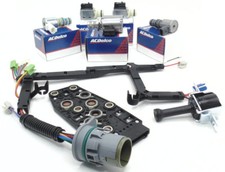
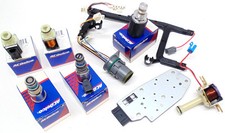
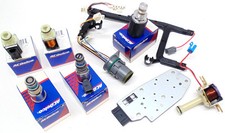
Inside the pan, a 4L60E is run by a small set of electrical devices fed through an internal wire harness that plugs into the case connector on the passenger side. There is no mechanical decision-making left. The core components are [1][3]:
- Shift Solenoid A and Shift Solenoid B — two on/off solenoids that, in combination, select which of the four gears the trans is in.
- The EPC (pressure control) solenoid — a variable solenoid that sets line pressure, which controls shift firmness and how hard the clutches apply.
- The TCC solenoid — applies the torque converter clutch for lockup.
- The 3-2 downshift solenoid and, on later units, a PWM/TCC solenoid that meters converter apply.
All of those signals pass through one internal harness and out the case connector to the vehicle harness and the computer. That internal harness is a genuine wear item — heat, miles, and fluid cook the connectors and chafe the wires, and a single broken conductor there will set a solenoid code that looks exactly like a failed solenoid. When you have the pan off during a swap, it is cheap insurance to replace the solenoids and the internal harness together rather than reuse a 20-year-old one.
PWM vs. Non-PWM: The Split That Matters Most
The single most important thing to know before an LS swap is whether your 4L60E is a PWM or non-PWM unit, because it changes both the wiring and which computer can run it.
Early 4L60Es controlled the torque converter clutch with a simple on/off TCC solenoid — the clutch is either applied or released, nothing in between. Starting in 1995, GM added a second TCC solenoid driven by pulse-width modulation (PWM). Per Sonnax, under PWM control the computer sends a variable duty cycle to that second solenoid to control the regulated apply valve, and the percentage of that duty cycle sets the rate at which the converter clutch applies and releases [2]. That's what gives later trucks their smooth, almost imperceptible lockup instead of the abrupt clunk of an on/off unit.
You can tell the two apart without pulling the pan. Sonnax notes the PWM units (the EC3 electronically-controlled-capacity-clutch design) carry a 13-pin case connector and a PWM/TCC solenoid — five solenoids total — while the earlier non-PWM units use a 12-pin case connector and have only the 3-2 solenoid in the valve body, for four solenoids total [2][3].
| Feature | Non-PWM (early) | PWM / EC3 (1995-up) |
|---|---|---|
| Case connector | 12-pin | 13-pin |
| Solenoid count | Four | Five (adds PWM/TCC) |
| TCC control | On/off | Variable duty cycle |
| Runs on Gen III LS PCM? | No — needs standalone | Yes (1996-up), when tuned |
Mixing these up has real consequences. Sonnax makes the same warning on the hardware side: the TCC apply valve for non-PWM units and the one for PWM units are different parts, and installing the wrong one causes rapid converter failure [2]. The lesson carries straight into wiring — a PWM harness and calibration expect a PWM valve body, and vice versa.
Which Computer Can Run It
1996-and-later: the LS PCM can do it all
If your 4L60E is a 1996-or-newer PWM unit, the good news is you may not need a separate box at all. A Gen III LS-series PCM can control the 1996-and-newer 4L60E directly, managing the shift solenoids, line pressure, and PWM converter lockup, provided the PCM is running an operating system and calibration that includes transmission control [5]. This is the cleanest setup: one computer, one harness, factory-quality shift logic. The catch is the tune — the PCM has to be told it is running a trans, with the right shift points and TCC schedule, or you'll get erratic or missing shifts even though the wiring is perfect.
Case-connector pin count also climbed over the years, which matters when you're matching a trans to a harness. LS-swap specialist PSI documents the progression: 1996–2006 units use the 13-pin connector; 2007–2008 units move to a 15-pin connector that adds an input speed sensor signal; and 2009-and-later units use a 17-pin connector [4]. PSI also notes that 1999-and-newer transmissions are the easiest starting point because they bolt directly to Gen III LS and Vortec engines, while the 2007-up 15- and 17-pin units are the preferred choice on late Gen IV (58x) applications [4].
1993–1995: you need a standalone controller
The early units are the trap. A 1993–1995 4L60E does not have the PWM TCC solenoid the LS PCM expects — that solenoid was added in 1995 — and these transmissions are not compatible with Gen III PCM transmission control [5]. If you're stuck with an early core, the answer is an aftermarket standalone transmission controller: a dedicated box, typically running $1,000-plus, that drives the solenoids independently of the engine computer [5]. A standalone also earns its keep even on a compatible trans when you want full control over shift firmness, shift points, WOT behavior, and TCC lockup without re-tuning the whole engine calibration.
4L60E Solenoid & Filter Service Kit (Shift, EPC, TCC, Harness, Filter, Gaskets)
Doing the electrical side of your swap right means new solenoids and a new internal harness, not a 20-year-old one. This 1993-up service kit bundles the shift, EPC, and TCC solenoids with the internal wire harness, filter, and gaskets — the parts most worth refreshing while the pan is off. Sold by our sister store, CoreTransmissionParts.com.
View the kit at CoreTransmissionParts →The Wiring Inputs the Trans Can't Live Without
Whether you run the LS PCM or a standalone, the transmission control side needs a handful of inputs to behave. Skip one and you get a trans that shifts wrong, won't lock up, or won't downshift when you brake:
- Switched 12V power to the case connector. On a 4L60E, one feed powers the shift solenoids and the TCC solenoid; the computer switches them to ground to command them.
- A vehicle/output speed signal. The controller decides shift timing from road speed, so it needs the output-speed input satisfied. LS PCM setups that came from a cable-speedometer vehicle often use a VSS adapter to feed the PCM its speed signal [5].
- A throttle/load signal. The computer needs to know how hard you're asking — from the TPS or, on drive-by-wire, from the pedal — to schedule shifts and firmness.
- A brake input for TCC unlock. The converter clutch has to release the instant you touch the brake, or the engine stalls when you stop. On the factory system this is the brake switch telling the computer to drop lockup; keep that input wired.
One more note for anyone bolting an early non-PWM trans to a controller that expects PWM: because the early units lock the converter on/off rather than by duty cycle, the PWM lockup output simply goes unused — the controller commands the single TCC solenoid on or off and the ramp settings are ignored. It works, but you lose the smooth apply, which is one more reason to source a later PWM unit for a swap when you can.
Get the Plan Right First
The 4L60E is a great swap transmission, but it is only as good as the control system feeding it. Before you order a harness or a controller, confirm three things: the year of your transmission, whether it's PWM or non-PWM (count the case-connector pins), and which computer is going to run it. A 1996-up PWM unit on a properly tuned LS PCM is the simplest, cleanest path [4][5]; a pre-1996 core means budgeting for a standalone [5]. Nail those down and the actual wiring becomes a short, predictable job instead of a week of chasing no-shift gremlins.
Doing the job? Our line pressure testing walkthrough covers verifying EPC behavior once it's wired, and the diagnostic habits there apply directly to sorting out a fresh swap that isn't shifting the way you expect.
Sources
- Sonnax — GM 4L60-E Transmission (unit overview), reference for the 4L60E's clutch-to-clutch, fully electronic architecture and its solenoid control. sonnax.com/units/455-4l60-e
- Sonnax — 20 Years Later: What's New with 4L60-E PWM Modifications, on the second PWM TCC solenoid, variable-duty-cycle converter apply, 12-pin vs 13-pin case connector identification, and PWM vs non-PWM valve differences. sonnax.com/tech_resources/214
- Sonnax — GM 4L60-E Valve Body Identification Guide, on identifying PWM vs non-PWM units by solenoid count and case connector. sonnax.com/tech_resources/614
- PSI Conversion — 4L60E & 4LXX Series Transmission Guide for LS Swaps, on case-connector pin counts by year (13/15/17 pin) and which transmissions bolt to Gen III/IV engines. psiconversion.com/LSXGuide/transguide.html
- LS Engine DIY (CarTech) — Upgrading to Gen III LS-Series PCM: Transmission Guide, on the LS PCM controlling 1996-up 4L60Es, the 1993–1995 incompatibility and need for a standalone controller, PWM lockup, and VSS input. lsenginediy.com/upgrading-gen-iii-ls-series-pcm-transmission-guide