Ask around about 4L60E line pressure and you get the same two numbers every time: 55 to 189 psi in Drive, Park and Neutral, and 64 to 324 psi in Reverse. They are correct, but almost nobody quoting them knows where they came from — and that matters, because the source also tells you what conditions the test demands and what the pressure should do between those extremes.
They are unit conversions. GM publishes 4L60E line pressure in kilopascals: 380 to 1,300 kPa for Drive, Park or Neutral, and 440 to 2,235 kPa for Reverse. Convert those and you get 55 to 189 and 64 to 324 psi almost exactly. The shop-forum spec is real OEM data, laundered through a calculator and stripped of everything that made it useful.
This is the rest of it: what sets line pressure in this unit, the factory test procedure and the conditions it demands, the full pressure control solenoid current-versus-pressure chart, and how to tell a worn pump from a lying scan tool.
The short version: Line pressure in a 4L60E is set by the pressure regulator valve in the pump, biased by a boost valve that is fed torque signal oil from the pressure control (EPC) solenoid. Current to that solenoid is inversely related to pressure — about 1.0 amp at idle for low pressure, dropping toward 0 amps at wide-open throttle for high pressure. The factory test sweeps solenoid current in 0.1 amp steps in Park and compares the gauge against a chart. A reading 50 to 100 psi below spec in Reverse points at pressure regulator valve bore wear, not at the solenoid.
What Actually Sets Line Pressure in a 4L60E
Three parts do the work, and knowing the order they act in is what makes the gauge reading mean something.
The pressure regulator valve lives in the oil pump cover. It regulates line pressure by dumping excess oil into a decrease circuit that feeds back to the pump slide, which is how a variable-displacement vane pump controls its own output. Per GM's description of the circuit, the PR valve is biased by four things at once: torque signal fluid pressure, the pressure regulator spring, line pressure fed to the end of the valve, and reverse input pressure acting on the boost valve in Reverse.
The boost valve raises pressure on demand. Torque signal oil pushes it against an isolator spring, and that spring passes the force to the pressure regulator valve. More throttle means more torque signal, more force on the regulator, higher line pressure. Reverse input oil acts on the same boost valve, and that is the entire reason the Reverse spec tops out at 2,235 kPa while Drive stops at 1,300 kPa. Reverse is not a different pump setting; it is the same regulator with an extra hydraulic thumb on the scale.
The pressure control solenoid — EPC solenoid, or force motor, depending on who you learned from — creates that torque signal. It is a variable-bleed solenoid that regulates actuator feed limit (AFL) oil down into torque signal oil, and the PCM controls it by varying current, not by switching it on and off.
The part that trips people up is the direction. Duty cycle and current flow are inversely proportional to throttle angle. At idle the PCM commands the most current, the solenoid bleeds the most AFL oil away, and line pressure sits at the bottom of its range. Open the throttle and the PCM reduces current, the bleed closes down, and pressure climbs. A tech who expects amps and pressure to move together will condemn a good solenoid every time.
There is also a mechanical backstop: a pressure relief ball and spring in the pump prevent line pressure from exceeding roughly 2,240 to 2,520 kPa, about 325 to 365 psi. Above that, line oil unseats the ball and exhausts. A gauge that parks itself in that neighborhood and refuses to come down is a regulator that has lost control, not a normal high-pressure command.
The Factory Numbers
GM specifies 4L60E line pressure as two calibrated ranges, one for Drive, Park and Neutral, and one for Reverse:
| Gear range | GM spec (kPa) | Converted (psi) |
|---|---|---|
| Drive, Park or Neutral | 380 – 1,300 kPa | 55 – 189 psi |
| Reverse | 440 – 2,235 kPa | 64 – 324 psi |
| Pressure relief ball opens | 2,240 – 2,520 kPa | 325 – 365 psi |
Those are full operating ranges, not targets. A healthy unit moves through them as the PCM changes solenoid current, which is why the useful test is not "what is my pressure," it is "does my pressure track the commanded current."
The Real Test: Sweep the Solenoid, Watch the Gauge
The OEM procedure is a bidirectional test: command the pressure control solenoid to a specific current in 0.1 amp steps and read the gauge at each one. It is the most informative thing you can do to a 4L60E with the pan still on. Per GM service information:
- Check fluid levels and the manual linkage for correct adjustment and wear. Do this first — a misadjusted manual valve throws the whole test.
- Connect a scan tool capable of bidirectional PCS control.
- Install an oil pressure gauge (GM calls out tool J21867 or equivalent) at the line pressure tap.
- Select Park, firmly apply the park brake, start the engine and warm it up at idle.
- Access the Miscellaneous Tests menu, then the PCS Control test.
- Raise commanded PCS current in 0.1 amp increments, letting pressure stabilize five seconds after each change, and read the gauge at each step.
- Compare each reading against the chart below.
Three conditions are not optional. Skip any of them and the numbers are unusable:
- Engine speed 1,500 rpm. The chart is built at 1,500 rpm, not at idle.
- Fluid at 66 C, about 151 F. Line pressure drops as temperature rises, so a hot-soaked unit reads low against this chart and a cold one reads high.
- Total test time under two minutes. GM is explicit that exceeding it can damage the transmission. You are holding the unit at commanded pressures in Park with nothing absorbing the energy.
Also expect the scan tool to allow PC solenoid control only in Park and Neutral with the vehicle stopped. That is deliberate: it protects the clutch packs from being handed extremely high or low pressure in Drive or Reverse.
PCS current versus line pressure
GM publishes the chart per engine family, because the boost valve calibration differs. Both columns are the same test, and the psi figures are converted from the published kPa:
| PCS current | V6 (kPa) | V6 (psi) | Gen III V8 (kPa) | Gen III V8 (psi) |
|---|---|---|---|---|
| 0.00 A | 1,261 – 1,399 | 183 – 203 | 1,369 – 1,507 | 199 – 219 |
| 0.10 A | 1,257 – 1,395 | 182 – 202 | 1,356 – 1,494 | 197 – 217 |
| 0.20 A | 1,233 – 1,371 | 179 – 199 | 1,334 – 1,472 | 193 – 213 |
| 0.30 A | 1,201 – 1,339 | 174 – 194 | 1,299 – 1,437 | 188 – 208 |
| 0.40 A | 1,139 – 1,277 | 165 – 185 | 1,229 – 1,367 | 178 – 198 |
| 0.50 A | 1,055 – 1,193 | 153 – 173 | 1,143 – 1,281 | 166 – 186 |
| 0.60 A | 921 – 1,059 | 134 – 154 | 1,016 – 1,154 | 147 – 167 |
| 0.70 A | 818 – 956 | 119 – 139 | 868 – 1,006 | 126 – 146 |
| 0.80 A | 649 – 787 | 94 – 114 | 693 – 831 | 101 – 121 |
| 0.90 A | 439 – 577 | 64 – 84 | 481 – 619 | 70 – 90 |
| 1.00 A | 379 – 517 | 55 – 75 | 333 – 471 | 48 – 68 |
| 1.10 A | 339 – 477 | 49 – 69 | — | — |
Read the shape of that table, not just the rows. Pressure barely moves between 0.00 and 0.30 amps — roughly 15 psi across three steps — then falls off a cliff between 0.60 and 1.00 amps, dropping about 100 psi. That is the calibration doing its job: fine control where it matters for shift feel, and a hard floor for idle. It also means a solenoid gone lazy at the low-current end barely moves your readings, while one off at the high-current end shows up immediately as a unit that will not come down to idle pressure.
GM also warns that the transmission may shift harshly or softly for up to two days afterward. That is the adaptive strategy re-learning. Tell the customer before they call you about it.
Testing Without Bidirectional Control
If your scan tool will not command the solenoid, you can still get most of the way there by watching current and pressure together while you drive the truck. Rob Faucett, writing for ATRA's Gears magazine, gives the numbers: at idle, roughly 10 percent engine load and 0.9 to 1.1 amps on the pressure control solenoid. During a wide-open-throttle pull just before the 1-2 shift, engine load should reach 90 to 100 percent and solenoid command should drop to 0.2 to 0 amps. As load comes up, amperage drops and line pressure rises.
The critical detail is how you measure that current: amp clamp on the pressure control solenoid feed wire, gauge on the tap, watch both. Do not trust the commanded-amperage PID by itself. Transmission Digest is blunt about this on the 4L60E: the PID will often display the proper commanded amperage when it is in fact wrong, which happens when the PCM's EPC solenoid driver has failed — especially on 1993 to 1997 models. The scan tool reports what the computer intended, not what the coil received.
That point generalizes: most transmissions have no pressure transducer feeding the PCM at all, so what looks like pressure data on the scan tool is a command, not a measurement. If commanded and actual agree, your solenoid, pressure valves and pump are all working. If they do not, you have split the problem in half.
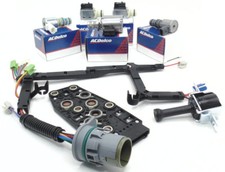
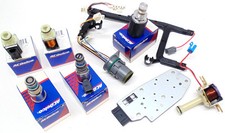
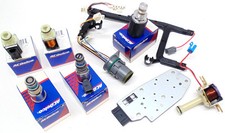
4L60E EPC Pressure Control Solenoid (1992-2002)
If the sweep shows pressure that will not follow commanded current, and the wiring and PCM driver check out, this is the part. Direct replacement force motor for the 4L60E. Available at our sister store CoreTransmissionParts, or browse the full 4L60E parts collection.
Shop the 4L60E EPC Pressure Control Solenoid →Gauge Rules That Keep the Test Honest
Jeff Parlee of the Sonnax TASC Force wrote the short list on this, and every item came from somebody's ruined afternoon:
- Use a gauge rated above the maximum pressure you expect. On a 4L60E in Reverse that means above 324 psi, so a 0-100 psi gauge is not a tool, it is a projectile — and people grab one because idle pressure fits on it.
- Measure during a road test, not on the lift. There is no way to load the transmission on a lift the way real driving does.
- Keep the gauge outside the cabin. Washing the outside of a car beats shampooing the interior after a hose lets go.
- Route the hose away from exhaust, driveshafts, axles, fan blades and linkage, and secure the hood with a tie if it has to ride ajar.
The 4L60E has one pressure tap, for line pressure. Line taps generally have no restriction ahead of them and feed straight off the pump or the pressure regulator valve, so the reading stays honest even if a clutch circuit downstream is leaking.
Reading the Result
Low across the board
Verify the basics before condemning anything internal: fluid level, filter, and pan. On 1998-and-later C/K trucks and G vans that use the deep pan, fitting the early shallow filter lets the filter fall off the pump — the pan is what retains it — and that alone produces low pressure and slipping. Check pan-to-filter clearance any time a unit shows up low right after somebody serviced it.
Low only, or mostly, in Reverse
This is the classic worn pressure regulator valve bore. Sonnax gives a specific threshold: a worn OE pressure regulator valve shows up on a dyno test as low line pressure during boost conditions, and the number to look for is 50 to 100 psi less than specified in Reverse. The matching vehicle symptoms are clutch slippage, reverse chatter and 3-4 clutch failure. It shows in Reverse first because that is where the boost valve asks the regulator for the most pressure, so leakage past the valve lands is at its most visible.
Needle bounce
An unsteady needle is a finding, not a bad gauge. Sonnax calls needle-bounce a sure sign of poor pressure regulator valve control, and identifies the pressure pulsation behind it as the real killer of pump vane rings — a far more expensive failure than the valve that caused it. PR valve bore wear is common in these units, and it also causes erratic pump slide movement.
High and stuck high
Before you touch the pump, check for codes. Transmission Digest points out that many 4L60E harsh 1-2 shift complaints come from TCC slippage setting P1870 and P0894, which puts the unit into a high line pressure mode — it is doing what it was told. Once TCC slippage is addressed, the remaining suspects are the PCM's EPC solenoid driver, lean misfire conditions, MAF sensor problems, and the EPC solenoid itself.
Bench check the solenoid
Before you order parts, measure the coil. GM's resistance specs for the 4L60E are worth having on the wall:
| Component | At 68 F (20 C) | At 212 F (100 C) |
|---|---|---|
| PC (EPC) solenoid | 3 – 5 ohms | 4 – 7 ohms |
| 1-2 and 2-3 shift solenoids | 19 – 24 ohms | 24 – 31 ohms |
| 3-2 control solenoid | 20 – 24 ohms | 29 – 32 ohms |
| TCC solenoid | 21 – 26 ohms | 26 – 33 ohms |
| TCC PWM solenoid | 10 – 11 ohms | 13 – 15 ohms |
The EPC solenoid reading low single digits is normal — it is a force motor, not a switch, so do not condemn it for reading 4 ohms. Also check for shorts to ground: resistance from ground to each solenoid terminal at the 20-pin in-line connector should exceed 250 kilohms.
The Order That Saves the Rebuild
The sequence that keeps you from doing the job twice:
- Pull codes first. A stored P1870 or P0894 explains a high-pressure complaint without any hydraulic work at all.
- Check fluid level, filter fitment and manual linkage.
- Gauge on the line tap. Run the PCS sweep in Park at 1,500 rpm and 66 C if you have bidirectional control; otherwise amp-clamp the solenoid and road test it.
- Compare against the chart, and watch the needle for stability as carefully as you watch the number.
- Low in Reverse by 50 to 100 psi, or a bouncing needle, means the pump's regulator circuit — not another clutch pack.
- Confirm the solenoid electrically before replacing it, and confirm the PCM driver before blaming the solenoid.
Line pressure is the one measurement that tells you whether everything else you are about to do has a chance of holding. A clutch pack cannot hold torque the pump never gave it, and a rebuild that goes back in with an unrestored regulator bore is a burnt 3-4 clutch waiting on a calendar.
For the gauge hookup basics, see our transmission line pressure testing guide; the pressure regulator and boost valve wear writeup covers the repair once the gauge points you at the pump.
Sources
- GM Service Information — Hydra-Matic 4L60-E, Section 7C1/7C3 (GM Holden VY Commodore service information). Backs the line pressure ranges (Drive/Park/Neutral 380–1,300 kPa, Reverse 440–2,235 kPa), the Line Pressure Check procedure, tool J21867, the PCS Control sweep in 0.1 amp steps, the 1,500 rpm / 66 C / two-minute test conditions, the Park-and-Neutral-only restriction, and the pressure control solenoid current-versus-line-pressure chart (Table 7C3-1) for V6 and Gen III V8. holden.wiki — Section 7C3, Hydraulic/Mechanical Diagnosis (PDF)
- General Motors — Hydra-Matic 4L60-E Electronic Controls (GM service information). Backs the transmission component resistance specifications: PC solenoid 3–5 ohms at 68 F and 4–7 ohms at 212 F, the shift, 3-2 and TCC solenoid values, and the greater-than-250-kilohm short-to-ground check at the 20-pin in-line connector. Hydra-Matic 4L60-E Electronic Controls (PDF)
- ATRA / Gears Magazine — Rob Faucett, "Controlling Pressure: General Motors" (August 8, 2023). Backs the field values for pressure control solenoid current: 0.9–1.1 amps at idle with about 10 percent engine load, dropping to 0.2–0 amps at 90–100 percent load before the 1-2 shift, and the amp-clamp-plus-gauge method for verifying that pressure responds to the command. gearsmagazine.com — Controlling Pressure: General Motors
- Transmission Digest — Jeff Parlee (Sonnax remanufactured valve body product support manager, Sonnax TASC Force), "Diagnosis with Pressure Gauges." Backs the gauge-selection and road-test safety rules, the point that a scan tool pressure figure is a PCM command rather than transducer data on most units, and that unrestricted line taps read true even with a downstream clutch-circuit leak. transmissiondigest.com — Diagnosis with Pressure Gauges
- Transmission Digest — "4L60E Harsh 1-2 Shift." Backs the P1870/P0894 high line pressure mode, the warning that the commanded EPC amperage PID often displays correctly while being wrong, and the PCM EPC solenoid driver failures common on 1993–1997 models. transmissiondigest.com — 4L60E Harsh 1-2 Shift
- Sonnax — Oversized Pressure Regulator Valve 77917-07 (GM 4L60-E, 4L65-E, 4L70-E). Backs the 50–100 psi below-spec-in-Reverse threshold for a worn OE pressure regulator valve, the associated symptoms (clutch slippage, reverse chatter, 3-4 clutch failure), and that PR bore wear allows leakage and contributes to erratic pump slide movement. sonnax.com — Oversized Pressure Regulator Valve 77917-07