P0741 is the code that gets more good torque converters thrown in the scrap bin than any other. The description reads Torque Converter Clutch Circuit Performance or Stuck Off, the customer hears "torque converter," and the job turns into a converter, a flush and a comeback three months later with the same code.
The 4L65E makes this worse than most, because the 4L65E is an EC3 unit. It is designed to slip the converter clutch on purpose. Understanding what the PCM is actually measuring, and how far outside normal the number has to go before it complains, is the whole diagnosis.
The Exact Conditions That Set P0741
This is not a guess. Sonnax technical specialist Gregg Nader, writing for the TASC Force, published the GM set logic. If the PCM detects high converter slip while the TCC is commanded on, P0741 sets when all of the following are true, twice during the same ignition cycle:
- TCC duty cycle greater than 50 percent
- TCC slip speed greater than 180 RPM
- Held for 7 seconds
Now put that next to what the transmission does normally. Under EC3 control, the PCM does not want a fully locked converter clutch at cruise. Sonnax documents the target: a consistent slip of about 20 to 40 RPM under most operating conditions, with the regulator solenoid duty cycle raised in rapid steps to around 50 percent to get there. Only under high torque or sustained freeway load does the PCM push duty to 98 percent and eliminate slip entirely.
So the code needs roughly four to five times the normal commanded slip, sustained, twice, before it will illuminate the lamp. P0741 is a late warning. By the time it sets, the circuit has been leaking for a while and the converter has been making heat for a while. Treat the code as confirmation, not as the first symptom.
P0741 versus P1870 on this family
Techs get tangled here constantly. P1870 is GM's manufacturer-specific code for transmission component slipping, in use since 1995 on the 4L60-E, 4L80-E, 4L30-E and 4T60-E. P0741 is the generic OBD-II equivalent for TCC stuck off. Sonnax notes that some late-model units in this family will set P1870 or P0741 depending on how the computer is programmed, and that P0741 sets for all the same reasons P1870 does. If you have been chasing P1870 on 4L60-E cores for years, none of your diagnostic habits need to change. The code number changed; the failure did not.
The Seven Documented Causes
Sonnax lists these as the known causes of P0741, and after enough of these units come across the bench the list holds up:
- Worn TCC valve bores in the valve body
- Damaged or worn pump bearing seal
- Defective TCC PWM or TCC apply solenoids
- Restricted separator plate solenoid feed orifice
- Defective converter
- Computer reprogram
- Channel plate sleeve and turbine shaft sealing ring damage
Note where "defective converter" sits: fifth. Six of the seven are hydraulic or electrical faults upstream of the converter, and five of those six are cheaper to fix than a converter. That ordering should drive your diagnostic sequence.
Start at the Solenoid and the Pump Cover, Not the Valve Body
Most 4L60-E family P0741 write-ups jump straight to valve body bore wear. That is a real and very common cause, and we cover it in depth in the 4L65E P0894 guide — but it is not where GM tells you to start, and it is not where the fastest wins are.
GM Preliminary Information bulletin PIP5009G (November 2012) gives a specific five-step procedure for P0741 on this transmission family. It was written against the 4L60E RPO M30, but the TCC enable solenoid, the internal wiring harness and the pump-cover converter clutch valve are shared hardware with the 4L65E, and the check is worth doing on any unit in the family:
- With a scan tool, verify P0741 is present, then clear it.
- Remove the oil pan.
- Remove the TCC enable solenoid and the internal wiring harness.
- Stroke the converter clutch valve (224) in the pump cover. It should freely stroke at least 3/8 of an inch. If it does not move freely, remove retaining ring (222) and valve stop (223), pull the valve out, and inspect the valve and bore for debris and damage.
- Install a new TCC enable solenoid and internal wiring harness, GM part number 24237980.
Two things to take from that. First, the converter clutch valve stroke test is a five-minute check with the pan already down, and a valve stuck on debris will produce a textbook P0741 with a perfectly good converter and a perfectly good valve body bore. Second, GM considers the solenoid-and-harness assembly a wear item worth replacing any time the unit is open, not just when it fails.
The bulletin also flags a date-code trap: check the five-digit date code on the TCC enable solenoid body before you replace it. First digit is the month of build, second and third the day, fourth the calendar year, fifth the build line. Anything produced on or after April 17, 2012 — date code 4172 and up — is already the updated part.
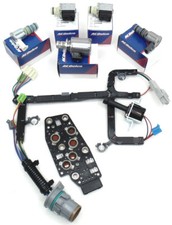
4L65E TCC Solenoid with Internal Wiring Harness (GM 24237980)
This is the exact assembly PIP5009G calls out for P0741 with a harsh 1-2 shift. Solenoid and internal harness together, so you are not reusing a 15-year-old harness with fatigued terminals behind a new solenoid. Check your solenoid date code first — if it is 4172 or later it has already been updated.
View the 4L65E TCC solenoid and harness →Need the valve body side too? See the TCC regulator valve and isolator sleeve kit (Sonnax 77754-04K).
The Scan Tool Sequence That Saves the Converter
Before the pan comes down, drive it and watch data. Four PIDs matter.
- TCC Slip Speed — engine RPM minus input speed sensor RPM. At steady cruise with the clutch applied, you want 20 to 40 RPM. Anything sitting north of 100 RPM is a circuit that is losing pressure even though the code has not tripped yet.
- TCC PWM Solenoid Duty Cycle — the most useful number on this transmission. Under EC3, duty should climb in steps to roughly 50 percent to establish apply and hold the slip window there. Sonnax gives the diagnostic tell directly: a low-mileage unit averaging around 79 percent duty is a PCM compensating for circuit wear, most likely in the regulator bore. It has not set a code. It is going to.
- Trans Fluid Temp — note whether the slip appears only when hot. A fault that only shows above about 180 degrees F is a clearance that opens as the aluminum grows and the fluid thins, which points at bore wear or a seal, not at electronics.
- Trans ISS and OSS — graph both. If gear ratio is also wrong, you have a slipping clutch pack in addition to a converter clutch problem, and the priority changes.
Do this before you commission any parts. A unit that holds 25 RPM of slip at 48 percent duty has a healthy circuit and a converter you should not touch. A unit that needs 80 percent duty to hold 150 RPM of slip has a leak, and now you are looking for where.
4L65E TCC enable solenoids and internal harnesses, PWM lock-up solenoids, TCC regulator and isolator kits, converters, pump bearings and DEXRON VI — shipped fast from the USA.
Shop 4L65E parts →The Restricted Feed Orifice, and Why Low Mileage Does Not Rule It Out
A restricted separator plate solenoid feed orifice is on the documented cause list, and it is the one that makes a good tech doubt himself. There is no electrical fault. Solenoid resistance is in spec. The valve body bores vacuum test fine. The converter is new. And the clutch still will not hold.
A partially blocked feed orifice starves the apply circuit of volume without producing a single code on the electrical side. Hold the plate up to a light. Look at the TCC feed orifice specifically, not just the shift solenoid feeds. If there is any question, replace the plate rather than trying to clean it — drilling or picking at a calibrated orifice changes the calibration, and you will not get it back.
This failure shows up on genuinely low-mileage units. GM has documented the same class of problem in the pump-side TCC apply fluid orifice on this family, calling out units under about 5,000 miles specifically. If a fresh rebuild came back with P0741, look at the plate before you look at anything else you installed.
Cross Leaks: Pump Bearing Seal and Turbine Shaft Rings
Two of the seven causes are seals, and they are the two that require the unit to come out.
The converter apply and release circuits both run through the pump and the turbine shaft. A damaged pump bearing seal, or worn channel plate sleeve and turbine shaft sealing rings, let apply pressure cross-leak into the release circuit. The result on the scan tool looks identical to a worn valve bore: high duty cycle, high slip, code sets. The difference is that no amount of valve body work will fix it.
This is why the order matters. Confirm the accessible items first — solenoid, harness, converter clutch valve stroke, separator plate, valve body bores. If those are all good and the slip is still there, then you are pulling the unit, and you inspect the turbine shaft sealing rings and the pump bearing area while it is on the bench. Do not pull it first and guess.
Vacuum Test the Bores Before You Reassemble
If the valve body is off, vacuum testing is the only honest way to know whether a bore is worn. Sonnax publishes a vacuum test guide for the 4L60-E, 4L65-E and 4L70-E showing the critical wear areas and exact test locations. Low vacuum at a port means wear, and the guide names the Sonnax part for each one.
For the TCC circuit specifically, the guide flags the TCC regulator valve with the symptom set of code 894 and 1870, low line pressure, overheated converter, low TCC apply pressure, burnt 3-4 clutch and harsh 1-2 shift. Note how many of those the customer might be describing instead of, or alongside, the lockup complaint. One worn bore produces a spread of symptoms that look like five different problems.
Test the isolator end of that bore too. Sonnax engineer Tory Royce points out that many builders assume kit 77754-04K restores the whole bore, when on a high-mileage unit the isolator section can be worn as well. The lengthened isolator valve in the kit is designed to ride in unworn casting, but if that section is worn, the bore is oversized with reamer 77754-RM5 or tool kit F-77754-TL4 and isolator sleeve kit 77754-ISO goes in so the isolator valve also runs in a wear-resistant sleeve.
What not to do
There is a shop-floor shortcut where the TCC regulator valve gets blocked with a 700-R4 inner pump slide spring, converting the unit back to on/off lockup. The code goes away. So does the converter, eventually. Sonnax measured what that mod does: it admits full line pressure up to 140 psi into the apply circuit against an OE apply range of roughly 60 to 80 psi. The documented results are cracked or deformed TCC pistons, broken damper rivets, torsional driveline disturbance, damaged crankshaft bearings, harsh apply feel and friction lining delaminating from the piston. It also leaves the worn bore open to line pressure, so you have added a line pressure leak on top of everything else. It hides the wear. It does not fix it.
Fluid, Cooler and Reassembly
If the converter clutch has been slipping hard enough to set P0741, it has been generating heat and shedding friction material into the fluid. Per the Lubegard OEM ATF conversion chart, 2006-and-later 4L65-E applications specify DEXRON VI; earlier applications called for DEXRON III with DEXRON VI accepted as the replacement. Total capacity is listed at 11 quarts (10.6 liters), with roughly 5 quarts (4.7 liters) for a pan and filter service.
Flush and flow-test the cooler before the fill. GM makes this point explicitly in its P0741 guidance for other units in the lineup: loose converter clutch friction material can pass through the pump and score it, dropping line pressure and distressing clutches downstream. A cooler that is still holding debris will feed it straight back into a fresh repair. Replace the filter, flush the cooler, verify flow, then fill.
After the repair, clear the code and drive it through a full apply cycle at steady cruise. You are looking for duty cycle back near 50 percent with 20 to 40 RPM of slip. That is a fixed 4L65E. Anything higher is a leak you have not found yet.
FAQ
What exactly makes a 4L65E set P0741?
Sonnax documents the GM set logic as three conditions occurring together, twice during the same ignition cycle: TCC duty cycle greater than 50 percent, and TCC slip speed greater than 180 RPM, held for 7 seconds. Because an EC3 4L65E deliberately runs 20 to 40 RPM of commanded slip at cruise, the code needs roughly four to five times normal slip before it will set. That is why P0741 is a late warning, not an early one.
Is P0741 on a 4L65E the same thing as P1870?
They describe the same failure through different code sets. P1870 is a GM manufacturer-specific code for transmission component slipping, while P0741 is the generic OBD-II code for TCC stuck off. Sonnax notes that some late-model 4L60-E family units will set P1870 or P0741 depending on how the computer is programmed, and that P0741 sets for all the same reasons P1870 does. Diagnose them the same way.
Do I have to drop the transmission to fix P0741 on a 4L65E?
Often not. The TCC enable solenoid, the internal wiring harness, the separator plate feed orifice and the valve body TCC regulator and isolator bores are all reachable with the pan down and the unit in the vehicle. The converter clutch valve in the pump cover, the pump bearing seal and the turbine shaft sealing rings are not, so confirm the accessible items first before you plan a removal.
Can a restricted orifice in the separator plate set P0741?
Yes, and it is a common miss. Sonnax lists a restricted separator plate solenoid feed orifice among the known causes of P0741. GM has documented the same class of problem in the pump-side TCC apply fluid orifice on this family, specifically on low-mileage units under about 5,000 miles. A partially blocked orifice starves apply pressure without producing a single electrical fault.
What fluid and how much does a 4L65E take after this repair?
Per the Lubegard OEM ATF conversion chart, 2006-and-later 4L65-E applications specify DEXRON VI, and earlier applications called for DEXRON III with DEXRON VI accepted as the replacement. Total capacity is listed at 11 quarts, about 10.6 liters, with roughly 5 quarts, about 4.7 liters, for a pan and filter service. If the converter clutch has been slipping, flush and flow-test the cooler before you fill.
Sources
- Sonnax — Gregg Nader, "Beyond 1870: GM Converter Codes P0741, P0742 and 1887" (September 15, 2003). Backs the P0741 set conditions (TCC duty cycle greater than 50 percent, TCC slip speed greater than 180 RPM for 7 seconds, occurring twice during the same ignition cycle), the statement that P0741 sets for all the same reasons P1870 does, the relationship between the manufacturer-specific P1870 and generic P0741 on GM units, and the seven known causes: worn TCC valve bores, damaged or worn pump bearing seal, defective TCC PWM or TCC apply solenoids, restricted separator plate solenoid feed orifice, defective converter, computer reprogram, and channel plate sleeve and turbine shaft sealing ring damage. sonnax.com
- General Motors — Preliminary Information bulletin PIP5009G, November 2012 (hosted by NHTSA). Backs the bulletin number and date, the five-step P0741 procedure, the instruction to stroke the converter clutch valve (224) in the pump cover and the 3/8 inch minimum free stroke specification, retaining ring (222) and valve stop (223) removal for access, TCC enable solenoid and internal wiring harness part number 24237980, the P0741-with-harsh-1-2-shift complaint, and the five-digit solenoid date code rule that anything produced on or after April 17, 2012 (date code 4172 or greater) does not need replacement. static.nhtsa.gov
- Sonnax — "20 Years Later: What's New with 4L60-E PWM Modifications" (December 9, 2014). Backs the PWM and EC3 control history on this family, the EC3 target of 20 to 40 RPM commanded slip, duty cycle raised in rapid steps to about 50 percent to establish apply and to 98 percent for full lock under high load, the 79 percent average duty cycle on a low-mileage unit as evidence of regulator bore wear, and the consequences of blocking the TCC regulator valve with a 700-R4 inner pump slide spring: full line pressure up to 140 psi against an OE apply range of about 60 to 80 psi, cracked or deformed TCC pistons, broken damper rivets, torsional driveline disturbance, damaged crankshaft bearings, harsh apply and delaminated friction linings. sonnax.com
- Sonnax — Tory Royce, "Understanding 4L60-E Series Isolator Bore Wear & How to Address It" (January 27, 2025). Backs that constant oscillation of the TCC regulator and isolator valves wears the aluminum valve body casting and allows apply pressure to exhaust, that 20 to 40 RPM of TCC slip is normal EC3 operation, that many builders wrongly assume kit 77754-04K restores the entire bore, that isolator-section casting wear is detectable by vacuum testing, and the repair path of oversizing the bore with reamer 77754-RM5 or tool kit F-77754-TL4 and installing isolator sleeve kit 77754-ISO. sonnax.com
- Sonnax — "GM 4L60-E, 4L65-E, 4L70-E Vacuum Test Guide" (January 21, 2013) and TCC Regulator & Isolator Valve Kit 77754-04K part information. Backs the vacuum test methodology and critical wear area locations for this valve body, that a low vacuum reading indicates wear, the TCC regulator valve symptom set of code 894 and 1870, overheated converter, low TCC apply pressure, burnt 3-4 clutch, harsh 1-2 shift and low line pressure, and the kit contents (isolator valve, spring, regulator valve, regulator sleeve) with fitment for all years including 1998-later EC3 units. sonnax.com • 77754-04K part page
- Lubegard — OEM ATF and Conversion Chart, 12th Edition. Backs the 4L65-E fluid specification and capacities: DEXRON VI as the specified fill for 2006-and-later 4L65-E applications, DEXRON III with DEXRON VI accepted on earlier applications, a total capacity of 11 quarts (10.6 liters), and roughly 5 quarts (4.7 liters) for a pan and filter service. lubegard.com