The complaint usually walks in before the code does. The truck drives fine, then it dies coming off the highway ramp. Restart it, ease into traffic, and it dies again at the next light. The customer is convinced it is an engine problem. It is not. On a 4L65E that is the torque converter clutch refusing to release, and the PCM will eventually stamp P0742: TCC System Stuck On on it.
The 4L65E is the heavy-duty branch of the 4L60E family — RPO M32, five-pinion planets, a seven-plate 3-4 clutch pack, and a career behind 6.0L and 8.1L engines in 2500-series trucks, Escalades, H2s and the Trailblazer SS. It shares the 4L60E pump, valve body layout and solenoid lineup, so it shares this code and its causes exactly.
P0742 has two completely separate root causes — one electrical, one hydraulic — that produce identical symptoms from the driver's seat. Guess wrong and you buy a converter you did not need.
What Actually Sets P0742
GM publishes the setting criteria in its Mode $06 transmission diagnostic parameter tables. The 2005 4L60-E family table — covering Silverado, Sierra, Tahoe, Yukon, Suburban, Avalanche, Escalade, Express, Savana and the Hummer H2 with the 4.3L LU3, 4.8L LR4, 5.3L LM7/L59/L33 and 6.0L LQ4 — is the same PCM strategy the 4L65E runs behind those engines. Here is the real definition, not a code-book paraphrase:
- Sensed parameter: TCC System Stuck ON, signal type software. GM's own wording: "This DTC detects low torque converter slip when the TCC is commanded off."
- Primary detection: TCC slip of -20 to +20 RPM, with a fail counter of 2 or more.
- Fail monitoring: 5 seconds, checked continuously. DTC Type B, so it takes two trips to command the MIL on.
The enable conditions matter as much as the trip point, because they tell you how to reproduce the fault on a road test. Per the same table, the monitor only runs when:
- Engine speed is above 450 RPM for 6 seconds and the engine is not in fuel cutoff
- Gear range is D4, commanded gear is not 1st, and there has been no range change within 5 seconds
- Engine speed is 1000 to 3000 RPM and vehicle speed is 15 to 50 mph
- Throttle position is 17 to 45 percent, engine torque is 50 to 400 ft-lbs, vacuum is 0 to 105 kPa
- Transmission temperature is 20 C to 130 C (68 F to 266 F)
- Speed ratio is 0.64 to 1.35, and the TCC is commanded off
- No TP, VSS, PSA, TCC enable solenoid or TCC control solenoid DTCs are already set, and there is no engine torque default
Read that last line twice. If a solenoid electrical code is already stored, the P0742 monitor is disabled entirely. Repair the electrical code first, clear it, then road test again, or you are chasing a symptom the PCM has stopped watching for.
Why the -20 to +20 RPM window is the whole story
The 4L65E runs an EC3 converter clutch strategy, and EC3 is not a lockup switch. Sonnax describes the intent plainly: under most conditions the PCM aims for a consistent slip of about 20 to 40 RPM rather than full lock, pushing duty cycle to 98 percent only under high torque or sustained freeway load. A healthy 4L65E almost never shows zero slip.
So P0742 is not saying "the clutch is applied." It is saying slip has collapsed to essentially nothing while the clutch is commanded off — the engine and the turbine are turning as one solid piece. That is a mechanical lock, and it is why the engine stalls when the driveshaft stops.
P0742 vs P0741 vs P1870
These three get muddled constantly, and they point in opposite directions:
- P0741, TCC stuck off. High slip with the clutch commanded on. Sonnax names worn TCC valve bores, a damaged pump bearing seal, defective TCC PWM or apply solenoids, a restricted separator plate solenoid feed orifice, a defective converter, or a needed PCM reprogram.
- P1870, transmission component slipping. The older GM-specific slip code on this family, and the classic fingerprint of TCC regulator valve bore wear letting apply pressure exhaust.
- P0742, TCC stuck on. The opposite fault. Sonnax's list of known causes for all GM units is short and specific: a sticking TCC apply valve, or a defective TCC PWM or TCC apply solenoid.
Two causes. One hydraulic, one electrical, and there is a road test that separates them in about ten minutes.
Cause 1: The Apply Valve in the Pump Strokes Itself Into Lockup
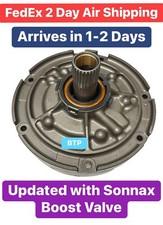
This is the one that catches people, because on the 4L60E family the TCC apply valve lives in the pump, not the valve body. You can rebuild a valve body, install every kit in the catalog, and never touch the valve causing the problem.
The mechanism, per Sonnax's writeup on the 4L60-E, 4L65-E and 4L70-E apply valve: excess pump bore-to-valve clearance lets converter feed oil leak past the OE spool. That leaked feed oil combines with the orificed signal oil already in the circuit, and the total is more than the solenoid can exhaust. The solenoid ends up with no control over the valve's position at all. The valve strokes fully into the lockup position and stays there, which Sonnax describes as creating a "no power" or "no brake cancel" condition — precisely what your customer is describing when the truck dies at the light.
There is a meaner version of the same wear: if the cross-leak floats the valve to a mid-way position instead of stroking it fully, it restricts cooler flow. The converter cooks itself while the transmission still shifts normally, and you end up with a burned converter and no obvious cause.
One warning before ordering parts: this valve exists in PWM and non-PWM versions and they are not interchangeable. Sonnax is explicit that mismatching them causes rapid converter failure. Identify by spool count — a single spool at the identifying location means a PWM unit, double spools means non-PWM. Do not go by valve material; some early PWM pumps used steel valves like the non-PWM pumps did.
The builder modification that causes this on purpose
Ask what has already been done to the unit. There is a decades-old shop fix for TCC slip codes that blocks the TCC regulator valve with an inner pump slide spring from a 700-R4, converting the circuit back to on-off operation. It masks the slip code without repairing the bore wear behind it, and Sonnax has warned about the consequences for years: the modification lets full line pressure, up to 140 psi under load, into the apply circuit, against an OE apply range of roughly 60 to 80 psi. Documented results include cracked or deformed TCC pistons, broken damper rivets, harsh apply, lining delamination and converter failure. At least one aftermarket kit mimics the same approach. If a converter was replaced recently and the code came back, check this first — a perfectly built converter will fail behind an improperly modified transmission.
Cause 2: The Solenoid, or the Wire Feeding It
The other half of the Sonnax list is a defective TCC PWM or TCC apply solenoid, and it shows up two ways.
Mechanically stuck. Debris from a previous failure, varnish, or a swollen seal holds the solenoid open. It passes an ohm test perfectly and still will not release, which is why a resistance reading alone never clears a solenoid on this code.
Electrically energized full time. This one is invisible on a scan tool. Per the ATRA GEARS writeup of the 4L60-E solenoid circuit, power comes from the ignition switch through the 10-amp ING 0 fuse in the I/P fuse block to the case connector, where it feeds the TCC, TCC PWM, 1-2, 2-3 and 3-2 solenoids on a shared feed. The PCM does not supply power — it supplies the ground, and switches that ground to control each solenoid.
So a TCC control wire chafed and shorted to ground anywhere between the case connector and the PCM gives that solenoid a permanent ground path. It is energized whenever the key is on, regardless of what the PCM commands: scan data shows TCC commanded off while the solenoid is fully applied, and slip sits at zero.
That failure has a favorite location. GEARS notes the classic damage point on this family is the harness pinched between the bellhousing and the engine block during installation, crimping the wires so they break open or short against the block. If this transmission was out of the vehicle recently, look there first.
Working a 4L65E this week?
TCC solenoids, PWM solenoids, internal wiring harnesses, pump apply valve kits, valve body parts, filters and DEXRON VI — the parts to fix P0742 properly, shipped from the USA.
Shop 4L65E parts →Diagnosis: Separate Hydraulic From Electrical Before You Open Anything
1. Verify the complaint, and watch the right PIDs
Get the transmission to operating temperature, then graph TCC Slip Speed (RPM), TCC Duty Cycle (%), TCC Enable Solenoid state, Engine Speed, Vehicle Speed, Commanded Gear and Transmission Fluid Temperature. Drive in D4 inside the GM enable window: 15 to 50 mph, 17 to 45 percent throttle, above 68 F fluid temperature. With TCC commanded off, healthy slip on an EC3 unit sits around 20 to 40 RPM at light cruise and climbs well above that on a coastdown. A slip reading near zero with the command off confirms P0742 rather than a wiring glitch.
While you are in the data, note the average duty cycle when the clutch is commanded on. Sonnax points out that this number is diagnostic gold: as the regulator bore wears, the PCM has to raise duty cycle to hold slip in range, so a low-mileage unit averaging 79 percent is telling you the circuit is already leaking even if no code has set yet. Apply normally begins around the 50 percent mark on a good unit.
2. The power-off test that splits the diagnosis
With the engine off, disconnect the transmission case connector so no solenoid in the unit can be electrically energized. Start the engine and drive gently — the transmission drops into failsafe, so expect third gear and Reverse only at maximum line pressure, and a fistful of codes afterward.
- If the engine still stalls at a stop with the connector unplugged, no solenoid is applying anything. The fault is hydraulic or mechanical: the pump apply valve, or a mechanically seized converter clutch.
- If it drives and stops normally with the connector unplugged, the hydraulics are releasing. The fault is on the electrical side: solenoid or control circuit.
A note on that connector, because it saves a callback. The ATRA procedure is to squeeze the two tabs toward each other and pull straight up — no screwdriver prying, and minimal twisting, which bends pins. To reinstall, line up the arrows on each half and push straight down without angling the halves until it clicks. Expect multiple DTCs if it is disconnected with the engine running, so clear codes when you are done.
3. Ohm the circuit, then chase the ground
Per ATRA Technical Bulletin 269, the TCC solenoid reads across case connector pins E and T at 20 to 40 ohms. Pin E is the shared feed for the shift, TCC and 3-2 solenoids, so if all of those read open while the pressure control solenoid on pins C and D reads fine, chase pin E rather than replacing four solenoids.
An in-spec reading does not clear the solenoid on this code. Follow it with a short-to-ground check on the TCC control circuit: disconnect both the PCM connector and the case connector, then measure from the control terminal to a known good chassis ground. Anything other than an open circuit is your fault. Wiggle the harness along the bellhousing while you watch the meter.
4. On the bench
If the power-off test pointed at hydraulics, the pump comes apart. Pull the TCC apply valve and inspect the bore for the polished, out-of-round wear that lets converter feed cross-leak. Vacuum testing is the fast, objective way to find it — Sonnax maps the critical wear areas and test locations for the 4L60-E, 4L65-E and 4L70-E. A low vacuum reading at the apply valve means wear, full stop.
While it is open, air-check the converter clutch apply and release circuits and inspect the TCC regulator and isolator bores in the valve body. Those bores are the source of this family's slip codes, and if the unit has been apart before, that is where a blocking modification would be sitting.
4L65E TCC Apply Valve Kit with PWM (Sonnax 77805E-K)
This is the exact repair for a pump apply valve that has cross-leaked itself into permanent lockup. The kit uses a PTFE-sealed replacement valve that stops converter feed and signal oil cross-leak, so the solenoid gets control of the valve back. PWM units only — check your spool count before ordering.
View the 4L65E TCC apply valve kit →Need the solenoid side instead? The 4L65E TCC solenoid with internal wiring harness covers the electrical repair, or browse the full 4L65E parts collection.
The Fix
- Repair the pump TCC apply valve bore when vacuum testing or inspection shows wear. A sealed replacement valve restores solenoid control of the circuit; a new solenoid in front of a worn bore does nothing.
- Replace the TCC and TCC PWM solenoids if either is mechanically stuck or out of the 20 to 40 ohm window. With the pan already down, doing both plus the filter is cheap insurance.
- Repair the control circuit if you found a short to ground. Replace the internal harness rather than splicing it, and route the external harness clear of the bellhousing pinch point on reassembly.
- Address the TCC regulator and isolator bores while the valve body is off, especially on a high-mileage unit. This is the family's known wear point and the reason units come back with slip codes six months later.
- Undo any regulator-valve blocking modification you find, and restore normal PWM or EC3 operation.
- Replace the converter only when the clutch is seized, the lining is delaminated, or the unit ran hot enough to cook it. Flush the cooler and lines either way if the fluid came out burned.
Fluid, capacity and torque
Refill with DEXRON VI. GM specifies DEXRON-VI for this family in the owner literature and it supersedes the older DEXRON III fill, so it is the right choice for any 4L65E on the bench today. GM lists the approximate service capacity for the four-speed 4L60-E and 4L70-E family at 5.0 quarts (4.7 L) — a pan-and-filter refill, not a dry fill. A rebuild with a new or flushed converter takes considerably more, so fill in stages and set the final level hot, in gear, on level ground.
Torque the valve body bolts to 89 to 106 in-lbs (roughly 8 to 9 ft-lbs) and snug the pan bolts evenly in a crisscross pattern. Overtightening distorts the separator plate and creates the exact cross-leaks you just repaired.
On the prevention side, the GM severe-service schedule calls for a fluid and filter change when GVWR is over 8,600 lbs, or with heavy city traffic at 90 F or higher, hilly terrain, frequent towing, or taxi, police and delivery use. That describes most trucks a 4L65E lives in, and clean fluid is what keeps debris out of the solenoid and the apply valve bore.
FAQ
What does P0742 mean on a 4L65E?
P0742 is TCC System Stuck On. GM's diagnostic table describes it as detecting low torque converter slip when the TCC is commanded off. The PCM watches TCC slip speed, and when slip collapses into a window of minus 20 to plus 20 RPM with the converter clutch commanded off, it counts a failure. Two counts and the code sets. It is a statement about slip, not about wiring.
Why does my truck stall when I come to a stop with P0742?
Because the converter clutch is mechanically locking the engine to the input shaft and will not let go. With the clutch applied there is no fluid coupling left to absorb the difference between engine speed and a stopped driveshaft, so the engine gets dragged down to zero the same way it would if you stopped a manual transmission car without pushing the clutch pedal in. Sonnax calls the hydraulic version of this a no power or no brake cancel condition.
Is P0742 the solenoid or the valve body?
Sonnax lists two known causes for P0742 across GM units: a sticking TCC apply valve, and a defective TCC PWM or TCC apply solenoid. On the 4L60E family the apply valve lives in the pump, not the valve body, and bore wear there lets converter feed oil leak past the spool. Combined with orificed signal oil that is more than the solenoid can exhaust, the valve strokes fully into lockup no matter what the PCM commands.
Can a shift kit or TCC modification cause P0742?
It can. A long-standing shop modification blocks the TCC regulator valve with an inner pump slide spring from a 700-R4 to mask slip codes, which converts the circuit back to on-off operation and lets full line pressure, up to 140 psi under load, into the apply circuit against an OE range of roughly 60 to 80 psi. Sonnax documents cracked and deformed TCC pistons, broken damper rivets and lining delamination from that pressure. Always ask what was done to a unit before you condemn parts.
Do I have to replace the torque converter for P0742?
Not automatically. Replace it when the clutch itself is mechanically seized or the lining has delaminated, or when the unit ran locked and overheated long enough to cook it. If the fault turns out to be a worn pump apply valve bore, a stuck solenoid or a shorted control wire, a new converter installed behind the untouched cause simply locks up again. Find the cause first, then decide on the converter.
4L65E TCC and PWM solenoids, internal harnesses, pump apply valve kits, valve body components, filters and DEXRON VI — shipped fast from the USA.
Shop 4L65E parts →Sources
- General Motors Service Parts Operations — 2005 4L60-E Transmission Diagnostic Parameters (Mode $06). Backs the P0742 definition and every setting figure quoted above: "TCC System Stuck ON," software-detected, "This DTC detects low torque converter slip when the TCC is commanded off," primary detection of TCC slip -20 to +20 RPM with fail counter greater than or equal to 2, 5-second continuous fail monitoring, DTC Type B, and the full secondary enable list (D4, commanded gear not 1st, 1000-3000 RPM, 15-50 mph, 17-45 percent throttle, 50-400 ft-lbs engine torque, 20-130 C, speed ratio 0.64-1.35, TCC commanded off, no TP/VSS/PSA/TCC solenoid DTCs set). Also backs the engine and vehicle application list. gsitlc.ext.gm.com
- Sonnax (Gregg Nader, TASC Force) — "Beyond 1870: GM Converter Codes P0741, P0742 and 1887." Backs the P0742 description for all GM units ("when the PCM detects low slip speed with TCC commanded off") and its two known causes: sticking TCC apply valve, and defective TCC PWM or TCC apply solenoid. Also backs the P0741 cause list used in the code-comparison section, including worn TCC valve bores, pump bearing seal damage, restricted separator plate solenoid feed orifice and channel plate sleeve or turbine shaft sealing ring damage. sonnax.com
- Sonnax — TCC Apply Valve Kit 77805E-K (GM 4L60-E, 4L65-E, 4L70-E). Backs the pump apply valve mechanism: excess pump bore-to-valve clearance lets converter feed oil leak past the OE spool, which added to orificed signal oil is more than the solenoid can exhaust, leaving the solenoid with no control over valve position and stroking the valve fully into lockup to create a "no power" or "no brake cancel" condition; and that cross-leaks may float the valve mid-way and restrict cooler flow, burning the converter. Also backs the PWM versus non-PWM identification by spool count and the warning that mismatching them causes rapid converter failure. sonnax.com
- Sonnax — "20 Years Later: What's New with 4L60-E PWM Modifications." Backs the EC3 control description (about 20 to 40 RPM of commanded slip under most conditions, duty cycle raised in steps to around 50 percent for apply and to 98 percent for full lock under high load), the diagnostic value of a rising average duty cycle as regulator bore wear, and the 700-R4 pump-slide-spring blocking modification that admits full line pressure up to 140 psi against an OE apply range of about 60 to 80 psi, with the resulting cracked or deformed TCC pistons, broken damper rivets, torsional disturbance, lining delamination and converter failure. sonnax.com
- ATRA / GEARS Magazine (Mike Brown) — "A Logical Approach to Solenoid Circuit Testing." Backs the 4L60-E family solenoid circuit architecture used in the electrical section: power from the ignition switch through the 10-amp ING 0 fuse in the I/P fuse block to the case connector, feeding the TCC, TCC PWM, 1-2, 2-3 and 3-2 solenoids on a shared feed with the computer supplying the switched ground; the note that a solenoid code can hide other circuit faults because the computer stops checking after the first one; and the harness-pinched-between-bellhousing-and-block failure that breaks or shorts the wires. gearsmagazine.com
- ATRA — Technical Bulletin 269, "GM 4L60-E Solenoid/Switch Resistances." Backs the TCC solenoid resistance specification of 20 to 40 ohms across case connector pins E and T, the shared pin E feed, the pressure control solenoid reference on pins C and D, and the pass-through connector removal and installation procedure including the warning that multiple DTCs set if it is disconnected with the engine running. atracom.blob.core.windows.net
- General Motors — 2007 Chevrolet Silverado Owner Manual. Backs the fluid and service figures: DEXRON-VI automatic transmission fluid as the specified fill, an approximate capacity of 5.0 quarts (4.7 L) for the four-speed 4L60-E and 4L70-E family, and the severe-service condition list that calls for a fluid and filter change (GVWR over 8,600 lbs, heavy city traffic at 90 F or higher, hilly or mountainous terrain, frequent trailer towing, taxi, police or delivery use). assets.gm.com