P0751 is the code that gets the most solenoids thrown at it and the fewest of them fixed. It reads Shift Solenoid A Performance or Stuck Off, and the word that matters is performance. The PCM did not find a bad coil. It commanded solenoid A to change state, watched the gear ratio, and the ratio did not follow the command.
On a 4L65E — RPO M32, the heavy-duty branch of the 4L60E family with five-pinion planets and a stronger input shaft, running behind 6.0L and 8.1L engines in 2500-series trucks, Escalades, H2s and the Trailblazer SS — that mismatch is more often hydraulic than electrical. The solenoid can be perfect and still throw P0751 if the oil that operates it never arrives, or if the valve it is supposed to move is sitting in a worn bore.
The circuit and valve body are shared with the lighter unit, so the companion piece on 4L60E P0751 covers the same code from the 4L60E side.
What Shift Solenoid A Actually Does
The 4L65E uses two on/off shift solenoids and a pulsed EPC solenoid. Per ATRA's Testing Electronic Transmissions chapter on the 4L60E family, the solenoids receive power any time the key is on, and the computer supplies ground to energize them. That detail matters for diagnosis: you are looking for a ground the computer pulls, not a feed it sends.
ATRA publishes the state table, and it is worth memorizing because it explains every symptom this code produces:
- First gear — both shift solenoids receive ground. Solenoid A is ON.
- Second gear — the computer releases ground from solenoid A. Only B is grounded. Solenoid A is OFF.
- Third gear — the computer releases ground from solenoid B. Neither is grounded.
- Fourth gear — the computer supplies ground only to solenoid A. Solenoid A is ON again.
Read that column again. Solenoid A is energized in first and in fourth, and de-energized in second and third. That is why a genuinely stuck-off solenoid A gives you the classic pair of complaints: it starts off in second gear, and it never gets fourth. The unit is effectively a two-speed stuck between the two states where solenoid A is supposed to be off.
It also explains why P0751 and P0753 are not interchangeable. P0753 is Shift Solenoid A Electrical — the PCM sees a circuit problem in the coil, the wiring or the driver. P0751 is performance: the electrical side looked acceptable, but the mechanical result did not match. Two different codes, two different diagnostic paths. If you have both, chase the electrical one first.
The Detail That Explains Second-Gear Starts
Here is the piece most people miss, and it is the single most useful fact in a 4L65E second-gear-start diagnosis.
Writing in Transmission Digest, ATSG's Wayne Colonna lays it out plainly: the 4L60-E valve body is in second gear by default when the engine is off. Once the engine starts and line and AFL pressure build, the 1-2 shift valve gets stroked into the first-gear position. It takes roughly 48 psi to overcome the 1-2 shift valve spring. Any deficiency that lets pressure sit below that threshold produces second-gear starts.
So the unit does not fall into second gear when something breaks. Second gear is where it already lives. First gear has to be actively created by adequate pressure moving a valve, and a stuck-off solenoid A is only one of several ways to fail to create it.
In the case Colonna documents, the technician had already replaced both shift solenoids, swapped in a complete replacement valve body, and enlarged the solenoid feed orifices in the spacer plate to .035 in. The second-gear start survived all of it. Line pressure checked out at 62 psi in Drive, which ruled out the pressure and AFL side. The actual fault was a missing rubber seal on the 1-2 accumulator piston, letting accumulator pressure feed past into the band apply circuit. One seal fixed a job that had already consumed a valve body.
The lesson for P0751 work is simple: parts do not diagnose this code. Pressure and ratio data do.
The Three Root Causes, Ranked
1. Actuator feed limit valve bore wear
This is the one that turns a routine solenoid job into a comeback. Shift solenoids do not run on line pressure directly. They run on a regulated feed produced by the actuator feed limit (AFL) valve.
Per Sonnax's hydraulics fundamentals work on AFL and solenoid modulator valves, in the GM 4L60-E family line pressure is regulated to approximately 115 psi and fed to the shift solenoids, the pressure control solenoid, the TCC solenoid, the 3-2 control solenoid, and the 2-3 shift valve lineup. Every solenoid in the unit drinks from that one circuit.
The OE AFL valve has a large reaction area on its spring end. Sonnax notes that this makes the valve highly susceptible to side-loading, which wears the aluminum bore, and that the EPC solenoid oscillating the torque signal and AFL oil increases valve action further. As the bore wear increases, oil pressure is reduced to the shift solenoids, which causes solenoid and ratio codes — Sonnax lists "solenoid performance codes," "wrong gear starts," "2nd Gear starts," "no 4th" and "erratic line pressure" as the symptom set for this exact wear. That is a description of P0751 written from the hydraulic side.
A starved solenoid cannot do its job no matter how good the coil ohms out. On a high-mileage 4L65E, check what feeds the solenoid before you condemn it.
2. 1-2 shift valve bore wear
Sonnax's vacuum test guide for the 4L60-E, 4L65-E and 4L70-E lists the symptoms tied to the 1-2 shift valve bore specifically as wrong gear starts and gear ratio codes. That is the second half of the P0751 picture. Solenoid A can be commanded correctly and receive full feed pressure, and the shift still will not happen if the valve it controls is leaking past a worn casting bore.
3. The solenoid, the harness, and the case connector
Sometimes it really is the solenoid, and on a unit with a hundred-plus thousand miles and neglected fluid, a shift solenoid that sticks intermittently is a legitimate finding. But the internal wiring harness and the pass-through case connector fail at a similar rate on this family, and a high-resistance joint at the connector reads exactly like a dying solenoid from outside the case.
Diagnosis: Data First, Pan Second
Step 1 — Read the codes as a set
P0751 rarely travels alone, and its companions tell you where to look:
- P0751 alone — solenoid A commanded but ratio did not follow. Hydraulic or mechanical bias.
- P0751 plus P0753 — the electrical fault is the parent. Fix the circuit and re-evaluate.
- P0751 plus P0756 (solenoid B performance) — both shift solenoids underperforming at once points hard at the shared feed, meaning AFL pressure, not two dead solenoids.
- P0751 plus ratio codes (P0731 through P0734) — corroborates a real gear-ratio mismatch rather than a marginal circuit.
Step 2 — Watch the PIDs on a road test
Before anything comes apart, log these with the scan tool:
- Commanded Gear vs Actual/Calculated Gear — the exact comparison that sets the code. Note the throttle position and vehicle speed at the moment they diverge.
- Shift Solenoid A (1-2 SS) commanded state — confirm the PCM is actually commanding the change. If it never commands the shift, you have an input problem, not a solenoid problem.
- Output Shaft Speed (and Input/Turbine Speed where the application has it) — the ratio math lives here.
- Transmission Fluid Temperature — note whether the fault is cold-only, hot-only, or both. A fault that only appears hot points at clearance and leakage, which means bore wear.
- Throttle Position — solenoid performance faults that only appear at high load are pressure faults.
The 4L60-E family gear ratios are 3.06 first, 1.63 second, 1.00 third, 0.70 fourth. A ratio that parks near 1.63 from a standstill is a second-gear start, and that is your confirmation that the unit never made first — consistent with either a stuck-off solenoid A or a pressure deficiency below the 48 psi the 1-2 shift valve needs.
Step 3 — Ohm the circuit at the case connector
ATRA Technical Bulletin 269 publishes the GM 4L60-E case connector map, and it isolates this fault without dropping the pan. Per bulletin 269:
- 1-2 shift solenoid (A) — pins E and A, 20 to 40 ohms
- 2-3 shift solenoid (B) — pins E and B, 20 to 40 ohms
- TCC solenoid — pins E and T, 20 to 40 ohms
- 3-2 control solenoid — pins E and S, 9 to 14 ohms
- Pressure control solenoid — pins C and D, 3.5 to 8.0 ohms
- Output/vehicle speed sensor — 1,260 to 1,540 ohms
Pin E is the shared feed for the shift, TCC and 3-2 solenoids. If several of those circuits read open at once, chase pin E instead of buying four solenoids. And if solenoid A reads a healthy 20 to 40 ohms here, you have just eliminated the part most people would have replaced first.
Step 4 — Use a voltmeter, not a testlight
ATRA's GEARS Magazine is blunt about this in its solenoid circuit testing walkthrough, and it is worth repeating: never use a testlight to diagnose electrical problems on computer circuits. Testlights will illuminate on as little as eight volts, some on less — well below what a shift solenoid needs to function properly. A testlight will show you a "good" circuit that cannot actually operate the solenoid. Always use a voltmeter.
The broader point in that article: a solenoid code names a circuit, not a part. Power, ground, wiring, connections and even the computer live inside that circuit, and any of them can set the code.
Step 5 — Line pressure test
Tap the line pressure port and read it in Drive at idle and under load. Given the 48 psi threshold to stroke the 1-2 shift valve into first, this is not optional on a second-gear-start complaint. Low or unstable pressure sends you to the AFL valve, the pressure regulator and boost valve, and the pump before it sends you to a solenoid.
Step 6 — Vacuum test the valve body
With the valve body on the bench, vacuum testing tells you in seconds what a visual inspection cannot. Sonnax's guidance is that if 25 in-Hg is your no-leak sealed baseline, then the tests should read 25 in-Hg; a one-inch loss when stacking a second component is acceptable, but a bigger drop means the surface or the bore needs attention. Test the AFL valve and the 1-2 shift valve locations from the Sonnax 4L60-E/4L65-E/4L70-E guide. A low reading at either is your P0751.
Working a 4L65E this week?
Shift solenoids, internal wiring harnesses, case connectors, valve body components, filters and DEXRON VI — the parts to fix P0751 properly, shipped from the USA.
Shop 4L65E parts →The Fix
- Replace shift solenoid A only if it reads outside the 20 to 40 ohm window, sticks on a bench test, or fails to move oil under a commanded state change. Replace A and B together while the pan is down — they are the same part, and the second one is a few dollars against a second teardown.
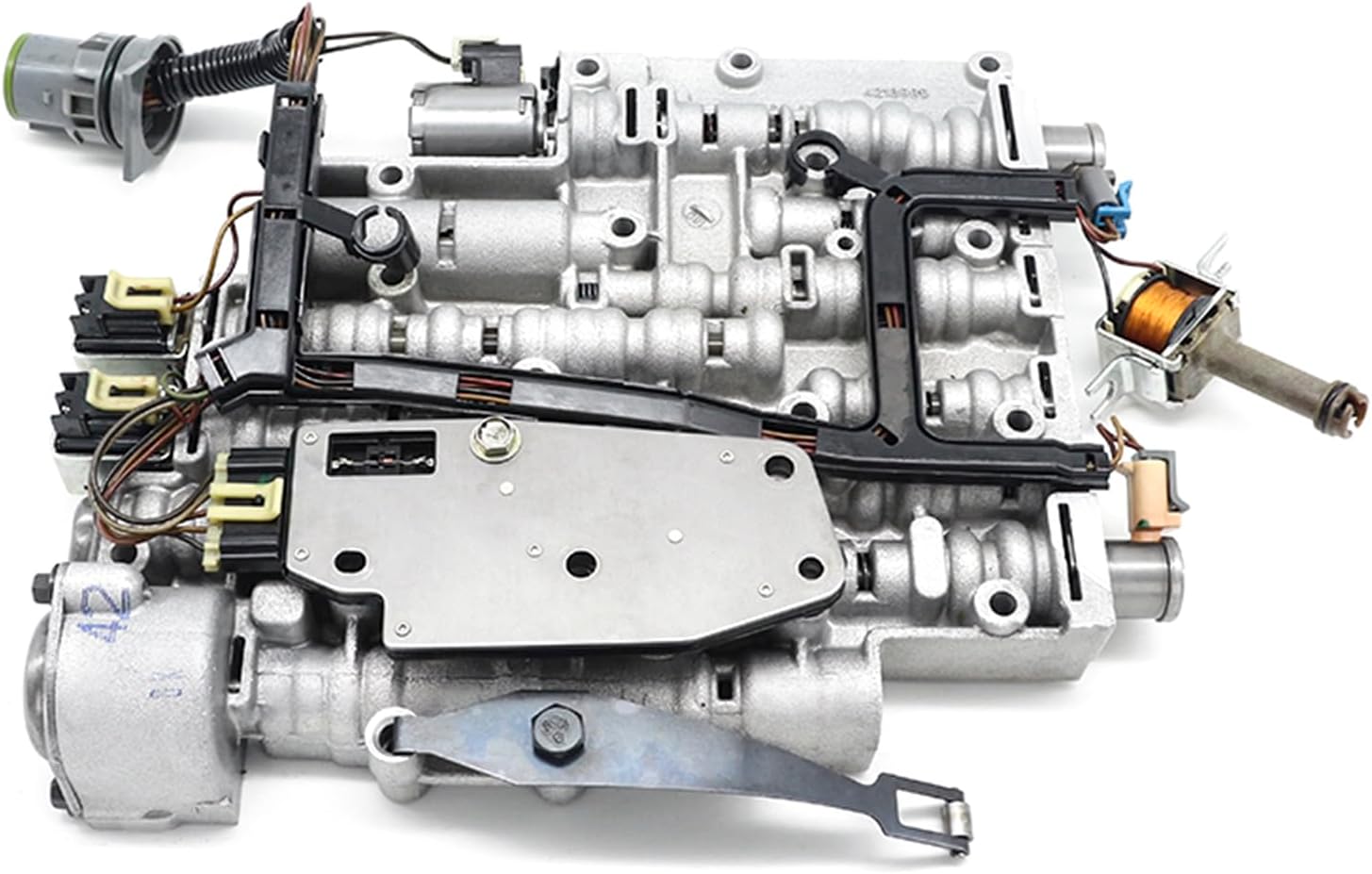
- Repair the AFL valve bore if vacuum testing shows leakage or line and feed pressures are low. Sonnax's kit for this family is 77754-09K, which uses a hardcoat anodized valve with annular grooves to resist side-loading and a full-contact sleeve that increases valve support by 54 percent. It requires tool kit 77754-TL. This is the step most often skipped on a repeat P0751.
- Repair the 1-2 shift valve bore if that location fails the vacuum test. Sonnax lists 77754-62K for the 1-2 shift valve, with tooling F-77754-TL62.
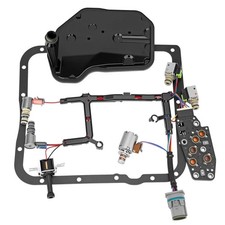
- Replace the internal wiring harness if terminals are damaged, insulation is chafed against the pan rail or valve body, or resistance differs between the solenoid and the case connector.
- Check the 1-2 accumulator piston and seal before you close it up, especially if the complaint includes a bind-up in manual low. A missing or cut seal feeds accumulator pressure into the band apply circuit and produces symptoms that survive every parts change you can throw at them.
- Refresh the case connector if the pass-through shows fluid intrusion, spread terminals or pushed-back pins.
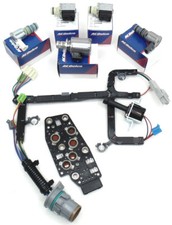
4L65E Shift Solenoid Kit (2006-2008)
The shift solenoid set for this repair, matched to the 4L65E. Check your year and connector style before ordering — the solenoid hardware changed across the 2001-2013 production run, so confirm the fit for your application first.
View the 4L65E shift solenoid kit →Different year, or need the valve body and filter too? Browse the full 4L65E parts collection.
Fluid, Capacity and Torque
Refill with DEXRON VI. GM moved this family to DEXRON VI and it is backward compatible with the older DEXRON III fill, so DEXRON VI is the correct choice for any 4L65E on the bench today. A pan drop and filter takes roughly 5 to 6 quarts; a full dry fill after a rebuild or converter swap runs about 11 to 12 quarts. Fill in stages and set the level hot, in gear, on level ground — verify against the service information for your specific year and application.
Torque valve body bolts to 89 to 106 in-lbs (about 8 to 9 ft-lbs) and snug the pan bolts evenly in a crisscross pattern. Overtightening distorts the separator plate and creates the exact cross-leaks you just went in to repair. After the work, clear codes and give the adaptive pressure logic a relearn cycle before you judge shift quality.
Keeping It Fixed
Everything that causes P0751 on a 4L65E traces back to heat and dirty fluid. Aluminum bores wear faster with contaminated oil moving through them at temperature, and a solenoid living in varnished fluid sticks sooner. These units sit behind big engines and often behind trailers, which is the duty cycle that gets fluid hot.
- Service fluid and filter on a real interval, not the severe-service asterisk. Tow duty is severe service.
- If the unit ran hot or came apart, flush or replace the cooler and lines. Debris returned from a dirty cooler will kill a fresh valve body.
- Address AFL and 1-2 shift valve bore wear at rebuild time on any high-mileage core, not after the comeback.
- Set line pressure and confirm it under load before the unit goes back in the truck.
FAQ
What does P0751 mean on a 4L65E?
P0751 is Shift Solenoid A Performance or Stuck Off. The PCM commanded shift solenoid A to change state, compared the resulting gear ratio against what it expected, and found a mismatch. It is not an electrical fault. The electrical version of this fault is P0753, Shift Solenoid A Electrical, and it follows a different diagnostic path.
What is the resistance spec for the 4L65E 1-2 shift solenoid?
ATRA Technical Bulletin 269 lists the GM 4L60-E family 1-2 shift solenoid at 20 to 40 ohms, measured across case connector pins E and A. The 2-3 shift solenoid on pins E and B carries the same 20 to 40 ohm spec. Pin E is the shared feed for the shift, TCC and 3-2 solenoids, so if several circuits read open at once, chase pin E rather than replacing multiple solenoids.
Why does my 4L65E start in second gear with P0751 set?
Because second gear is the valve body's default. As Transmission Digest documents for this family, the 4L60-E valve body sits in second gear with the engine off, and it takes about 48 psi of line and AFL pressure to stroke the 1-2 shift valve into first. A stuck-off solenoid A is one way to fail to make first gear, but so is any pressure deficiency that keeps the circuit below that threshold. Check line pressure before condemning the solenoid.
Can a bad solenoid A really be a good solenoid?
Frequently, yes. Sonnax documents that actuator feed limit valve bore wear reduces oil pressure to the shift solenoids and produces solenoid performance codes, wrong gear starts, second gear starts and no fourth. The AFL valve regulates the roughly 115 psi feed that every solenoid in the unit runs on. A solenoid starved of that feed will fail a performance test with a perfectly healthy coil.
Is it safe to drive a 4L65E with P0751?
Only far enough to get it somewhere it can be worked on. With solenoid A stuck off you lose first and fourth, which means launching in second and turning highway rpm with no overdrive. Both of those add heat, and heat is what kills these units. Get the ratio data and the pressure reading, then fix it.
4L65E shift solenoids, internal harnesses, case connectors, valve body components, filters and DEXRON VI — shipped fast from the USA.
Shop 4L65E parts →Sources
- ATRA — "Testing Electronic Transmissions," Chapter 3: GM's 4L60E Transmission Overview. Backs the solenoid state table used throughout this article: solenoids receive power with the key on and the computer supplies ground to energize them; both shift solenoids grounded in first; ground released from solenoid A for second; ground released from solenoid B for third; ground supplied only to solenoid A for fourth. atracom.blob.core.windows.net
- ATRA — Technical Bulletin 269, "GM 4L60-E Solenoid/Switch Resistances." Backs the case connector pin map and every resistance figure quoted: 1-2 shift solenoid on pins E and A and 2-3 on pins E and B at 20-40 ohms each, TCC solenoid on pins E and T at 20-40 ohms, 3-2 control solenoid on pins E and S at 9-14 ohms, pressure control solenoid on pins C and D at 3.5-8.0 ohms, and the output/vehicle speed sensor at 1,260-1,540 ohms. atracom.blob.core.windows.net
- Transmission Digest — Wayne Colonna, "Fixing 4L60-E 1-2 shift issues" (July 5, 2022). Backs that the 4L60-E valve body is in second gear by default with the engine off, that roughly 48 psi is required to overcome the 1-2 shift valve spring and stroke the valve into first, the 62 psi Drive-range line pressure reading that ruled out the pressure and AFL side on that case, the .035 in. spacer plate solenoid feed orifice detail, and the missing 1-2 accumulator piston seal that fed accumulator pressure into the band apply circuit. transmissiondigest.com
- Sonnax — "Hydraulics Fundamentals Part VII: AFL/Solenoid Modulator Valves." Backs that a worn or stuck AFL valve leads to solenoid codes, wrong gear starts, clutch and band failure and harsh or soft shifts; that GM 4L60-E line pressure is regulated at approximately 115 psi and fed to the shift solenoids, pressure control solenoid, TCC solenoid, 3-2 control solenoid and 2-3 shift valve lineup; and that the valve's large reaction area causes side-loading that wears the bore, leaving solenoid feed flooded or starved. sonnax.com
- Sonnax — Actuator Feed Limit Valve Kit 77754-09K (4L60-E, 4L65-E, 4L70-E). Backs the symptom list tied to AFL bore wear — wrong gear starts, solenoid performance codes, erratic line pressure, no fourth, harsh shifts and second gear starts — the stated cause that AFL bore wear results in low pressure at the shift and EPC solenoids, the note that EPC oscillation increases valve action, and the kit's hardcoat anodized valve, annular grooves and 54 percent additional support in a full contact sleeve, with tooling 77754-TL. sonnax.com
- Sonnax — "GM 4L60-E, 4L65-E, 4L70-E Vacuum Test Guide." Backs the 1-2 shift valve bore symptoms of wrong gear starts and gear ratio codes with repair part 77754-62K and tooling F-77754-TL62, the AFL valve test location and its 77754-09K repair, and the principle that a low vacuum reading at a test location indicates wear. sonnax.com
- GEARS Magazine (ATRA) — Mike Brown, "A Logical Approach to Solenoid Circuit Testing." Backs the warning never to use a testlight on computer circuits because testlights illuminate on as little as eight volts, well below what a shift solenoid needs to function, and the point that a solenoid DTC names a circuit — power, ground, wiring, connections and the computer included — rather than a single part. gearsmagazine.com