The 4L70E is the strongest four-speed GM built on the 4L60E case, and it shows up behind the 6.0L trucks and SUVs, the TrailBlazer SS and SSR, and a long list of 2006-and-later rear-drive applications carrying RPO M70. It shares its hydraulic layout, ratios and bellhousing with the 4L60E and 4L65E, so most of the failure list is inherited. What is not inherited is the input speed sensor, and a fair share of the 4L70E jobs that come back a second time come back because of it.
This is the honest failure list: what actually breaks, how to prove it, and what the fix is. Every spec and part number below is cited at the bottom.
The short version: the 4L70E fails in six repeatable ways — input speed sensor wiring and sealing (P0716/P0717, fluid out the vent), burnt 3-4 clutches from leaked 3rd gear oil, actuator feed limit bore wear that mimics everything, TCC isolator bore wear that cooks the converter, and a reaction sun shell that strips its splines. Five of the six are pressure or sealing faults, not worn friction material. Diagnose the leak before you buy clutches.
First, Know What Makes a 4L70E Different
If you treat a 4L70E as a 4L65E with a different tag, you will miss the two failures that are unique to it. The defining change is the input speed sensor, also called the turbine speed sensor, which lets the TCM read actual turbine RPM instead of inferring converter slip from engine speed and output speed. Adding it was not a bolt-on: GM redesigned the pump, the stator, the internal wiring harness and the input shaft to make room for the sensor and its rotor.
Two details matter on the bench. On the 2005 to 2006 transition units the input shaft rings were moved roughly 0.190 in. rearward so the rotor would clear, which is why input shafts do not swap freely across that break. And by late 2006 the unit carried a 15-pin case pass-through connector rather than the earlier count. Some 2006 units were built with an ISS rotor even in non-ISS applications, so the rotor alone does not prove what you have — the pump, harness and connector do.
The other difference is fluid. GM's Recommended Fluids and Lubricants table in the 2008 TrailBlazer owner manual lists the requirement as DEXRON-VI, full stop, and unlike an early 4L60E there is no DEXRON-III argument to have. A pan and filter takes about 5.0 qt (4.7 L); a dry overhaul with an empty converter runs closer to 10 to 11 qt.
Problem 1: P0716 or P0717 After a Rebuild
This is the 4L70E comeback. The unit goes back in, drives fine on the lot, and sets an input speed sensor performance code (P0716) or a low ISS circuit voltage code (P0717) a week later.
Per Transmission Digest, the cause is usually the ISS wiring not being properly secured in its locating brackets on the back of the pump assembly. The reverse input drum spins right next to that harness, and it will cut the wires off if they are left loose. The correction is nothing more than routing and securing the harness the way the brackets intend — but you only get that chance with the unit out.
There is a second, less obvious cause worth knowing before you pull a transmission over a code: the ISS ground circuit supplied by the TCM can be lost internally. Transmission Digest documents the field repair — splice into circuit 1984/1231, which runs from TCM terminal 45 to terminal V at the case connector, and ground it externally. If the sensor and its harness check out and the fault follows the TCM, that saves a unit removal.
Bench check before it goes in: harness seated in every bracket, nothing crossing the reverse input drum path, sensor bolted down. That last one leads straight to the next failure.
Problem 2: Fluid Pushing Out the Vent
A 4L70E that vents fluid after an overhaul, with no cooler restriction, no filter problem and no sign of cavitation, is usually not aerated at all. On this pump, the input speed sensor passage and the vent passage can be connected. Transmission Digest traces the complaint to the rebuilder either leaving the O-ring seal off the input speed sensor or leaving out the ISS retaining bolt, which lets the sensor work its way out of its bore. Pressurized fluid then takes the shortest path to the case vent, and a P0717 sets along with it.
The fix is the O-ring and the bolt. It earns its own section because the instinct on a venting transmission is always to pull fluid out and start looking at the cooler circuit. On a 4L70E, check the ISS sealing first.
Problem 3: Burnt 3-4 Clutch
The 3-4 clutch is the most common mechanical failure in the whole 4L60E family, and the 4L70E does not escape it. What separates a rebuilder from a parts changer here is understanding that the clutch is a victim. Sonnax puts it directly: low line pressure and leaks of 3rd gear oil are the root cause of most 3-4 slipping, and the 3-4 circuit interconnects with the D4, forward clutch, 2nd, 2nd clutch and 3rd accumulator circuits, so a pressure loss anywhere in that group shows up as a cooked 3-4 pack.
The leak paths worth testing, roughly in the order they pay off:
- Input housing checkball. Vacuum-test it. Sonnax calls for a minimum of 25 in-Hg; anything that will not hold that is leaking apply oil and will burn the pack.
- Housing bore to input shaft. Pour oil around the spline area, put the blow gun in the 3-4 feed port, block the input shaft sealing-ring feed hole, apply air and watch for bubbles. Galling or scratches in the housing bore means a new input housing, not a polish.
- Third accumulator checkball capsule. Sonnax names this the leading cause of failure in that circuit, and tells you to test new ones too. Never substitute a cup plug for the checkball — it kills the venting and gives you soft 2-3 shifts and flares.
- Stator support and bushings. Check the stator sleeve where the input shaft seal rings ride, confirm the sleeve has not rotated and blocked a feed hole, and replace the front and rear stator support bushings. Input shaft stability lives on those bushings.
- Pump halves and boost valve. Vacuum-test the boost valve and the pressure regulator valve, verify the pump slide moves freely when assembled dry, and wet air-test the 3-4 and forward passages for hairline cracks with the stator installed.
Two upgrades address the pack itself rather than the circuit: the weak OE backing plate flexes during apply and lets heat build unevenly, so fit a heavy-duty plate, and the OE return spring is very light, which is why Sonnax sells a 3-4 clutch boost spring (77763-01). For units that have already eaten a housing, the Smart-Tech input housing kit (77733-06KA) is the reman-grade answer.
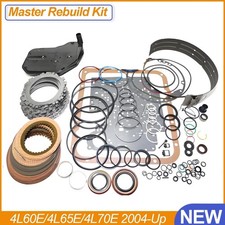
4L70E Master Transmission Rebuild Kit with Pistons
If the 3-4 pack is burnt, the frictions, steels, bonded pistons and seals go in as a set — there is no partial version of this job that lasts. This is the matched kit for a 4L70E overhaul.
See the 4L70E master rebuild kit →Problem 4: Actuator Feed Limit Valve Bore Wear
If a 4L70E has symptoms that do not add up — second-gear starts one day, a harsh shift the next, a ratio code after that — check the actuator feed limit valve before anything else. The AFL is the solenoid feed regulator: it takes line pressure and regulates it down to a controlled feed, typically in the 80 to 115 psi range, for the EPC solenoid and the shift solenoids.
The OE valve has a large reaction area and is highly affected by side-loading, which wears the aluminum bore oval. As the bore wears, feed pressure to the solenoids drops, and Sonnax lists the resulting complaints: second-gear starts, reduced 3-4 clutch life, band failure, clutch failure, harsh shifts, no 4th, solenoid codes and wrong-gear starts. The same loss pulls line pressure down with it. That is the diagnostic trap — a shift solenoid performance code here is usually a starved solenoid, not a failed one.
The fix is a corrected valve and a wear-resistant sleeve (Sonnax 77754-09K) reamed into the worn bore, which restores support and removes the side-loading that caused the wear. While you are in there, replace the AFL screen filter and the two additional AFL screens on the separator plate — they load up with debris and cause their own pressure drop.
Problem 5: TCC Shudder, Converter Heat and the Isolator Bore
The TCC regulator and isolator valves control converter clutch apply pressure. Starting with the EC3 controls of the late 1990s, the PWM system keeps those valves in constant oscillation in an aluminum valve body, and the casting wears progressively until apply pressure leaks away. Sonnax ties that wear to codes 894 and 1870, overheated converters, low TCC apply pressure and 3-4 clutch burnout — which is why this problem and Problem 3 keep showing up in the same unit.
The basic repair is the TCC regulator and isolator valve kit (77754-04K) with reamer 77754-RM5. The permanent version is to oversize the bore with that reamer or tool kit F-77754-TL4 and install the isolator sleeve kit (77754-ISO), which puts a wear-resistant sleeve in the casting instead of trusting aluminum a second time. One thing not to do: never simply block the TCC regulator or isolator valves to stop the leak. Recondition the bore.
Problem 6: The Reaction Sun Shell
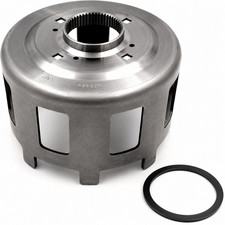
The reaction sun gear shell is the oldest weak spot in this family, carried straight over from the 700-R4. The splines wear down or strip out entirely, and when they go you lose the gears that depend on the shell. The classic complaint is a truck that pulls in some gears and freewheels in others with no clutch material in the pan to explain it.
The design problem behind it is the thrust path. In the OE shell, thrust load passes from the shell through the sun gear and overloads the small captured planetary bearing, which is why even thicker aftermarket shells kept killing rear planetary bearings. The Sonnax SmartShell (77749-02K) addresses both halves: an electron-beam-welded collar reinforces the hub area with a final machining pass for alignment, the shell splines and lugs are heat-treated, and a thrust bearing replaces the black plastic washer while a height-controlled roller clutch race reroutes thrust away from the captured planet bearing and sun gear.
If you are in the unit for any reason and the shell is original, replace it. Cheapest insurance on the parts list.
Bulletins Worth Pulling Before You Sell a Rebuild
Two GM bulletins cover complaints on this unit that are calibration or procedure issues rather than hardware. Confirm the current revision and the exact application list in GM service information or the NHTSA TSB lookup before you quote the job:
- 10-07-30-003 — harsh 1-2 shift at light throttle on 2007-2008 6.0L trucks and SUVs with the 4L70E, attributed to excessive adapt pressure in the lowest shift adapt cells (0 through 3), which cannot be viewed on a Tech 2. The published correction is a recalibration, not a teardown.
- 08-07-30-027 — no movement when the transmission is shifted into Drive or third, covering 2006-2008 GM trucks and SUVs with the 4L60E, 4L65E or 4L70E.
The first one will save you an argument. A light-throttle 1-2 bang on an otherwise healthy 2007 truck may be a known adapt condition, and no amount of valve body work fixes a calibration.
The Two Habits That Prevent Half of This List
Fluid first: licensed DEXRON-VI, at the right level. Filling a freshly overhauled unit with the five-quart pan figure is how you end up with no pressure on the first start — the dry number is 10 to 11 qt, converter included.
Debris control second. GM's own recommendation, repeated by Sonnax, is a second pan magnet specifically to protect the EPC solenoid from debris. On a unit whose entire pressure control runs through an EPC solenoid, an AFL valve and a set of screens, keeping steel out of that circuit is not optional.
4L70E master rebuild kits, sun shells, solenoid kits, valve bodies, pumps, input speed sensors and O-rings, filters and DEXRON-VI — shipped fast from the USA.
Shop 4L70E parts →FAQ
What is the difference between a 4L65E and a 4L70E?
The headline change is the input speed sensor. To fit it, GM redesigned the pump, the stator, the internal wiring harness and the input shaft, and on the 2005 to 2006 transition units the input shaft rings moved about 0.190 in. rearward to clear the sensor rotor. By late 2006 the unit carried a 15-pin case pass-through connector. Everything else, including the ratios and the valve body layout, is shared with the 4L65E.
What causes P0716 or P0717 on a 4L70E after a rebuild?
Nine times out of ten it is the input speed sensor harness, not the sensor. Transmission Digest documents the wiring not being seated in its locating brackets on the back of the pump, where the spinning reverse input drum then cuts into it. The other known cause is a loss of the ISS ground inside the TCM, which can be repaired externally by grounding circuit 1984/1231 between TCM terminal 45 and case connector terminal V.
Why is my 4L70E pushing fluid out of the vent?
On this unit the input speed sensor passage and the vent passage in the pump can be connected. If the ISS O-ring was left off, or the retaining bolt was not installed and the sensor walked out of its bore, pressurized fluid finds the case vent and a P0717 sets with it. Installing the O-ring and the bolt stops it. Do not start draining fluid to chase a vent leak on a 4L70E.
Why does a 4L70E burn the 3-4 clutch?
Because the 3-4 circuit is fed low or leaks down, not because the frictions were cheap. Sonnax states plainly that low line pressure and leaks of 3rd gear oil are the root cause of most 3-4 slipping, and the 3-4 circuit interconnects with the D4, forward clutch, 2nd, 2nd clutch and 3rd accumulator circuits. Fix the leak path first or the new clutch pack burns the same way.
Can you run DEXRON-III in a 4L70E?
No. The 4L70E is a 2006-and-later design that arrived with GM's move to DEXRON-VI, so it never had a DEXRON-III service fill to revert to. DEXRON-VI is backward compatible into older units, but the older fluids are not forward compatible into transmissions designed around DEXRON-VI. A pan and filter takes about 5.0 qt; a dry overhaul with an empty converter is closer to 10 to 11 qt.
Sources
- Sonnax — GM 4L70-E unit page, for the unit's catalogued complaint list (3-4 clutch burned, 2-4 band burned, no lockup, TCC slip, low line pressure, wrong gear starts) and the part numbers referenced here: SmartShell 77749-02K, 3-4 clutch boost spring 77763-01, Smart-Tech input housing kit 77733-06KA. sonnax.com/units/423-4l70-e
- Sonnax — "All Over the Map: Attacking 4L60-E Burnt 3-4 Clutches With Confidence," for the root-cause statement on 3rd gear oil leaks, the 25 in-Hg input housing checkball vacuum spec, the housing-bore air check, the 3rd accumulator checkball capsule warning, the OE backing plate and return spring weaknesses, and the second pan magnet recommendation. sonnax.com/tech_resources/659
- Sonnax — "Uncovering the Root Cause of Pressure Complaints: The Critical Role of Solenoid Modulator & AFL Valves," for the AFL valve's 80 to 115 psi regulated feed range, the side-loading wear mechanism, and the symptom list (second-gear starts, no 4th, solenoid and ratio codes). sonnax.com/tech_resources/1208
- Sonnax — "Understanding 4L60-E Series Isolator Bore Wear and How to Address It," for the EC3 PWM oscillation wear mechanism, codes 894 and 1870, and the repair path: kit 77754-04K with reamer 77754-RM5, or bore oversizing plus isolator sleeve kit 77754-ISO. sonnax.com/tech_resources/1440
- Transmission Digest — "GM 4L70-E ISS DTC P0716 or P0717," for the ISS harness chafing against the reverse input drum and the TCM ground repair using circuit 1984/1231 between TCM terminal 45 and case connector terminal V. transmissiondigest.com/gm-4l70-e-iss-dtc-p0716-or-p0717
- Transmission Digest — "GM 4L70E Leaking Out of Vent" (Wayne Colonna), for the connected ISS and vent passages in the pump, the missing ISS O-ring or retaining bolt as the cause, and the accompanying P0717. transmissiondigest.com/gm-4l70e-leaking-out-of-vent
- General Motors — 2008 Chevrolet TrailBlazer Owner Manual, Recommended Fluids and Lubricants, for the DEXRON-VI automatic transmission fluid requirement on 4L70E applications. experience.gm.com — 2008 TrailBlazer owner manual (PDF)