A 4L70E that sits in Drive or Reverse and simply does not go anywhere is one of the worst calls to get, because the symptom itself tells you almost nothing. It is not a shift complaint, it is not a code you can look up and match to a fix, and the causes range from a five-minute fluid top-off to a full gear train teardown. The job is to narrow that range fast, and the order you check things in is what separates a quick fix from an unnecessary transmission removal.
This is the diagnostic path in the order it actually pays off, plus three failures that get called "no movement" by owners and shops when the truck is actually still moving in some gears — which changes the diagnosis completely.
The short version: check fluid level and condition first, then install a line pressure gauge before you touch anything internal. A normal pressure reading rules out the pump and the pressure regulator valve in one step and tells you the problem is downstream in the clutches or gear train. Do not assume pump failure just because nothing moves — a documented 4L60-E family rebuild case had totally normal line pressure and still needed a teardown.
Step 1: Confirm It Is Actually "Any Gear"
Before a gauge goes anywhere near the unit, get a precise answer to one question: does the truck refuse to move in Drive, Reverse, and every manual range, or does it move in some ranges and not others? That single fact splits the diagnosis in two completely different directions, and it is the detail that gets skipped when someone is in a hurry.
If the truck will not move in any range at all — Drive, 1, 2, 3, and Reverse — you are looking at something upstream of the individual clutch packs: fluid supply, the pump, the pressure regulator valve, or a shared component like the input shaft or converter. If it moves in some ranges but not others, the fault is almost always isolated to whichever clutch or band applies only in the missing range, and total line pressure is not the problem. Treating a partial complaint like a total one is how a good pump gets replaced for nothing.
Step 2: Fluid Level, Condition, and Linkage
This step takes five minutes and rules out the two cheapest causes. Check the fluid level with the engine off, then start the engine and recheck it. A functioning pump pulls fluid out of the pan and up into the circuit, so the level should drop slightly and settle at its running mark. If the level does not move at all with the engine running, the pump is not pulling fluid, which points to a lost prime, a cracked pickup tube, or a broken rotor.
While the dipstick is out, check the fluid's color and smell. Dark, burnt-smelling fluid with metal flake in the pan means something has already failed internally and you are diagnosing the aftermath, not the original cause. Clean fluid at the correct level means you are still looking for the fault, not just confirming one.
Last, confirm the shift linkage is fully seating the manual valve in each detent. A loose or misadjusted cable can land the valve a few degrees off its intended position and mimic a no-movement complaint that has nothing to do with the hydraulic circuit at all. It costs nothing to rule out and it is embarrassing to miss.
Step 3: The Line Pressure Gauge Test
This is the step that actually separates a pump problem from an internal one, and it is the step that gets skipped most often because people assume "no movement" automatically means "dead pump." Transmission Digest documented exactly this mistake on a rebuilt 4L60-E family unit installed in a 2006 Suburban: no cooler flow and no engagement in any range after the install, and the rebuilder and the installer each blamed the other for a broken pump. Instead of guessing, the shop installed a gauge into the line-pressure port. The reading came back normal, which meant the pump was intact and the pressure regulator valve was not stuck open — and that ruled out the entire pump assembly as a suspect in a single test.
A normal line pressure reading with no movement means the fault is downstream: a stripped input shaft, a failed clutch pack, a broken gear train component, or a torque converter that is not transmitting power. A low or absent pressure reading sends you back to the pump, the suction side of the circuit, or a stuck pressure regulator valve. Either way, you now know which half of the transmission to open up instead of guessing.
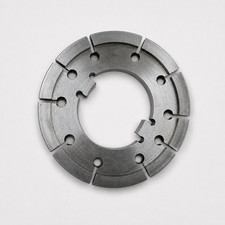
4L70E Pump
If the gauge test comes back low or absent, this is the part that restores line pressure. Matched to the 4L70E's pump body and bolt pattern, ships complete.
Shop 4L70E pumps and parts →Step 4: The Forward Clutch Path, When Pressure Is Normal
If line pressure checks out and the truck still will not move, the next place to look is the forward clutch circuit, and the failure usually has a traceable history rather than showing up out of nowhere. Sonnax documents the OE forward accumulator piston on the 4L60E, 4L65E, and 4L70E as a known weak point: the factory plastic piston wears or cracks at its pin bore, and later aluminum replacements wear at the same bore from repeated reciprocation. Either way, fluid escapes past the worn bore instead of staying in the apply circuit.
That leak does not go from fine to total failure overnight. Sonnax lists the progression as delayed engagement first, then forward clutch slip, and finally burnt clutches and bands once the leak starves the pack of the pressure it needs to hold. A truck that has been slow to engage Drive for weeks and then one day does not engage at all is very often this exact piston finishing its failure, not a sudden unrelated event. Reverse can still work through all of this, since it applies a different clutch pack, which is itself a useful diagnostic clue: no-forward-but-working-reverse points at the forward clutch path specifically, not a shared pump or pressure fault.
The permanent fix is not reusing the OE-style piston. Sonnax's pinless accumulator piston kit replaces the pin-and-bore design with dual seals that stabilize the piston and seal the bore without relying on a pin that will just wear the hole out again. If the clutch pack itself has already burned from the leak, the piston alone will not fix a truck that will not move — at that point the pack and the hard parts it damaged need to come out and go in as a set.
Three Failures That Get Mistaken for "No Movement"
Before you commit to a full teardown, make sure the complaint is not actually one of these three, which share some symptoms with total no-movement but have completely different causes and fixes.
Lost 3rd and 4th only (DTC P0757)
Brake & Front End documents this exact failure pattern on the 4L60-E, 4L65-E, and 4L70E family: the MIL comes on with P0757 stored, 3rd and 4th gears go missing, the transmission seems to shift into neutral or momentarily lose drive, and the vehicle freewheels above roughly 30 mph. The cause is chips or debris blocking the bleed orifice of the 2-3 shift solenoid, which holds the unit in 2nd when 3rd is commanded and drops it to 1st when 4th is commanded. The transmission still moves, it just will not get past 2nd gear. Diagnosing this as "no movement" sends you looking in the wrong half of the unit entirely — the fix is cleaning or replacing the solenoid, the 2-3 shift and shuttle valves, and checking the pan for friction debris, not a pump or forward clutch repair.
Stator sleeve rotation
Sonnax documents a second look-alike: the stator support sleeve on these units can rotate from overheating or a manufacturing flaw and block an oil feed hole. The resulting symptom list is 3-4 clutch failure, codes 894 and 1870, an overheated converter, no 3rd gear, and delayed reverse — not a total loss of movement. A truck with this failure still drives in 1st and 2nd. The fix is a stator support shaft assembly that locks the sleeve in place with Loctite so it cannot rotate and block the passage again.
Neutral safety or linkage faults
Covered in Step 2 above, but worth repeating here because it is the single most common false alarm: a shift cable that is not fully seating the manual valve, or a range switch that is not reporting the gear correctly, can produce a no-movement complaint with a completely healthy transmission underneath it. Rule this out before you open anything.
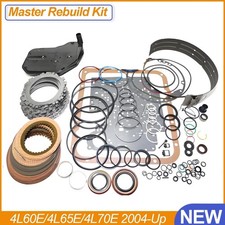
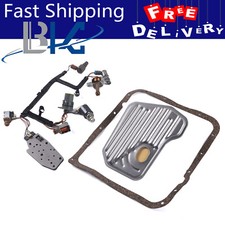
4L70E pumps, master rebuild kits, accumulator pistons, solenoid kits and stator support assemblies — shipped fast from the USA.
Shop 4L70E parts →FAQ
What is the first thing to check when a 4L70E won't move in any gear?
Fluid, before anything else. Check the level with the engine off, then start it and recheck. A pump that has lost its prime or a rotor that has broken up will not pull fluid from the pan, so the level stays put instead of dropping to its running mark. Also check the fluid's color and smell for burnt friction material, and confirm the shift linkage is fully engaging the manual valve detent. Only move on to a pressure gauge once those basics are ruled out.
Does no movement in any gear always mean the pump is bad?
No, and assuming so is how good pumps get replaced for nothing. Transmission Digest documented a rebuilt 4L60-E family unit with no engagement in any range where a line pressure gauge installed at the pressure tap read normal, which ruled out the pump and the pressure regulator valve and pointed the diagnosis at the gear train and clutch packs instead. Pull a pressure reading before you pull the pump.
Can a worn forward accumulator piston cause total loss of movement?
Yes, but it gets there in stages. Sonnax documents the 4L60E/4L65E/4L70E forward accumulator piston wearing or cracking at its pin bore, which first shows up as delayed engagement and forward clutch slip. Left alone, the leak gets worse and the clutch pack burns, which does eventually present as no forward movement, even though reverse may still work because it rides on a different clutch.
My 4L70E lost 3rd and 4th but still moves in 1st and 2nd — is that the same problem?
No, that is a different and more common complaint, and it is good news by comparison. Brake & Front End documents DTC P0757 on the 4L60E/4L65E/4L70E family, caused by debris blocking the bleed orifice of the 2-3 shift solenoid, which holds the unit in 2nd when 3rd is commanded and drops it to 1st when 4th is commanded. That is a solenoid and valve body contamination issue, not the total hydraulic or mechanical failure covered here.
Why does a seized stator sleeve get confused with no movement?
Because it also follows an overhaul and also feels catastrophic from the driver's seat. Sonnax ties a rotated stator support sleeve to 3-4 clutch failure, codes 894 and 1870, an overheated converter, no 3rd gear and delayed reverse. The truck still moves in the gears that do not depend on the blocked oil feed, which is the tell that separates it from a true no-movement-in-any-gear complaint.
Sources
- Transmission Digest — "4L60-E No Move After Rebuild," for the case study of a rebuilt 4L60-E family unit with no engagement in any range, the line pressure gauge test methodology, and the conclusion that normal pressure rules out the pump and pressure regulator valve. transmissiondigest.com/4l60-e-no-move-after-rebuild
- Sonnax — Pinless Forward Accumulator Piston Kit, Part No. 77987-01K, for the OE plastic forward accumulator piston wear/crack failure on 4L60-E, 4L65-E and 4L70-E units and the resulting delayed engagement, forward clutch slip, and burnt clutches and bands. sonnax.com/parts/2518-pinless-forward-accumulator-piston-kit
- Sonnax — Forward Accumulator Piston, Part No. 74927-AP, for the aluminum piston's pin-bore wear mechanism and OE part numbers (8686017, 24200126) it replaces. sonnax.com/parts/4583-forward-accumulator-piston
- Sonnax — Stator Support Shaft Assembly, Part No. 77918S-08K, for the stator sleeve rotation failure on GM 4L60-E, 4L65-E and 4L70-E units and its symptom list: 3-4 clutch failure, codes 894 and 1870, overheated converter, no 3rd gear, and delayed reverse. sonnax.com/parts/2501-stator-support-shaft-assembly
- Brake & Front End — "Tech Tip: GM Vehicle Has DTC P0757 Set, MIL Illuminated and Slipping Transmission," for the affected 4L60-E/4L65-E/4L70E (RPO M30/M32/M70) applications, the 2-3 shift solenoid bleed orifice failure mechanism, and the corrective procedure. brakeandfrontend.com/tech-tip-gm-vehicle-has-dtc-p0757-set-mil-illuminated-and-slipping-transmission