A 4L70E that takes two, three, five seconds to pick up Drive on a cold morning is not a quirk of an aging truck. It is the unit telling you it can no longer fill a clutch circuit fast enough to hold pressure, and every one of those late engagements is a clutch pack sliding before it clamps. Sonnax lists the complaint set for this transmission plainly: delayed engagement, delayed Forward, delayed Reverse and low line pressure upon engagement. Four names, one hydraulic failure, a short list of causes.
GM does not treat this unit as a 4L60E with a sticker on it — the 2008 Tahoe owner manual lists it as the 4L70-E Super Duty Transmission with its own line in the capacity table. What it does share with the 4L60E is the pump, the valve body casting and the accumulator design — exactly where delayed engagement comes from.

What Delayed Engagement Actually Is
Pull the selector into Drive and the manual valve routes line pressure to the Forward clutch circuit, which has to fill the clutch apply cavity and the accumulator before pressure rises enough to clamp the pack. Delay is the time it takes to fill a circuit that is leaking, or one fed by a pump that cannot make pressure at idle.
So there are two questions. Is the circuit leaking? Fluid going where it should not — past a cracked accumulator piston, out a worn bore, past a bad seal ring — fills the cavity slowly no matter how good the pump is. Or is the supply low? A pump that has lost internal sealing, or a boost circuit that will not rise, never had the pressure to fill anything quickly. A gauge answers the second; the first takes a vacuum tester.
Check the Fluid First, Because It Is Free
Low fluid produces every symptom on this page and is the one cause you can rule out in the parking lot. GM's procedure for these trucks: park level with the engine running and the brake set, move the selector through every range pausing about three seconds in each, return to Park, then idle three minutes or more before pulling the dipstick. Wipe it, push it fully back in, wait three seconds, pull it again and read the lower side.
The number that matters is a service fill, not a dry fill: that manual lists the 4L70-E Super Duty and 4L60-E at 5.0 quarts (4.7 L) on DEXRON-VI, and notes that correcting a low level generally takes less than one pint (0.5 L). If someone dumped two quarts in chasing a slip, that aeration is now part of your problem. While the pan is down, read what came out — clutch material and aluminum changes the job from which valve to which rebuild.
Cold Only, Hot Only, or Always
Ask the customer one question before you touch the truck: when is it delayed. That answer narrows the list more than any test.
| When it is delayed | What that points at | Why |
|---|---|---|
| Only after sitting overnight, clears in 30 seconds, never returns that day | Converter and pump drainback | Fluid drains out of the converter into the pan; the pump must refill it before anything engages. |
| Fine cold, worse as the unit heats up | Bore wear and clearance leaks | Hot fluid is thinner and leaks past worn bores far more easily, so wear shows up hot first. |
| Delayed every time, hot or cold | Forward accumulator, pump, or a hard circuit leak | A real leak, or a pump that cannot make pressure, ignores temperature entirely. |
| Delayed Reverse specifically | Reverse abuse valve bore and its bore plug | Sonnax ties the Reverse abuse valve and its bore plug directly to delayed Reverse. |
| Delayed Forward specifically | Forward abuse valve bore, Forward accumulator piston | Sonnax ties the Forward abuse valve to delayed Forward and Forward clutch distress. |
Prove the Pressure Side Before You Pull the Pan
Put a gauge on the line tap and a low-amp clamp on the pressure control solenoid feed wire, and read them together — that solenoid commands line pressure, and it can lie to a scan tool. Per ATRA's Gears magazine, it should sit at roughly 0.9 to 1.1 amps at idle with about 10 percent engine load, dropping to 0.2 to 0 amps at wide open throttle. The relationship is inverse: as engine load comes up, amperage drops and line pressure rises. An engagement complaint on a unit whose solenoid is stuck high in current is a low-pressure complaint by definition. The Gears case vehicle calibrates what wrong looks like: idle pressure around 60 psi, then wandering between 90 and 150 psi during a stall test.
- Amps correct, pressure correct and rising with load. Supply is fine — the delay is a circuit leak: accumulator, seal rings, clutch pack.
- Amps correct, pressure low or flat. Hydraulic: pressure regulator bore, boost valve, actuator feed limit bore, or the pump.
- Amps wrong or erratic. Electrical: solenoid, internal harness, case connector or module driver. Gears is direct about it — a steady command with erratic clamped current puts the computer on the hook, not the transmission.
The Four Hydraulic Causes, In the Order I Check Them
1. The Forward accumulator piston
First thing I look at on a delayed Forward, and it is cheap. Sonnax documents the OE Forward accumulator piston as a plastic part that cracks, sitting in an aluminum bore that wears at the pin bore. Either one loses fluid out of the Forward circuit, and the published symptom list for the aluminum replacement (74927-AP) reads: delayed engagement, Forward slip, burnt clutches and bands, cracked pistons. The circuit bleeds into the accumulator bore instead of filling the clutch, so the pack takes longer to clamp and slips on the way in. On the Sonnax exploded view it is item 212 — right there when the valve body comes off.
2. The pressure regulator and boost valve in the pump cover
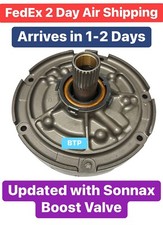
If the delay is there hot and cold and the gauge shows soft pressure, go to the pump cover. Sonnax's wear-area guide lists the pressure regulator valve with erratic line pressure, low line rise, 3-4 clutch failure, excess pump noise and reverse chatter. The fix is oversized valve 77917-07, which needs 77917-TL or 77917-TLC tooling because the bore has to be cut true first.
Next to it, the boost valve assembly carries low line rise, poor shift quality, 3-4 clutch failure and 2-4 band failure. Check which pump you have before ordering, because Sonnax splits these by sleeve length: early pumps use a 1.907 inch long sleeve (kits 77898E-K, -3K, -4K, -6K), late pumps a 1.890 inch sleeve (77898E-14K, 77898E-16K). The line pressure booster kits split the same way — 4L60E-LB1 for long-sleeve pumps, 4L60E-LB2 for the late design. Wrong kit means a wasted teardown.
3. The actuator feed limit and TCC regulator bores
The actuator feed limit valve regulates line pressure down and supplies the solenoids. Sonnax's list for a worn AFL bore includes erratic line pressure, solenoid performance codes, wrong gear starts, clutch and band failure; Gears puts it the same way, that a worn AFL valve either starves or floods the solenoids. If that circuit is unstable, the pressure control solenoid cannot make stable line pressure however good it is. Repair is kit 77754-09K.
The TCC regulator and isolator bores are the sleeper. Sonnax explains the mechanism: constant oscillation of those valves in the aluminum body wears the casting, letting critical apply pressure exhaust. It got worse from 1998 on, when EC3 controls kept the valves moving constantly — which covers every 4L70E built. Published symptoms include low line pressure plus TCC slip codes 894 and 1870, an overheated converter, a burned 3-4 clutch and harsh 1-2 shifts. Standard repair is sleeve kit 77754-04K; for wear in both sections, reamer 77754-RM5 (or tool kit F-77754-TL4) then isolator sleeve kit 77754-ISO.
4. The pump slide pivot pin
Overlooked because the part is tiny. This family uses a variable-displacement pump whose slide pivots on a pin. Sonnax states that oil pressure meant to maintain proper line pressures leaks past a worn pin, giving low or high line pressure; their replacement (65797) is through-hardened steel to stop the wear recurring. Inspect the pin and slide any time the pump is apart — a leaking pivot means the slide never holds position at idle, exactly when you need displacement for engagement.
Vacuum Test the Valve Body Instead of Guessing
Guessing which bore is worn is how a rebuild comes back. Sonnax publishes a vacuum test map for the 4L60-E, 4L65-E and 4L70-E showing the exact port to seal and test for every valve in the body and pump cover, with one governing rule: a low vacuum reading indicates wear. Pass and fail numbers live in the instructions that ship with the individual kits. For an engagement complaint, test the Forward and Reverse abuse valves and their bore plugs, the actuator feed limit valve, the TCC regulator valve, and in the pump cover the pressure regulator and boost valve assembly.
Two notes off that guide, because they are where false readings come from. OE valves are tested in their rest position unless stated otherwise, and some (the 3-2 control) need the spring out so the valve sits at the bottom of the bore. Several locations must also be blocked off from the manual valve with putty or foam ear plugs, and a few need a back-side orifice sealed with a thumb or pencil eraser. Miss one and a good bore reads as worn.
Delayed or Dead After a Rebuild? Check the Stator Support
This one fools experienced people. Ed Lee, writing for Transmission Digest as a member of the Sonnax TASC Force, documented a 2006 Chevrolet Suburban C1500 with 128,967 miles that came back after a complete rebuild with no cooler flow and no engagement in any range — yet line pressure measured normal, proving the pump was not broken and the pressure regulator valve was not stuck open.
The cause was the stator support. During the transition to an input speed sensor, GM moved the converter-charge and TCC-release oil feed hole to make room for the sensor, in steps spread over more than a year. The rebuilder fitted an early non-ISS support because his pump cover had no sensor hole — but that cover was already a late-style casting with the boss in place for a hole not yet drilled. The charge-oil port did not line up, so no oil reached the converter.
Lee's tell for a pump that needs the late-style support is the boost valve assembly bore: early bores ran out to the pump's outer diameter, late ones are short. A 4L70E is an ISS unit — match the support to the cover, not to the sensor hole you can see.
What Actually Fixes It
Work it in that order and most of these jobs close out cheap: fluid first, then the amp clamp and gauge together, then the Forward accumulator piston whenever the pan is off on a delayed-Forward unit. Vacuum test before you buy anything else and sleeve only the bores that fail. If the pump cannot make pressure at idle, valve body work alone will not save the engagement — and clutch material in the fluid means a rebuild, with those bores handled on the bench instead of in a second teardown.
Need the Sonnax pressure regulator valve for this fix?
CoreTransmissionParts stocks the Sonnax oversized pressure regulator valve 77917-07 for the 4L60E/4L65E/4L70E pump cover — the part that restores line rise when that bore has worn. It needs the matching reamer, so order the tooling with it if it is not already on your bench.
Get the 77917-07 valve →Need Parts For This Job?
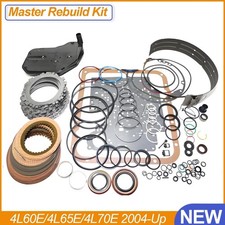
Pumps, accumulator piston kits, valve bodies, solenoid sets and master rebuild kits for this unit are on one page: shop 4L70E transmission parts. Checkout is on site and everything ships from the USA.
FAQ
Why is my 4L70E slow to engage when cold but fine once it warms up?
Cold-only delay that clears in the first half minute and never returns that day is usually converter drainback: fluid drains into the pan overnight and the pump has to refill the converter before anything engages. Delay that gets worse as the unit heats up is the opposite story, because hot fluid slips past worn bores far more easily — that points at bore wear or a tired pump.
How much fluid does a 4L70E take and what type?
GM specifies DEXRON-VI, and the 2008 Tahoe owner manual lists the 4L70-E Super Duty, together with the 4L60-E, at 5.0 quarts / 4.7 liters. That is a service fill for a pan-and-filter job, not a dry fill with the converter. Check the level hot with the engine running after cycling the selector through every range; GM notes that correcting a low level usually takes less than a pint.
Can a bad pressure control solenoid cause delayed engagement?
Yes, because line pressure is commanded by it. Per ATRA's Gears, the solenoid should sit at roughly 0.9 to 1.1 amps at idle and fall to 0.2 to 0 amps at wide open throttle, and current works inversely to pressure. A solenoid biased toward high current holds line pressure low, which reads as late engagement and soft shifts. Clamp the actual current instead of trusting the command PID, because the two disagree when the module's driver has failed.
My rebuilt 4L70E has no engagement at all but line pressure is normal. What now?
Check that the stator support matches the pump cover. Transmission Digest documented exactly this on a 2006 Suburban: no cooler flow, no engagement in any range, normal line pressure. The converter-charge oil hole moved during the input-speed-sensor transition, and an early non-ISS support behind a late-style cover blocks that passage. Normal line pressure with zero cooler flow is the fingerprint of a blocked charge circuit, not a bad pump.
Sources
- General Motors — 2008 Chevrolet Tahoe Owner Manual Backs the OEM fluid data and the level-check procedure: GM's designation of the unit as the "4L70-E Super Duty Transmission" and its listed transmission fluid capacity of 5.0 qt (4.7 L) alongside the 4L60-E; DEXRON-VI Automatic Transmission Fluid as the specified automatic transmission fluid; the check procedure of parking level with the engine running, moving the shift lever through each range for about three seconds, returning to Park and idling three minutes or more before reading the dipstick; and the note that correcting a low level generally takes less than one pint (0.5 L). assets.gm.com
- Sonnax — GM 4L60-E, 4L65-E, 4L70-E Critical Wear Areas & Vacuum Test Locations Backs the vacuum test section and the bore-by-bore symptom lists: the rule that a low vacuum reading indicates wear and that OE valves are tested in their rest position unless noted; the instruction to block certain test locations off from the manual valve with putty or foam ear plugs; the Forward abuse valve (delayed Forward, Forward clutch distress) and Reverse abuse valve (delayed Reverse, low/reverse clutch distress) and their bore plugs; the actuator feed limit valve symptoms (erratic line pressure, solenoid performance codes, wrong gear starts, clutch and band failure) with kit 77754-09K; the pressure regulator valve symptoms (erratic line pressure, low line rise, 3-4 clutch failure, excess pump noise, reverse chatter) with valve 77917-07 and tools 77917-TL / 77917-TLC; the boost valve sleeve split of 1.907" early versus 1.890" late with kits 77898E-K/-3K/-4K/-6K and 77898E-14K/-16K; and the Forward accumulator piston as item 212 on the valve body exploded view. sonnax.com
- Sonnax — GM 4L70-E unit page Backs the opening complaint set documented for this transmission: delayed engagement, delayed Forward, delayed Reverse and low line pressure upon engagement. sonnax.com
- Sonnax — Forward Accumulator Piston 74927-AP Backs the Forward accumulator section: the OE plastic piston being prone to cracking and the aluminum piston bore wearing at the pin bore, causing a loss of fluid; the published symptom list of delayed engagement, Forward slip, burnt clutches and bands and cracked pistons; the GM 4L60-E, 4L65-E and 4L70-E application; and the aluminum drop-in replacement. sonnax.com
- Sonnax — Pump Slide Pivot Pin 65797 Backs the pump slide section: oil pressure meant to maintain proper line pressures leaking past a worn pivot pin, the resulting low or high line pressure, the through-hardened steel replacement, and the 200-4R, 4L60, 4L60-E, 4L65-E and 4L70-E application. sonnax.com
- Sonnax — "Understanding 4L60-E Series Isolator Bore Wear & How to Address It" Backs the TCC regulator and isolator bore section: the constant oscillation of the TCC regulator and isolator valves in the aluminum valve body causing casting wear that allows critical apply pressure to exhaust; the issue becoming prevalent after EC3 controls were added in 1998; the symptom list of TCC slip codes 894 and 1870, overheated converter, low TCC apply pressure, burned 3-4 clutch, harsh 1-2 shifts and low line pressure; and the repair path of kit 77754-04K, or reamer 77754-RM5 / tool kit F-77754-TL4 followed by isolator sleeve kit 77754-ISO for wear in both sections. sonnax.com
- Rob Faucett, ATRA / Gears Magazine — "Controlling Pressure: General Motors" Backs the electrical test specifications: the pressure control solenoid command of approximately 0.9 to 1.1 amps at idle with around 10 percent engine load, dropping to 0.2 to 0 amps at wide open throttle; the inverse relationship in which solenoid amperage drops and line pressure rises as engine load comes up; the case-vehicle readings of roughly 60 psi at idle with pressure fluctuating between 90 and 150 psi during the stall test; the AFL valve either starving or flooding the solenoids when worn; and the amp clamp versus scan tool command comparison that identified a failed computer rather than a transmission fault. gearsmagazine.com
- Ed Lee (Sonnax TASC Force), Transmission Digest — "4L60-E No Move After Rebuild" Backs the stator support case study: the 2006 Chevrolet Suburban C1500 with a 5.3L and 128,967 miles that had no cooler flow and no engagement in any range after a complete rebuild while line pressure measured normal; the conclusion that normal line pressure ruled out a broken pump and a stuck-open PR valve; the charge-oil / TCC-release passage being relocated to make room for the input speed sensor in steps over more than a year; the mismatched early non-ISS stator support behind a late-style cover blocking the charge-oil passage; and the short boost-valve bore as the way to identify a pump that requires the late-style support. transmissiondigest.com