A 4L80E rarely dies of one bad part. It dies of heat, and by the time anything on the dash tells you about it the damage is already paid for. ATRA's Gears Magazine puts the ideal maximum fluid temperature at 200 degrees F, and states the rule plainly: for every 20 degrees above 200, expected transmission life drops by a factor of two.
Now compare that to what the truck actually tells you. GM does not set P0218, transmission fluid over temperature, until transmission fluid temperature exceeds 130 degrees C (266 degrees F) for 600 seconds. By the numbers above, a unit that trips P0218 has been running at roughly an eighth of its design life for that entire time. The code is a post-mortem, not a warning. Prevention on this transmission means owning the temperature yourself, and that starts with trusting your temperature reading, which is not automatic.


What normal actually is on a 4L80E
The GM-derived 4L80E troubleshooting supplement issued for HMMWV service defines normal operating temperature as 180 to 200 degrees F (82 to 93 degrees C), and notes the transmission reaches it after roughly 15 miles (24 km) of driving. That same window is the one you check fluid level in, because level moves with temperature and a cold check on this unit reads low and tempts you into overfilling it.
The whole picture on one table:
| Fluid temperature | What it means |
|---|---|
| 180-200 F (82-93 C) | Normal range. Correct window for a level check. |
| 200 F | ATRA's ideal maximum. |
| 220 F | Roughly half of expected life. |
| 240 F | Roughly one quarter of expected life. |
| 260 F | Roughly one eighth of expected life. |
| 266 F (130 C) for 600 seconds | GM finally sets P0218. |
| 306 F (151 C) indicated | DTC 58 territory. Usually a sensor fault, not real fluid temperature. |
A truck that spikes to 215 pulling a grade and settles back into the 180s on level ground is fine. A truck that finds 215 and stays there empty is not fine, it is just not sick enough to complain yet.
Verify the TFT sensor before you trust the number
On the 4L80E the transmission fluid temperature (TFT) sensor is part of the internal wiring harness inside the case. The TCM feeds it a 5 volt reference on CKT 923. Cold fluid means high sensor resistance and high signal voltage; as the fluid warms toward 100 degrees C (212 degrees F), resistance falls and the signal drops to roughly 1.5 to 2.0 volts.
You can check the sensor against GM's own temperature-to-resistance values at two points and catch a skewed unit before it lies to you:
| Resistance (ohms) | Degrees C | Degrees F |
|---|---|---|
| 185 | 100 | 210 |
| 450 | 70 | 160 |
| 1,800 | 38 | 100 |
| 3,400 | 20 | 70 |
| 7,500 | 4 | 40 |
| 13,500 | -7 | 20 |
| 25,000 | -18 | 0 |
| 100,700 | -40 | -40 |
The hard failures are easy. DTC 58 (TFT sensor circuit low, high temperature indicated) sets when signal voltage indicates a fluid temperature above 151 degrees C (306 degrees F) with all conditions met for one second, and the TCM then substitutes a warm default temperature value. DTC 59 is the open-circuit opposite and typically displays -40 C / -40 F.
The failure that actually hurts you is the skewed sensor. It reads plausibly, it moves, it just reads wrong by 30 or 40 degrees, and nothing sets. GM's diagnostic aids note a skewed sensor can show up as delayed garage shifts, firm shifts or TCC complaints, because the module is making line pressure and converter clutch decisions on a number that is not true. The manual's own sanity check is useful on a cold start: on a scan tool, TFT should climb steadily to about 66 degrees C (150 degrees F) and then stabilize. A reading that jumps in large steps, parks early, or never moves at all is a sensor problem, not a cooling problem.
Measure cooler flow instead of assuming it
Oil goes pump, pressure regulator valve, torque converter, cooler, lube, in that order, and Sonnax describes the PR valve as a priority valve that gives priority to line pressure and less to converter and lube pressure. Everything downstream of the converter, your cooler and the gear train's lubrication included, gets what is left over.
That makes cooler flow a measurement, not an assumption. Sonnax's spec is direct: on a transmission with 5/16 in. cooler lines, flow should be a minimum of one quart of fluid in 20 seconds, and most transmissions working correctly will produce a quart in 10 seconds. ATRA's overheating guidance puts the same requirement in different units: at least a gallon per minute.
How to run it honestly:
- Warm the vehicle to operating temperature first. Sonnax is specific about this. Cold fluid is thicker and will fail a healthy cooler.
- Disconnect the cooler return line and route it into a graduated container.
- Idle in Park and stop at one quart. Do not let the pan run low chasing a longer sample.
- Do not rely on a cooler flusher's gauge to tell you flow. Sonnax says this outright. Flushers push fluid through under their own pressure and will pass a cooler that the transmission cannot.
Under a quart in 20 seconds means you have a restriction, and on this unit the candidates are a cooler core packed with converter debris, a crushed or kinked line, a plugged filter, or the pressure regulator valve covered next.
The 4L80E's own way of starving its cooler
This one is specific to the transmission and gets missed constantly because it only shows up under load. Sonnax's TASC Force material on line-to-lube balance describes the mechanism: when the PR valve sits too far into its bore, converter and lube flow gets restricted or cut off entirely, and under towing, an overloaded vehicle or a hill climb that condition can persist long enough to blue the converter and overheat the transmission. Nothing is broken. The valve is simply in the wrong place for the load.
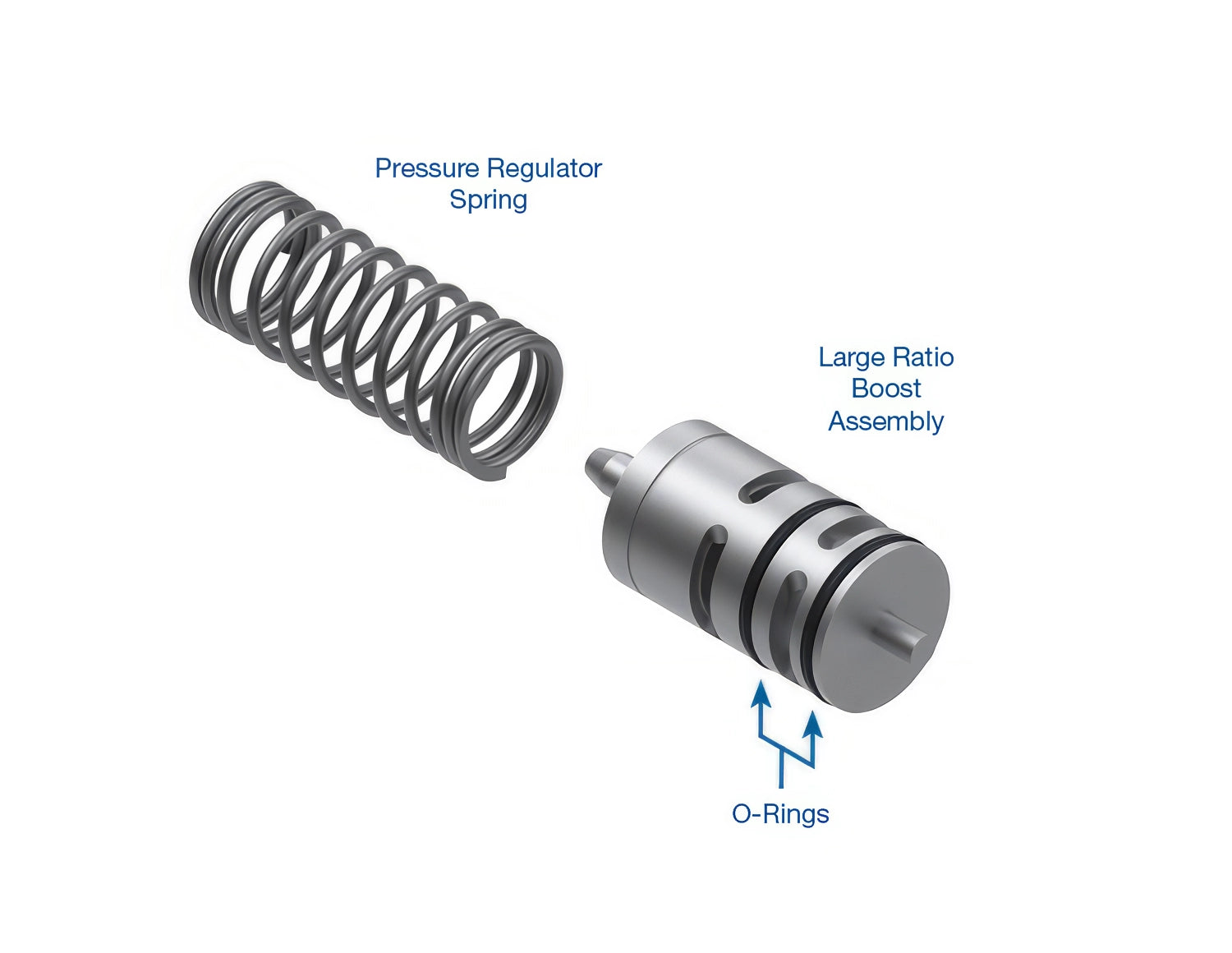
On the 4L80E and 4L85E it has a known trigger. Sonnax notes that on 1999-and-later applications the factory EPC pressure was set high at idle, and lists the resulting symptom set as engine surge at idle, low cooler flow, and low TCC release pressure, with the stated cause being low converter release pressure at idle. Their fix is the lube regulated pressure regulator valve, part 34200-14K, a drop-in that allows regulated flow to the converter charge and lube circuit at idle while still preventing converter and pump drainback.
Two more things. First, a worn PR bore produces the same result mechanically, because the valve cannot complete its stroke; that one needs reaming and an oversized valve, not a drop-in. Second, performance tuning causes it deliberately. Sonnax documents that raising idle line pressure from the factory 60 to 70 psi range up to 100 to 105 psi mispositions the valve at idle and produces low cooler flow, overheating, converter complaints and engine stall.
The field tell is consistent: cooler lines barely warm at idle, temperature climbs only under load, and the transmission cools off normally when the truck is empty.
The six common causes, in the order worth checking
ATRA's list of the primary causes of overheating is short and it holds up on this unit:
- Plugged cooler lines. Inspect the full run for pinches, kinks, dents and crush marks. Road damage on a truck line is often invisible from one side.
- Plugged cooler. Almost always debris from a prior converter or clutch failure.
- Plugged filter. A restricted filter starves the pump, and a starved pump cannot feed converter, cooler or lube.
- Vehicle overloading. Heat is slip multiplied by torque, and no cooler sizes around a chronically overloaded truck.
- Engine overheating. On a stock truck the transmission cooler lives in the radiator tank, so engine coolant temperature is the ceiling on transmission cooling.
- Fan clutch malfunction. Same reason. ATRA's test on an electronic clutch: bring the engine to operating temperature, raise speed to 2000 RPM, and run there until fan speed increases to 1850 RPM or more for 30 seconds, then compare against the manufacturer's speed chart.
Add one more for the 4L80E specifically: converter clutch slip. Slip times torque is heat with no third variable, and a clutch that slips 80 RPM at highway load will cook fluid all day without setting a code.
The service numbers that go with the job
Per Chevrolet Performance's own Supermatic instruction sheet for the 4L80 family, the fluid is Dexron VI. Capacity is 7.3 L (7.7 quarts) on a bottom pan removal and 12.5 L (13.2 quarts) dry. Dexron VI is back-serviceable into applications that originally specified Dexron III, so an early 4L80E gets it too. The cooler pipe connector nut torques to 38 N-m (28 lb-ft) at the case, and GM's instruction is to flush the cooler and lines on every install, new transmission or not.
If you are replacing a burnt unit, flushing matters more than most shops treat it. Sonnax's procedure: flush the cooler in the direction of flow for a half hour, back-flush for a half hour, then flush in the direction of flow again, using a hot flusher with the ability to pulse the flow.
Overheated fluid is evidence, not just a consumable. Dark color and a burnt smell mean friction material from the clutches or the converter lining is already in circulation.
A prevention routine that actually holds
- Put TFT on the dash, and verify the sensor once against two points off the resistance table, or at minimum the cold-start climb-to-150-F check.
- Flow test the cooler circuit any time the unit comes apart, and any time a temperature complaint is not explained by load. One quart in 20 seconds is the pass line.
- Treat 200 F as the ceiling, not the target. Sustained readings above it mean a cooling system out of capacity for how the truck is used.
- Fix the engine cooling system first on a stock cooler setup, and watch TCC slip at cruise, before spending money on cooling hardware.
- Service fluid and filter on time and check level hot, after about 15 miles, in the 180 to 200 F window.
- If the truck was tuned for line pressure, re-check cooler flow. Higher idle EPC pressure and low cooler flow travel together on this unit.
FAQ
What temperature is too hot for a 4L80E?
Treat 200 degrees F as the ceiling. ATRA's guidance is that 200 F is the ideal maximum and that every 20 degrees above it cuts expected life in half, so 220 F is half the life, 240 F is a quarter and 260 F is an eighth. Normal operating temperature for this unit is 180 to 200 F, reached after roughly 15 miles of driving. Brief spikes under load are normal; a truck that will not come back down to the 180s unloaded is telling you the cooling system is out of capacity.
Will the truck warn me before the heat does damage?
No. GM does not set P0218 for transmission fluid over temperature until fluid temperature exceeds 130 degrees C (266 degrees F) for 600 seconds, which is ten continuous minutes at a temperature already costing roughly seven eighths of the transmission's expected life. The code is useful confirmation after the fact but it is not a prevention tool. Monitoring TFT yourself is the only early warning that exists on this transmission.
How do I test cooler flow on a 4L80E?
Warm the vehicle to operating temperature, disconnect the cooler return line into a graduated container, idle in Park and time one quart. On 5/16 in. cooler lines, Sonnax specifies a minimum of one quart in 20 seconds, and a healthy unit will usually deliver a quart in about 10 seconds. ATRA states the same requirement as at least a gallon per minute. Do not use a cooler flusher's own gauge as the measurement, because the flusher supplies its own pressure and will pass a cooler the transmission cannot.
Can I trust the transmission temperature on my scan tool?
Only after you have checked the sensor. The TFT sensor is a thermistor on a 5 volt reference from the TCM on CKT 923, and a skewed sensor reads plausibly while being 30 or 40 degrees wrong, without setting a code. Check it against GM's temperature-to-resistance values, where 185 ohms corresponds to 100 C (210 F) and 3,400 ohms to 20 C (70 F). On a cold start the reading should climb steadily to about 66 C (150 F) and then stabilize; a value that jumps, parks early or never moves is a sensor fault.
Will changing the fluid fix an overheating 4L80E?
It resets the clock but it does not fix the cause. Dark, burnt fluid means clutch or converter lining material is already circulating, and fresh Dexron VI in a transmission with a restricted cooler, a plugged filter or a slipping converter clutch will be dark again quickly. Do the flow test and the TCC slip check first, fix what you find, and then fill it with 7.7 quarts on a pan drop.
Need parts for this job?
Filters, cooler bypass kits, TCC solenoids, valve bodies and rebuild kits for the 4L80E and 4L85E, on our own checkout and shipped from the USA.
Shop 4L80E parts →Sources
- Gears Magazine (ATRA) — "48RE/68RFE/AS68RC Transmission Overheating." Backs the temperature-to-life rule used throughout this article: an ideal maximum transmission temperature of 200 degrees F, with expected life reduced by a factor of two for every 20 degrees above it (half at 220 F, one quarter at 240 F, one eighth at 260 F); the cooler flow requirement of at least a gallon per minute; the six primary causes of overheating; and the electronic fan clutch test of holding 2000 RPM until fan speed rises to 1850 RPM or more for 30 seconds. gearsmagazine.com
- AM General / General Motors — 4L80E Transmission Troubleshooting, Supplement 7. Backs the 4L80E-specific electrical and temperature data: normal operating temperature of 180 to 200 degrees F (82 to 93 degrees C) reached after approximately 15 miles (24 km) of driving; the TFT sensor as a thermistor in the internal wiring harness fed a 5 volt reference on CKT 923; the drop to approximately 1.5 to 2.0 volts at 100 degrees C (212 degrees F); the DTC 58 set condition of indicated TFT above 151 degrees C (306 degrees F) for one second and the TCM's warm default substitution; the DTC 59 open-circuit display of -40 C; the temperature-to-resistance table reproduced here; and the cold-start diagnostic aid that TFT should rise steadily to about 66 degrees C (150 degrees F) then stabilize, with a skewed sensor causing delayed garage shifts, firm shifts or TCC complaints. Supplement 7 (PDF)
- Sonnax — "Avoiding After-Overhaul Problems" (TASC Force technical article). Backs the cooler flow pass/fail specification and the flushing procedure: a minimum of one quart of fluid in 20 seconds on a transmission with 5/16 in. cooler lines, with most correctly working transmissions producing a quart in 10 seconds; the instruction to check cooler flow only after the vehicle is at operating temperature and not to rely on the cooler flusher to determine flow; and the flush-forward, back-flush, flush-forward half-hour procedure using a hot flusher capable of pulsing flow. sonnax.com
- Sonnax — "Line to Lube, Converter: A Balancing Act. PR Valve Position Is Key" (TASC Force technical article). Backs the pressure regulator valve mechanism: a mispositioned PR valve leaves the converter and lube circuit greatly diminished or completely starved; under towing, overload or hill climbing that condition can persist long enough to blue the converter and overheat the transmission; bore wear prevents proper valve stroke and requires reaming with an oversized valve; and tuning that raises idle line pressure from the factory 60 to 70 psi range to 100 to 105 psi produces low cooler flow, overheating, converter complaints and engine stall. sonnax.com
- Sonnax — Lube Regulated Pressure Regulator Valve 34200-14K, 4L80-E / 4L85-E product data. Backs the model-specific cooler-starvation fix: the listed symptoms of engine surge at idle, low cooler flow and low TCC release pressure; the stated cause of low converter release pressure at idle; the note that the OE PR valve design prevents adequate cooler flow at low RPM and high pressure or demand; the high factory EPC idle pressure on 1999-and-later 4L80-E and 4L85-E units; and the drop-in valve that allows regulated flow to the converter charge and lube circuit at idle while preventing converter or pump drainback. sonnax.com
- Chevrolet Performance (General Motors) — Supermatic Transmission Specifications, instruction sheet 19211852. Backs the GM service figures: Dexron VI as the specified fluid, 7.3 L (7.7 quarts) capacity on bottom pan removal and 12.5 L (13.2 quarts) dry, the cooler pipe connector nut to case torque of 38 N-m (28 lb-ft), and the instruction to flush the cooler and lines on every installation. chevrolet.com (PDF)
- Sonnax — "Anatomy of a Transmission: Oil Flow in the Pump-PR-Converter-Cooler-Lube Circuits." Backs the hydraulic priority order described here: oil travels pump, pressure regulator valve, torque converter, cooler, then lube, and the PR valve acts as a priority valve giving more priority to line pressure and less to converter and lube pressure, so that an out-of-balance valve restricts the converter circuit until line pressure recovers. sonnax.com
4L80E 6AN PTFE cooler line kit → or browse all 4L80E parts →