The 1999-2002 Expedition is the truck that starts this argument. Ford's 2002 Expedition owner guide lists two different automatics for the same body: the 4R70W, with a 13.9 quart fill of MERCON V, and the 4R100, with 15.9 or 16.4 quarts of MERCON depending on 4x2 or 4x4. Two trucks parked side by side can need completely different rebuild kits, fluid, and solenoids. Go one step up the lineup and the 4R100 is also the Super Duty, E-Series, and F-53 motorhome transmission, while the 4R70W lives in F-150s, Crown Victorias, Mustangs, and Expeditions.
They are both Ford four-speed overdrive automatics with electronic shift control, and that is where the family resemblance ends. The 4R70W grew out of the AODE. The 4R100 grew out of the E4OD. This guide covers what a rebuilder actually needs: how the gear trains differ, both ratio sets, fluid and capacity, the solenoid packs, how to tell them apart on the bench, the known weak spots in each, and which one is the right foundation for towing. Every hard number is tied to Ford, ATSG, or ATRA material in the Sources list at the bottom.
4R70W vs 4R100: the short answer
The 4R70W is a light-duty unit built around one compound (Ravigneaux) planetary set. The 4R100 is a heavy-duty unit built around three simple planetary sets, with more friction elements, a coast clutch, an optional PTO drive, and a bigger fluid volume. They do not share a gear train, a valve body, a solenoid pack, or a converter. If a customer asks whether one will drop into the other's truck, the answer is no without changing the PCM calibration and a lot of hardware, and that is rarely worth doing on a 20-year-old truck.
| Spec | 4R70W | 4R100 |
|---|---|---|
| Family | AODE-based, 1993 on | E4OD-based, heavy duty |
| Gear train | One Ravigneaux compound set | Three simple planetary sets (overdrive, forward, reverse) |
| 1st / 2nd / 3rd / 4th | 2.84 / 1.55 / 1.00 / 0.70 | 2.71 / 1.54 / 1.00 / 0.71 |
| Reverse | 2.32 | 2.18 |
| Holding devices | 4 clutches, 2 bands, 2 one-way clutches | 6 clutches, 1 band, 3 one-way clutches |
| Solenoids | SS1, SS2, TCC, EPC | SS1, SS2, coast clutch (CCS), TCC, EPC |
| Original fluid | MERCON V (XT-5-QM) | MERCON (XT-2-QDX) |
| Capacity (2002 Expedition) | 13.1 L / 13.9 qt | 15.0 L / 15.9 qt (4x2), 15.5 L / 16.4 qt (4x4) |
| PTO option | No | Yes, on 8,500 lb GVW and up Super Duty with 6.8L or 7.3L |
Two different gear trains
The 4R70W sends power from the converter through the turbine shaft and stub shaft into a single Ravigneaux set: a forward sun, a reverse sun, one carrier with long and short pinions, and one ring gear on the output shaft. ATSG's AODE/4R70W handbook lists four clutch packs (forward, direct, reverse, intermediate), two bands (overdrive and low/reverse), and two one-way clutches. Fourth gear is the direct clutch driving the carrier with the overdrive band holding the reverse sun. That overdrive band is why 4R70W 3-4 complaints so often come back to the servo and band rather than a clutch pack.
The 4R100 is a different design. ATSG's 4R100 manual describes three simple planetary gearsets (overdrive, forward, and reverse), seven friction apply elements (intermediate band plus coast, overdrive, intermediate, direct, forward, and low/reverse clutches), and three one-way clutches (overdrive roller, intermediate sprag, low roller), behind a four-element converter with a converter clutch. In first through third, the overdrive roller clutch locks the front set at 1:1 and the rear two sets make the ratios. In fourth, the overdrive clutch applies and the front set overdrives the output.
The practical result: a 4R70W puts all the work through one compact gearset and two bands, and a 4R100 spreads it across three sets and more clutch area. That is the main reason the 4R100 went behind the 7.3L Power Stroke and the V10 and the 4R70W did not.
Gear ratios and what they do on the road
ATSG gives the 4R70W at 2.84, 1.55, 1.00, 0.70 and 2.32 reverse, and the 4R100 at 2.71, 1.54, 1.00, 0.71 and 2.18 reverse. ATRA's gear ratio chart in GEARS (January/February 2006) agrees on both reverse ratios, 2.32 for the 4R70W/AODE family and 2.18 for the 4R100.
- First gear: the 4R70W's 2.84 is about 5 percent deeper than the 4R100's 2.71. On paper the light-duty box has more launch multiplication. In the real world the 4R100 trucks run deeper axles, so overall first-gear ratio usually ends up higher on the Super Duty.
- Spread: 2.84 / 0.70 is about 4.06 for the 4R70W; 2.71 / 0.71 is about 3.82 for the 4R100. Both are narrow by modern standards, which is why these trucks feel busy on the highway compared to a six-speed.
- 1-2 step: the 4R70W drops engine speed about 45 percent on the 1-2 shift (1.55 / 2.84) and the 4R100 about 43 percent (1.54 / 2.71). It is the hardest-working shift in both, and the one that shows wear first.
- Reverse: 2.18 on the 4R100 is shallower than its own first gear. Backing a heavy trailer up a grade loads the reverse elements harder than most owners expect.
Ratio codes and shift complaints are calibrated to these numbers. ATSG warns that the 4R70W gear train will not interchange with the AODE and that the computers are programmed for different ratios. The same logic applies to a 4R100 in a 4R70W truck: the PCM reads turbine and output speed against an expected ratio, and the wrong unit sets codes even if it bolts up.
Solenoids, coast braking, and the adaptive strategy
The 4R70W picks gears with two on/off shift solenoids, runs the converter clutch with a PWM solenoid, and sets line pressure with EPC. The 4R100 adds a fifth solenoid, the coast clutch solenoid. ATSG says the 4R100 hydraulic system has five electronically controlled solenoids for shift feel (line pressure), shift scheduling, engine braking during coast, and TCC apply. With overdrive cancelled the PCM applies the coast clutch for engine braking in third, and in manual 2 and 1 it holds the coast clutch on. The 4R70W gets its manual-low engine braking from the low/reverse band instead.
That matters for diagnosis. A 4R100 that freewheels on decel with O/D off points at the coast clutch circuit, which a 4R70W does not have. Ford's 2002 Expedition owner guide also notes that the 4R100 uses an adaptive learning strategy kept alive by battery power. After a battery disconnect it has to relearn, and Ford says optimal shifting comes back within a few hundred miles. Tell the customer that before they come back about a firm shift the day after a battery swap.
Fluid type and capacity
This is the difference that costs people transmissions. Ford's 2002 Expedition owner guide specifies Motorcraft MERCON V (XT-5-QM) for the 4R70W and Motorcraft MERCON (XT-2-QDX) for the 4R100, and it says plainly that MERCON and MERCON V are not interchangeable and should not be mixed. The same guide lists 13.1 L (13.9 qt) for the 4R70W and 15.0 L (15.9 qt) or 15.5 L (16.4 qt) for the 4R100 in 4x2 and 4x4 Expeditions. Ford's 2003 Super Duty owner guide lists the 4R100 at 16.7 L (17.7 qt), approximate dry fill, varying with cooler size. Super Duty cooler plumbing holds more fluid than the Expedition's.
Those are dry-fill numbers. A pan drop gives you back only a portion, because the converter and cooler stay full. Set the final level on the dipstick at operating temperature, roughly 150-170 F, engine idling in Park on level ground. A cold check reads low and leads to overfilling. The original MERCON spec is long discontinued at retail, so check the current Motorcraft cross-reference for a 4R100 before you buy fluid, and never guess from a jug that says "MERCON / MERCON V" on the label.
How to tell them apart on the bench and on the truck
- PTO window: ATSG notes that 4R100 cases have a PTO window on the left side. Only 8,500 lb GVW and up Super Duty trucks with the 6.8L or 7.3L were PTO-capable from the factory, but the window is on the case either way. A 4R70W has no PTO provision.
- Size and weight: the 4R100 is visibly longer and heavier, with a larger pan. The 4R70W looks like an AODE, because externally it nearly is one.
- Converter: Sonnax groups the 4R100 converter with the E4OD and 5R110W: same pilot, flexplate bolt circle, overall height, and 31 input splines (same as a C6). The 4R100 turbine has a 2.955 inch bore against 2.765 inches on the E4OD. A 4R70W converter is AODE-family and shares none of that.
- Gear train inside a 4R70W: ATSG's tooth counts identify a true 4R70W: an 88-tooth ring gear, 25/24-tooth pinions, a 38-tooth reverse sun and a 31-tooth forward sun. A 72-tooth ring means AODE parts in the case.
- On the truck: check the transmission code on the certification label on the driver door or pillar, then match it to the Ford application. On an Expedition, do not assume from the engine. Confirm the code.
Known weak points in each
4R70W. ATRA's 4R70W/4R75E interchange material covers most of the comebacks. The sun shell cracks at the chamfer, and Ford's fix is a matched set (kit 4L3Z-7D234-AA: shell, bearing, and forward sun) so end play stays correct. The case harness changed for 1998 from a white connector with soft wiring to a black connector with a hard lead frame, and the solenoids do not cross between the two. For 2004 Ford moved the output speed sensor trigger from six holes in the ring gear to 24 parking pawl lugs. ATRA says an early ring gear in a late unit cuts the OSS signal by 75 percent and it will not shift out of first, while a late ring gear in an early unit reads 400 percent fast. Order planetary and ring gear parts by year, not just by model.
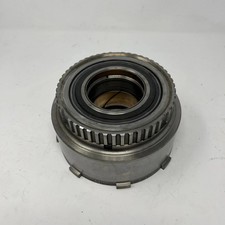
4R100. The classic complaint is second gear slipping or no second. ATRA's 2003 Ford seminar book puts it on the durability of the intermediate diode sprag and lists the sprag (E9TZ-7A089-B), clutch plates (1C3Z-7B164-BA), and the updated drums: YC3Z-7D044-AA, a 4-plate drum for the 5.4L and 6.8L, and YC3Z-7D044-BA, a 5-plate drum for the 7.3L only. The updated drum may also need a new piston and return spring. ATSG adds that both the forward and rear carriers came in 4-pinion and 6-pinion versions and recommends the 6-pinion carriers for their higher torque capacity, with 3-tang thrust washers on both sides of the 6-pinion rear carrier. On a diesel or tow build that came in with 4-pinion carriers, that is the cheapest strength upgrade in the box.
Shop the part for this fix: 4R100 and 4R70W rebuild parts
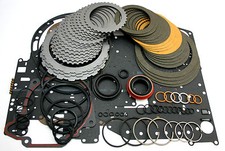
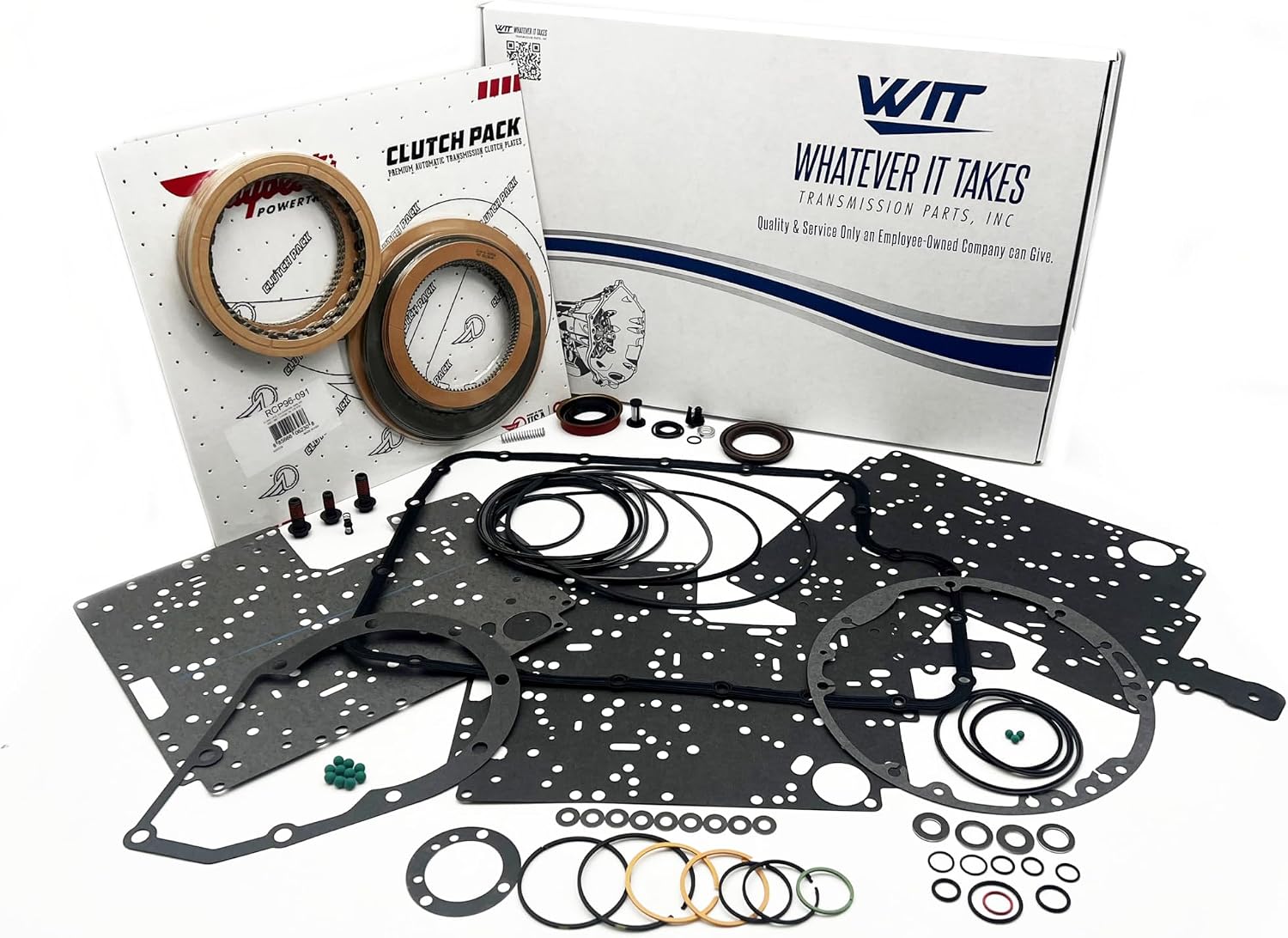
Building a 4R100 for a Super Duty or motorhome, or a 4R70W for an F-150 or Expedition? CoreTransmissionParts carries model-specific kits, sprags, drums, and valve body parts for both units. Order by unit and by year.
Shop 4R100 transmission parts →Working on the light-duty side? Browse 4R70W transmission parts.
Which one is stronger, and which one to tow with
The 4R100 is the heavy-duty unit. Ford's 2003 RV and Trailer Towing Guide pairs it with the 7.3L Power Stroke at 250 hp and 525 lb-ft with the automatic, with the 6.8L V10 at 310 hp and 425 lb-ft, and with the V10 in the F-53 Class A motorhome chassis at a 26,000 lb GCWR. Those are Ford's own factory pairings, and that is the strongest evidence of what the unit was built to carry.
The 4R70W is not weak for what it was put in. Ford's 2003 Expedition press kit says the Expedition's 4R70W is rated to handle up to 506 lb-ft of torque, well above the 5.4L's 350 lb-ft. In the 2002 Expedition owner guide, the 4.6L tops out at 11,000 lb GCWR and the 5.4L at 13,500 lb GCWR on a 3.73 axle. Inside its range the 4R70W lasts, as long as it gets the right fluid and a cooler that works.
The honest builder's answer: if the truck tows near its limit every weekend, the 4R100's extra clutch area, 6-pinion carrier option, and coast clutch make it the better foundation. A light-duty 4R70W truck that tows heavy is better served by a correct rebuild, the 2004-style sun shell kit, an auxiliary cooler, and using O/D cancel on grades than by trying to swap in a 4R100.
Need parts for this job?
Master rebuild kits, sprags, drums, solenoid packs, and valve bodies for the Ford 4R70W and 4R100. Secure checkout on our site.
Shop 4R70W parts →Frequently Asked Questions
Is the 4R100 stronger than the 4R70W?
Yes. The 4R100 is Ford's heavy-duty four-speed, with three simple planetary sets, six clutches and a band, and Ford paired it with the 7.3L Power Stroke at 525 lb-ft and the V10 in the F-53 motorhome chassis at a 26,000 lb GCWR. The 4R70W is a light-duty unit, though Ford's 2003 Expedition press kit rates it at up to 506 lb-ft, well above the 5.4L's output.
Can you swap a 4R100 in place of a 4R70W?
Not as a bolt-in job. The gear trains, valve bodies, solenoid packs and converters are different, the 4R100 adds a coast clutch solenoid, and the PCM is calibrated for each unit's ratios. A matching calibration, wiring, crossmember, driveshaft and cooler work would all be needed, which is rarely worth it on an older truck.
Do the 4R70W and 4R100 use the same transmission fluid?
No. Ford's 2002 Expedition owner guide lists Motorcraft MERCON V (XT-5-QM) for the 4R70W and Motorcraft MERCON (XT-2-QDX) for the 4R100, and warns that MERCON and MERCON V are not interchangeable. Check the current Motorcraft cross-reference for the 4R100 because the original MERCON spec is discontinued.
How much fluid do the 4R70W and 4R100 hold?
Ford lists the 4R70W at 13.1 L (13.9 qt) in the 2002 Expedition. The 4R100 is 15.0 L (15.9 qt) in a 4x2 Expedition, 15.5 L (16.4 qt) in a 4x4, and 16.7 L (17.7 qt) in a 2003 Super Duty. Those are approximate dry-fill numbers; set the final level hot on the dipstick.
Which Expedition has the 4R100?
Ford's 2002 Expedition owner guide lists both the 4R70W and the 4R100 for that model year, so the same truck could leave the plant with either unit. Read the transmission code on the certification label and match it to the Ford application rather than guessing from the engine.
Sources
- Ford Motor Company — 2002 Expedition Owner Guide (archived copy). Backs the 4R70W fill of Motorcraft MERCON V XT-5-QM at 13.1 L / 13.9 qt; the 4R100 fill of Motorcraft MERCON XT-2-QDX at 15.0 L / 15.9 qt (4x2) and 15.5 L / 16.4 qt (4x4); the MERCON / MERCON V "not interchangeable" warning; the 4R100 adaptive learning strategy after a battery disconnect; and the 4.6L and 5.4L GCWR table. Ford PDF (archive.org)
- Ford Motor Company — 2003 F-250 to F-550 Super Duty Owner Guide (archived copy). Backs the 4R100 capacity of 16.7 L / 17.7 qt of MERCON in Super Duty trucks. Ford PDF (archive.org)
- ATSG — Ford 4R100 Technical Service Information manual. Backs the three simple planetary gearsets, seven friction apply elements and three one-way clutches, the five-solenoid hydraulic system including the coast clutch, the 2.71 / 1.54 / 1.00 / 0.71 / 2.18 ratios, the PTO window and PTO availability (8,500 lb GVW and up, 6.8L and 7.3L), and the 4-pinion vs 6-pinion carrier recommendation. ATSG 4R100 manual (PDF)
- ATSG — AODE / 4R70W / 4R70E / 4R75E Transmission Update Handbook. Backs the Ravigneaux gear train description, the 4R70W ratios 2.84 / 1.55 / 1.00 / 0.70 / 2.32 against the AODE's 2.40 / 1.47 / 1.00 / 0.67 / 2.00, the tooth-count identification, and the no-interchange warning. ATSG handbook (PDF)
- ATRA / GEARS Magazine — gear ratio chart, January/February 2006. Backs the reverse ratios of 2.32 (4R70W/AODE) and 2.18 (4R100). ATRA PDF
- ATRA — 2003 Ford technical seminar manual, 4R100 section (p.148). Backs the 4R100 2nd-gear slip / no 2nd cause (intermediate diode sprag durability) and the part numbers E9TZ-7A089-B, 1C3Z-7B164-BA, YC3Z-7D044-AA (5.4L/6.8L) and YC3Z-7D044-BA (7.3L). ATRA PDF
- ATRA — 2009 seminar manual, 4R70W/4R75E section. Backs the sun shell kit 4L3Z-7D234-AA and the 2004 output speed sensor ring gear change (75 percent low / 400 percent fast mismatch). ATRA PDF
- Ford Motor Company — 2003 RV and Trailer Towing Guide (archived copy), and 2003 Expedition press kit (archived). Backs the 4R100 pairings with the 7.3L (250 hp / 525 lb-ft automatic) and 6.8L V10 (310 hp / 425 lb-ft) and the F-53 chassis 26,000 lb GCWR with the 4R100; the press kit backs the Expedition 4R70W rating of up to 506 lb-ft. Ford towing guide (archive.org) · Ford press kit (archive.org)
- Sonnax — "Identifying Converter Components: 6 Key Features to Understand in Ford E4OD, 4R100, 5R110W." Backs the shared pilot, bolt circle, height and 31 input splines, and the 4R100 turbine bore of 2.955 in vs 2.765 in on the E4OD. sonnax.com