The 4R70W gear ratios are 2.84 first, 1.55 second, 1.00 third, 0.70 overdrive and 2.32 reverse. Those are the numbers from the ATSG update handbook for the AODE/4R70W family, and they are what separates a 4R70W from the AODE that looks identical on the outside (2.40, 1.47, 1.00, 0.67 and 2.00 reverse). The ratio change is the whole reason the "W" exists, so it is worth knowing where those numbers come from, what they do to engine rpm, and how to tell which gear train is actually inside a case before you order parts.
This guide covers the full ratio chart, the tooth counts behind it (you can check the math yourself), the apply chart, the year-by-year changes that trip up rebuilders, and the specs you will need on the bench. Every hard number is tied to a source at the bottom.
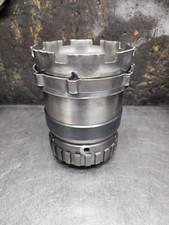
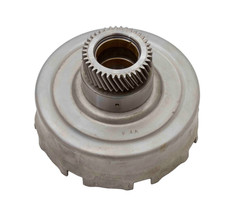
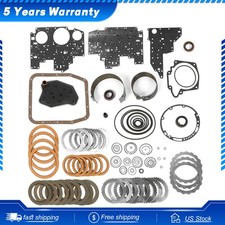
4R70W vs AODE Gear Ratios
| Gear | 4R70W / 4R70E / 4R75W / 4R75E | AODE (1992 intro) | AOD (hydraulic) |
|---|---|---|---|
| 1st | 2.84:1 | 2.40:1 | 2.40:1 |
| 2nd | 1.55:1 | 1.47:1 | 1.47:1 |
| 3rd | 1.00:1 | 1.00:1 | 1.00:1 |
| 4th (overdrive) | 0.70:1 | 0.67:1 | 0.67:1 |
| Reverse | 2.32:1 | 2.00:1 | 2.00:1 |
ATSG notes that the hydraulic AOD and the electronic AODE share the same planetary ratios, which is why AOD gear train parts got swapped into AODEs early on. The 4R70W, introduced for 1993, changed them. Ford's stated reason in the ATSG bulletin is closer ratios for fuel economy and performance. In practice the big change is first gear: 2.84 against 2.40 is 18 percent more multiplication off the line, which is what a heavier truck or a Crown Victoria with a tall axle needs.
The later 4R70E and 4R75E use the same ratios. ATRA's interchange notes state that the planetary gear set is the same ratio and dimensions between the 4R70W and the 4R70E/75E; the only difference is that the later carrier's rear cover is welded instead of riveted. You will sometimes see a 2.23 reverse ratio quoted online. That is a typo that has been copied around. The ATSG figure is 2.32, ATRA's GEARS magazine gear ratio chart lists the 4R70W/AODE family entry at the same 2.84, 1.55, 1.00, 0.70 and 2.32, and the tooth counts below prove it.
Where the Ratios Come From: Tooth Counts
The 4R70W uses a Ravigneaux compound planetary: a forward (small) sun gear, a reverse (large) sun gear, one carrier with long and short pinions, and one ring gear on the output shaft. ATSG lists the tooth counts that changed in 1993:
| Part | 4R70W | AODE |
|---|---|---|
| Output shaft ring gear | 88 teeth (direct drum passes through the front) | 72 teeth (direct drum will not pass through) |
| Planetary long / short pinions | 25 / 24 teeth, retaining pins recessed | 18 / 18 teeth, pins flush |
| Reverse sun gear and shell | 38 teeth, approx. 2.438 in. OD | 36 teeth, approx. 2.600 in. OD |
| Forward sun gear | 31 teeth, approx. 2.062 in. OD | 30 teeth, approx. 2.225 in. OD |
| Rear case bearing (No. 9) | 3-piece closed, approx. .144 in. thick, F3LY-7F242-A | 2-piece open, approx. .113 in. thick, E0AZ-7F242-A |
With a Ravigneaux set, the pinion tooth counts do not enter the ratio; the suns and the ring do. Run the ATSG numbers and you get the published ratios exactly:
- 1st (forward sun driven, carrier held by the low roller clutch): ring / forward sun = 88 / 31 = 2.84.
- 2nd (forward sun driven, reverse sun held): 88 x (38 + 31) / (31 x (88 + 38)) = 1.55.
- 3rd: two members locked together, 1.00.
- 4th (carrier driven, reverse sun held by the overdrive band): 88 / (88 + 38) = 0.70.
- Reverse (reverse sun driven, carrier held by the low/reverse band): 88 / 38 = 2.32.
Plug in the AODE counts (72, 30, 36) and the same formulas give 2.40, 1.47, 0.67 and 2.00, which matches the AOD/AODE line in ATRA's gear ratio chart. That is a handy bench check. If a customer's unit shows a ratio code and somebody has been in it before, count the ring gear teeth. A 72-tooth ring in a 4R70W case means a mixed gear train, and ATSG is blunt about it: none of these parts interchange with the earlier design, and the transmissions cannot be swapped between vehicles because the computers are programmed for different ratios.
What the Ratios Do to RPM
The ratio spread explains most of how a 4R70W drives. Each upshift drops engine rpm by the ratio of the two gears:
- 1-2 shift: 1.55 / 2.84 = 0.55, so rpm falls about 45 percent. On an AODE it falls about 39 percent (1.47 / 2.40).
- 2-3 shift: 1.00 / 1.55, rpm falls about 35 percent.
- 3-4 shift: 0.70 / 1.00, rpm falls 30 percent.
That big first-to-second step is why a tired 4R70W with a soft intermediate apply feels like it "falls on its face" on the 1-2: the engine drops a long way out of its torque band, and any slip is obvious. It is also why the 1-2 shift is the one people complain about most.
For overall gearing, multiply the transmission ratio by the axle ratio. Ford's 2003 RV and Trailer Towing Guide lists F-150 automatic combinations on 3.08, 3.31, 3.55 and 3.73 axles, so the spread in the field is wide. My own worked example, using a 3.55 axle and a tire of about 31 inches (roughly 650 revolutions per mile):
- First gear overall ratio: 2.84 x 3.55 = 10.08:1, versus 8.52:1 for an AODE on the same axle.
- At 65 mph the driveshaft turns about 2,500 rpm, so the engine turns about 1,750 rpm in overdrive with the converter locked, and about 2,500 rpm in third.
Change the tire size or axle and the numbers move, but the point holds. If a customer says the truck "revs high on the highway," check the TCC and overdrive commands before you blame the ratio. A locked 4R70W in fourth should be well under 2,000 rpm at 65 on a typical half-ton setup.
Apply Chart and Pressure Specs
Per the ATSG component application chart for this family, the gear train is controlled by four clutch packs (forward, direct, reverse, intermediate), two bands (overdrive and low/reverse) and two one-way clutches (intermediate and low):
- 1st: forward clutch, low one-way clutch holding.
- 2nd: forward clutch and intermediate clutch, intermediate one-way clutch holding.
- 3rd: forward and direct clutches (intermediate clutch stays applied and overruns).
- 4th: direct clutch and overdrive band.
- Reverse: reverse clutch and low/reverse band.
- Manual 1: forward clutch plus low/reverse band for engine braking.
Two ON/OFF shift solenoids (SS1 and SS2) pick the gear, a PWM solenoid runs the converter clutch, and the EPC solenoid sets line pressure. The ATSG line pressure chart gives 50-75 psi idle line in Park, Neutral and the forward ranges and 80-120 psi in Reverse, with the EPC tap at 0-9 psi at idle. Those numbers are the baseline for any pressure test. Fluid is MERCON V per Ford's ATF chart, which also warns against supplemental additives and treatments. Capacity is roughly 13.9 quarts dry, and our 4R70W fluid type and capacity guide breaks down the Ford figures and the hot-check procedure.
Year-by-Year Changes That Matter on the Bench
The ratios stayed put from 1993 on, but a lot of hardware around them changed. These are the ones that cause wrong-part comebacks, from ATRA's 4R70W/4R75E interchange section and Sonnax's valve body identification guide:
- Case harness connector: 1993-1997 units use a white connector with soft wiring; 1998-on use a black connector and a hard plastic lead frame harness. Solenoids do not interchange between the two. ATRA warns the wrong harness can set multiple codes and cause erratic shifts.
- Valve body: Sonnax identifies 1993-1995 bodies by 13 mm dowel pins and an F3 rough forging number, and 1996-2000 by 10 mm dowels and an F6 number. The 2-3 accumulator stiffener plate was eliminated on 2001-later bodies, and 2009-later units went back to a soft wire harness.
- Output speed sensor: the connector changed from oval to square in 2001. For 2004, Ford moved the OSS trigger from six machined holes in the ring gear to 24 extended parking pawl lugs. ATRA says an early ring gear in a late unit cuts the OSS signal by 75 percent and it will not shift out of first; a late ring gear in an early unit reads 400 percent fast and it is in fourth by 10 mph. No interchange.
- Sun shell: 2004-up shells are stronger, with thicker metal at the chamfer to reduce cracking. The shell, bearing and forward sun gear must be changed as a set (Ford kit 4L3Z-7D234-AA) or end play will be wrong. The 4R70E/75E shell is also non-magnetic so the turbine speed sensor can read the forward drum; a magnetic shell there causes harsh or no shifts and speed sensor codes.
- Intermediate diode: 2007 brought a mechanical diode with more ratchet teeth and a snap-ring-retained element. ATRA recommends a spiral snap ring in place of the stock ring.
Hardened 4R70W sun gear shell
The sun shell is the part that cracks in a hard-working 4R70W. If you are in the gear train anyway, this hardened replacement is cheap insurance.
See the hardened 4R70W sun shell →Need something else for this build? Browse the full 4R70W parts collection.
How to Identify a 4R70W vs an AODE
- Extension housing: ATSG notes the 4R70W has a "W" cast into the extension housing and a larger rear seal for a thicker driveshaft yoke. The AODE has no "W".
- Input shafts: both the AODE and 4R70W have two splined shafts at the front; the hydraulic AOD has three. That separates AOD from the electronic units at a glance.
- Ring gear: 88 teeth on a 4R70W, 72 on an AODE. With the extension off, the direct drum will pass through the front of a 4R70W ring gear but not an AODE's.
- Rear case bearing: closed three-piece (.144 in.) on the 4R70W, open two-piece (.113 in.) on the AODE, with different ring gear support profiles that do not interchange.
- Year and harness: a white soft-wire connector means 1993-1997; black lead frame means 1998-2008.
Do not rely on the external case alone. ATSG's warning that the two "look identical from the external appearances" is exactly why wrong gear sets end up in cases. Count teeth when you are unsure.
FAQ
What are the 4R70W gear ratios?
First is 2.84:1, second 1.55:1, third 1.00:1, fourth (overdrive) 0.70:1 and reverse 2.32:1, per the ATSG handbook for the AODE/4R70W family. The 4R70E, 4R75W and 4R75E use the same gear set and the same ratios.
What is the difference between 4R70W and AODE gear ratios?
The AODE runs 2.40, 1.47, 1.00, 0.67 and 2.00 reverse, the same as the hydraulic AOD. The 4R70W changed to 2.84, 1.55, 1.00, 0.70 and 2.32 in 1993 by using a different ring gear, sun gears and planetary carrier. None of those gear train parts interchange between the two.
Can I put a 4R70W gear set in an AODE?
Not as a simple swap. ATSG lists different tooth counts on the ring gear, carrier and both sun gears, plus a different ring gear support and rear case bearing, and the computer is programmed for the original ratios. Mixing parts or swapping units without matching calibration causes ratio and shift problems.
How do I tell a 4R70W from an AODE?
Look for a W cast into the extension housing and a larger rear seal on the 4R70W. Inside, the 4R70W output ring gear has 88 teeth versus 72 on the AODE, and it uses a closed three-piece rear case bearing about .144 inch thick instead of the AODE's open two-piece bearing.
What rpm does a 4R70W run at highway speed?
It depends on axle ratio and tire size. With a 3.55 axle and a roughly 31-inch tire, a 4R70W in overdrive with the converter locked turns about 1,750 rpm at 65 mph, and about 2,500 rpm in third.
Rebuilding a 4R70W?
Planetaries, sun shells, master rebuild kits, pumps, valve bodies and solenoids for 1993-2008 units — shipped fast from the USA.
Shop 4R70W parts →Sources
- ATSG — "AODE, 4R70W, 4R70E, 4R75E Update Handbook," Automatic Transmission Service Group, 2006 (PDF). Backs the 4R70W ratios (2.84, 1.55, 1.00, 0.70, 2.32 reverse) and AODE ratios (2.40, 1.47, 1.00, 0.67, 2.00); AOD and AODE sharing ratios; 1993 introduction and "closer ratios" reason; tooth counts (ring 88 vs 72, pinions 25/24 vs 18/18, reverse sun 38 vs 36, forward sun 31 vs 30); rear case bearing and ring gear support part numbers; the "W" extension housing and larger rear seal; two splined shafts on AODE vs three on AOD; no interchange of gear train parts or transmissions; the component application chart; and the line pressure chart. ATSG handbook (PDF)
- ATRA — "Ford 4R70W/4R75E" technical manual interchange section, 2009 (PDF). Backs the same planetary ratio and dimensions between 4R70W and 4R70E/75E (welded vs riveted cover), 1993-1997 white soft-wire vs 1998-on black lead frame connector, 2001 OSS connector change, 2004 ring gear OSS trigger change with the 75 percent / 400 percent signal errors, the 2004-up sun shell and Ford kit 4L3Z-7D234-AA, the non-magnetic 4R70E/75E sun shell, and the 2007 mechanical diode and spiral snap ring recommendation. atracom.blob.core.windows.net
- ATRA — GEARS magazine, "Gear Ratios" reference chart, January/February 2006, pages 58-60 (PDF). Independently backs the 4R70W ratios (2.84, 1.55, 1.00, 0.70, 2.32 reverse) and the AOD/AODE ratios (2.40, 1.47, 1.00, 0.67, 2.00 reverse), confirming 2.32, not 2.23, as the 4R70W reverse ratio. atracom.blob.core.windows.net (ATRA PDF)
- Sonnax — "AODE/4R70W/75W Valve Body Identification." Backs the 1993-1995 13 mm dowel / F3 and 1996-2000 10 mm dowel / F6 identification, the removal of the 2-3 accumulator stiffener plate on 2001-later bodies, and the soft wire vs molded lead frame harness years. sonnax.com
- Ford Motor Company — 2003 RV and Trailer Towing Guide (PDF). Backs the 3.08, 3.31, 3.55 and 3.73 axle ratios listed for F-150 automatic transmission combinations, used for the overall-ratio and rpm examples. rvsafety.com (Ford PDF) (Internet Archive copy; the original host now blocks access)
- Ford Customer Service Division — "Automatic Transmission Fluid Chart" (PDF). Backs MERCON V as the fluid for the 4R70W, 4R70E, 4R75W and 4R75E, and the caution against supplemental additives, treatments and cleaning agents. fcsdchemicalsandlubricants.com