"The 4R75W is making noise" gets you nowhere by itself. The first real fork in the road is whether that noise is a whine or a clunk, because those are two different mechanical events with two completely different repair paths. A whine is a continuous tone produced by something spinning under load and slowly wearing, a bearing, a planetary member, a pump. A clunk is a single, sharp impact noise tied to one specific moment, a shift, a direction change, a load reversal, and on this platform it usually traces back to the rear axle or driveline rather than anything inside the case. The 4R75W arrived for the 2003 model year as Ford's upgrade to the 4R70W, running mainly behind the 5.4L V8 in F-150 and Expedition, and also showing up in Panther-platform Crown Victoria, Grand Marquis and Town Car, and the 4.6L Mustang GT. Mechanically it shares the same case, output shaft, and pump architecture as the 4R70W, which is exactly why Sonnax publishes its bearing-wear warning for both units together. This guide sorts whine from clunk by documented cause on that shared platform, works through Ford's own F-150 driveline diagnosis chart with the actual torque and runout numbers it specifies, and flags the one place where a "4R75W" noise complaint is really a 4R75E problem wearing the wrong label.
Whine vs. clunk: tell them apart before you touch anything
Characterize the noise with the truck parked before you road-test it. With the engine running in Park, is there a tone present at idle that climbs with RPM? That points at something on the pump or converter side, internal to the transmission. Now take a short, slow drive: does the tone instead track road speed and hold steady regardless of engine RPM, present in both drive and coast? That points at the output shaft bearing instead. A clunk gets diagnosed on a different axis entirely: note the exact transition that triggers it. A clunk only on the Reverse-to-Drive shift, or only on takeoff from a dead stop, or only on throttle-on/throttle-off transitions, is the signature of mechanical slack in the driveline, not a transmission internal failure, and Ford's own driveline manual backs that up directly, covered in detail below.
Whine source 1: the output shaft bearing Sonnax has flagged on this exact case family
Sonnax publishes a direct warning about a bearing noise complaint on the 4R70W/4R75W case that keeps getting misdiagnosed as a torque converter problem, specifically because the symptom seems to fade or change character once the converter locks up. Their qualifying test is simple: confirm the noise is present only while the output shaft is turning, not simply whenever the engine runs, and rule out the differential too, since Sonnax notes shops have mistakenly torn one down chasing this exact noise. A stethoscope is the tool for locating it; the noise is loudest at the rear of the case, just ahead of where the extension housing or transfer case adapter bolts on, which points at the output shaft support rather than the planetary set or the differential.
On teardown, the source is the bearing between the output shaft and the case; a bad one shows pitting or spalling on the rollers and on both races. Sonnax ties the failure to the bearing's design history: this location has used three generations since the AOD. Generation one was open-faced, using the output shaft itself as a race. Generation two was a robust, enclosed design with larger rollers. Generation three, enclosed with fewer and smaller rollers, is the one showing this wear pattern, which Sonnax calls a probable design defect rather than normal wear. Drive configuration doesn't matter, their data shows roughly equal numbers of 2WD and 4WD cases affected. Catch it early and it's a bearing swap; let it go and you risk damaging the case or the output shaft itself. Sonnax's own internal bearing kit for the platform, SBK-F6, lists 1993-2003 coverage and names bearing noise and bearing failure as the symptoms it's built to fix, alongside several of the unit's other internal bearing locations in the same kit.
Whine source 2: sorting pump, converter and planetary noise
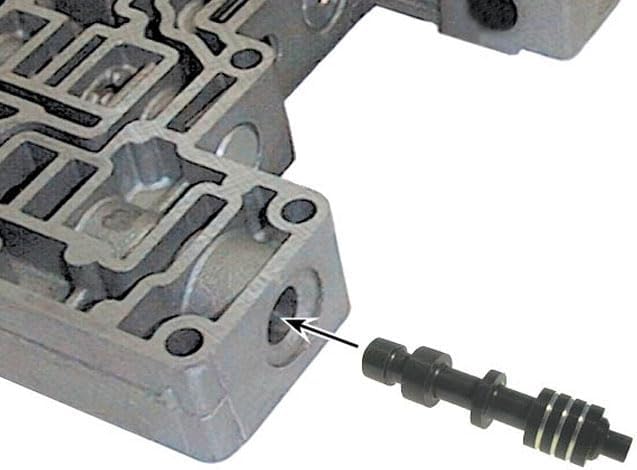
Gears magazine, ATRA's technical publication, lays out a practical method for separating these three, and it applies directly to the 4R75W. For the torque converter: sit stationary in neutral and listen; if it's quiet there, select any gear and add a little throttle. A noise that increases with throttle in gear points at the converter, likely the bearings between the stator and pump or the stator and turbine. For the pump: stay stationary in neutral and raise engine RPM; a pitch that rises with RPM suggests a pump problem, though a clogged or leaking filter or air entering the intake produces the identical sound, so the pump itself may not be the actual fault. ATRA also recommends testing in reverse at idle, since line pressure typically rises there; a louder noise in reverse points at the pump, and gear-and-crescent pumps, what the 4R75W uses, are the most sensitive to this test. If reverse makes it worse, check the converter hub and the pump's inner gear for wear, since wear there lets the gear shift toward the crescent and changes clearance, which is exactly the kind of wear a boost valve and sleeve kit is built to correct once the bore itself has gone out of tolerance.
For the planetary geartrain, rule out the converter and pump first, then use the gear-range method: pitch changes with vehicle speed, volume changes with load, and the trick is matching which gear the noise shows up in against which planetary member is doing work in that gear. Like other Ford overdrive automatics in this family, the 4R75W's direct gear runs 1:1 with no planetary member under reduction load, so a whine that persists unchanged through that gear is probably not planetary at all. A whine present in some gears and absent in others points straight at whichever member is active where it shows up. ATRA's article adds one more universal check worth doing on every noise complaint regardless of source: inspect the engine and transmission mounts, since a worn mount can transmit an otherwise normal noise straight into the cabin.
| Noise & pattern | Likely source | Fix | Source |
|---|---|---|---|
| Whine, tracks road/output speed, present in drive and coast, loudest at rear of case | Output shaft bearing (3rd-generation design) | Replace with a 2nd-generation-style bearing | Sonnax |
| Whine/tone that rises with throttle in any gear, fades in lockup | Torque converter stator/turbine bearings | Converter replacement | Gears Magazine (ATRA) |
| Rising-pitch whine with engine RPM, stationary in neutral; louder in reverse at idle | Pump or converter-hub wear, or filter/intake air leak mimicking pump noise | Check filter/intake first, then pump and boost valve/sleeve inspection | Gears Magazine (ATRA) / Sonnax |
| Whine present in some gears, absent in the 1:1 direct gear | Planetary member active in the affected gears | Internal inspection by gear-range pattern | Gears Magazine (ATRA) |
| Grinding/whine with slipping or loss of reverse, on a 4R75E with a speed sensor | Planetary gear assembly failure (4R75E only) | Ford service kit AL3Z-7A398-C | Ford TSB 16-0032 |
| Clunk on Reverse-to-Drive shift | Axle lube level, axle backlash, pinion bearings, or U-joints | Check/fill axle lube, inspect U-joints and backlash | Ford driveline diagnosis manual |
| Clunk on takeoff from a stop | Worn CV/U-joints with play, or loose axle mount | Inspect and replace U-joints/driveshaft; check mount bolts | Ford driveline diagnosis manual |
| High-pitched whine with cavitation symptoms, low/old fluid | Low fluid level or aerated ATF | Correct fluid level, use spec'd MERCON V | Motorcraft |
Clunk sources: Ford's own driveline chart, with the actual numbers
Ford's own driveline diagnosis manual (Section 205-00, written around the 2005 F-150 but applicable across Panther and F-150 platforms running this case family) carries a Noise, Vibration and Harshness chart that lists exactly where to look for a clunk, and the transmission is not the listed cause for any of them. A driveline clunk when shifting from Reverse to Drive is attributed to incorrect axle lubricant level, excessive backlash in the axle, damaged or worn pinion bearings, or damaged or worn U-joints. A clunk that occurs as the vehicle starts to move forward following a stop is attributed to a worn driveshaft CV joint or U-joints with excessive play, or a loose axle mount. A clunk during acceleration or the transition from cruise to coast/deceleration is attributed to a damaged or worn CV joint. The same chart separately lists axle howling or whine as its own condition, caused by low axle lubricant, axle housing damage, worn wheel hub bearings, or a worn differential ring and pinion or its bearings, worth knowing because a rear-axle whine is routinely reported by a customer as "the transmission is whining" when it isn't.
Ford's manual also gives a concrete way to check pinion bearing wear rather than guessing: with the transmission in Neutral, one rear wheel on the ground and the other raised off the floor, it specifies a torque wrench rated to at least 271 Nm (200 lb-ft) to rotate the axle shaft, and the breakaway torque required just to start that rotation must be at least 27 Nm (20 lb-ft). If the shaft spins free with noticeably less resistance than that, worn or incorrectly preloaded pinion bearings are a real candidate for the clunk on Reverse-to-Drive, not a guess. The same section specifies a maximum pinion flange runout of 0.25 mm (0.010 in); beyond that, Ford's procedure is to remove the flange, reindex it a half turn on the pinion, and recheck before condemning the ring and pinion. Both numbers come straight from the manual, not estimates, and they turn "it feels loose" into an actual pass/fail check.
Ford's prescribed checks follow directly from the chart: check and correct the axle lubricant level and look for excessive backlash, inspect the U-joints for wear or play with the rear wheels chocked, transmission in Neutral and the engine off, pulling and twisting the driveshaft at each joint to feel for play, and check for a loose axle mount. None of that work touches the transmission. A 4R75W pan coming off before anyone has checked axle backlash and U-joint play is the job being done in the wrong order.
The 4R75E trap: when a "4R75W" noise complaint isn't a 4R75W at all
The 4R75W and 4R75E share the same case family, but the 4R75E adds a turbine shaft speed sensor and is the electronically shifted version, mostly found in E-Series vans and some F-150 applications. Ford's TSB 16-0032 covers a documented planetary gear assembly failure on 2008-2010 F-150 and E-Series 4R75E units, separate from the earlier 14-0153 bulletin covering the same failure mode: the complaint is grinding or whine-type noise, vibration, and/or gear slippage while driving, sometimes with a loss of reverse, usually alongside DTCs in the P0731-P0734 range along with related codes. The fix starts with pulling the pan and checking for metal debris with a magnet; if debris is present, the repair calls for the planetary upgrade kit, Ford part AL3Z-7A398-C, plus a torque converter replacement if certain TCC-related codes (P0741, P1741, P1742, P1743) are also present. None of that kit or procedure applies to a mechanical 4R75W. If your noise complaint is paired with slipping, loss of reverse, or those specific codes rather than a clean whine or clunk, confirm which unit is actually on the vehicle from the case ID tag before ordering parts.
Diagnostic sequence: work through it in order
- Characterize first. Continuous tone or single impact? If it's a tone, does it track engine RPM (even in Park) or road/output speed? If it's an impact, what exact transition triggers it?
- For a tone, run the converter, pump and gear-range tests. Listen in neutral with throttle applied for converter noise, raise RPM stationary in neutral for pump noise, and check whether the whine persists through the 1:1 direct gear to rule the planetary set in or out.
- If the tone tracks road speed and is loudest at the rear of the case, stethoscope the area just ahead of the extension housing or transfer case adapter and suspect the output shaft bearing before assuming it's the converter or the differential.
- If there's slipping, loss of reverse, or TCC-related codes alongside the noise, confirm whether you're actually on a 4R75E before ordering a 4R75W part.
- For any clunk, start outside the transmission. Chock the rear wheels, put the transmission in Neutral with the engine off, and pull/twist the driveshaft at each U-joint to feel for play. Check the axle fluid level and look for excessive backlash, and run the breakaway-torque check if pinion bearing wear is suspected.
- Check fluid level and condition early in either case. A low or aerated fill produces its own whine through pump cavitation that has nothing to do with a worn part.
Fluid note
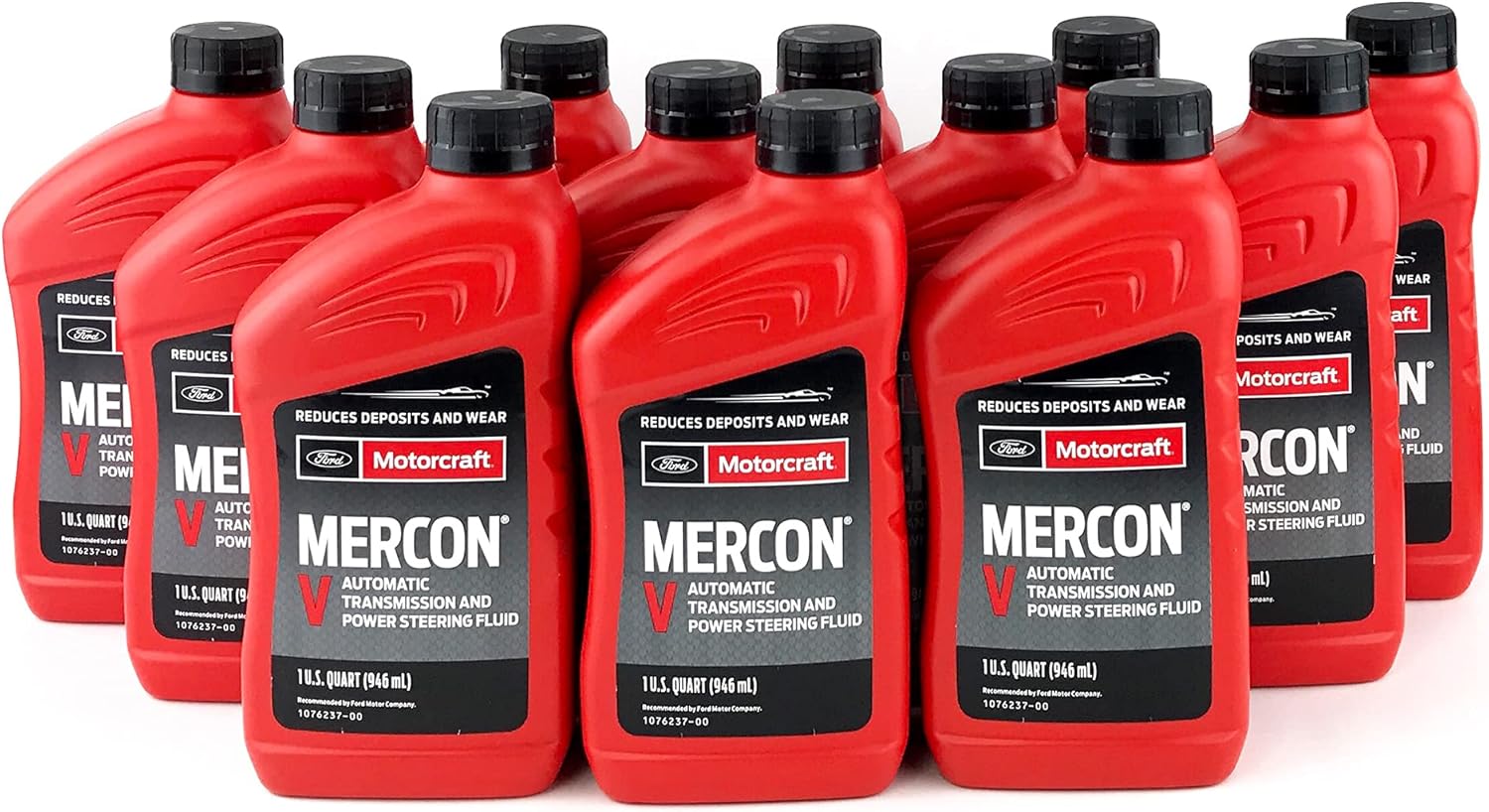
None of the mechanical noise sources above are caused by the wrong fluid, but a low or aerated fill produces a whine of its own through pump cavitation, so rule it out early and cheaply before any teardown. The 4R75W specs Motorcraft MERCON V, a premium ATF built from hydroprocessed base oils with performance additives and dyed red for leak detection; it's Ford's correct replacement spec across Ford, Lincoln and Mercury applications that previously called for standard MERCON. See our 4R75W fluid type and capacity guide for exact fill quantities.
Need parts for this job?
Our 4R75W parts page carries pumps, valve body components, solenoid kits and rebuild kits for the platform. Checkout is on site.
4R75W Remanufactured Pump Assembly 2004-2008
If the pump-side test above points at actual pump wear rather than a filter or intake leak, this is the part that fixes it. Sold by our sister store, CoreTransmissionParts.
Shop the part for this fix →Chasing the output shaft bearing, a case bushing, or a full rebuild instead? Browse the full 4R75W parts collection on CoreTransmissionParts.
FAQ
What's the difference between a 4R75W whine and a clunk?
A whine is a continuous tone produced by something spinning under load and wearing: a bearing, a planetary member, or the pump. A clunk is a single, sharp impact noise tied to one specific moment, like a gear shift or a direction change, and it usually points to mechanical slack somewhere in the driveline rather than a part spinning itself worn. Sort which one you actually have before you ever pull a pan, because the two point at completely different repairs.
Why does a 4R75W rear-case whine seem to fade when the converter locks up?
Sonnax has documented exactly this pattern on the 4R70W/4R75W case family getting misdiagnosed as a converter bearing problem. The real source, the bearing between the output shaft and the case, is loudest while the output shaft is spinning under load; once the converter clutch locks the converter to the engine, the load path through the rear of the case shifts enough that the tone can fade or change character, even though the bearing, not the converter, is the actual source. Confirm the noise is present only while the output shaft is turning before you condemn the converter.
Is a clunk shifting from Reverse to Drive always a transmission problem on an F-150 or Crown Victoria?
No. Ford's own driveline diagnosis manual lists a loud clunk on the Reverse-to-Drive shift under four possible sources: incorrect axle lubricant level, excessive backlash in the axle, damaged or worn pinion bearings, or damaged or worn U-joints, none of which are inside the transmission. Check the rear axle and driveshaft first; tearing into a 4R75W to chase this specific complaint is usually the wrong move.
What's actually failing when a 4R75W's output shaft bearing goes bad?
Sonnax traces it to the design used in the third generation of this bearing, an enclosed design with fewer and smaller rollers than the earlier generations, which it calls a probable design defect rather than ordinary wear. A failing one shows pitting or spalling on the rollers and both races once the case is opened. Sonnax recommends replacing it with the more robust second-generation-style bearing, and its own SBK-F6 internal bearing kit lists bearing noise and bearing failure as the symptoms it addresses.
Is a 4R75W whine with slipping or a loss-of-reverse complaint actually a 4R75E problem?
It can be, if you're actually looking at the electronic 4R75E rather than the 4R75W. The two units share a case family but the 4R75E adds a turbine shaft speed sensor; Ford's service kit AL3Z-7A398-C addresses a documented planetary gear assembly failure on 2008-2010 F-150 and E-Series 4R75E units that causes grinding or whine-type noise, vibration, gear slippage, and sometimes loss of reverse, usually alongside codes like P0731 through P0734. Confirm which unit you actually have from the ID tag before ordering parts, because the 4R75W does not use that kit.
Related guides
- 4R75W Pump Failure Symptoms
- 4R75W Valve Body Problems and Testing
- 4R75W TCC Lockup Explained
- 4R75W Fluid Type and Capacity
- 4R70W vs. 4R75W Differences
Sources
- Sonnax, "4R70W/4R75W Mystery Bearing Noise" (tech resource). Backs the output shaft bearing wear point, the three bearing generations, the stethoscope location at the rear of the case, and the test confirming the noise occurs only with the output shaft turning. sonnax.com
- Sonnax, SBK-F6 Bearing Kit product page, 4R70W/4R75W applications. Backs the bearing noise/bearing failure symptoms the kit addresses and the bearing locations it covers. sonnax.com
- Gears Magazine (ATRA), "Beyond the Basics: The Sound of Silence, Diagnosing Transmission Noises." Backs the converter/pump/planetary diagnostic tests, including the throttle-in-gear converter test, the stationary-RPM pump test, the reverse-idle pump test, and the gear-range method for isolating planetary noise. gearsmagazine.com
- Ford Motor Company, F-150 Workshop Manual, Section 205-00, "Driveline System - Diagnosis and Testing" (2005 F-150 edition). Backs the driveline clunk symptom-to-cause entries, the axle howl/whine entry, and the breakaway-torque (27 Nm/20 lb-ft minimum) and pinion flange runout (0.25 mm/0.010 in maximum) specifications. blueovaltrucks.com
- Ford Motor Company / Motorcraft, MERCON V Automatic Transmission and Power Steering Fluid product page (FCSD Chemicals and Lubricants). Backs the MERCON V fluid specification referenced in the fluid note. fcsdchemicalsandlubricants.com
- Vehicle Service Pros, "Noisy Ford Transmission, Including F-150, Gets Service Kit," reporting Ford TSB 16-0032. Backs the 4R75E planetary gear assembly failure, the DTC range, the AL3Z-7A398-C kit, and the TCC-code converter replacement step covered in the 4R75E section above. vehicleservicepros.com