No movement in any gear, forward or reverse, with the engine idling clean and the fluid level correct, is the symptom that sends most techs straight to the front pump on a 4R75W. The pump is the one component that has to work before anything else in the transmission can — no pump pressure, no clutch apply, no gear, no matter what shape the rest of the unit is in. The 4R75W shares its front pump and converter architecture with the rest of the AODE/4R70E/4R70W/4R75E family, which is also why the real documentation on pump wear and the parts built to fix it comes from sources written for that whole platform rather than the 4R75W by itself.
The complication is that a weak or dead pump and a worn pressure regulator valve in the valve body produce almost the same symptom: low or erratic line pressure. Replacing a pump that was never the problem is how a shop eats the labor twice.
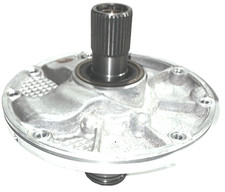
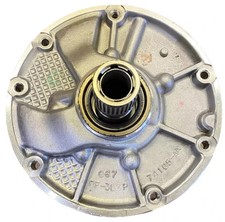
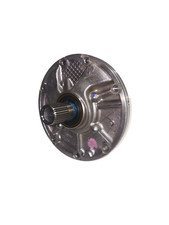
What the Front Pump Does and Why It Wears
The front pump bolts into the front of the case and is driven directly by the torque converter hub, which rides inside a bushing pressed into the pump body. Every time the engine turns, the pump's job is to draw fluid from the pan and push it out as regulated line pressure to the valve body, the clutches, and the cooler circuit. There is no other source of pressure in the transmission — if the pump can't build and hold pressure, nothing downstream can apply, no matter how good the clutches or valve body are.
That converter hub-to-bushing interface is the platform's documented weak point. Sonnax's own pump bushing listing for the AODE/4R70E/4R70W/4R75E/4R75W group (shared with C6, 4R100, E4OD, AOD and 5R110W) names four conditions the bushing is built to correct: a leaking front seal, pump noise, excess converter hub-to-bushing clearance, and low pump volume. Sonnax's separate technical article on bushing wear generally notes that a rough or dirty shaft journal is a leading cause of bushing failure, and recommends an 8–12 RMS surface finish on the shaft riding in it — which is exactly the surface the converter hub presents to the pump bushing on this platform.
Symptoms That Point at the Front Pump
- No movement in any gear, forward or reverse, with correct fluid level and a normally running engine — the single clearest pump symptom there is.
- A whine or growl that changes pitch with engine RPM, not road speed, which points at a worn pump rotor, slide, or bushing rather than a bearing or gear noise downstream.
- Delayed or soft engagement into gear after the vehicle has sat, especially if it improves briefly after revving the engine.
- Low or erratic line pressure across all ranges on a gauge test.
- Foamy or aerated-looking fluid on the dipstick, a sign the pump is drawing air through a worn bushing or a bad O-ring rather than pulling clean fluid.
- Overheating, since a pump that can't deliver full volume also can't push adequate flow through the cooler circuit.
Cause 1: Pump Bushing and Converter Hub Wear
This is the documented mechanical weak point on this platform, not a rare fluke. The OE pump bushing is machined in place at the factory; Sonnax's replacement bushing (36002-01) is a steel-backed bronze, finish-in-place part specified to a shaft diameter of 1.996" and a housing bore of 2.124", because aftermarket bushings that come pre-sized often run too thin and leave excess clearance between the bushing and the converter hub. Once that clearance opens up, the hub rides loose in the bushing, the seal around it starts leaking, pump noise shows up, and pump volume drops because fluid works its way past the clearance instead of being delivered as usable pressure.
The practical implication for a rebuild: if a pump is noisy, leaking at the front seal, or weak on volume, check the actual converter hub-to-bushing clearance before assuming a new pump alone fixes it. A worn or scored hub on the old converter will open up clearance in a brand new bushing almost as fast as it did in the old one, which is why the hub itself deserves inspection any time the pump is replaced.
Cause 2: A Worn Pressure Regulator Valve Can Mimic Pump Failure
Before condemning the pump on a low- or erratic-pressure complaint, rule out the valve body. Sonnax sells a direct-replacement main pressure regulator valve (76948-09) for '96-and-later 4R70E, 4R70W, 4R75E, 4R75W and AODE valve bodies specifically because a worn OE regulator valve spool produces low or erratic line pressure in every range — the same complaint a weak pump produces. Sonnax tech writer Brian Wing documents how common this is: scoring on the EPC end of the PR valve in 4R70W, 4R75W and AODE units, with reduced line pressure and low line rise as the result, and a bore that usually wears along with the valve, so a new valve alone may not seal (Sonnax, "Watch Out for 4R70W Pressure Regulator Valve & Casting Wear"). The Sonnax installation sheet for this valve calls for a vacuum test of at least 18 in-Hg at the regulator's test port after installation, which gives a concrete bench check that the regulator circuit itself is sealing correctly once the new valve is in.
The diagnostic split is straightforward in principle even if it takes some bench time to confirm: gauge line pressure with the valve body apart and the regulator valve known-good (new or freshly inspected). If pressure is still low or erratic with a good regulator in place, the fault is upstream at the pump. If pressure comes back to spec once the regulator valve is replaced, the pump was never the problem.
A Related Family Bulletin, With a Caution
Ford has issued a service kit for the electronically controlled 4R75E — used in 2008–2010 Mark LT and F-150, 2008–2011 Crown Victoria, Grand Marquis and Town Car, and 2008–2010 plus 2013–2014 E-Series — covering grinding or whine-type noise, vibration, gear slippage, or loss of reverse traced to planetary failure, with a planetary upgrade kit (AL3Z-7A398-C) as the fix. This bulletin is written for the 4R75E, not the 4R75W — they are different transaxle/transmission codes in the same broad Ford family, and the fix does not transfer directly. It's worth knowing this bulletin exists so a 4R75E complaint doesn't get diagnosed as a 4R75W pump problem by mistake, but don't apply its parts or DTC list to a 4R75W job.
Diagnosing It on the Bench and Scan Tool
- Confirm fluid level and condition hot, on level ground, before anything else. Foamy or aerated fluid points at the pump drawing air.
- Listen for pump whine with the vehicle in Park and the engine revved slowly. A whine that tracks RPM, not road speed, is consistent with pump wear rather than a downstream bearing or gear.
- Gauge line pressure at idle and at a stall test, comparing against factory spec. Low pressure across every range is the starting point for both of the causes above.
- Isolate pump vs. regulator by testing or replacing the pressure regulator valve first, since it's the far cheaper and faster check, before pulling the pump.
- Pull the pump and inspect the bushing bore and converter hub for scoring, wear, or excess clearance if pressure stays low with a known-good regulator valve.
- Check the torque converter hub surface finish whenever the pump comes out, regardless of which part turns out to be the root cause.
The Fix
Match the repair to what's actually worn, not to whichever part is sitting on the shelf:
- Worn pump bushing with a good converter hub: a finish-in-place replacement bushing restores correct hub clearance without replacing the whole pump.
- Worn or scored converter hub: replace or recondition the converter. Installing a new bushing against a bad hub just restarts the same wear cycle.
- Worn pump rotor, slide, or cracked housing: replace the pump assembly outright rather than trying to recondition internal wear surfaces.
- Low pressure that persists after a known-good regulator valve: this confirms the pump itself, not the valve body, and justifies the replacement.
- Low or erratic pressure that resolves with a new regulator valve: the pump was fine — stop there and don't replace it.
4R75W Remanufactured Pump Assembly, 2004-2008
Direct replacement front pump assembly for 2004-2008 4R75W units. Check the torque converter hub for wear before reinstalling — a scored hub will open up clearance in a new pump just as fast as it did in the old one.
Get the 4R75W pump assembly →Need just the bushing or a full rebuild kit instead? Browse the full 4R75W parts collection.
Fluid, and Why It Matters Here
The 4R75W specifies MERCON V. Ford's Customer Service Division made MERCON V the mandatory replacement for MERCON ATF as of July 1, 2007, citing improved anti-oxidation, anti-wear and anti-shudder properties over the fluid it replaced. The spec is measurable: Motorcraft's MERCON V product data sheet lists license number M5091101, 7.5 cSt at 100°C, 33.2 cSt at 40°C and a viscosity index of 205, so check that an aftermarket bottle carries a MERCON V license rather than a vague "suitable for" claim. Fluid that has oxidized and lost film strength lubricates the pump bushing and converter hub less effectively, so running the correct fluid, changed on a reasonable interval, is a real factor in how long that bushing clearance stays within spec rather than just a box to check after the repair.
The Short Version: A Pump Failure Checklist
- Confirm the symptom: no movement in any gear is the clearest pump signal; a changing-pitch whine and low pressure are the next strongest clues.
- Rule out the pressure regulator valve before condemning the pump — it produces the same low-pressure symptom and is far cheaper to replace.
- If pressure stays low with a known-good regulator, pull the pump and inspect the bushing bore and converter hub for wear or scoring.
- Replace or recondition the converter hub alongside the pump if it's worn — don't put a new bushing against a bad hub.
- Refill with MERCON V only and confirm fluid condition before road testing.
Worked in that order, most pump complaints turn into either a cheap valve body fix or a pump-and-converter job done once, instead of a pump swap that quietly fails again a few thousand miles later because the real wear was in the converter hub all along.
FAQ
What are the first signs of front pump failure on a 4R75W?
The classic sign is no movement in any gear, forward or reverse, with the engine running fine and the fluid level correct — that points straight at the pump not generating pressure. Short of total failure, watch for a whine that changes pitch with engine RPM, delayed or soft engagement after the vehicle sits, and fluid that looks foamy or aerated on the dipstick, which is a sign the pump is drawing air instead of pure fluid.
Can a worn pressure regulator valve be mistaken for a bad pump?
Yes, and it happens often enough that Sonnax sells a direct-replacement regulator valve (76948-09) for this exact reason on 4R70E, 4R70W, 4R75E, 4R75W and AODE units. A worn regulator valve spool produces erratic or low line pressure in every range, which looks and feels a lot like a weak pump. The difference is that a pump test at the line pressure port with a known-good regulator will show correct pressure; if pressure is still low after the valve body is ruled out, the pump itself is the problem.
Does converter hub wear really cause pump failure?
It is one of the documented causes. Sonnax's own pump bushing listing for this platform names excess converter hub-to-bushing clearance as one of the conditions its replacement bushing is built to correct, alongside pump noise, a leaking front seal, and low pump volume. A worn or scored converter hub rides in the pump bushing, and as that clearance opens up, fluid bypasses the pump's pressure side instead of being delivered to the clutches, which shows up as weak or inconsistent line pressure.
Should the torque converter be inspected when replacing a 4R75W pump?
Yes. The converter hub is the shaft that actually rides inside the pump bushing, so if the pump failed from bushing or hub wear, a scored or undersized hub on the old converter will start the same wear cycle in a brand new pump. Checking the hub diameter and surface finish against spec before the new pump goes in is cheap insurance against doing the job twice.
What fluid does a 4R75W use and does it matter for pump life?
The 4R75W specifies MERCON V, which Ford's Customer Service Division made the mandatory replacement for MERCON ATF as of July 1, 2007, citing improved anti-oxidation and anti-wear properties. Fluid that has broken down loses lubricating film strength at the pump bushing and converter hub, so running the correct, fresh fluid is a real factor in how long that bushing clearance stays within spec.
Working a 4R75W pump this week?
Pump assemblies, bushings, converters and full rebuild kits — shipped fast from the USA.
Shop 4R75W parts →Sources
- Sonnax — Pump Bushing, Part No. 36002-01, product page. Backs the shared AODE/4R70E/4R70W/4R75E/4R75W pump bushing design, the steel-backed bronze finish-in-place replacement spec (1.996" shaft diameter, 2.124" housing bore), and the four symptoms it addresses: leaking front seal, pump noise, excess converter hub-to-bushing clearance, and low pump volume. sonnax.com
- Sonnax — Main Pressure Regulator Valve, Part No. 76948-09, installation instructions. Backs this valve's fitment for '96-and-later 4R70E, 4R70W, 4R75E, 4R75W and AODE valve bodies, its use as a direct fix for low or erratic line pressure caused by a worn OE regulator spool, and the minimum 18 in-Hg vacuum test called for after installation. cdn.transend.us
- Sonnax — "Bushwhacked! Keys to Avoiding Preventable Bushing Problems," Tech Resources. Backs the general bushing-wear mechanism cited for the converter hub/pump bushing interface: rough or dirty shaft journals as a leading cause of bushing failure, and the recommended 8-12 RMS shaft surface finish. sonnax.com
- Vehicle Service Pros — "Noisy Ford Transmission, Including F-150, Gets Service Kit." Backs the separate Ford 4R75E service kit (planetary upgrade kit AL3Z-7A398-C) for grinding/whine noise, vibration, gear slippage and loss of reverse on 2008-2011 Mark LT, F-150, Crown Victoria, Grand Marquis, Town Car and E-Series — cited here specifically to distinguish the 4R75E bulletin from the 4R75W covered in this article. vehicleservicepros.com
- Underhood Service — "Ford Announces More Stringent Specification Replacement for MERCON Automatic Transmission Fluid." Backs the July 1, 2007 mandatory transition from MERCON to MERCON V and the stated anti-oxidation, anti-wear and anti-shudder improvements. underhoodservice.com
- Sonnax — Brian Wing, "Watch Out for 4R70W Pressure Regulator Valve & Casting Wear," Tech Resources. Backs EPC-end PR valve scoring in 4R70W, 4R75W and AODE units, the resulting reduced line pressure and low line rise, and bore wear that a new valve alone will not fix. sonnax.com
- Ford Customer Service Division (Motorcraft) — MERCON V Automatic Transmission Fluid Product Data Sheet. Backs license number M5091101, 7.5 cSt at 100°C, 33.2 cSt at 40°C and viscosity index 205. Motorcraft MERCON V data sheet (PDF)