A 4T65E that bangs into every gear almost always gets the same first guess: bad pressure control solenoid, order one, drop it in. Sometimes that's the whole fix. Just as often the truck or car comes back three to six months later with the same harsh shifts and a fresh code, because the solenoid was never the real problem. The 4T65E's line pressure circuit is a chain of parts working together, and you have to know where in that chain things actually broke before you buy anything.
The short version: Per GEARS magazine (ATRA), the 4T65E uses a PCM-controlled Pressure Control Solenoid Valve instead of a vacuum modulator, and that solenoid works with the Actuator Feed Limit Valve, Torque Signal Regulator Valve, and Line Boost Valve to set line pressure. When any of those stick or leak, pressure goes too high and shifts get harsh. Code P1811 (Maximum Adapt and Long Shift) sets when an upshift runs 0.65 seconds longer than the target time on two occurrences in one ignition cycle, and the PCM responds by commanding maximum line pressure with no check-engine light. Transmission Digest adds a second, easy-to-miss cause: excess 2nd- and 3rd-clutch-pack clearance that slips under hard throttle and sets a related ratio code. Confirm which one you have with a line pressure gauge before you order parts.
How the 4T65E Controls Line Pressure
Unlike the vacuum-modulated 4T60E, GEARS magazine explains that the 4T65E uses a PCM-controlled Pressure Control Solenoid Valve for line pressure, which lets the computer adapt shift feel to engine load, driving style, and manufacturing wear. The PCM drives the solenoid with a variable duty-cycle signal at a fixed frequency of 292.5 Hz: a higher duty cycle increases current through the solenoid, a lower duty cycle decreases it, and the PCM monitors that current to hold it steady.
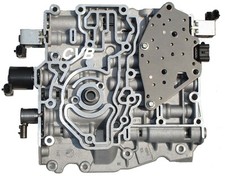
The solenoid itself works on a feed/bleed principle. It receives a regulated supply of oil from the Actuator Feed Limit (AFL) Valve in the channel plate, which caps feed pressure at roughly 115 psi so the solenoid never floods. That feed oil passes through a 0.035-inch orifice under a screen in the solenoid's snout. Magnetic force from the solenoid's winding current acts on a pintle valve that controls the solenoid's bleed rate, which creates a variable boost signal. That signal positions the Torque Signal Regulator (TSR) Valve in the valve body, which modulates line pressure down to a boost pressure. The boost pressure then feeds the Line Boost Valve, which pushes directly on the Pressure Regulator Valve to raise line pressure. Four parts, one chain: Pressure Control Solenoid → Actuator Feed Limit Valve → Torque Signal Regulator Valve → Line Boost Valve → Pressure Regulator Valve.
That's also why a bad reading anywhere downstream of the solenoid can look like a solenoid problem. If the AFL valve, TSR valve, or line boost valve sticks or leaks from sediment and wear, line pressure rises even with a perfectly good solenoid.
What Actually Sets Code P1811
GM's 4T65E control strategy is adaptive. Per GEARS, the PCM tracks the time each upshift takes, compares it to a target time, and stores the result in memory locations called TAP cells (Transaxle Adaptive Pressure). Each transmission operating state, such as the 1-2 shift under moderate throttle, has its own TAP cell, and each cell step represents about 12.5 ft-lbs of calculated engine torque. When a shift takes longer than desired, the PCM adds pressure for next time; when the adaptive limit is reached and the shift is still too slow, the PCM gives up adapting.
Transmission Digest defines the trigger precisely: if a shift takes longer than 0.65 second and the adaptive modifier cannot shorten it by raising pressure, an internal counter increases by one. If that happens twice in the same ignition cycle, the PCM sets DTC P1811 (Maximum Adapt and Long Shift), commands maximum line pressure, and disables further shift adapts. Neither source lists P1811 as a code that lights the Malfunction Indicator Lamp, so the only symptom is a transmission that suddenly bangs into every gear, including Park to Drive and Park to Reverse.
GEARS lists the common causes for P1811, in roughly the order techs encounter them:
- Pressure control solenoid failure
- Sediment, debris, or wear at the Torque Signal Regulator Valve, causing it to stick or leak
- Sediment, debris, or wear at the Actuator Feed Limit Valve, causing it to stick or leak
- A worn Line Boost Valve and sleeve assembly
- PCM calibration, on certain early applications
Transmission Digest describes a related but separate failure path: the 4T65E has a turbine-speed sensor that lets the PCM compare commanded gear to actual gear ratio, something the older 4T60E could not do. If the 2nd- or 3rd-clutch-pack clearance is excessive, a driver who gets into the throttle can make that clutch slip. The PCM tries to compensate by raising line pressure first, which is why the fault is intermittent; if raising pressure holds the clutch together, no code sets that trip. When it finally can't compensate, you get a ratio-related code alongside, or instead of, P1811. This is why a solenoid swap that "fixes" the shift for a few months and then the problem returns is a classic 4T65E callback.
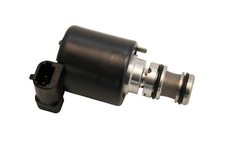
4T65E Pressure Control Solenoid, 1995-2003
If your line pressure gauge shows pressure following the solenoid's commanded current correctly but still reading high across the board, start here. GEARS notes these solenoids have a high failure rate even at low mileage, and can fail in just one pressure range while testing fine elsewhere.
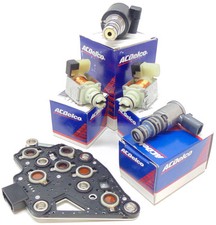
Shop the 4T65E pressure control solenoid →Need the 2003-up version or the full solenoid kit instead? Browse all 4T65E parts.
Diagnosing It: Gauge Before Guessing
GEARS lays out the bench approach:
1. Check for a calibration update first
On 1998 Buick LeSabre and Park Avenue, Oldsmobile Eighty Eight, and Pontiac Bonneville models with the 3.8L V6 (8th VIN character K), GEARS documents a PCM calibration update that addresses insufficient line rise commands that can cause a shudder or slip during hard acceleration after slowing for a stop. Check the installed calibration number against the known-update list with a scan tool before you assume a hardware failure.
2. Put a gauge on it
Connect a 0-300 psi gauge to the line pressure port and use a scan tool to command line pressure directly, which GEARS notes only works in Park or Neutral. Compare the readings against the solenoid's published current-to-pressure chart; GEARS gives figures from roughly 243-310 psi at 0 amps down to 65-80 psi at 1.1 amps. Any reading that deviates from that curve means you have a line pressure control problem somewhere in the chain.
3. Use mileage as a tiebreaker
Per GEARS, under 50,000 miles on a transmission that's clean and free of debris, the pressure control solenoid itself is the most likely cause; these solenoids fail even at relatively low mileage, sometimes giving poor control in just one pressure range (such as 80-120 psi) while reading correctly everywhere else. Over 50,000 miles, or if there's debris in the pan or filter, GEARS says to inspect the Torque Signal Regulator Valve and bore, the Actuator Feed Limit Valve and bore, and the Line Boost Valve and sleeve assembly for wear or sticking before you replace the solenoid again.
Sonnax's own technical documentation on the 4T65E valve body backs up the wear angle from the other direction: on the 3-4 accumulator valve train, bore wear lets torque signal, accumulator, or line pressure exhaust, which Sonnax lists as a cause of soft shifts and poor line rise in that specific circuit. The lesson carries across the valve body: a worn bore doesn't reliably give you one symptom. Depending on which passage it leaks, the same kind of wear can read as too much pressure in one circuit and too little in another, which is exactly why a pressure gauge and a careful look at the valve body beat a parts-cannon approach.
Fluid and the Adaptive Relearn
GM specifies DEXRON-VI for the 4T65E. Per GM's own GMW16444 global service-fill specification, documented in SAE technical paper 2006-01-3242, DEXRON-VI was engineered specifically to remain backward-compatible with DEXRON III and DEXRON II applications, so it's correct across both older and newer 4T65E builds; always check the fluid fill label or service manual for the specific vehicle in front of you. Low or badly worn fluid won't set P1811 by itself, but it will make an already-marginal valve body or solenoid worse, so a fluid and filter service is worth ruling out before you start pulling the pan apart.
After any repair, whether it's a new solenoid or a rebuilt valve body, clear the TAP cell values with a scan tool and drive the vehicle through a normal cycle so the PCM can relearn fresh adaptive pressures. A unit that spent months commanding maximum pressure to compensate for a stuck valve can carry some of that learned pressure forward if the adapts aren't reset, which can make a freshly repaired transmission feel firmer than it should for the first several miles.
Preventing a Repeat
Don't replace the pressure control solenoid on faith. Pull a line pressure reading first, note the mileage and pan condition, and use GEARS' own mileage rule to decide whether to start with the solenoid or the valve body. If the vehicle already had a solenoid replaced and came back with the same complaint, go straight to the valve body and the clutch-pack clearance Transmission Digest describes, rather than installing a second solenoid.
Don't let a harsh unit run on max adapts for long, either, because the damage spreads past the valve body. Sonnax's note on the 4T65-E TCC relief valve (84757-01K) explains that the OE apply relief does not crack until 175 psi, on a converter piston designed for 135 psi, and that under high line pressure conditions like max adapts, apply pressure can climb above 225 psi. At that point the piston deflects and can destroy the piston and lining. A car that has been banging shifts for months often has a converter on the way out, too.
The same goes for a harsh engagement into Drive from Park or Neutral. Sonnax ties most 4T65-E forward band failures to intermittent EPC control: the TCM raises pressure as Drive is selected, the EPC lags, and the band "would shudder then slam in" once pressure caught up, until it broke. Their overhaul fix is a new EPC solenoid, verified pressure regulator and torque signal bores, and an extended forward servo pin (84571-01K) about .200 inch longer than stock to cut the roughly .400 inch servo stroke in half.
FAQ
What causes a 4T65E to shift hard?
Almost always too much line pressure. GEARS magazine lists pressure control solenoid failure, sediment or wear at the torque signal regulator valve, sediment or wear at the actuator feed limit valve, and a worn line boost valve and sleeve as the common causes, with PCM calibration as a less common fifth cause.
What is DTC P1811 on a 4T65E?
P1811 is Maximum Adapt and Long Shift. Per GEARS and Transmission Digest, it sets when an upshift runs 0.65 seconds longer than the PCM's desired time on two occurrences in one ignition cycle. The PCM then commands maximum line pressure and disables shift adapts, so every shift gets harsh and the check engine light does not come on.
Does a new pressure control solenoid always fix P1811?
No. Transmission Digest describes units that come back three to six months after a solenoid swap because the real problem was excess clutch-pack clearance or valve body wear, not the solenoid. GEARS gives a mileage rule: under 50,000 miles on a clean transmission, suspect the solenoid first; over 50,000 miles or with debris in the pan, inspect the torque signal regulator and actuator feed limit valve bores before replacing parts.
How do you test 4T65E line pressure to confirm the cause?
Connect a 0-300 psi gauge to the line pressure port and use a scan tool to command line pressure in Park or Neutral, per GEARS. Compare the readings to the solenoid's published current-versus-pressure chart. A reading that will not follow the commanded current points to the solenoid; a reading that tracks current correctly but is still out of range points to a valve body problem.
What transmission fluid does a 4T65E take?
GM specifies DEXRON-VI for the 4T65E. Per GM's own GMW16444 global service-fill specification, DEXRON-VI fluid is backward-compatible with earlier DEXRON III and DEXRON II applications, so it is correct for both older and newer 4T65E builds. Always confirm the exact spec against your vehicle's own fluid label or service manual.
Keep the numbers at the bench. Our free transmission fluid spec chart lists the correct ATF type for the 4T65E and dozens of other units, so you never top off with the wrong fluid.
Sources
- GEARS Magazine (ATRA) — Mike Van Dyke, "4T65E Headaches: The Causes for, and Diagnosis of, Code P1811" (June/July 2002). Backs: the Pressure Control Solenoid Valve/AFL Valve/Torque Signal Regulator Valve/Line Boost Valve pressure chain, the 292.5 Hz duty-cycle signal, the 115 psi AFL limit and 0.035-inch orifice, TAP cells and the 12.5 ft-lbs per cell step, the 0.65-second long-shift definition, the five common P1811 causes, the 1998 calibration update for 3.8L V6 Buick/Olds/Pontiac models, the line-pressure-gauge diagnostic method and current-to-pressure chart, and the under/over 50,000-mile diagnostic rule. atracom.blob.core.windows.net/gears/2002/2002-07/2002_07_22.pdf
- Transmission Digest — Wayne Colonna, "The 4T65-E: 'Slip-Sliding Away'" (August 1, 2003). Backs: P1811 and P0730 appearing three to six months after overhaul, the 0.65-second adaptive-modifier threshold and the two-occurrence-per-ignition-cycle rule for setting P1811, the 4T65E's turbine-speed sensor enabling ratio monitoring that the 4T60E lacks, and excess 2nd/3rd-clutch-pack clearance as an intermittent root cause that a solenoid replacement will not fix. transmissiondigest.com/the-4t65-e-slip-sliding-away
- Sonnax — 4T65-E Oversized 3-4 Accumulator Valve Kit technical page. Backs: bore wear at the accumulator valve train allowing torque signal, accumulator, or line pressure to exhaust, producing soft shifts and poor line rise in that circuit, supporting the point that valve body wear can produce either high or low pressure symptoms depending on which passage leaks. sonnax.com/parts/2574-oversized-3-4-accumulator-valve-kit
- SAE International — Paper 2006-01-3242, “General Motors DEXRON®-VI Global Service-Fill Specification.” Backs: GM's GMW16444 specification for DEXRON-VI as the specified 4T65E fluid and its backward compatibility with DEXRON III and DEXRON II applications. saemobilus.sae.org/papers/general-motors-dexron-vi-global-service-fill-specification-2006-01-3242
- Sonnax — TCC Relief Valve 84757-01K for GM 4T65-E. Backs: the 135 psi TCC piston design limit, the 175 psi OE relief crack point, apply pressure above 225 psi under high line pressure such as max adapts, and the resulting piston and lining damage. sonnax.com/parts/2589-tcc-relief-valve
- Sonnax — “Stop 4T60-E, 4T65-E Case Wear, Band Slippage & Breakage with a Longer Servo Pin.” Backs: intermittent EPC lag as the main cause of harsh Drive engagement and forward band breakage, the ~.400 inch stock servo stroke, the ~.200 inch longer pin 84571-01K, and the EPC/PR/TC signal overhaul recommendations. sonnax.com/tech_resources/612-stop-4t60-e-4t65-e-case-wear-band-slippage-breakage-with-a-longer-servo-pin