"Slipping" on a 4T65E almost always turns out to be one of three distinct problems, and they do not share a fix. A weak 1-2 shift with a soft Reverse is a valve body bore wear issue. A shudder or slip that only shows up at a steady 40-55 mph cruise is the torque converter clutch losing apply pressure. And a transaxle that revs with zero forward movement in Drive but pulls fine in Low and Reverse is a one-way clutch that has physically let go. None of those three get fixed by the same part, so the first job is figuring out which one you actually have.
This is a front-wheel-drive unit found across a huge range of GM cars and minivans from 1997 through 2011 — Impala, Grand Prix, Lumina, Regal, Century, Venture, Uplander and more — and the valve body wear points are consistent across all of them because the casting and hydraulic design barely changed. Here is how to separate the three failure patterns and what actually fixes each.
Rule Out Fluid Before Anything Else
Check level and condition first, because both can produce a slip that looks mechanical but costs nothing to fix. A low level pulls air into the pump on hard acceleration or a tight turn, and aerated fluid compresses instead of transmitting pressure cleanly — it flares, slips, and recovers, intermittently, in whatever gear or converter state you happened to be in. GM's fluid specification for 4T65E-equipped vehicles calls for DEXRON-VI, with the 2008 Chevrolet Impala owner's manual listing an automatic transmission fluid capacity of 7.4 qt (7.0 L) and a note that more fluid may be needed when the converter is drained or replaced. Dark, burnt-smelling fluid is not a warning sign at that point — it is confirmation that friction material has already cooked once.
If the level and color both check out, the problem is mechanical or hydraulic, and the next question is exactly which gear or driving condition triggers it.
Weak 1-2 Shift, Flare, Delayed Engagement, or Soft Reverse
This pattern — a flare or slip specifically around the 1-2 shift, a noticeably delayed engagement when you put the car in gear, or a Reverse that feels weak or slow to build — points at a single wear location shared across the whole valve body family. Sonnax's technical notes on its oversized 1-2 and Reverse servo boost valve kit describe the mechanism directly: continuous stroking of the 1-2 (Forward) and Reverse servo boost valves wears the cast valve body bores they ride in, creating excess clearance and reduced apply pressure to both servos. The listed symptom set is exactly this complaint — 1-2 flare, delayed engagement, low Reverse pressure, and a burned 1-2 band from the clutch running without full apply force.
This affects GM 4T60, 4T60-E and 4T65-E units as a group, because the servo bore design carried forward largely unchanged across all three. The fix is Sonnax part 84754-40K, a hardcoat anodized aluminum valve sized to more than double the valve-to-bore contact area compared to the OE valve, which stops the leak path without replacing the whole valve body casting. One kit repairs one bore; if both the 1-2 and Reverse bores are worn, which is common on a unit with this many miles on the same valve body, you need two kits and the dedicated reaming tool.
4T60E / 4T65E Transmission Filter and Pan Gasket Kit 58837
Any valve body repair means the pan comes down and the valve body comes off. The filter and pan gasket are the two consumables every one of these jobs eats, and reusing a heat-set gasket on a unit you just repaired for a pressure leak is a false economy.
View the filter and gasket kit →Slip or Shudder Only at Steady Light-Throttle Cruise
If the slip shows up specifically as a shudder or vibration during a light-throttle highway cruise — and goes away the moment you lift off or push harder — you are not looking at a gear clutch at all. You are looking at the torque converter clutch (TCC) losing its grip. The 4T65E runs the TCC on a controlled-apply strategy rather than a simple on/off lockup, which is part of what GM's own engineering paper on the transaxle describes as a redesigned torque converter with reduced internal leakage incorporating a controlled-slip clutch, introduced as part of the third evolution of this front-wheel-drive four-speed family.
Sonnax's technical notes on the 4T65-E TCC regulated apply valve kit lay out the failure: the OE TCC regulated apply bore wears, which lets both TCC signal (PWM) oil and TCC regulated apply oil leak past the valve. That leak lowers the pressure actually holding the converter clutch closed, and a clutch that is not fully clamped slips under load — which at light cruise throttle is exactly the condition where it has the least margin to begin with. The listed symptom set is TCC slip, diagnostic trouble code P0741, and a TCC slip RPM that cycles up and down rather than sitting flat, which is the saw-tooth pattern you would see if you logged it on a scan tool. The repair, Sonnax part 84754-34K, replaces the valve with a hardcoat anodized unit and a wear-resistant sleeve rather than relying on the worn cast bore to seal it.
Because this symptom disappears under hard acceleration — the PCM commands full line pressure and unlocks the converter outright once you're off cruise — it's easy to dismiss as "just a quirk" for months. It isn't. The bore wear only gets worse, and P0741 typically arrives well after the driver has already been living with the shudder.
No Movement in Drive or Overdrive, Normal in Low and Reverse
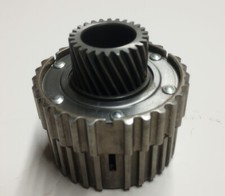
This is the pattern that gets misdiagnosed as "the transmission is completely dead" when it is actually one specific part. If the engine revs with no forward movement in D or OD, but the car pulls normally in manual Low (1) and Second (2), and Reverse also works, you are not dealing with a slipping clutch pack at all — Drive and Overdrive on this unit rely on the forward (input) sprag, a one-way clutch, locking up to transmit torque. Low range and Reverse apply an entirely different clutch and band, so they keep working even with the sprag completely gone.
A one-way clutch either locks or it doesn't; there is no partial-slip middle ground the way there is with a friction clutch pack, which is why this failure tends to announce itself suddenly rather than building up gradually like a worn clutch does. Once a forward sprag has failed, it is replaced as a matter of course on any overhaul that gets that far into the unit — there's no field adjustment or hydraulic fix, because the part itself is physically broken or has lost its rollers' grip on the race.
Do not keep driving a car in this state trying to "get it somewhere." A failed sprag that's partially hanging up rather than fully broken can shed hardened pieces into the valve body and clutch circuits, turning a sprag-and-case job into a full rebuild.
Confirm Before You Commit
Fluid level and condition first. Then narrow by exactly which gear or driving condition triggers the slip — 1-2/Reverse points at the servo boost valve bores, light-cruise shudder with a cycling TCC slip RPM points at the TCC regulated apply valve, and no-movement-in-D-with-normal-Low-and-Reverse points straight at the forward sprag. A scan tool reading TCC slip RPM and shift-adapt data while road testing will confirm the converter-clutch pattern before you ever drop the pan, and it costs nothing but time.
If more than one of these patterns is present at once — say, a soft Reverse and a cycling TCC slip — treat them as two separate repairs rather than looking for one part that explains both. On a valve body this old, multiple bores wearing out around the same mileage is normal, not a sign you're missing something.
Diagnosis points at a valve body repair, not a full rebuild?
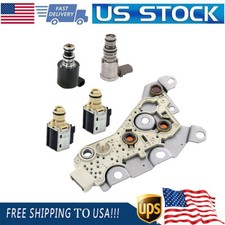
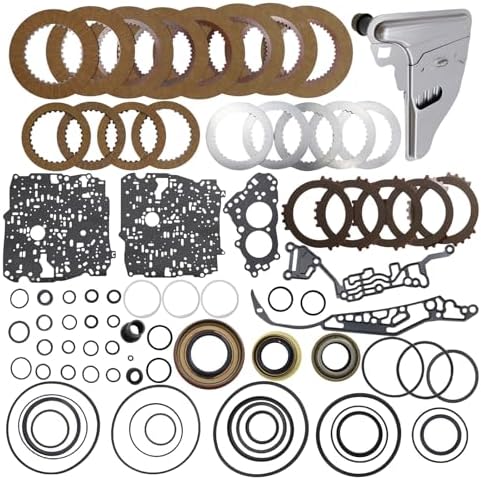
Pressure control and TCC solenoids, valve bodies, sprag clutches, and full master rebuild kits for the 4T65E are in stock and ship fast.
Shop 4T65E parts →FAQ
What does it mean if a 4T65E has no movement in Drive but is fine in Low and Reverse?
That split is the signature of a failed forward (input) sprag, not a clutch pack or valve body problem. The forward sprag is a one-way clutch that has to lock for the unit to pull in Drive, Third and Overdrive. Low range and Reverse apply a different clutch and band entirely, so they keep working normally even with the sprag completely gone. If you can move the car in 1 and 2 but it just revs with no movement in D or OD, the sprag has failed and the unit needs to come apart.
Why does a 4T65E slip only on light throttle TCC lockup, not under hard acceleration?
Because that is a torque converter clutch apply problem, not a gear clutch problem. Sonnax's technical notes on the 4T65-E TCC regulated apply valve describe how bore wear in the valve body lets regulated apply oil leak past the valve, which lowers the pressure holding the converter clutch closed. Under light cruise throttle the clutch is barely holding to begin with, so a small pressure loss shows up as slip or shudder. Under hard acceleration the PCM commands full line pressure and unlocks the converter anyway, which is why the symptom disappears.
Can low transmission fluid cause a 4T65E to slip?
Yes, and it is the first thing to rule out because it is free to check. A low level lets the pump draw air, and aerated fluid compresses instead of applying a clutch cleanly, which produces an intermittent slip or flare that comes and goes rather than a consistent one. GM's own fluid specification for 4T65E-equipped vehicles calls for DEXRON-VI, with a stated automatic transmission fluid capacity of 7.4 quarts (7.0 L) on the 2008 Impala, plus a note that more fluid may be needed when the converter is drained. Check level hot, in Park, per the dipstick procedure, before assuming anything mechanical.
Is a worn 1-2 and Reverse servo boost valve a common cause of 4T65E slip?
Yes. Sonnax documents this as a wear item across the shared 4T60, 4T60-E and 4T65-E valve body family: continuous stroking of the 1-2 (Forward) and Reverse servo boost valves wears their bores, creating excess clearance and reduced apply pressure. The listed symptoms are 1-2 band slip or flare, delayed engagement, low Reverse pressure, and a burned 1-2 band. It is a valve body repair, not a case-apart rebuild, using an oversized hardcoat valve to restore the seal.
Sources
- Sonnax — Oversized 1-2 & Reverse Servo Boost Valve Kit (84754-40K) technical page. Backs the servo boost valve bore wear mechanism shared across GM 4T60, 4T60-E and 4T65-E units, and the resulting 1-2 flare, delayed engagement, low Reverse pressure and burned 1-2 band symptoms. sonnax.com
- Sonnax — TCC Regulated Apply Valve Kit (84754-34K) technical page. Backs the TCC regulated apply bore wear mechanism, the resulting TCC signal and apply oil leakage, and the TCC slip, code P0741 and cycling TCC RPM symptom set. sonnax.com
- Sonnax — Sure Cure Kit (SC-4T65E) product page. Backs the valve body compatibility of these repairs across 4T65-E applications from 1997 through 2011, including Buick, Chevrolet and Pontiac platforms. sonnax.com
- SAE International — "General Motors 4T65-E Electronic Four-Speed Automatic Transaxle," SAE Technical Paper 980821. Backs the 4T65-E being the third evolution of GM's original four-speed front-wheel-drive automatic, and the redesigned torque converter with reduced internal leakage incorporating a controlled-slip clutch. saemobilus.sae.org
- General Motors — 2008 Chevrolet Impala Owner Manual. Backs DEXRON-VI as the specified automatic transmission fluid, the 7.4 qt (7.0 L) fluid capacity figure, and the note that additional fluid may be needed when draining or replacing the torque converter. assets.gm.com