A 4T65E pan-and-filter service looks like the easiest job in the shop right up until someone torques the pan bolts down like a cylinder head, reuses a gasket that already took a permanent set, or pours in a round number of quarts because a spec sheet somewhere says "7.4 qt" and they assume that is what comes back out. None of those mistakes announce themselves immediately. They show up two weeks later as a drip off the pan rail, a seep at the vent, or a dipstick reading that will not make sense no matter how carefully it is checked. This is the service done the way GM's own documentation, not a guess, says to do it.

The Pan Drop Only Touches Part of the System
GM's own capacity chart for a 4T65E-equipped Chevrolet Impala lists the automatic transmission at 7.4 qt (7.0 L), with a footnote: "When draining/replacing converter, more fluid may be needed." That number is a total-system figure covering the pan, the valve body area, the cooler lines, and the torque converter together — and a routine pan-and-filter service never touches the converter or the full cooler circuit. It only drains what is sitting in the pan and around the valve body.
That is the entire reason two shops can report wildly different quart counts for "a 4T65E fluid change" without either one being wrong. One is describing a pan drop, the other a converter swap or a full refill after a rebuild. The habit that keeps you out of trouble is simple: measure what actually comes out of the pan, pour back in close to that measured amount, then finish the fill on the dipstick rather than chasing the 7.4-quart total-system number during a service that was never designed to recover it. Overfilling a 4T65E from a misread capacity spec causes aeration and shift quality complaints that look exactly like a low-fluid problem, just in the opposite direction.
Torque Matters More Than It Looks Like It Should
This transaxle has a documented history of punishing a sealing surface that was not torqued correctly, and it did not take a pan to prove it. GM Technical Service Bulletin #01-07-30-032E covers 1997-2009 GM passenger cars and light-duty trucks, including Saturn, built with the Hydra-Matic 4T65-E, for a transmission fluid leak at the vent. The bulletin's stated cause is an improperly torqued channel plate (case cover) gasket, and the fix GM specifies is simply replacing that gasket correctly — not a redesign, not a recall. That is a different gasket than the one under the pan, but it tells you something real about this case: it does not forgive a gasket that was clamped unevenly or cranked down past where it needed to go.
Treat the pan the same way. Run every bolt down finger-tight first, then bring them up in a criss-cross pattern across two or three passes rather than torquing each one fully in sequence around the perimeter. Stop as soon as the gasket is evenly compressed, not when the bolt stops turning. A stamped-steel pan warps easily, and an overtightened corner opens a gap at the opposite corner just as surely as an undertightened one does — the comeback leak looks identical from the outside either way.
Filter and Seal: Replace What Actually Fails
The filter rides in a press-fit collar sealed by an O-ring, and that O-ring, not the filter media, is the part most likely to seep if there is a leak right at the filter neck after a service. Pull the old filter straight down out of the collar, and replace the seal every time regardless of how clean the filter itself looks. A filter that tests clean on a worn or nicked seal will still let fluid bypass around it.
The factory 4T65E pan gasket is a reusable, pressure-formed gasket rather than a paper-and-RTV setup, and it is designed to seal on clamping pressure alone. "Reusable" is not the same as "reuse indefinitely," though. Once a gasket shows a crushed or hardened edge where it has sat under the pan rail for years, replace it rather than adding sealant to compensate — sealant on a gasket that is supposed to seal dry just changes which direction the leak eventually finds.
Fluid: What Actually Goes Back In
GM's Service Insights technical documentation states that DEXRON-VI "replaces DEXRON-III(H) and DEXRON-II(E)" and is the recommended fill across GM's stepped-gear automatic transmissions, which covers both the earlier DEXRON-III-spec 4T65E units and the later DEXRON-VI factory fills. There is no scenario on this transaxle where the service bay needs to stock a separate older-spec fluid for an older car — DEXRON-VI was engineered specifically to take over that role.
On the interval, GM's maintenance schedule splits normal and severe service rather than using one number for every car. Under severe service, the schedule calls for a fluid and filter change roughly every 50,000 miles. Under normal service, it shows a single scheduled change at 100,000 miles. GM defines severe service, for this purpose, as a vehicle mainly driven in heavy city traffic at 90°F (32°C) or higher, in hilly or mountainous terrain, while frequently towing a trailer, or in taxi, police, or delivery use. Read that list against how most daily-driven 4T65E cars actually spend their time and a lot of owners who assume they are on the easy schedule are closer to the severe one than they realize.
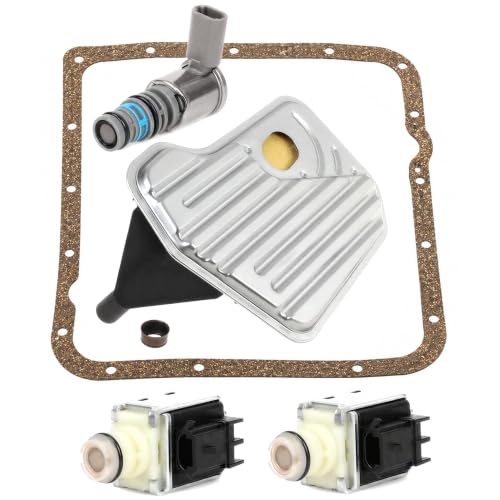
4T60E / 4T65E Transmission Filter and Pan Gasket Kit 58837
Every pan-drop service on this transaxle eats a filter seal and, eventually, a gasket. Carrying the kit means a comeback leak never gets blamed on a part that was sitting on the shelf the whole time.
View the filter and gasket kit →While the Valve Body Is Exposed, Check This Too
A pan drop on a 4T65E exposes the separator plate and the valve body bores underneath it, which makes this the cheapest moment to catch a second wear point before it becomes its own comeback. Sonnax's TCC apply valve kit (84754-43K) for this transmission documents the converter apply valve wearing its own cast-aluminum bore from continuous oscillation, worsened by side loading built into the valve body's casting and oil flow design. The published symptom list is specific: no lockup, code P0741, falling out of lockup when hot, converter shudder, and high TCC slip RPM. None of that shows up during a pan-and-filter service by itself, but if the vehicle came in with any of those complaints alongside a fluid service request, this is the bore to check while everything is already apart, rather than sending the car out and having it come back for a second teardown.
What the Fluid You Drain Is Telling You
A pan drop is also a free diagnostic look, and it is worth treating it that way instead of just dumping the pan and moving on. Fine, uniform gray-black material on the magnet is normal wear. Metal flakes or chunks, a clutch-material smell, or fluid that is dark brown and burnt rather than dark red are not routine, and they point at a problem a filter and fluid change will not fix. If that is what the pan shows, the right next step is a real diagnostic path rather than a repeat service — our 4T65E common problems and diagnosis guide and the 4T65E torque converter shudder diagnosis guide both start from exactly this kind of pan evidence.
FAQ
How much fluid actually comes out during a 4T65E pan drop?
Less than the total system figure. GM's own capacity chart for a 4T65E-equipped Impala lists 7.4 qt (7.0 L) for the automatic transmission, with a footnote that more fluid is needed when the converter is drained or replaced. A pan drop never touches the converter or the full cooler circuit, so it only recovers a portion of that 7.4-quart total. The right amount to pour back in is whatever you measured coming out, finished on the dipstick, not a fixed quart count.
What fluid does a 4T65E take for a filter service?
DEXRON-VI. GM's Service Insights technical documentation states DEXRON-VI replaces DEXRON-III(H) and DEXRON-II(E) across its stepped-gear automatic transmissions, which covers both the early DEXRON-III-spec 4T65E units and the later DEXRON-VI factory fills. There is no reason to hunt down an older-spec fluid for this service.
Can the 4T65E pan gasket be reused?
Only if it has not taken a set. The factory gasket is a reusable, pressure-formed design rather than a paper gasket, but once it shows a crushed or hardened edge where it has ridden the case for years, replace it instead of chasing a leak with sealant. GM's own bulletin on this transmission's channel plate gasket shows the case is sensitive to torque on its sealing surfaces, and the pan deserves the same care.
How often should the fluid and filter be changed on a 4T65E?
Under GM's severe-service schedule, roughly every 50,000 miles. Under normal service, the factory schedule shows a single change at 100,000 miles. Severe service covers heavy city traffic at 90°F or higher, hilly or mountainous terrain, frequent trailer towing, or taxi, police, or delivery use, per GM's owner's manual maintenance schedule.
Why would a 4T65E leak fluid from the vent right after a service?
GM Technical Service Bulletin #01-07-30-032E documents exactly this symptom on 1997-2009 4T65E-equipped vehicles, tracing it to an improperly torqued channel plate (case cover) gasket rather than a design flaw, with the fix being a straightforward gasket replacement. It is a different gasket than the pan, but it is proof this case does not forgive a gasket that was over- or under-torqued during assembly or service.
Shop 4T65E filters, pan gaskets, solenoids, valve body components and rebuild kits — shipped fast from the USA.
Shop 4T65E parts →Sources
- General Motors — 2008 Chevrolet Impala Owner Manual. Backs the 7.4 qt (7.0 L) automatic transmission capacity with the footnote that more fluid may be needed when draining or replacing the converter; DEXRON-VI as the specified fluid; and the severe-service fluid-and-filter interval of roughly every 50,000 miles versus a single normal-service change at 100,000 miles, including GM's definition of severe service. assets.gm.com
- GM Service Insights — "Use the Right Transmission Fluid." Backs DEXRON-VI replacing DEXRON-III(H) and DEXRON-II(E) and being the recommended fill across GM's stepped-gear automatic transmissions, including earlier DEXRON-III-spec units. gmserviceinsights.com
- General Motors Technical Service Bulletin #01-07-30-032E (reproduced in full, Sept. 29, 2008 revision), "Transmission Oil Leaking From Transmission Vent (Replace Transmission Case Cover (Channel Plate) Gasket)." Backs the bulletin's coverage of 1997-2009 4T65E-equipped GM vehicles and its finding that the leak traced to an improperly torqued channel plate gasket, corrected by gasket replacement. xlr-net.com
- SAE International — "General Motors 4T65-E Electronic Four-Speed Automatic Transaxle," Paper 980821. Backs the 4T65E's introduction for the 1997 model year as GM's third evolution of this front-wheel-drive four-speed transaxle, including its revised oil pump and torque converter design. saemobilus.sae.org
- Sonnax — TCC Apply Valve Kit, part 84754-43K (GM 4T65-E). Backs the converter apply valve bore wear mechanism from continuous oscillation and casting-driven side loading, and the published symptom list: no lockup, code P0741, falling out of lockup when hot, converter shudder, and high TCC slip RPM. sonnax.com – TCC Apply Valve Kit