The 4T65E pump does not live where a rear-wheel-drive guy expects it. There is no pump bolted to the front of the case behind the converter. On this transaxle the pump is a variable-displacement vane pump mounted on the valve body and channel plate under the side cover, driven by a long pump shaft that runs through the channel plate and picks up its drive from the converter. That layout changes how a pump failure shows up, what else fails along with it, and which replacement pump you can actually bolt on. This is how to tell a tired pump from a pressure-regulation problem, what to measure on the bench, and how not to order the wrong design level.
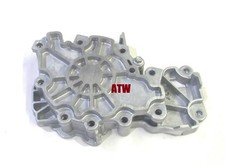
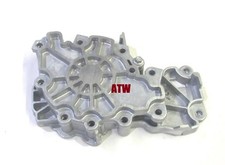

How the 4T65E Pump Makes and Loses Pressure
The pump is a rotor and vane set running inside a slide. The slide pivots to change how much oil the pump moves: at idle it swings toward maximum output, and as line pressure comes up the slide is pushed back toward minimum so the pump is not wasting horsepower. Line pressure itself is set by the pressure regulator valve in the valve body, with a boost valve assembly behind it that raises pressure when torque signal oil from the pressure control (EPC) solenoid circuit asks for more.
That gives you three ways to end up with low line pressure, and only one of them is the pump:
- The pump cannot make the volume. Worn rotor, vanes, slide or pocket faces, or a slide that is stuck. Sonnax's 4T65E-LB1 instruction sheet puts it plainly: excess clearance equals low pump volume and pressure. Too loose gives low pressure; too tight gives no line rise because the slide is stuck.
- The regulator side is leaking it away. Sonnax documents that the OE 4T65-E boost sleeve is aluminum with two steel valves and a steel plug inside it, and the steel valves wear the sleeve and leak boost oil. Their listed symptoms for that wear are erratic line pressure, soft upshifts (especially 1-2), delayed Reverse and low line rise in Forward and Reverse.
- The signal is wrong. The torque signal regulator valve sits under the EPC solenoid. Sonnax warns that sticking, binding or wear there causes low line pressure, and GM bulletin 00-07-30-002B lists sediment in the PC solenoid and a sticking torque signal regulator valve as causes of high or low line pressure on 1997-2002 units.
Replace a pump for a worn boost sleeve and the customer comes back with the same soft 1-2. Sort these out before you order anything.
Pump Failure Symptoms and What Each One Points To
| Complaint | Most likely area | Why |
|---|---|---|
| Delayed engagement into Drive and Reverse, worst after sitting or when hot | Worn pump clearances, or worn boost sleeve | Low volume at idle means the apply circuits take longer to fill. Thin hot fluid leaks past worn clearances faster. |
| Whine that rises and falls with engine rpm, not road speed | Pump rotor, vanes or slide; low fluid causing cavitation | The pump turns with the converter, so pump noise tracks engine speed in Park and Neutral too. |
| Soft, long shifts, P1811 on a hot drive | Low line rise: pump, boost valve, AFL or torque signal circuit | The PCM raises pressure through the adapts and sets P1811 when it runs out of room. |
| No movement in any range after a rebuild or valve body job | Pump shaft not engaged, damaged pump, loose pump bolts | No drive to the rotor means no pressure at all. Check this first on a fresh install. |
| TCC slip, P0741, second-gear starts, falls out of 4th | Worn AFL valve bore in the channel plate | Not the pump itself, but it starves the solenoids and is easy to blame on the pump. |
How the PCM Reacts to a Weak Pump
A worn pump rarely sets a code that says "pump." What you get is the adapt system trying to cover for it. Wayne Colonna's write-up in Transmission Digest (August 2003) explains the 4T65E strategy: the PCM uses the turbine speed sensor to time every shift, and if a shift takes longer than 0.65 second and the adapts cannot shorten it by raising line pressure, a counter increments. Two of those in one drive cycle sets P1811, maximum adapt and long shift. If the shift completes in time, the PCM watches gear ratio, and slip lasting more than six seconds sets P0730.
On the scan tool, that means a weak pump shows up as high TAP (transmission adaptive pressure) cells across several shifts, not just one. Colonna lists the shift error, shift time, TAP cell and steady-state TAP PIDs. A pump problem tends to push TAP values up on every shift and in every gear at once. A single high cell, such as 3-4 only, points at that clutch or its apply circuit instead.
Diagnosis Before the Side Cover Comes Off
1. Fluid level and condition
A low level will make a healthy pump cavitate, whine and drop pressure on turns and hard stops. GM's owner manual for 4T65E cars such as the 2008 Impala calls for DEXRON-VI, lists the transaxle at 7.4 quarts (7.0 L) with a note that more may be needed if the converter is drained or replaced, and says to check it at normal operating temperature of 180-200°F. Look at the filter and pan too. Aluminum paste and vane fragments are pump; clutch material with no metal is usually something else.
2. Line pressure, done the GM way
GM bulletin 00-07-30-002B covers 1997-2002 4T65-E units with harsh or soft shifts, flares, shudder or P1811/P0748, and its pressure test has three rules worth following on any year. First, the scan tool can only command the PC solenoid in Park and Neutral with the vehicle stopped, which protects the clutches in Drive and Reverse. Second, the specification table assumes 70°C fluid, and pressure changes with temperature, so test hot. Third, because the faults can be intermittent, run the test at least three times.
Read the results this way:
- Low at idle and stays low as you command pressure up: the pump cannot make volume, or the regulator is dumping it. Pump clearances and boost sleeve go to the top of the list.
- Normal at idle but will not rise to the commanded value: look at the boost valve and sleeve, the torque signal regulator valve under the EPC solenoid, the PC solenoid itself, and the AFL valve. Also consider a stuck slide, which Sonnax ties to "no line rise."
- Pressure follows the command but the shift is still long: pressure is not your problem. Go to clutch clearances, piston seals and accumulators.
3. Rule out the AFL valve and channel plate
Sonnax's channel plate guide lists the four common 4T65-E channel plate problems: a worn actuator feed limit (AFL) valve bore, a pitted or noisy axle bearing, a worn or damaged pump shaft sleeve, and channel plate to case gasket blowout. The AFL valve regulates line pressure to a maximum of 115 psi and feeds the EPC solenoid and the 1-2/3-4 shift solenoid. A worn bore leaks that oil to exhaust, which Sonnax ties to low line rise with P1811, TCC slip with P0741, second-gear starts and falling out of 4th. Those are pressure complaints, and they get blamed on the pump all the time. The same guide is the reason to inspect the pump shaft sleeve whenever the channel plate is off: if the shaft has been riding on a worn sleeve, you will see it on the shaft as well.
Bench Checks on the Pump
Once the pump is on the bench, Sonnax's 4T65E-LB1 sheet gives the measurements:
| Check | Spec / method | What a failure means |
|---|---|---|
| Slide end play | 0.0003-0.0016 in | Over spec bleeds volume. Under spec can bind the slide. |
| Rotor and vane end play | 0.0020-0.0033 in | Over spec means low volume, worst hot and at idle. |
| Method | Feeler gauge and straight edge across the pump face, or Plastigauge with the pump bolted together | Measure; do not judge by eye. |
| Slide freedom | Strip all pump parts and seals, assemble the halves with only the slide, and shake | You should hear the slide move. If it does not, expect no line rise. |
While it is apart, look for scoring on the pocket faces, chipped vanes, a rotor with a worn spline, and wear on the pump shaft where it rides in the channel plate sleeve. Scoring you can catch a fingernail on is a replacement, not a cleanup.
4T65E Pump, 1997-2001
Bench numbers out of spec on an early two-piece unit? Swap in a complete pump assembly. Check the ID tag first; the 2002-03 redesign below matters.
View the 1997-2001 4T65E pump →Ordering the Right Pump: the 2002-2003 Redesign
This is where people lose a week. Per Transmission Digest's June 2004 Tech/Talk, beginning in June 2002 Hydra-matic changed the 4T65-E oil pump from a two-piece to a three-piece design on 2002 and 2003 models, and it dragged related parts with it:
- Pump: the three-piece pump now carries the rotor support sleeve, which used to be in the valve body.
- Pump bolts: different lengths from the earlier bolts. Do not reuse the old set on the new pump.
- Valve body: the rotor support sleeve was removed from the valve body to accept the three-piece pump.
- Pressure switch assembly: changed to a much smaller unit with every switch eliminated except the TCC switch, with a matching internal harness.
- Pressure control solenoid: much smaller than the earlier design.
The article lists four combinations you can find in the field (two-piece or three-piece pump, each with the large first-design or small second-design pressure switch) and states that none of those parts interchange. First-design parts go together and second-design parts go together. It also warns that the new and old PC solenoids will physically fit in either unit, and that swapping them causes "customer dissatisfaction and additional repairs." The only reliable way to order is to read the update level on the ID tag before you buy. A used pump off an unknown core is a gamble unless you match the design to the valve body.
Replacement: Doing It Once
- Find the cause of the wear. Debris from a failed clutch or a plugged filter will wear a new pump fast. Flush the cooler and lines and replace the filter.
- Match the design level of pump, valve body, pressure switch and PC solenoid to the ID tag, per the redesign above.
- Address the regulator side while you are there. If line rise was low, inspect the boost valve and sleeve. Sonnax's drop-in boost valve kit 84754-30K replaces the worn OE sleeve assembly so the valve body can be saved, and it is vacuum tested at 18 in-Hg minimum per their instructions. Check the torque signal regulator valve under the EPC solenoid at the same time.
- Inspect the AFL bore and the pump shaft sleeve in the channel plate, and flat-sand the channel plate if the gasket has blown out, per the Sonnax guide.
- Torque the pump and valve body bolts to the service manual value in sequence with an inch-pound wrench. Loose bolts under the pump are a real cause of no movement; one owner on a Grand Prix forum traced a no-movement 4T65E to three 10 mm bolts below the pump that had backed out completely.
- Confirm the pump shaft is engaged before the side cover goes on. No engagement means no pressure and no movement.
- Fill with DEXRON-VI, set the level hot, then reset the adapts. The PCM learned high TAP values to cover the weak pump. Clear them with a scan tool and drive normal traffic so it relearns on the new pressure.
Shop 4T65E pumps, master rebuild kits, valve bodies and pressure control solenoids — shipped fast from the USA.
Shop 4T65E parts →FAQ
What are the symptoms of a bad 4T65E pump?
Delayed engagement into Drive and Reverse, a whine that follows engine rpm even in Park, soft or long shifts that get worse hot, and P1811 from the PCM running out of adapt range. A pump with no drive at all gives no movement in any range.
Is the 4T65E pump in the front of the transmission?
No. On the 4T65E the oil pump is a vane pump mounted on the valve body and channel plate under the side cover. It is driven by a pump shaft that runs through the channel plate, so the side cover has to come off to service it.
Do 4T65E pumps interchange between years?
Not freely. Transmission Digest reports that beginning in June 2002 the pump changed from a two-piece to a three-piece design, with matching changes to the valve body, pump bolts, pressure switch and PC solenoid. First-design and second-design parts do not interchange, so read the ID tag before ordering.
How do I know if low line pressure is the pump or the valve body?
Test hot and repeat the test at least three times. If pressure is low at idle and stays low as you command it up, suspect pump clearances or a worn boost sleeve. If idle pressure is normal but it will not rise, look at the boost valve, the torque signal regulator valve under the EPC solenoid, the PC solenoid and the AFL valve.
Shop the 4T65E master rebuild kit at CoreTransmissionParts → or browse all rebuild kits
Related 4T65E guides
Sources
- Transmission Digest — Tech/Talk, June 2004 issue, "THM 4T65-E: 2002-2003 Oil-Pump Changes." Backs the June 2002 change from a two-piece to a three-piece pump, the rotor support sleeve moving from the valve body into the pump, different pump bolt lengths, the smaller pressure switch and PC solenoid, the four field combinations, no interchange between design levels, the PC solenoid warning, and reading the ID tag before ordering. transmissiondigest.com
- Sonnax — Line Pressure Booster Kit 4T65E-LB1 instructions (4T65E-LB1-IN, 2022). Backs excess pump clearance causing low volume and pressure, too loose = low pressure and too tight = stuck slide with no line rise, the feeler gauge/straight edge and Plastigauge methods, the slide shake test, slide end play 0.0003-0.0016 in, rotor and vane end play 0.0020-0.0033 in, and the torque signal regulator valve under the EPC solenoid. sonnax (PDF)
- Sonnax — 4T65-E Boost Valve Kit 84754-30K. Backs the OE aluminum boost sleeve with two steel valves and a steel plug, sleeve wear leaking boost oil, and the symptoms of erratic line pressure, soft upshifts, delayed Reverse and low line rise; plus the 18 in-Hg vacuum test from its instructions. sonnax.com
- Sonnax — "GM 4T65-E Channel Plate Common Problems & Solutions." Backs the worn AFL bore, worn or damaged pump shaft sleeve, axle bearing and gasket blowout problems, AFL regulation to 115 psi feeding the EPC and 1-2/3-4 solenoids, and the P1811, P0741, second-gear start and falls-out-of-4th symptoms. sonnax.com
- Wayne Colonna, Transmission Digest — "The 4T65-E: 'Slip-Sliding Away,'" August 1, 2003. Backs the turbine speed sensor shift timing, the P1811 (over 0.65 second, twice per drive cycle) and P0730 (slip over six seconds) logic, and the shift time, shift error and TAP PIDs. transmissiondigest.com
- General Motors — 2008 Chevrolet Impala Owner Manual. Backs DEXRON-VI, the 7.4 qt (7.0 L) capacity, and the 180-200°F operating temperature for the fluid check. assets.gm.com (PDF)
Also referenced: GM service bulletin 00-07-30-002B (line pressure test conditions on 1997-2002 4T65-E units), and a Grand Prix owner forum thread for the loose pump bolt field case.