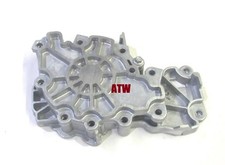
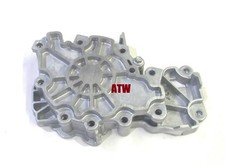
If your 2002 or later Chevrolet Impala, Monte Carlo, Buick LeSabre, Century or Pontiac Grand Prix with the 4T65E is slow to pick up Drive or Reverse after it sits, whines in step with engine speed, or has started setting P1811 on a long hot drive, the oil pump belongs on your suspect list. This is a remanufactured 4T65E pump for the 2002-and-later design, supplied with the pump rotor support already in place. The listing references GM part numbers 24225894 for the pump and 24213197 / 24206183 for the rotor support, which is what you should compare against your old unit.
What the pump does in a 2002-up 4T65E
The 4T65E does not use a front-mounted pump behind the converter. Its pump is a rotor-and-vane design riding inside a pivoting slide, bolted to the valve body and channel plate under the side cover and turned by a long pump shaft driven from the converter. The slide swings toward full output at idle and backs off as pressure builds, so a pump with worn pocket faces, chipped vanes or a slide that hangs up loses volume first at hot idle. Starting in June 2002, Hydra-matic changed this pump from a two-piece to a three-piece design and moved the rotor support sleeve out of the valve body and into the pump. That change is exactly why this listing exists separately from our earlier two-piece pump.
Symptoms of a worn 4T65E pump
- Delayed engagement into Drive and Reverse, worst after sitting or when the fluid is hot
- A whine that rises and falls with engine rpm, even in Park or Neutral
- Soft, long shifts across every gear with P1811 (long shift and maximum adapt) stored
- Slipping in all ranges and fluid that runs hot or smells burnt
- No movement in any range after a repair if the pump shaft is not engaged or the pump bolts have loosened
How to confirm it before you order
Check the fluid hot first; a low level will make a good pump cavitate and whine. Then run a line pressure test hot, in Park and Neutral, at least three times. Pressure that is low at idle and stays low as you command it up points at the pump or a worn boost valve sleeve. Pressure that is fine at idle but will not rise points more toward the boost valve, the EPC solenoid circuit or a worn AFL valve bore in the channel plate. Our 4T65E pump failure guide walks through the full test and the bench clearances, and the delayed engagement guide covers the other causes of a slow Drive or Reverse.
Fitment
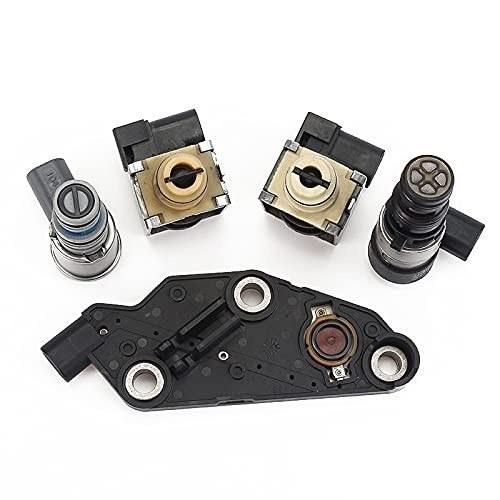
This pump is the three-piece design for 4T65E transaxles built from June 2002 on. Model year 2002 is the split year: a car built early in the 2002 run can still carry the first-design two-piece pump, the valve body with the rotor support sleeve, the large pressure switch assembly and the large pressure control solenoid. Transmission Digest reported that first-design and second-design pumps, valve bodies, pressure switches and PC solenoids do not interchange. Read the ID tag on the case and compare your old pump against the part numbers above before you order, or send us your year and VIN and we will check it. If your unit turns out to be the earlier design, you need our 1997-2001 4T65E pump instead. Browse the rest of the 4T65E parts collection for matching second-design parts.
Install notes
- Find the cause of the old pump's wear. Debris from a failed clutch or a plugged filter will chew up a new pump, so flush the cooler and lines and fit a new filter.
- Use the bolt lengths specified for the three-piece pump; they differ from the earlier pump, so do not reuse a mixed set.
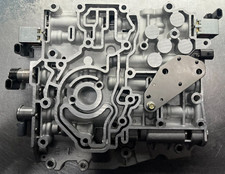
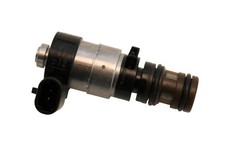
- If you are replacing the valve body or pressure control solenoid at the same time, stay with second-design parts such as our 2003 4T65E valve body and 2003 pressure control solenoid.
- Torque pump and valve body bolts in sequence with an inch-pound wrench and confirm the pump shaft is engaged before the side cover goes on.
- Fill with DEXRON-VI, check the level at operating temperature, then clear the transmission adapts with a scan tool so the PCM relearns on the new pump's pressure.