"It shudders when I accelerate" is one of the least useful sentences a customer can say about a 4T65E, and one of the most common. The complaint gets written on the repair order as a transmission problem, and a good share of the time the transmission is innocent. On the cars this transaxle lives in — Impalas, Grand Prix, LaCrosse and Allure, Montana and Uplander vans, mostly behind a 3800 or a 3.5/3.9 V6 — a shudder under throttle can be the converter clutch, a clutch pack slipping, a misfiring cylinder, or an engine mount that let go. All four feel alike from the driver's seat. They do not look alike on a scan tool. This is how I sort them, in the order that wastes the least time and money.

Write Down Exactly When It Happens
Before anything gets unplugged, drive it with the customer if you can and record four numbers at the moment of the shudder: vehicle speed, commanded gear, engine rpm and throttle position. Aaron Golas makes this the first step in his GEARS Magazine piece on shudder diagnosis, and it is the right one, because the operating point alone narrows the field more than any part swap. A shudder that only shows up between 35 and 45 mph in 3rd or 4th at light throttle is, in his words, a strong sign of converter lock-up shudder. A shudder that gets worse the harder you push at low rpm points somewhere else.
| When it shudders | First suspect | What to watch |
|---|---|---|
| Light throttle, steady 35-55 mph, 3rd or 4th, not shifting | Torque converter clutch (TCC) | TCC commanded vs actual slip, TCC duty cycle |
| Heavy throttle, low rpm, gets worse with load | Engine misfire | Mode 6 misfire counters per cylinder |
| Heavy throttle in 2nd, 3rd or 4th with flare or rpm climb | 2nd clutch slip | Steady-state TAP cells, shift time, shift error |
| Takeoff and hard throttle, felt as a thump or buzz through the floor | Engine or transaxle mounts | Engine movement under brake torque |
| Only on coastdown or decel | Overpressurized TCC piston / lining damage | Debris in pan and cooler return |
Step One: Prove Whether It Is the Converter
GM's own method for this is the cleanest one I know. In bulletin 16-NA-175, written for light-throttle shudder between 30 and 65 mph, GM has the technician drive the same steady-state condition three ways: normal operation, then with the scan tool commanding the TCC disabled (converter open), then with the TCC commanded enabled (fully locked, slip at zero). If the vibration is there in normal operation but disappears both when the clutch is held open and when it is held fully locked, the root cause is TCC shudder. If it is still there with the converter open, or still there when the clutch is fully locked with zero slip, GM states plainly that the root cause is not TCC shudder and the vehicle goes into general vibration diagnosis. That bulletin was written for the 8L90, but the logic applies to any controlled-slip converter, and the 4T65E is one.
The reason it works: TCC shudder is a stick-slip event at the friction interface. It only happens while the clutch is partially applied and slipping. Hold it fully open and nothing is rubbing; hold it fully clamped and nothing is slipping. A misfire, a bad mount or a worn axle does not care what the converter is doing, so it stays.
If your scan tool cannot command the TCC on this platform, use the data stream instead. Watch TCC commanded slip and TCC actual slip alongside engine load, throttle position and vehicle speed, and make sure the inputs are steady while you watch. Golas notes that most applications run under 60 rpm of slip once applied, but check that against the manufacturer's number rather than treating it as a spec. A converter that hunts above its commanded slip every time the shudder comes in is your answer.
Rule Out a Misfire Before Anyone Touches the Transaxle
This is the one that gets 4T65E transaxles replaced for no reason. When the converter clutch applies, the engine loses the cushion of the fluid coupling. A cylinder that is only slightly weak at 1,400 rpm under load now pulses straight through the driveline, and it feels exactly like converter chatter. Unlock the converter and the shudder goes away, which convinces everyone it was the transmission.
The GEARS article gives the test: pull Mode 6 misfire data and watch the per-cylinder counters. If one counter climbs every time the shudder comes in, you have found it, and the check engine light does not need to be on for this to be true. Intermittent misfires frequently do not set a code. If the misfire is on one cylinder, swap ignition parts to another cylinder and see if it follows; on a 3800 that means coil and plug wire positions on the waste-spark pack, and the plug itself. If it does not move, do a compression test. If several cylinders show counts, look at fuel and air before ignition. And note that GM's light-throttle test above will not separate a misfire from a converter by itself — with the TCC open the engine is cushioned and the misfire hides. Mode 6 is what tells them apart.
Mounts and the Front-Drive Driveline
The 4T65E is a transverse front-drive unit, so the engine and transaxle rock as one mass on their mounts. Golas lists mounts and driveline components as the next check after misfire for any shudder complaint, and on high-mileage W-body cars the mounts are old rubber. Look for cracked or separated rubber and excessive engine movement under brake torque in Drive and Reverse. A collapsed mount lets the powertrain contact the cradle under load, and the resulting buzz shows up on acceleration and goes away on decel. An inner CV joint that binds under load gives a shake that grows with throttle and does not change when the converter is commanded open or locked, which GM's three-mode test will catch.
If It Is the Converter: Pressure or Friction
Once the three-mode test points at the TCC, the cause sorts into two families: the pressure applying the clutch is wrong, or the friction surface is damaged.
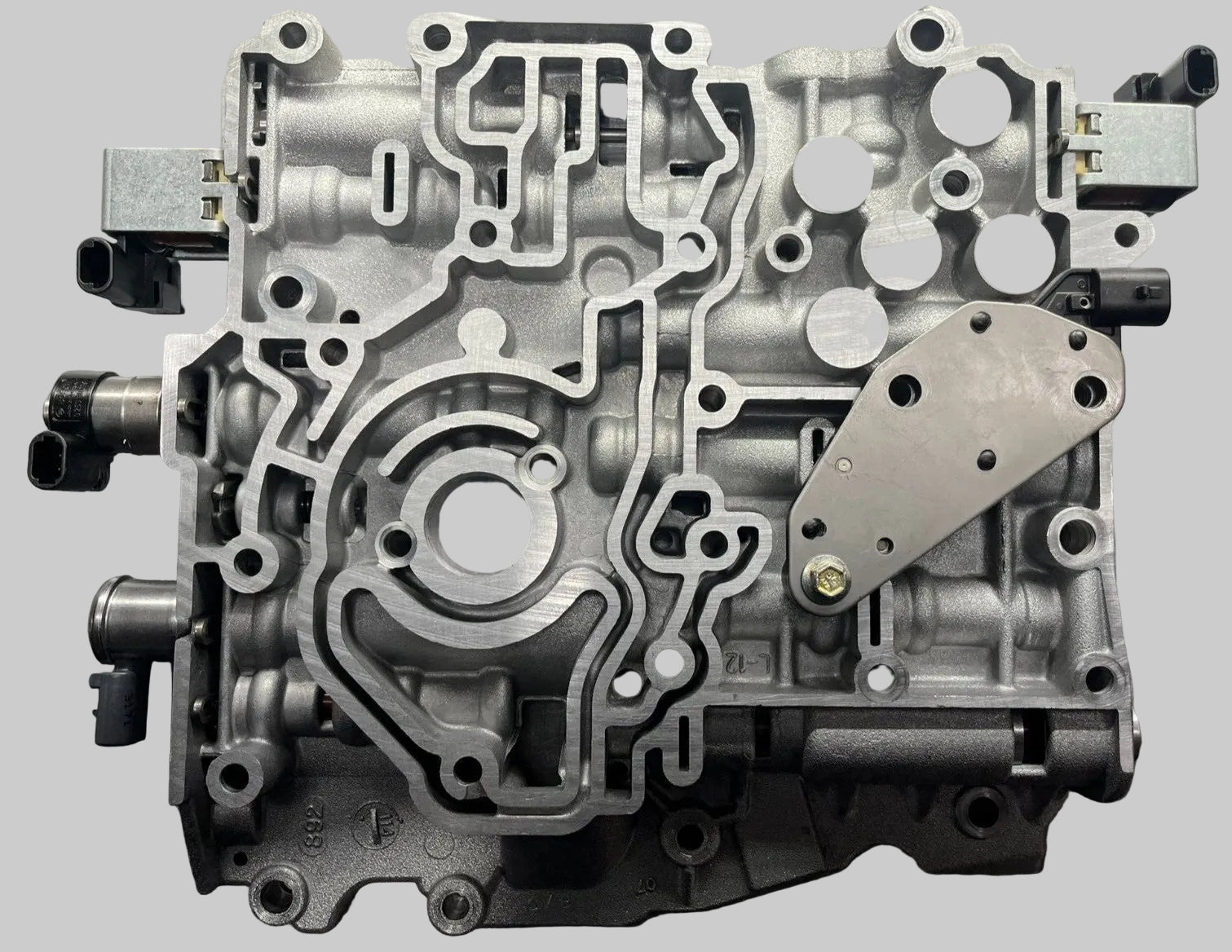
Pressure. Bob Warnke of Sonnax lays out the 4T65E pressure chain in "Troubleshooting the 4T65-E: A Matter of Interpretation." Line pressure from the pressure regulator valve feeds the actuator feed limit (AFL) valve, which caps what reaches the EPC solenoid. EPC control is directed by line pressure through the boost sleeve, and line pressure flows through the TCC regulator valve to apply the TCC piston. Wear in any of those valves can raise both line and apply pressure, overpressurizing the piston on apply. Sonnax's channel plate guide adds the opposite failure: a worn AFL bore lets regulated oil leak to exhaust, starving the EPC and shift solenoids. The documented results include low line rise with P1811, TCC slip with P0741, 2nd-gear starts and falling out of 4th. Sonnax's fixes for this chain include boost valve and sleeve kit 84754-30K, TCC regulated apply valve kit 84754-34K, and TCC relief valve 84757-01K, which limits PCM-commanded apply pressure. The worn TCC apply and regulated apply bores in the valve body are covered in detail, with vacuum-test steps, in our 4T65E torque converter shudder guide.
Friction. The converter itself is a known weak spot. Ed Lee of Sonnax wrote that the 4T65-E and 4L30-E are notorious for TCC apply and shudder problems, and that part of the reason is the OE flat TCC piston. It has no outer-diameter lip, so it is more prone to deflect than earlier 245mm pistons. When it dishes, contact area shrinks and holding force drops. Warnke describes where overpressure takes it: lining damage that progresses to piston failure, with material ground off the piston surface collecting at the return cooler checkball seat and showing up in the pan and cooler circuit. If you find friction material in the pan or at the cooler return, the converter is done. Fixing the valve body without replacing the converter just puts a new pressure system behind a damaged clutch. And the reverse is true: a new converter behind an overpressurizing valve body will be back.
4T65E Valve Body 2003-Up, Remanufactured
When the TCC apply, regulated apply or AFL bores are worn and you would rather not ream and sleeve them on the bench, a remanufactured valve body replaces the whole circuit. Confirm your year and calibration first.
View the 4T65E valve body →Shudder Under Hard Throttle in Gear: Look at the 2nd Clutch
Not every acceleration shudder is the converter. A clutch pack that slips and grabs under load feels like a shudder too, often with a small rpm flare the driver does not notice. On this transaxle the usual suspect is the 2nd clutch, because it stays applied in 2nd, 3rd and 4th.
Wayne Colonna laid out the computer side of this in Transmission Digest ("The 4T65-E: Slip-Sliding Away"). Unlike the 4T60-E, the 4T65E has a turbine speed sensor, so the PCM compares turbine speed to output speed and can see slip. Before it sets a code, it tries to cover the slip by raising line pressure. If a shift takes longer than 0.65 second and the adaptive modifier cannot shorten it, a counter increments, and two of those in one drive cycle set P1811. If the shift is on time but the PCM sees slip in any gear lasting more than six seconds, it sets P0730. A marginal clutch can therefore go a long time with no code at all while the PCM keeps turning up the pressure.
That compensation is what you read. Pull the 1-2, 2-3 and 3-4 shift error, shift time and TAP cells, and the steady-state TAP values in kPa. Large steady-state TAP numbers mean the PCM had to add pressure to hold the gear. Colonna's key point: 2nd clutch slip under heavy throttle shows up across 2nd, 3rd and 4th, while 3rd clutch slip only shows in 3rd. If the steady-state numbers are high in all three upper gears, the 2nd clutch is your shudder.
The root cause is often clearance. GM does not publish clutch clearance for this unit. Colonna's rule of thumb is 0.008 to 0.012 inch per friction plate. The 2nd clutch drum holds six frictions, so the pack should land at 0.048 to 0.072 inch total. Alto makes a 0.090-inch 2nd clutch steel, part 062733-228, about 0.020 inch thicker than OE, and using one to three of them pulls a loose pack into range. A pack built loose with tired frictions can road-test fine and then come back months later with heavy-throttle slip.
Fluid: The Cheap Check, Not the Cure
Check level and condition before anything else, because it costs nothing. GM's owner manual for the 4T65E-equipped 2008 Impala specifies DEXRON-VI, lists 7.4 qt (7.0 L) total capacity, and has the level checked at 180-200°F operating temperature. Low fluid aerates and drops apply pressure, and that alone can cause a slip-and-grab. GM does correct some newer-unit TCC shudder with a fluid exchange, because a converter clutch's friction behavior depends partly on fresh friction modifiers in the fluid. On a 4T65E with a worn bore, a dished piston or a loose clutch pack, though, new fluid may quiet it for a few weeks and then it comes back. Treat a fluid change as a way to rule out the cheap cause. It does not repair anything mechanical.
A Working Order of Operations
- Record speed, gear, rpm and throttle at the shudder. Scan for codes, including history.
- Check fluid level and condition hot. Drop the pan if it is dark or smells burnt and look for lining material.
- Pull Mode 6 misfire counters during a shudder event. Fix any misfire first and re-test.
- Run the three-mode test: normal, TCC commanded open, TCC commanded locked. Gone in both open and locked means TCC shudder.
- If it is TCC: vacuum-test the TCC apply, regulated apply and AFL circuits and inspect the boost valve and sleeve. Replace the converter if the pan or cooler return shows friction material.
- If it is not TCC and it slips under load in gear: read steady-state TAP cells and shift times to identify which clutch is slipping, then check clearance at teardown.
- If none of the above: mounts, axles and general vibration diagnosis.
- After any repair, clear adapts and let the PCM relearn before the final road test.
Shop 4T65E valve bodies, pressure control solenoids and master rebuild kits — shipped fast from the USA.
Shop 4T65E parts →FAQ
Why does my 4T65E shudder when I accelerate?
The most common causes are torque converter clutch shudder, an engine misfire that shows up when the converter locks, 2nd clutch slip under load, and worn engine or transaxle mounts. They feel alike from the driver's seat. Record speed, gear, rpm and throttle at the shudder, then use Mode 6 misfire data and a TCC open versus locked test to separate them.
How do I know if the shudder is the torque converter?
Drive the same steady light-throttle condition three ways: normal, with the TCC commanded open, and with the TCC commanded fully locked. GM's bulletin 16-NA-175 treats a shudder that disappears in both the open and locked tests as TCC shudder. If it stays with the converter open or fully locked, the converter clutch is not the cause.
Can a misfire feel like transmission shudder on a 4T65E?
Yes. When the converter clutch applies, the engine loses the cushion of the fluid coupling, so a weak cylinder under load pulses straight through the driveline. Watch the Mode 6 misfire counters during a shudder event, because intermittent misfires often do not set a code or turn on the check engine light.
Will a transmission fluid change fix 4T65E shudder?
Only if the cause is fluid. Correct DEXRON-VI at the right hot level rules out low or degraded fluid. A worn TCC regulator or AFL bore, a dished converter piston, or a loose clutch pack stays the same after a fluid change, and the shudder usually comes back within weeks.
Shop the 4T65E torque converter at CoreTransmissionParts → or browse all rebuild kits
Related 4T65E guides
Sources
- General Motors Service Bulletin 16-NA-175, "Shake and/or Shudder During Light Throttle Acceleration Between 48 and 104 km/h (30 and 65 mph) at a Steady State," November 2016 (via NHTSA). Backs the three-mode test (normal, TCC commanded open, TCC commanded locked) and GM's rule that a vibration still present with the converter open or fully locked is not TCC shudder. static.nhtsa.gov (PDF)
- Aaron Golas, GEARS Magazine (ATRA) — "Shudder Diagnosis," April 2023. Backs recording speed, gear, rpm and throttle; the 35-45 mph 3rd/4th lock-up shudder pattern; TCC commanded vs actual slip and the typical sub-60 rpm slip; Mode 6 misfire counters and the coil/plug swap test; mounts and driveline checks. gearsmagazine.com
- Bob Warnke, Sonnax — "Troubleshooting the 4T65-E: A Matter of Interpretation," September 2005. Backs the pressure regulator, AFL, EPC, boost sleeve and TCC regulator chain; TCC piston overpressurization causing lining damage and piston failure; debris at the return cooler checkball seat; Sonnax kits 84754-30K, 84754-34K and 84757-01K. sonnax.com
- Ed Lee, Sonnax — "Upgrading the Flat TCC Pistons for the 4L30-E & 4T65-E," October 2010. Backs the 4T65-E's reputation for TCC apply and shudder problems, the lipless OE flat piston deflecting under pressure, and reduced holding force when it dishes. sonnax.com
- Sonnax — "GM 4T65-E Channel Plate Common Problems & Solutions." Backs AFL bore wear leaking regulated oil to exhaust and causing low line rise with P1811, TCC slip with P0741, 2nd-gear starts and falling out of 4th. sonnax.com
- Wayne Colonna, Transmission Digest — "The 4T65-E: 'Slip-Sliding Away.'" Backs turbine speed sensor slip monitoring, the P1811 (0.65 second, twice per drive cycle) and P0730 (slip over six seconds) logic, shift error/shift time/TAP cell PIDs, 2nd clutch slip showing in 2nd through 4th, the 0.008-0.012 in per friction rule, six 2nd clutch frictions, and Alto steel 062733-228. transmissiondigest.com
- General Motors — 2008 Chevrolet Impala Owner Manual. Backs DEXRON-VI, the 7.4 qt (7.0 L) capacity and the 180-200°F fluid check temperature. assets.gm.com (PDF)