Every 545RFE that rolls in for a fluid service comes with the same question from the owner: "Should I flush it or just change it?" The quick-lube menu says flush. A forum thread says a flush will kill a high-mileage transmission. Neither one is the real answer. The real answer starts with what Chrysler wrote in its own maintenance schedule, then comes down to arithmetic: how much fluid each method actually replaces, what it does with the dirt, and whether the job ends with the level set correctly.
Everything here also applies to the 45RFE, which shares the case, pump, valve body and filter layout.


What Chrysler Actually Calls For
Chrysler never put a machine flush on the 545RFE maintenance schedule. The wording in the Schedule B table for the 4.7L and 5.7L applications is "drain and refill the automatic transmission fluid, and replace main sump filter" at 60,000 miles, and at 120,000 miles the same line adds the spin-on cooler return filter (per Chrysler's maintenance schedules for the 2007 Commander, source 1). Schedule B is the severe-service schedule: towing, heavy loads, stop-and-go, freezing temperatures, dust, sustained highway speed in heat. Chrysler's own note is that most vehicles operate under Schedule B conditions. If you tow with a Ram 1500 or a Durango, you are on Schedule B whether you think of it that way or not.
The fluid side is just as specific. Chrysler calls for Mopar ATF+4 and says it "strongly recommends against" adding anything else to the transmission, other than leak-detection dye (source 3). Shift-feel additives, varnish cleaners and "sealers" are all on the do-not-use side. That matters here because many flush machines run a chemical cleaner through the unit before the new fluid goes in. If the shop's process includes a cleaner, that is something Chrysler told you not to put in this transmission.
One more line from that same Chrysler page is worth knowing before anyone sells you a flush: ATF+4 is dyed red, the red is not permanent, and Chrysler says color and odor "cannot be used" to judge fluid condition or the need for a change. Brown ATF+4 is not proof of a problem, and bright red fluid after a service does not prove the job was done right.
The Numbers: How Much Fluid Each Method Replaces
This is where the argument usually goes off the rails, so here are Chrysler's figures (source 2):
- Service fill, 2WD: 5.2 L (11 pints)
- Service fill, 4WD: 6.2 L (13 pints)
- Overhaul (dry) fill: 13.33 L (28 pints), with Chrysler noting that the cooler type, cooler line length and diameter, and any auxiliary cooler will change that number
Divide the service fill by the dry fill and a 2WD pan drop replaces about 39 percent of the fluid. A 4WD truck, with its deeper pan, gets about 47 percent. The rest is sitting in the torque converter, the cooler and lines, the valve body and the clutch drums, and it stays there.
Repeat the drain-and-fill and the math stacks. Assuming the new and old fluid mix completely between services (drive it at least a day so they do), the share of fresh ATF+4 works out like this:
- One drain-and-fill: about 39 percent new (2WD), 47 percent (4WD)
- Two: about 63 percent (2WD), 71 percent (4WD)
- Three: about 77 percent (2WD), 85 percent (4WD)
A properly run fluid exchange, by comparison, pushes the full volume through and lands somewhere near complete replacement in one visit, provided the machine is fed more new ATF+4 than the system holds. On a 545RFE that means having roughly 18 to 20 quarts of ATF+4 on hand for an exchange, against 6 to 7 quarts for a single pan drop. That is the honest trade: an exchange gets more of the old fluid out; a drain-and-fill gets the filter changed and lets you read the pan.
What "Flush" Means on an RFE
The word covers three different jobs, and you should know which one is on the work order.
Fluid exchange (pump-driven)
The machine is tied into a cooler line. With the engine running, the transmission's own pump pushes old fluid out to the machine while the machine feeds new fluid back in at the same rate. On a 545RFE the cooler flow is modest: Sonnax measured about 1.3 GPM at idle in Drive on a truck with stock programming (source 5). That is enough to move the whole system volume through in a few minutes, but only if flow is normal.
Pressure flush with a cleaner
The machine drives its own pressure, often with a solvent or cleaning additive cycled through first. This is the version that earns flushes their bad reputation, and the cleaner step runs straight into Chrysler's no-additives position (source 3). On an RFE I do not run a cleaner.
Cooler and line flush
This is a different job entirely: cleaning the radiator cooler and lines when a transmission is replaced or rebuilt. More on that below, because it is the one flush that really is mandatory.
Why Low Cooler Flow Wrecks an Exchange
Here is a 545RFE detail most flush machine operators never think about. Sonnax found that when line pressure is raised by a performance tune, the pressure regulator valve sits in a position that starves the converter and cooler circuit. On their test truck, idle line pressure went from 60 to 70 psi stock to 100 to 105 psi tuned, and cooler flow dropped from 1.3 GPM to about 0.5 GPM, and as low as 0.3 GPM at maximum pressure (source 5).
A pump-driven exchange depends on that cooler flow. On a tuned truck sitting at idle, the machine is pulling fluid out at a fraction of the normal rate. A machine run by time, or stopped when the sight glass "looks red," leaves old fluid in the converter. Check for a tune before the exchange. With a scan tool, look at desired and actual line pressure in Drive at a stop. Sonnax gives 60 to 70 psi with a 22 to 24 percent line pressure duty cycle as stock; 100 psi or more with a duty cycle near 5 percent says the truck has been tuned (source 5). If the pump is that close to maximum output at idle, a drain-and-fill is the more predictable service.
When a Drain-and-Fill Is the Right Call
- Every scheduled service. It is what Chrysler specifies, and it is the only method that changes the sump filter. An exchange that does not drop the pan leaves the filter in place.
- You want to read the pan. Chrysler's filter-service procedure treats a light coat of clutch material in the pan as normal unless the truck also slips or has shift lag (the procedure and its source are in our 545RFE filter and pan service guide). Heavy metal on the magnet changes the conversation from service to diagnosis. You cannot see any of that through a flush machine's sight glass.
- Unknown history, high miles, and it drives fine. Two or three drain-and-fills spaced a few hundred miles apart gets most of the old fluid out while changing the filter at the start.
- Tuned trucks with low cooler flow. See above.
When an Exchange Makes Sense
- Wrong fluid went in. Somebody topped it off with a universal multi-vehicle fluid or Dexron. Chrysler says Dexron II is not recommended and that improper fluid can cause clutch chatter (source 3). One pan drop only gets you 39 to 47 percent of it back out. An exchange with ATF+4, after a pan drop and filter change, gets it all. Make sure the replacement fluid is a licensed ATF+4: Chrysler opened ATF+4 licensing on September 1, 2005, with every blender accredited and market-sampled, and warned that fluids merely "claiming to be like ATF+4" could jeopardize transmission life (source 8).
- Fluid that is badly oxidized but the pan is clean. If the pan and magnet are clean and the filter is fine, an exchange after the drain-and-fill finishes the job in one visit instead of three.
- Done the right way: pan dropped and filter changed first, pump-driven exchange with no cleaner, enough ATF+4 to over-feed, and the level set hot on the dipstick at the end.
The One Flush That Is Not Optional
When a 545RFE is replaced or rebuilt, the cooler and lines have to be cleaned. A Transmission Digest technical article by Lubegard's Pat Barrow lays out why: a failed transmission leaves clutch material, metal and sludge in the radiator cooler, and a contaminated cooler is a common cause of premature failure in a replacement unit (source 6). If the old unit came apart and filled itself with metal, he notes, no cleaning method may get all of it out. Some remanufactured units require a new radiator or cooler for the warranty to stand. (Barrow works for a company that sells a cooler flush; the contamination point holds regardless of method.)
For the 545RFE specifically, you have one advantage: Chrysler added a cooler return filter so debris coming back from the cooler is caught before it reaches the pump. Replace it on every rebuild or replacement, and on the 120,000-mile service per Schedule B (source 1). It is not a substitute for cleaning the cooler.
One caution when you change it. Chrysler issued a bulletin, summarized by ALLDATA, for 45RFE and 545RFE vehicles that develop a delayed first engagement into Reverse or Drive after sitting overnight, right after a service where the cooler return filter was replaced. The cause is an 04799662AB filter that lets fluid drain back out of the torque converter. The fix is an 04799662 filter with any other suffix; the stud-type replacement torques to 165 in-lb stud-to-filter and 125 in-lb filter-to-case, and the bulletin states the condition is not detrimental to the transmission (source 7). If a customer reports a morning "slip" after a drain-and-fill or an exchange, check that filter before blaming the service method.
Doing the Drain-and-Fill Right
- Drain and drop the pan. The factory pan has no drain plug, so this is the messy part. If you plan on repeat drain-and-fills, a pan with a drain plug turns the second and third services into a ten-minute job.
- Read the pan and magnet before anything is cleaned.
- Replace the sump filter with the seal pressed into the pump body first. Chrysler's procedure is blunt about this: do not install the seal on the filter neck and push them in together. The full procedure and torque values are in our filter and pan service guide.
- Refill with ATF+4 to the service fill: 5.2 L for 2WD, 6.2 L for 4WD (source 2). Treat that as a starting point, not the final level.
- Set the level hot (next section).
Setting the Level: Where Most Services Go Wrong
Whether the fluid went in through a machine or a funnel, the job is finished on the dipstick. Chrysler's procedure (source 4): vehicle on level ground, selector in Park (the converter fills in Park and Neutral), engine idling at least one minute. At normal operating temperature of about 180 F, the level should be in the HOT crosshatch. At about 70 F, it sits near the upper COLD hole. After adding fluid, wait at least two minutes for it to drain down the fill tube before you recheck.
Chrysler also notes that true transmission temperature can only be read with a scan tool in Reverse or a forward gear, so do not trust a guess based on how long the engine has run. Watch the transmission temperature reading on the scan tool in gear, then go back to Park to check.
Getting this wrong in either direction causes trouble. Chrysler explains that low fluid lets the pump draw air, so pressure builds slowly and runs low. Overfilling lets the geartrain whip the fluid into foam, which causes the same low-pressure symptoms plus overheating, oxidation, varnish, and fluid pushing out the vent where it looks like a leak (source 4). Plenty of "the flush ruined it" stories are really a level never set hot.
Bottom Line
Drain-and-fill with a new sump filter is the factory service; repeat it two or three times to get most of the old fluid out. Use a pump-driven exchange only after the pan and filter are done, with no cleaner and normal cooler flow. Set the level hot either way, and clean the cooler before any replacement unit goes in.
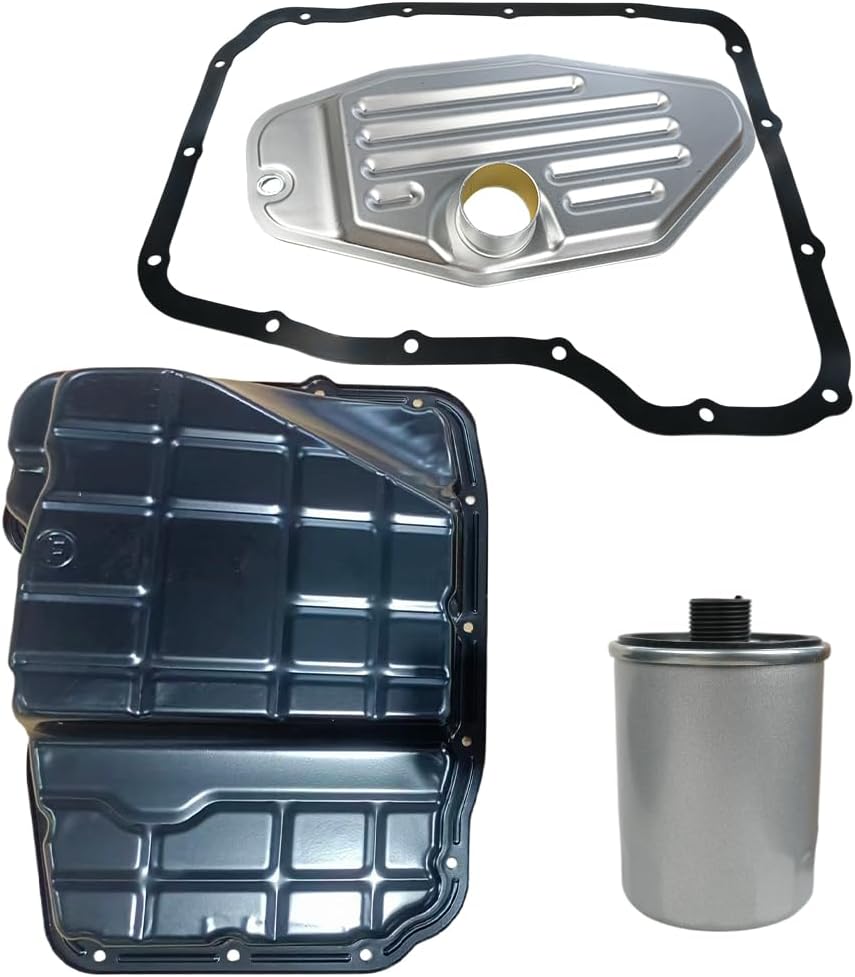
RFE Transmission Filter Kit with Pan Gasket, OE 5179267AC
Our sister store lists this RFE-family filter and pan gasket kit, the parts a proper drain-and-fill actually needs. Match it against the old filter or your VIN before you order.
View the RFE filter kit →Shop the RFE filter kit →
Need parts for this job?
Filter kits, drain-plug pans, coolers and solenoid packs for the 545RFE, on our own secure checkout.
Shop 545RFE parts →Frequently Asked Questions
Should I flush or drain and fill a 545RFE?
Chrysler's maintenance schedule calls for draining and refilling the fluid and replacing the main sump filter, not a machine flush. A drain-and-fill is the factory service and the only method that changes the filter. A pump-driven exchange is fine afterward if you need all of the old fluid out at once, as long as no cleaner is used.
How much fluid does a 545RFE drain-and-fill replace?
Chrysler lists a service fill of 5.2 liters for 2WD and 6.2 liters for 4WD against a dry fill of about 13.33 liters. That is roughly 39 percent of the fluid on a 2WD truck and 47 percent on a 4WD. Three drain-and-fills spaced apart get you to roughly 77 to 85 percent new fluid.
Will a flush damage a high-mileage 545RFE?
Fresh ATF+4 does not hurt a transmission, but a pressure flush with a chemical cleaner goes against Chrysler's position on additives, and a level left too high or too low after any service causes real problems. On an unknown high-mileage unit, two or three drain-and-fills with a new filter is the conservative path.
How do I check 545RFE fluid level after a service?
Park on level ground, put the selector in Park and let the engine idle at least one minute. At about 180 F the level should be in the HOT crosshatch on the dipstick; at about 70 F it sits near the upper COLD hole. Wait two minutes after adding fluid before rechecking, and read true transmission temperature on a scan tool in gear.
Sources
- Chrysler — Maintenance Schedules (2007 Jeep Commander service information). Backs the Schedule B conditions, Chrysler's note that most vehicles operate under Schedule B, the "drain and refill" wording with main sump filter replacement at 60,000 miles, and the 120,000-mile service that adds the spin-on cooler return filter. Chrysler Maintenance Schedules
- Chrysler — Specifications, Fluid Capacities. Backs the 545RFE service fill of 5.2 L (11 pt) 2WD and 6.2 L (13 pt) 4WD, the 13.33 L (28 pt) overhaul dry fill, and the note that cooler and line configuration changes the figure. Chrysler Fluid Capacities
- Chrysler — Automatic Transmission Fluid. Backs Mopar ATF+4 as the specified fluid, Dexron II not recommended, clutch chatter from improper fluid, color and odor not indicating condition, and the position against additives and sealers. Chrysler Automatic Transmission Fluid
- Chrysler — Fluid Level Check. Backs the Park, level-ground, one-minute-idle procedure, the 180 F HOT and 70 F COLD readings, the two-minute fill tube wait, scan tool temperature in gear, and the effects of low and high fluid level. Chrysler Fluid Level Check
- Sonnax — Resolving Stalling and Overheat Issues After Performance Tuning on RFE Transmissions. Backs the 1.3 GPM stock cooler flow at idle, the 0.5 and 0.3 GPM tuned figures, and the stock (60-70 psi, 22-24 percent duty) versus tuned (100-105 psi, 5.1 percent duty) line pressure readings. Sonnax tech article
- Transmission Digest — "To Flush Or Not To Flush," Pat Barrow (Lubegard), June 2019. Backs contaminated coolers as a cause of premature failure in replacement transmissions, the limit of cleaning after a catastrophic failure, and reman warranties that require a new cooler. Transmission Digest
- Chrysler service bulletin, 45RFE/545RFE delayed shift after cooler return filter replacement (ALLDATA, Eric Seifert, via Underhood Service). Backs the DG4/DGQ application, the 04799662AB converter drain-back cause and replacement filter, the 165 in-lb and 125 in-lb torques, and the not-detrimental statement. underhoodservice.com
- Brake & Front End — "Chrysler Group Licenses its Transmission Fluid, ATF+4, for Retail and Commercial Usage" (2005). Backs the September 1, 2005 licensing start, licensed-blender accreditation and market sampling, and Chrysler's warning about fluids claiming to be like ATF+4. brakeandfrontend.com