A 2005-2010 Grand Cherokee with the 4.7L or 5.7L Hemi comes in with the same complaint every time: "it slips." Sometimes that means the engine flares on the 2-3 shift. Sometimes the rpm climbs on the highway with no gain in speed. And on a WK, more often than on a truck, it is not the transmission at all. The Grand Cherokee puts a full-time transfer case, a tire-size calibration and a torque converter clutch between the driver's right foot and what they feel, and each one can fake a slipping 545RFE.
This is the order we work a WK. The towing-heavy Durango version is in our 545RFE Durango slipping guide. This one covers what the Jeep adds.


Step 0: Confirm It Is a 545RFE
Not every WK has one. Chrysler's 2007 Grand Cherokee service information lists two automatics with two separate service fills: 545RFE at 5.2 L (11 pints) on 2WD and 6.2 L (13 pints) on 4WD, and NAG1 at 5.0 L (10.6 pints) (Chrysler WK fluid capacities). The 545RFE sits behind the 4.7L and 5.7L. The 3.7L V6 and 3.0L diesel get the NAG1.
The gear ratios settle it if the sticker is gone. The 545RFE runs 3.00, 1.67, 1.50 (second prime), 1.00, 0.75 and 0.67. The NAG1 chart in the same manual reads 3.59, 2.19, 1.41, 1.00 and 0.83, with clutches and brakes labeled B1-B3 and K1-K3 (Chrysler NAG1 road test chart). Nothing in the rest of this guide applies to a NAG1. Different fluid, different filters, different codes.
Step 1: The Pre-Diagnostic Checks Most Shops Skip
Chrysler's 45RFE/545RFE pre-diagnostic procedure comes before every gear ratio test in the WK manual, and two items on it matter more on a Jeep than on a Ram (Chrysler pre-diagnostic procedure).
Pinion factor
The first line is to check pinion factor with the scan tool and program it for the actual tire size. A lot of WKs end up on taller all-terrain tires. If the controller thinks the tires are smaller than they are, its calculated output speed is off and the gear ratio math does not add up. That is a ratio error with nothing slipping. Check it before anything else on a Jeep with aftermarket wheels or tires.
Battery, engine codes and event data
Test only with a fully charged battery. Fix engine (PCM) codes first, because a misfiring Hemi will not give you a clean road test. Record every stored, active and pending transmission code along with the DTC event data. Chrysler treats a pending code as a matured one. It also warns that a battery disconnect clears the event data and resets all learned transmission values, which can cause erratic shifts on its own. Do not unhook the battery before you have the data.
Last item on the list: on any gear ratio code, read and record the Clutch Volume Index (CVI) data. We come back to that in Step 5.
Step 2: Rule Out the Transfer Case
This is the WK-specific trap. Chrysler's WK service information covers three transfer cases: the NV140, NV245 and NV146. They do not share a fluid. The NV140 takes Mopar ATF+4, the NV245 takes Mopar NV245/247 Transfer Case Fluid, and the NV146 takes Mopar NV146 Transfer Case Fluid (Chrysler WK transfer case lubricant). Capacities are 0.65 L (1.4 pints) for the NV140 and NV146 and 1.8 L (3.8 pints) for the NV245.
The NV245 is the electronically shifted case, and its control module watches the clutch inside it. Chrysler code C1438 - Transfer Case Differential Clutch Worn sets when the Final Drive Control Module cannot fully lock the case in 4-High or 4-Low because the clutch is worn (Chrysler C1438 procedure). The procedure also lists open or high-resistance faults on the 5-volt supply, mode sensor and sensor return circuits, with 5.0 ohms as the limit. Wrong fluid in an NV245 is on the factory diagnosis chart for hard shifts and noise in all modes. A driver who feels the Jeep "let go" while the transmission data looks normal needs the FDCM scanned.
Then run the VIN. NHTSA recall 13V-175 covers 2005-2010 Grand Cherokees built from February 11, 2004 through March 9, 2010, and 2006-2010 Commanders. A transfer case electrical failure may shift the case into neutral without warning (NHTSA recall data). The engine revs and the Jeep does not move. That gets written up as a transmission that quit, and it is not.
Step 3: Torque Converter Clutch or Gear Clutch?
A flare at steady highway speed with no shift happening is often the converter, not a clutch pack. The 545RFE applies the TCC through the L/R solenoid. Chrysler says the controller ramps L/R duty cycle up until converter slip, the difference between engine and input speed, is within 60 rpm. Then it goes to full lockup (FEMCC) at 100 percent duty cycle.
Code P0740 - TCC Out of Range sets in two ways. One: with input speed above 1750 rpm, the L/R solenoid hits maximum duty cycle and cannot pull engine speed within 60 rpm of input. Two: in full lockup, the converter slips more than 100 rpm for 10 seconds. Listed causes are a related P0750, the L/R solenoid, a stuck TCC switch valve or TCC regulator valve, a cut input shaft seal ring, and the converter itself. If P0740 is confirmed with no electrical fault, the factory says to replace the converter in all cases and check the other causes too (Chrysler P0740 procedure).
On the scan tool, watch engine rpm against input rpm. If input matches the commanded gear ratio and engine speed runs away from input, the slip is in the converter. If input speed itself drifts off the gear ratio, the slip is in the gear train.
Step 4: Line Pressure Before Clutches
The 545RFE builds line pressure from torque. The PCM calculates input torque and sets desired pressure from it, then holds a fixed 120 or 135 psi during shifts and in Park and Neutral. The pressure control solenoid (PCS) runs from 5 percent duty cycle (off, maximum pressure) to 62 percent (on, minimum pressure). P0868 - Line Pressure Low sets when actual pressure stays more than 15 psi below desired for 3.5 seconds (Chrysler P0868 procedure).
Look at the factory cause list for P0868. Low fluid. A cracked, plugged or mis-installed primary oil filter. A loose cooler return spin-on filter. A stuck main regulator valve. A poor line pressure sensor connection. Chrysler's first hands-on test is simple: engine off, push on the line pressure sensor connector. If the reading jumps to about 30 psi, the connector is the problem, not the transmission.
The filter is a real WK problem because this is a pan-drop job lots of owners and quick-lube shops do. Chrysler's WK filter procedure is explicit: the primary filter seal must be installed fully flush against the oil pump body. Never put the seal on the filter neck and push the two in together, or "damage to the transmission will result" (Chrysler WK fluid and filter replacement). A Jeep that started slipping a week after a fluid service gets the pan pulled and the seal checked before anything else.
When pressure reads right on the screen, watch the PCS duty cycle under load. GEARS Magazine points out that the controller drives duty cycle toward 5 percent to make up for internal leakage, so a reading near 5 percent means the unit is losing oil. It also warns that torque-based desired pressure can be too low under hard acceleration even when actual matches desired, a pattern that "commonly leads to failed overdrive clutches" (GEARS, "Controlling Pressure 2: Chrysler"). Our 545RFE pressure testing guide walks through the gauge test.
Step 5: Use the Codes and CVIs to Name the Clutch
The 545RFE has no bands, so every forward gear is two clutches applied together. From the WK clutch application chart: 1st is UD plus the overrunning clutch (L/R only below 150 rpm output speed), 2nd is UD plus 2C, second prime is UD plus 4C, 3rd is UD plus OD, 4th is OD plus 4C, and 5th is OD plus 2C. Chrysler says flare "usually means clutch, overrunning clutch, or line pressure problems" (Chrysler WK road testing and 545RFE clutch chart). If the Jeep has Electronic Range Select, the display counts second prime as a gear, so the "fifth" the driver reports may really be fourth.
The gear ratio codes come from two speed sensors. Input reads 60 teeth on the input clutch hub. Output reads 30 teeth on the park gear. Lose the shared sensor ground and both inputs read the input sensor at a stop in neutral, which gives an apparent 1:2 ratio and can set P1794 (Chrysler P0734 procedure). Check that ground before you trust any ratio code. Each code can take up to five minutes to turn on the MIL, so pull pending codes too.
- P0731 (1st): the cause list starts with a cut UD piston seal, low fluid, and a cracked or mis-installed primary filter or seal. It also includes a failed overrunning clutch, a cut UD accumulator seal ring or broken UD accumulator piston, and a missing dribbler orifice in the reaction shaft support (Chrysler P0731 procedure).
- P0734 (4th): a failed valve body accumulator cover, cut OD or 4C accumulator seals, cracked accumulator pistons, a missing OD bleed orifice, a cut 4C tower seal, missing #5 or #6 check balls, and a worn solenoid switch valve. If event data shows line pressure more than 10 psi below desired, Chrysler sends you to the primary filter and main regulator valve before the clutches.
Then read the CVIs. The CVI is the volume of oil the controller has learned it takes to stroke each clutch piston. ATRA's published RFE ranges, learned with fluid above 110 F, are L/R 82-134, 2C 25-64, OD 25-64, 4C 30-64 and UD 44-92 (ATRA Quick Learn notes). A number at or over the top of its range means that clutch needs too much oil to apply, from worn frictions, a cut seal or a leaking circuit. A high OD CVI on a Jeep that flares in 3rd, 4th and 5th tells you the clutch before the pan comes off. ATRA also warns that Quick Learn is not a fix for a shift complaint. Save it for after the repair.
Step 6: Read the Pan, Then Decide
Chrysler's WK service text gives you a useful line: a light coating of clutch material in the pan "does not indicate a problem unless accompanied by a slipping condition or shift lag." Heavy debris, chunks of lining or metal are another story. A clean pan with high pressure-control duty cycle and normal CVIs points at the valve body: switch valve wear, a cracked accumulator piston, a missing check ball. That is a valve body or accumulator repair, not a rebuild.
If the pan is full and a CVI is pegged, the unit comes out. On an OD failure, new frictions alone will bring it back. Caleb Perham of the Sonnax TASC Force names three things to check every time: the solenoid switch valve bore plug (it strokes on the 2-3 and back on the 3-4, so it wears its bore), the OD dribbler valve in the stator (air should pass from the pump side to the drum, not back), and OD clearance, since too tight causes bind-up and too loose lets it drag and overheat (Transmission Digest). Chrysler's 545RFE OD clearance is 0.043-0.073 in. (Chrysler 545RFE specifications). Set it toward the middle.
Refill with Mopar ATF+4 only, with no additives, and check the level hot in Park. After the job, run Quick Learn and watch the CVIs over the next few drives. A CVI that keeps climbing after a rebuild means a leak in that clutch's circuit.
Keep It From Coming Back
Most WK slip jobs we see started with something small. Wrong fluid or a botched filter seal. Tires changed with no pinion factor update. A transfer case running the wrong fluid. Or a Hemi that towed on a tired cooler. Fix the cause along with the clutches. Check the transfer case fluid type when you do the transmission service, update pinion factor any time the tire size changes, and keep the cooler clean. Our 545RFE overheating guide covers the cooling side.
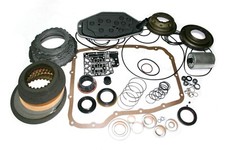
545RFE rebuild kits, accumulator pistons, valve bodies and filter kits for the 2005-2010 Grand Cherokee — shipped fast from the USA.
Shop 545RFE parts →Shop the part for this fix
Code trail points at a cracked OD or 4C accumulator piston? The 1999-up RFE accumulator piston kit fits the 545RFE valve body accumulators. Check your pistons against it before ordering.
Shop the RFE accumulator piston kit → All RFE-series partsFAQ
Can the transfer case make my Grand Cherokee feel like the transmission is slipping?
Yes. A worn clutch in the NV245 transfer case sets code C1438 in the Final Drive Control Module, and the wrong fluid in that case causes shift and noise complaints. Recall 13V-175 also covers 2005-2010 Grand Cherokees whose transfer case can shift into neutral, which revs the engine with no drive. Scan the FDCM and run the VIN before you condemn the 545RFE.
Why did my Grand Cherokee start setting gear ratio codes after new tires?
The controller uses a programmed pinion factor for tire size and axle ratio to calculate output speed. If larger tires go on without updating it, the calculated ratio no longer matches the gear and a ratio code can set with nothing slipping. Chrysler's pre-diagnostic procedure checks pinion factor first for this reason.
How do I tell torque converter slip from transmission slip on a 545RFE?
Watch engine rpm and input rpm on the scan tool. If input speed matches the gear ratio but engine speed climbs away from it, the converter clutch is slipping. Chrysler sets P0740 when the TCC cannot pull engine speed within 60 rpm of input speed, or slips more than 100 rpm for 10 seconds in full lockup.
Is clutch material in the 545RFE pan a sign it is slipping?
Not by itself. Chrysler's Grand Cherokee service text says a light coating of clutch material in the pan is not a problem unless it comes with slipping or shift lag. Heavy debris, chunks of lining or metal, along with a high CVI on one clutch, means the unit needs to come apart.
Related 545RFE guides
Sources
- Chrysler 2007 Grand Cherokee (WK) service information — Fluid Capacities, Road Testing (545RFE and NAG1 charts), Fluid and Filter Replacement. Backs the 545RFE and NAG1 service fills, transfer case capacities, both clutch application charts and gear ratios, flare meaning clutch, overrunning clutch or line pressure, the ERS display note, the primary filter seal caution and the light-clutch-material note. capacities, 545RFE road test, NAG1 road test, filter replacement; OD clearance from the 2007 545RFE specifications
- Chrysler 2007 Grand Cherokee (WK) 45RFE/545RFE diagnostic procedures — Pre-Diagnostic Troubleshooting, P0731, P0734, P0740, P0868. Backs pinion factor, battery and event data rules, the speed sensor tooth counts and P1794, the five-minute MIL delay, the P0731 and P0734 cause lists, the 10 psi event data check, TCC 60 rpm / 100 rpm for 10 seconds logic and converter replacement, PCS 5/62 percent duty cycle, 120/135 psi preset, the 15 psi for 3.5 seconds P0868 set condition and the 30 psi connector test. pre-diagnostic, P0731, P0734, P0740, P0868
- Chrysler 2007 Grand Cherokee (WK) transfer case information — Lubricant and C1438 Transfer Case Differential Clutch Worn; NHTSA recall 13V-175. Backs the NV140, NV245 and NV146 fluid specs, the C1438 set condition and circuit checks, and the 2005-2010 Grand Cherokee / 2006-2010 Commander transfer case neutral recall. lubricant, C1438, NHTSA recall data
- ATRA 2002 technical seminar manual — Chrysler 45RFE Quick Learn Procedure. Backs the CVI definition, the 110 F learn condition, the normal CVI ranges for each clutch and the warning against using Quick Learn to fix shift complaints. atracom.blob.core.windows.net (PDF)
- GEARS Magazine (ATRA) — "Controlling Pressure 2: Chrysler," Rob Faucett. Backs PCS duty cycle near 5 percent as a sign of internal leakage and torque-based desired pressure leading to failed overdrive clutches. gearsmagazine.com
- Transmission Digest / Sonnax TASC Force — "Troubleshooting RFE Overdrive Clutch Failure: Three Key Areas to Check," Caleb Perham. Backs the switch valve bore plug wear, the dribbler valve air test and OD clearance effects. transmissiondigest.com