Most "cooler line replacement" searches for the 5R110W TorqShift assume this is a GM-style job: unclip two quick-connects, swap a cracked line, done. On this transmission that's only half the story, because a chunk of these trucks built a filter canister directly into the cooler circuit, and that canister changes how you're allowed to service the lines. Get the sequence wrong and you can flush fluid straight past the cooler without knowing it, or chase a "bad line" for an hour when the real problem is twenty bolts away in the pump.
This post covers what's actually documented for the 5R110W cooler circuit: the bypass-filter design Ford used from 2003 through part of 2008, the real TSB covering cold-climate failures tied to that filter, and a factory-level diagnostic case that shows how to tell a line problem from a pump problem before you start swapping parts. Everything here traces back to Transmission Digest's technical coverage of this specific unit and a documented Ford service bulletin; sources are listed at the bottom.


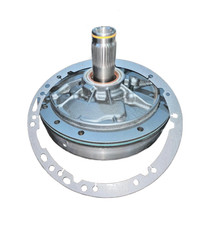
Two different cooler-circuit designs, split around mid-2008
When Ford launched the 5R110W in 2003, it built a bypass filtration system into the cooler circuit instead of a plain inline filter that just splices into the pressure or return line. Transmission Digest's technical editor describes it as looking "like a plumber's nightmare": the bulk of the cooler oil routes around the inline filter, while a small, metered amount is forced through a canister that looks like a roll of toilet paper, holding a much finer element than the transmission's own sump filter. That canister sits physically in the cooler line, usually near the transmission, and it's a separate service item from the pan filter.
Starting in the middle of the 2008 model year, Ford dropped that design. The external bypass system was phased out in favor of a newly designed sump filter built into the pan, which required a revised fluid pan to go with it. If you're working on a 2003 through early-2008 truck, expect to find the canister in the cooler line. If you're working on a mid-2008-or-later truck, there usually isn't one -- the filtration job moved entirely into the pan, and the cooler lines themselves are just lines.
The flush mistake that's specific to this transmission
This is the detail that trips up a lot of otherwise-correct cooler-line services on the 5R110W: you cannot flush the cooler or the cooler lines with the bypass filter element pulled out. Transmission Digest's R&R Tech coverage states it plainly -- with the element removed, the fluid just bypasses the cooler altogether, because the canister's internal plumbing is what forces flow through the radiator-mounted cooler in the first place. Pull the element to "make the flush easier" and you've actually defeated the point of the flush.
The documented workaround is one of two things: bypass the filter canister itself with a line (not just remove the element) so the flush machine's flow still routes through the actual cooler, or run the flush with a spare, already-clean filter element installed in the canister and then swap in the real new element once the flush is done. Either way, the new element goes in after the flush, not before.
On most years the element is replaceable by itself for about $8. But on some 2007 and 2008 units, Transmission Digest notes the element can't be separated from its canister -- in that case the entire canister has to be replaced, at roughly $80, because there's no way to adequately flush or service the filter portion on its own.
Cooler-line fitting service, honestly
We couldn't find a published Ford torque spec for the 5R110W's cooler-line quick-connect fittings or line-block bolt that we could verify -- what's floating around online for this truck is mostly forum numbers and aftermarket install-sheet specs for braided-line kits, which are not the factory 5R110W fitting hardware. If you need the exact figure, it's in Ford's Workshop Manual, which the cold-climate TSB below also points to by section number (307-01) for the related pump and transmission overhaul work.
What is safe general shop practice on these aluminum-cased fittings: use two wrenches (one to hold the line nut steady, one to turn the fitting) so you're not twisting the cooler line itself, snug threaded fittings hand-tight plus a quarter turn past that and check for weeping before going further, and never force a quick-connect with pliers -- use the correct-size plastic or steel disconnect tool so you don't crack the collet or distort the line's bead. If a quick-connect fitting on the transmission side won't release cleanly, confirm you have the right tool size for your model year before you start prying; fitting sizes on this platform aren't universal across every Super Duty cooler application.
The real TSB: cold climates, no external filter, bad pump match
There's a genuine, specific service bulletin tied to this cooler circuit, and it's worth knowing before you touch the pump on one of these trucks. It covers 2008-2009 Ford F-Super Duty, Econoline and LCF vehicles built roughly between May 18, 2007 and November 1, 2008, equipped with a 5R110W (transmission part number prefixes 8C3P-7000, 8C2P-7000, 8E7P-7000, 9C3P-7000, 9C2P-7000 and 9E9P-7000) that were built without the factory external in-line transmission filter -- in other words, early examples of the post-redesign, sump-filter trucks. Operated in cold climates, typically -35°F and below, these units can suffer premature failure of the low/reverse one-way clutch from inadequate lubrication.
The documented fix is a full transmission overhaul per Workshop Manual Section 307-01, replacing the front pump with part number 9C3Z-7A103-B (identifiable by engineering part number 9C3P-7A103-AC etched on the machined front face next to a bolt hole). The bulletin is explicit about the part number trap here: do not install the 9C3Z-7A103-B pump into a transmission that still has the factory-installed external in-line transmission filter. The two pump designs aren't interchangeable in both directions -- the bypass-system pump (9C3Z-7A103A, which retrofits back to 2003) and the non-bypass pump are matched to their respective cooler-circuit designs, and mixing them is how a cold-weather lube problem turns into a warranty comeback.
| Item | Detail | Applies to |
|---|---|---|
| Bypass filter element (replaceable separately) | ~$8, 5-micron element, ~10% of cooler flow routed through it | 2003-early 2008 trucks with external canister |
| Bypass filter canister (non-separable element) | ~$80, whole canister replacement required | Some 2007-2008 units |
| Sump filter (pan-integrated) | Redesigned, no external canister on the trucks that got it | Phased in from mid-2008; Ford's 2009 Super Duty guide still quotes a remote filter element change [6], so look before you order |
| Pump 9C3Z-7A103A | For filter-bypass system; retrofits to 2003 | Trucks with external in-line filter |
| Pump 9C3Z-7A103-B | Non-bypass design; never install into a unit with the external filter | Trucks without external in-line filter |
How to tell a line problem from a pump problem before you replace anything
Transmission Digest's technical editor documented a case worth knowing before you condemn a cooler line: a rebuilt 5R110W in a 2009 F-350 came back to the shop with the dash reading 250°F and DTC P0218 (transmission overtemperature) set. The problem only showed up at sustained highway speeds above 55 mph, which is why the first road test after clearing the code found nothing. Once the shop reproduced the exact driving condition, a laser thermometer on the pan sump confirmed 240°F -- a real overheat, not a sensor glitch.
The diagnostic step that mattered: the tech carefully disconnected the cooler return line at the transmission and checked actual flow. It was next to nothing. That pointed upstream, to the pump, since the only hard parts changed in the rebuild were the pump and converter. On teardown, the pump turned out to be the correct year for the unit, with every valve moving freely -- nothing visually wrong. The actual cause, confirmed against an ATSG manual's valve configuration diagram, was the converter anti-drain-back valve installed backward in the pump. Both valve lands on that spool are the same diameter, which is exactly why it's an easy mistake to make and an easy one to miss on a casual inspection.
The lesson carries directly into cooler-line work: a "cooler problem" complaint is not proof the lines or the external cooler are at fault. Before swapping lines, cap and disconnect the return line at the transmission and physically observe flow at a fast idle. Weak or no flow with the lines and external cooler confirmed clear points you back into the transmission -- pump valve orientation, a plugged bypass filter, or (per the same article) a mismatch between an early-style (2003/2004) and late-style (2005-and-up) pump, which Transmission Digest notes has separately caused no-move conditions along with abnormal line pressure readings around 150 psi.
Fluid after the service
Ford's original fluid spec for the 5R110W is Motorcraft MERCON SP. Ford's own FCSD chemicals and lubricants documentation lists Motorcraft MERCON LV as the fluid built for transmissions that use MERCON SP, which matters in practice since SP has gotten harder to find at parts counters. Don't substitute MERCON V into an SP-spec transmission -- Ford's own LV and V product pages both state that V is not approved anywhere SP, LV, or ULV fluid is specified. If you're not certain which fluid your specific truck calls for, check the dipstick or fill-tube label and the owner's manual before topping off.
Need parts for this job?
Our 5R110 TorqShift parts page has both filter-kit styles, pumps by year, Motorcraft-spec fluid and full rebuild kits for this unit, all on our own checkout. If the cooler-line symptoms turn out to be a bigger hydraulic problem once you're in there, our 5R110W common problems guide covers what else fails on this transmission.
Shop the part for this fix: 5R110W filter kit (pan-gasket style, 2003-2007)
Matches the early bypass-filter design covered in this post -- the filter kit that includes the pan gasket for 2003-2007 6.0L Super Duty trucks. More 5R110W-specific parts, including the later sump-filter kit, are at CoreTransmissionParts.
See the filter kit at CoreTransmissionPartsFAQ
Can I flush the 5R110W cooler lines with the inline filter removed?
No. On 2003-mid 2008 trucks the inline canister sits in the cooler circuit itself, and Transmission Digest's R&R Tech coverage is explicit that you cannot flush the cooler and cooler lines with the filter element removed, because the fluid will just bypass the cooler altogether. Bypass the canister with a hose, or run the flush with a spare clean element installed, then fit the real new element afterward.
How do I know if my 5R110W has the external bypass filter or the later sump filter?
Look for the canister. Ford used the external bypass design from the 5R110W's 2003 launch through part of the 2008 model year, then phased it out starting mid-2008 in favor of a redesigned sump filter built into the pan. If there's a screw-apart filter canister spliced into a cooler line near the transmission, you have the early system. If the lines run straight through with no canister, you have the later pan-integrated design. Do not assume by model year alone: Ford's 2009 F-250 through F-550 owner guide still lists the 5R110 refill as 17.5 quarts (16.6 L) of MERCON LV, and that figure "includes remote filter element change" [6]. The changeover was a running production change, so a 2009 truck can go either way.
What does the 5R110W's bypass filter canister actually do?
It polishes a slice of the cooler flow instead of filtering all of it. Roughly 10 percent of the fluid headed to the cooler is forced through the canister's 5-micron element while the rest bypasses it on the way to the cooler, and the transmission still has its own 60-micron filter in the sump. Over a few thousand miles that 10 percent slice cycles enough fluid through the fine element to clean the whole system at that micron level.
Why would a 5R110W overheat even after a cooler-line service?
Because a line that isn't leaking and isn't plugged can still deliver almost no flow if something upstream in the pump circuit is wrong. A documented case traced a 240°F overheat and a P0218 code to almost no flow at the cooler return line -- caused by a converter anti-drain-back valve installed backward in the pump, not by the lines or cooler at all. Before condemning lines, disconnect the return line and physically confirm flow at a fast idle.
Is there a real TSB for 5R110W cooler-circuit failures?
Yes, for a specific build window in cold climates. Ford's bulletin covers 2008-2009 F-Super Duty, Econoline and LCF trucks built between roughly May 2007 and November 2008 that lack the factory external in-line transmission filter and are run around -35°F or colder; those units can suffer premature low/reverse one-way clutch failure from inadequate lubrication. The fix is an overhaul with the correct replacement pump, and Ford is explicit that the non-bypass-design pump must never go into a transmission that still has the factory external in-line filter.
Related guides
- 5R110W Common Problems and Fixes
- 5R110W Fluid Change Cost
- 5R110W Fluid Leak Common Spots
- 5R110W Flush vs Drain and Fill
- 5R110W Pan Bolt Torque Spec and Service
Sources
- Mike Riley, Transmission Digest, "5R110W Lubrication Concern (Warm Weather — No Problem, but Winter's Coming)." Backs the 2003-launch bypass filtration design, the 2008 switch to a redesigned sump filter and non-bypass pump, the two pump part numbers (9C3Z-7A103A and 9C3Z-7A103B) and their installation restriction, and the advice to verify cooler flow under all conditions. transmissiondigest.com
- Mike Steen, Transmission Digest, "5R110W Filter Change." Backs the inline filter's 5-micron element passing about 10 percent of cooler flow versus the sump's 60-micron filter, the $8 element versus $80 full-canister replacement on some 2007-2008 units, and the rule that the cooler and lines cannot be flushed with the filter element removed. transmissiondigest.com
- Wayne Colonna, Transmission Digest, "A 5R110W With Transmission Overheating." Backs the documented diagnostic case: DTC P0218, 240°F pan sump temperature, near-zero cooler return flow traced to a converter anti-drain-back valve installed backward in the pump, and the early (2003/2004) versus late (2005-up) pump mismatch causing no-move conditions and abnormal line pressure. transmissiondigest.com
- Ford Technical Service Bulletin summary, "Crummy in the Cold," Vehicle Service Pros. Backs the 2008-2009 F-Super Duty/Econoline/LCF cold-climate low/reverse one-way clutch TSB, the affected build-date window, the transmission part-number prefixes covered, the Workshop Manual Section 307-01 overhaul procedure, and the pump part-number installation restriction. vehicleservicepros.com
- Ford Motorcraft / FCSD Chemicals and Lubricants, Motorcraft MERCON LV product page. Backs MERCON LV being built for transmissions that use MERCON SP, and MERCON V not being an approved substitute where SP, LV or ULV fluid is specified. fcsdchemicalsandlubricants.com
- Ford Motor Company, 2009 F-250/350/450/550 Owner Guide, Maintenance Product Specifications and Capacities (archive.org copy). Backs the 5R110 automatic transmission capacity of 17.5 quarts (16.6 L) including a remote filter element change, and Motorcraft MERCON LV (XT-10-QLV) as the specified fluid on 2009 Super Duty trucks. Ford 2009 Super Duty owner guide (PDF, archive.org)