The 5R110W TorqShift is not a typical valve-body transmission, and that changes what "high-mileage service" actually means on one. There are no shift valves in this unit at all — every shift is commanded directly by one of the solenoid body's solenoids, and the clutches wear, the fluid degrades, and the cooler circuit loads up on debris in patterns that are specific to this design. A generic "change the fluid every 30k" answer gets you partway there, but it misses which filter your truck actually has, which fluid Ford now authorizes, and the handful of mechanical wear points that show up over and over on units north of 100,000 miles.
This checklist covers the fluid and filter service Ford actually specifies, the cooler and cooler-line items that get skipped, and the clutch, converter and valve-body wear points that a tech should check on any high-mileage 5R110W — whether it's a 2003 6.0L or a 2010 6.4L. Every fact below is sourced to Ford's own fluid documentation, Transmission Digest's original TorqShift coverage and later lubrication bulletin, ATRA's Gears Magazine, and Sonnax's own technical documentation for the parts that fix these specific weak points. Full citations are at the bottom.

Fluid and filter: the foundation, done right
Transmission Digest's original coverage of the TorqShift, written the year it launched, is specific: Ford recommends replacing the fluid and bottom-pan filter every 48,000 km (30,000 miles), regardless of normal or special operating conditions. There is no extended interval for light-duty use on this transmission. If the truck tows, that interval doesn't shrink further — it's already the baseline.
The fluid itself has changed. The 5R110W launched on Mercon SP, and Ford's own documentation from the period states plainly that the use of any fluid other than Mercon SP can result in abnormal operation and/or transmission failure — it is explicitly not interchangeable with Mercon or Mercon V. Mercon SP is no longer a current Motorcraft product, though. Ford's current Motorcraft Automatic Transmission Fluid Chart (version 21, published 9/2026) lists the 5R110 TorqShift with a note authorizing back-servicing with Mercon LV for a complete refill and top-off. In practice: if you're servicing an older 5R110W today, Mercon LV (Motorcraft part XT-10-QLVC) is the correct, factory-sanctioned fluid, not a generic "universal" ATF and not leftover Mercon V from a 4R100.
| Item | Spec | Source |
|---|---|---|
| Fluid and bottom-pan filter interval | 48,000 km (30,000 miles), all conditions | Transmission Digest, original TorqShift coverage |
| Current authorized fluid | Mercon LV (back-service), part XT-10-QLVC | Ford Motorcraft ATF Chart, version 21 |
| Original-spec fluid (2003-era) | Mercon SP only — not interchangeable with Mercon/Mercon V | Transmission Digest, original TorqShift coverage |
| Remote bypass filter flow share | ~10% of total circuit flow | Transmission Digest, original TorqShift coverage |
Which filter you're actually servicing depends on the model year, and this is the step that gets missed most. Early 5R110W units (roughly 2003 through the 2007 model year) use an external bypass filtration design: most of the fluid runs straight through the cooler, while a small orifice forces about 10 percent of total flow through a serviceable screw-on remote filter mounted in the cooler line, which then feeds the rear lube circuit. Ford's guidance calls for replacing both the bottom-pan filter and this remote cooler-line filter at every service interval — service only the pan filter and you've left 10 percent of the circuit running on an old element indefinitely.
Starting in the 2008 model year, Ford dropped the external bypass design in favor of a redesigned sump filter that handles full flow from inside the pan, paired with a revised pump and pump cover. Transmission Digest's Technical Editor Mike Riley documented the two resulting pump part numbers in a later bulletin: 9C3Z-7A103A for applications with the filter-bypass system (and it retrofits back to 2003), and 9C3Z-7A103B for the non-bypass sump-filter design. The production part number 9C3P-7A103AC is etched into the pump's front face for identification. The two pump bodies are nearly identical castings; the difference is a small notch machined into one worm track on the non-bypass cover to keep oil flow crossing at all times. Mix the wrong cover onto the wrong design and you can starve lube flow, so if a pump or cover is ever on the bench, confirm which design you're actually working on before reassembly.
Cooler and cooler lines: easy to skip, expensive to ignore
The 5R110W uses an oil-to-air (OTA) cooler mounted in front of the radiator. Ford's guidance on this component is direct: replace the OTA cooler as part of any overhaul or exchange, and do not attempt to back-flush and clean it. A cooler that's been carrying metal or friction debris from a failing clutch pack is not something you flush out with solvent and trust going forward — it gets replaced, full stop, any time the transmission comes apart for a rebuild or exchange.
On the cold-weather side, Riley's bulletin on 5R110W lubrication makes a point worth building into any high-mileage inspection, not just a winter one: more vehicles than ever are equipped with a cooler-line thermal bypass valve, and if you're working on one, it's worth disassembling to confirm it's clean, free, and functioning correctly. His exact warning: work done in October at 50 degrees can come back on the hook in January at 20 below zero if that bypass isn't moving fluid properly under real cold-soak conditions. Any restriction to cooler flow lets fluid gel in the radiator tank or cooler lines, cutting off lubrication to the transmission entirely. A high-mileage inspection is the right moment to check this before it becomes a tow-in.
What actually wears out by high mileage
Past the fluid and cooler side, a handful of mechanical wear points show up repeatedly on 5R110W units once they've racked up real miles, especially under towing loads or on modified trucks running more power than the transmission was calibrated for.
Direct clutch capacity
Sonnax's own technical documentation for its 36965-01K high-capacity direct clutch apply piston kit attributes 5R110W direct clutch failures to three specific OE design weaknesses: insufficient clutch capacity, poor heat dissipation, and flexing of the apply and backing plates when line pressure is raised. If a high-mileage unit is slipping or flaring under load specifically in the gear range that uses the direct clutch, this assembly is the first place to look, and it's a known enough weak point that Sonnax built a dedicated fix for it (one additional friction plate plus a thicker, stiffer backing plate, for roughly a 25 percent increase in holding capacity).
Torque converter clutch and lining wear
Shudder under light throttle or steady highway cruise, especially after the transmission is fully warmed up, points at the torque converter clutch. Sonnax's performance converter kit documentation for the 5R110W's 8-stud converter notes that the OE clutch plates can slip and fail to hold, particularly as heat cycles accumulate from towing or added power. This is a wear-over-time failure on high-mileage units even in stock form, and it's worth a transmission-fluid-temperature check during a tow or grade pull as part of any high-mileage inspection — sustained high TFT accelerates exactly this kind of lining wear.
Low/reverse retaining ring and manual valve wear
ATRA's Gears Magazine, in its Street Smart column on the 5R110W, documents two more recurring issues on units that have been in service a while. The low/reverse retaining ring can work its way out of its case groove, which shows up as slipping in reverse and can damage the case lugs it rides against; the aftermarket fix is a wider, thicker ring with more outward tension. Separately, a worn manual valve is a common cause of delayed engagement into drive and reverse on higher-mileage units, since this transmission has no other shift valves to share the wear — the manual valve alone handles forward clutch apply, and an oversized replacement valve is the documented fix once it's worn enough to cause a lag.
Low-diode one-way clutch (2008-and-later design)
On the non-bypass, post-2008 pump design specifically, Riley's bulletin flags failure of the low-diode one-way clutch (OWC) in the rear planetary as an issue that became more consequential with the design change. If a later-model 5R110W shows a flare or slip specific to low-gear engagement, this is a design-specific wear point to rule in or out, separate from the direct clutch and converter issues that show up across both filter-design generations.
The high-mileage checklist, in order
- Confirm which filter design you have. Check the cooler lines on the passenger-side frame rail for a separate screw-on remote filter canister. If it's there, you're servicing two filters, not one.
- Fluid and both filters, every 30,000 miles, no exceptions for duty cycle. Use Mercon LV on a back-service, per Ford's current ATF chart — never Mercon V, Mercon, or a generic multi-vehicle fluid.
- Check TFT behavior under load. A tow pull or grade climb that pushes transmission fluid temperature high and keeps it there accelerates converter clutch lining wear and direct clutch heat damage. The factory temperature gauge on these trucks exists for a reason — use it.
- Listen and feel for direct-clutch and converter symptoms separately. A flare or slip under load in a specific gear range points at the direct clutch; a shudder at light throttle or steady cruise after warm-up points at the converter lockup clutch.
- Check reverse engagement and feel for delayed forward engagement. Slipping specifically in reverse suggests the low/reverse retaining ring has walked; a consistent lag going into drive or reverse points at manual valve wear.
- On 2008-and-later trucks, rule in or out the low-diode OWC if the symptom is a flare specific to low-gear engagement.
- Inspect the cooler-line thermal bypass valve for free movement and correct function, especially before cold weather, and replace the OTA cooler rather than back-flushing it if the transmission is already apart for a rebuild or exchange.
- After any battery disconnect, PCM replacement, or reflash, run the engagement relearn before assuming something's mechanically wrong: five Park-to-Reverse, five Drive-to-Reverse, five Reverse-to-Drive, and five Neutral-to-Drive engagements, five seconds apart, with fluid warmed to 54 C (130 F) per Ford's documented procedure. Skipping this step produces harsh or slow engagements that look like a hardware problem and aren't one.
Need parts for this job?
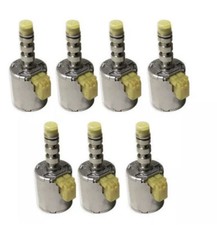
Our 5R110 TorqShift parts page has the correct filter kits for both filter-design generations, Motorcraft Mercon LV, solenoid kits, and master rebuild kits, all checked out on site. If the checklist above turns up a direct clutch or converter issue specifically, our 5R110W common problems guide goes deeper on diagnosis before you commit to a teardown.
Shop the part for this fix: 5R110W filter
Start a high-mileage service with the correct filter for your truck's design generation. More 5R110W parts, including solenoid kits and rebuild kits, are at CoreTransmissionParts.
See the filter at CoreTransmissionPartsFAQ
How often should a 5R110W get a fluid and filter service?
Every 48,000 km (30,000 miles), regardless of normal or special operating conditions. That interval comes from Ford's own service guidance as reported by Transmission Digest, and it applies whether the truck is towing every week or just commuting. On a bypass-filter truck (roughly 2003-2007), that service means both the bottom-pan filter and the remote cooler-line filter, not just the one in the pan.
Can I run Mercon LV in a 5R110W that originally called for Mercon SP?
Yes. Ford's current Motorcraft Automatic Transmission Fluid Chart (version 21) lists the 5R110 TorqShift under a note authorizing back-servicing with Mercon LV for complete refill and top-off. Mercon SP is no longer a current production fluid, so Mercon LV is the factory-authorized replacement. Don't substitute Mercon V, Mercon, or a generic multi-vehicle ATF; Ford's own fluid chart warns that using the wrong fluid can cause reduced functionality or damage.
Does my 5R110W have the bypass filter or the sump filter?
If your truck was built before the 2008 running changes, it most likely has the external bypass filtration system: a remote screw-on filter in the cooler line that filters about 10 percent of total flow. Starting in 2008, Ford phased this out in favor of a redesigned sump filter inside the pan, paired with a revised pump cover. Pop the hood and look along the cooler lines on the passenger-side frame rail; if there's a separate screw-on canister there, you have the bypass design and it needs its own filter at every service.
What's the most common high-mileage failure on a 5R110W?
Direct clutch wear and torque converter clutch shudder are the two most commonly reported high-mileage issues. Sonnax's own technical documentation for its direct clutch piston kit attributes OE direct clutch failures to limited clutch capacity, poor heat dissipation, and flexing of the apply and backing plates under raised line pressure. On the converter side, shudder under light throttle or steady cruise is the classic symptom of a worn or glazed lockup clutch lining, and it gets worse with heat cycles from towing.
Why does my 5R110W engage late or shift harsh after a battery disconnect?
This transmission runs an adaptive engagement strategy, and Transmission Digest's original TorqShift coverage documents that any time the battery is disconnected, a new PCM is installed, or the calibration is reflashed, that adaptive learning resets and needs to be relearned. Ford's relearn procedure calls for five Park-to-Reverse, five Drive-to-Reverse, five Reverse-to-Drive, and five Neutral-to-Drive engagements, each five seconds apart, with the fluid warmed to 54 C (130 F). Skip that and the truck can feel harsh or slow to engage for weeks, with nothing actually wrong mechanically.
Related guides
- 5R110 TorqShift Service Guide
- 5R110W Pan Bolt Torque Spec and Service
- 5R110W Fluid Change Cost
- 5R110W Common Problems and Fixes
- 5R110W Towing Upgrades
Sources
- Ford Motor Company / Motorcraft, "Automatic Transmission Fluid Chart," version 21 (published 9/2026). Backs the 5R110 TorqShift listing and the note authorizing back-servicing with Mercon LV (part XT-10-QLVC) for complete refill and top-off. fcsdchemicalsandlubricants.com (PDF)
- Dale England, Transmission Digest, "Ford 5R110W ('TorqShift')," published October 1, 2004. Backs the 30,000-mile/48,000 km fluid and bottom-pan filter interval regardless of operating conditions, the original Mercon SP-only fluid requirement and its non-interchangeability with Mercon/Mercon V, the remote bypass filter passing about 10 percent of flow, the OTA cooler replacement-not-backflush guidance, and the battery-disconnect/PCM engagement relearn procedure. transmissiondigest.com
- Mike Riley, Transmission Digest, "5R110W Lubrication Concern: Warm Weather, No Problem, but Winter's Coming," published December 1, 2014. Backs the 2008 design change from external bypass filtration to a sump filter, the two pump part numbers (9C3Z-7A103A bypass, 9C3Z-7A103B non-bypass) and production number 9C3P-7A103AC, the low-diode one-way clutch failure concern on the later design, and the cooler-line thermal bypass valve inspection guidance. transmissiondigest.com
- Mike Brown, Gears Magazine (ATRA), "Ford Torqshift/5R110: A Shot in the Dark," Street Smart column, September 2016 issue. Backs the low/reverse retaining ring walking out of its case groove and the manual valve wear causing delayed engagement into drive and reverse, along with the oversized manual valve fix. gearsmagazine.com
- Sonnax, product documentation for part 36965-01K, High Capacity Direct Clutch Apply Piston Kit. Backs the three OE direct clutch design weaknesses (insufficient capacity, poor heat dissipation, plate flexing) and the roughly 25 percent clutch capacity increase from the fix. sonnax.com
- Sonnax, product documentation for part 3899, Performance Converter Kit (Ford 5R110W, 8-stud). Backs the OE converter clutch plate slip/holding issue under load and heat-cycle wear on the 8-stud converter design. sonnax.com