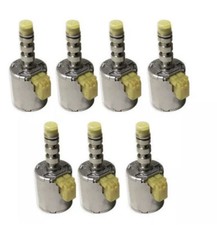
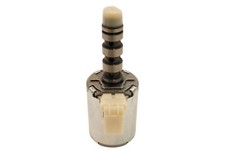
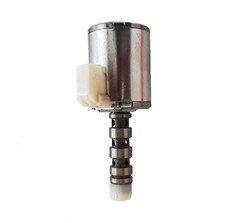
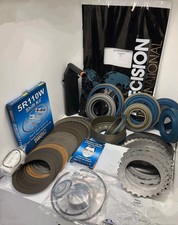
If your Ford Super Duty, Excursion or E-Series van with the 5R110W TorqShift has started slipping on one particular shift, banging into gear when hot, or dropping into limp mode with the Tow/Haul light flashing, the solenoids are one of the first places a transmission tech looks. This is a remanufactured set of OEM Ford 5R110W solenoids, sold with a 1-year warranty, for owners and shops who want to put known-good parts into the solenoid body instead of guessing which one of the seven has quit.
What the solenoid kit does in a 5R110W
Most older automatics use solenoids to push shift valves, and the valves do the real work. The 5R110W skips that step. Under the pan sits a solenoid body that holds seven variable-force solenoids, the fluid temperature sensor, the manual valve and a pressure relief ball, and that is about it. Every clutch except the forward clutch has its own solenoid metering oil straight to it, so the computer controls each apply directly by changing current between zero and one amp.
That design is precise when the parts are fresh. When a coil weakens, a valve sticks, or a snout separates from its stem, the clutch it feeds gets the wrong pressure at the wrong time. Some 5R110W solenoids are directly proportional and some are inversely proportional, so one failure can show up as a slip on one shift and a harsh apply on another.
Symptoms of worn 5R110W solenoids
- Flare or slip on a single shift, often the 1-2 or 2-3, and worst when towing
- Delayed engagement into Drive while Reverse engages normally
- Limp mode with a flashing Tow/Haul lamp
- Apply time codes P2700 through P2704, which line up with friction elements A through E and their SSPC-A through SSPC-E solenoids
- Pressure control solenoid codes such as P0752, P0753 or P0973
- Converter clutch that will not lock, or shudders, when the TCC solenoid is weak
How to confirm the solenoids are the problem
Check fluid temperature on a scan tool before anything else. The 5R110W runs a different shift pattern when it is very cold, so a truck that shifts oddly on a frozen morning may be working as designed, and a bad temperature sensor can mimic a solenoid fault. Rule out wiring next: a cracked internal harness or a contaminated connector at the PCM can throw the same electrical codes as a dead coil. With the pan down, all seven solenoids should read close to 4.5 ohms. An ohmmeter will not catch everything, though. Pull gently on each snout to find a failed crimp, and listen for the valve when you shake it. Our 5R110 shift solenoid symptoms and testing guide explains the snout ID marks and which code points at which solenoid.
Fitment
This listing covers the 5R110W TorqShift, which Ford installed in 2003 through 2010 F-250 through F-550 Super Duty trucks, the Excursion and E-Series vans with the 6.0L or 6.4L Power Stroke and the gas V8 and V10. The listing does not name a year range, and the 5R110W changed during production, including the early pressure switch bodies that Ford dropped in late 2004. Match your old solenoids to the photos by snout marks and connector, or send us your year and VIN and we will confirm it before it ships. If you need a set listed for a specific span, the 2004-2017 5R110W solenoid kit and the rest of our 5R110W TorqShift parts are on the collection page.
Install notes
- Drain the fluid, drop the pan and remove the solenoid body. Swap one solenoid at a time so each goes back into the bore it came from; they are keyed, but working one at a time keeps the harness routing straight.
- Fit new O-rings, lubricated with clean fluid, on every solenoid.
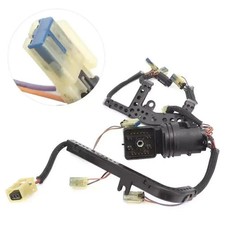
- Inspect the internal harness while it is out. If the jacket is brittle or the pins are discolored, replace it with the 5R110W internal wiring harness rather than reusing it.
- Replace the bottom pan filter, and on trucks with the external inline filter under the bellhousing, replace that too. Debris left in the circuit is the fastest way to stick a new solenoid valve.
- Refill with the fluid Ford calls for on your VIN. The unit was released on MERCON SP, which is not interchangeable with MERCON or MERCON V.
- Clear codes and perform the adaptive relearn: warm the fluid to 130 F, then five each of Park-to-Reverse, Drive-to-Reverse, Reverse-to-Drive and Neutral-to-Drive engagements, five seconds apart.
If the pan is full of friction material, the clutches are already damaged and solenoids alone will not fix the shift. In that case the 5R110W overhaul kit and our 5R110 TorqShift service guide are the better starting point.