A Ford 5R110W TorqShift that won't move in Drive or Reverse looks like a worst-case scenario from the driver's seat, but it rarely is one. In every documented case below, the transmission didn't need to come out of the truck at all, or it came out for a pump and valve body fix rather than a full rebuild. The complaint is almost always one of three things: the front pump isn't making line pressure, a valve in the valve body is misdirecting the pressure it does make, or the unit was just rebuilt and either the converter never got filled or a part from the wrong model year ended up in the pump. This guide walks those causes in the order a bench tech should actually check them, with the real documented failure mechanisms behind each one.
Don't Diagnose This One by Revving the Engine
Get this out of the way first, because it's how a cheap fix turns into an expensive one. If the transmission doesn't engage, the instinctive move is to rev the engine in gear to "see if it's in there." Per TransGo's technical documentation on this unit, if the pressure regulator (PR) valve is stuck in the exhaust position, raising engine RPM causes a surge in pump volume that can spike pump pressure dangerously. In Reverse, that spike can blow out the low/reverse clutch case lugs. In Drive, it can create a neutral-drop condition that damages the low diode assembly -- which itself then causes a no-forward condition. Put a line pressure gauge on it and read idle pressure before you touch the throttle.
Start With the Front Pump
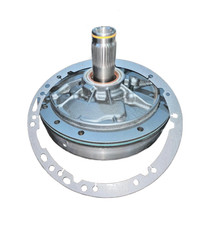
Across every source reviewed for this guide, the front pump is the component named most often in a total no-movement complaint, for two distinct reasons: it can physically destroy itself, or it can simply stop building pressure.
Broken, welded pump gears (the catastrophic version)
GEARS Magazine's "Tales From the Bench" column documents a freshly rebuilt 5R110 that lost power and then had no forward or reverse at all. Teardown found the front pump's inner and outer gears broken and welded to the pump cover's metal plate. The root cause traced back to the replacement pump bushing: the factory bushing is finished in place to run true to the converter hub's centerline, but a generic replacement bushing often doesn't, and the resulting off-center rotation generates enough heat to weld the bushing to the hub. The article's specified fix is to check converter hub-to-bushing clearance (0.003-0.0045 in.), confirm the bushing's lube slot is aligned, verify the inner gear contacts the converter hub evenly on both sides, and align the pump to true centerline using the stator support tube rather than a pump band during reassembly.
Fluid starvation and bad grounds -- often blamed on the wrong thing
The same GEARS Magazine teardown calls out two other pump killers that get misdiagnosed constantly. A pump that's run dry, even briefly, moves enough fluid that it can score both gears with matching hot spots -- a signature distinct from a one-sided wear pattern. Separately, bad battery or chassis grounds mainly damage the pump's inner gear. The article's verification spec is specific enough to use on the truck: no more than 0.10V DC drop, engine running, measured from the battery ground post to the engine block, frame, cab, transmission case, and ground cable, and under 0.40V DC during cranking. A ground circuit that fails that test is worth fixing before you ever pull the transmission, because it can take out a brand-new pump the same way it took out the old one.
A sticking pressure regulator valve (the non-catastrophic version)
The more common pump-side cause doesn't destroy anything -- it just stops making pressure. Per TransGo's documentation, the PR valve is prone to sticking in its bore in part because the pump casting itself distorts over time and mileage. When it sticks in the exhaust position, line pressure drops low or disappears, and nothing applies in any range. Sonnax's oversized pressure regulator valve kit (36940-03K) targets the same failure from the wear side: a worn PR valve bore lets excess valve-to-bore clearance leak line pressure back out of the circuit, cutting flow to the converter and lube circuits and setting codes P1744 and P1783 on top of the low-pressure complaint. Sonnax's kit also lists a heavy-duty input shaft (36670-HD) as a recommended companion part -- the input shaft is a shared weak point across the E4OD, 4R100, and 5R110W family, and a shaft that's already twisting under load is worth ruling out while the pump is apart anyway.
If the Pump Checks Out, Look at the Valve Body
A good pump making normal pressure doesn't guarantee that pressure reaches the clutches. The 5R110W's valve body has two documented wear points that produce a no-movement or delayed-engagement complaint with the pump completely healthy.
Manual valve and bore wear
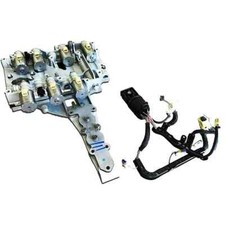
Sonnax's technical documentation on the 5R110W's factory manual valve describes it as prone to anodization flaking and degradation, which leads to premature valve wear and a loss of hydraulic control. Sonnax attributes the wear to linkage side-loads and extended service life, and notes that the OE shift linkage's pivot points are known to wear and misalign the manual valve against the valve body's internal passages. The documented symptoms are low line pressure, delayed drive, and delayed reverse -- in a bad enough case, effectively no movement until the linkage and valve are both corrected. Sonnax's fix path depends on severity: the 36940-22 is a direct-replacement valve for a bore that's still in spec, while a visibly worn bore (check the low/reverse clutch circuit and the line pressure/direct clutch circuit for wear marks) calls for the oversized 36940-11 valve, which requires reaming with Sonnax's F-36940-TL11 tool kit and VB-FIX fixture.
Clutch B bleed filter missing from a remanufactured pump
This one doesn't cause total no-movement, but it belongs in the same conversation because it's the other documented valve-body-adjacent cause of lost gears on this unit, and it's easy to confuse with a bigger problem. Transmission Digest's Wayne Colonna documents a 5R110W with no access to second or sixth gear, with the PCM capable of setting P0732 (gear ratio error in second), P0756 (B/overdrive clutch solenoid stuck off), or P2701 (B clutch performance/apply time out of range). The cause was a missing Clutch B bleed filter in a remanufactured pump -- a non-serviceable part, meaning the fix is a full pump cover replacement, cross-referenced against ATSG bulletin 19-37 for pump cover-to-pump body interchangeability. The broader lesson for a no-movement diagnosis: this transmission has a documented history of remanufactured-pump parts mismatches across model years, which is exactly the pattern that also shows up in the post-rebuild cause below.
If This Just Came Out of a Rebuild or Pump Swap
No movement immediately after a rebuild, a pump replacement, or a converter swap points away from wear and toward two specific, documented mistakes.
An unfilled torque converter
GEARS Magazine's fluid-fill procedure exists specifically because this failure is common enough to document: fill the torque converter with three quarts of fluid before it goes on the pump, add eight quarts after the transmission is installed, run the engine for about 20 seconds and shut it off, then add five more quarts before a final restart and fill to the correct level on the stick. Skip the pre-fill and the converter can take long enough to self-fill through the pump that the truck sits with no movement at all, or feels sluggish and air-bound, until it finally catches.
A converter clutch control valve from the wrong model year
Transmission Digest's Tech/Talk archive (January 2019 issue) documents a 5R110W with no movement after overhaul, where teardown revealed the torque converter had never been filled -- but the deeper cause was a parts mismatch: a longer converter clutch control valve, used on 2005-and-later pumps, installed into a 2003-04 pump cover. The longer valve doesn't seat correctly in the shorter bore, which blocks converter fill entirely and produces the identical no-movement symptom even though every individual part is a genuine 5R110W part. If a truck came out of a shop with a remanufactured pump and immediately has no movement, checking the pump's Rough Forge casting number against the converter clutch control valve installed is a five-minute check that can save pulling the transmission a second time.
A Practical Diagnostic Order
- Don't rev the engine to "test" engagement. Connect a line pressure gauge first.
- Check grounds: under 0.10V DC drop running, under 0.40V DC cranking, at the battery ground post to block, frame, cab, case, and ground cable.
- Read line pressure in Park, Drive, and Reverse. Low or no pressure in every range points to the pump or the PR valve bore before anything else.
- If pressure is present but movement is still delayed or absent, suspect the manual valve or its bore, and inspect the shift linkage pivot points for wear that could be misaligning it.
- If this followed a rebuild or pump swap, confirm the converter was pre-filled and check the pump's Rough Forge number against the converter clutch control valve length before assuming the new parts are defective.
- Only pull the pump and valve body for teardown once the hydraulic checks above have ruled out a quick fix.
Browse CoreTransmissionParts →
FAQ
What's the single most common cause of no movement in a 5R110W?
Front pump trouble leads the list. GEARS Magazine documents a 5R110 that lost all movement because the pump's inner and outer gears broke and welded themselves to the pump cover plate -- traced back to a replacement bushing that ran off the converter hub's true centerline and generated enough heat to weld itself in place. A sticking pressure regulator valve, caused by pump casting distortion, is the other common pump-side cause, since it can drop line pressure to the point nothing applies.
Can a bad ground really stop a 5R110W from moving?
Yes, indirectly. GEARS Magazine's teardown notes that bad battery or chassis grounds mainly damage the pump's inner gear, and specifies a verification spec: no more than 0.10V DC drop (engine running) from the battery ground post to the engine block, frame, cab, transmission case, and ground cable, and under 0.40V DC during cranking. A ground circuit failing that test can starve or damage the pump enough to kill movement, which is why it's worth five minutes with a voltmeter before you pull anything apart.
Why does my 5R110W have no movement right after a rebuild or pump swap?
Two post-rebuild causes show up repeatedly. First, a torque converter that was never filled with fluid before installation -- GEARS Magazine's fluid-fill procedure exists specifically to prevent this. Second, a parts mismatch: Transmission Digest documents a 2005-or-later converter clutch control valve installed into a 2003-04 pump cover, which blocks converter fill and produces the same no-movement complaint even though every part is technically a 5R110W part.
Is no movement in both Drive and Reverse always a pump problem?
No. Line pressure that's low or absent in every range usually does point to the pump or its pressure regulator valve, but a worn manual valve or manual valve bore can produce the same complaint by misdirecting line pressure before it ever reaches the clutches. Sonnax's tech documentation on the 5R110W's factory manual valve describes anodization flaking and bore wear that cause delayed drive, delayed reverse, and low line pressure -- a hydraulics problem, not a broken part, and one a line-pressure and valve-body inspection will catch before you condemn the pump.
Should I rev the engine to see if a dead 5R110W will engage?
Don't. If the pressure regulator valve is stuck in the exhaust position, revving the engine spikes pump volume and pressure. In Reverse that spike can blow out the low/reverse clutch case lugs; in Drive it can cause a neutral-drop condition that damages the low diode assembly, turning a repairable hydraulics problem into a case-and-clutch repair. Check line pressure with a gauge at idle instead of diagnosing by ear and throttle.
Related 5R110W guides
Sources
- GEARS Magazine (ATRA) — "5R110: A Dead Stop, No More Movement," Tales From the Bench, by Jarad Warren (April 2020). Backs the welded pump gear failure, the converter-hub bushing clearance spec (0.003-0.0045 in.), the ground-circuit voltage drop specs, and the torque converter fluid-fill procedure. gearsmagazine.com
- Sonnax — "2088 Oversized Pressure Regulator Valve Kit" technical product page. Backs the PR valve bore wear mechanism, codes P1744/P1783, low line pressure, part number 36940-03K, and the recommended heavy-duty input shaft 36670-HD. sonnax.com
- Sonnax — "2089 Oversized Manual Valve" technical product page. Backs the manual valve anodization-flaking/wear failure, delayed drive/delayed reverse/low line pressure symptoms, shift linkage pivot wear, and part numbers 36940-22 and 36940-11. sonnax.com
- Transmission Digest — "Ford 5R110W without second or sixth gear," Tech/Talk, by Wayne Colonna (October 31, 2024). Backs the missing Clutch B bleed filter failure, codes P0732/P0756/P2701, and the ATSG bulletin 19-37 pump cover reference. transmissiondigest.com
- Transmission Digest — Tech/Talk, January 2019 issue. Backs the unfilled-torque-converter no-movement case and the 2005-and-later converter clutch control valve mismatch in a 2003-04 pump cover. transmissiondigest.com
- TransGo — SK 5R110W-A shift kit technical documentation. Backs the PR valve sticking-from-casting-distortion mechanism and the pressure-spike case lug blowout (Reverse) / neutral-drop low diode damage (Drive) behavior when the engine is revved to test engagement. transgo.com