The classic 5R110W shudder complaint sounds like this: the truck feels fine through the gears, then somewhere between 40 and 55 mph at light throttle it starts shaking like it is driving over rumble strips. Step into it and the shake goes away. Lift off and it goes away. Put it in tow/haul and it often goes away too. That pattern tells you it happens when the converter clutch is applied or trying to apply, and it tells you very little else.
On a TorqShift, "converter shudder" can be four different problems: the fluid has lost its friction properties, the converter clutch surface is damaged, the valve body is not controlling apply and release pressure properly, or the engine is misfiring and the locked converter is passing the vibration straight into the cab. The last one is common on 6.0L and 6.4L diesels, and it causes a lot of good converters to get replaced. This guide works through them in order, cheapest to most expensive. The hydraulic behavior comes from Sonnax, the solenoid logic from Transmission Digest, and the scan-data method from GEARS magazine. Everything is listed under Sources at the bottom.
How the 5R110W applies its converter clutch
You need the control logic in your head before the scan data makes sense. Transmission Digest describes the 5R110W TCC solenoid as a directly proportional, three-port solenoid. The PCM varies DC current between 0 and 1 amp, and 1 amp is maximum pressure in the circuit. The solenoid controls both the apply rate and the release rate of the converter clutch. It is not an on/off lockup like an old two-wire solenoid. The PCM ramps the clutch on and can hold it in a controlled slip.
To decide when to do that, the PCM looks at engine coolant temperature, intake air temperature, accelerator pedal position, transmission fluid temperature, output shaft speed and the transmission range sensor. That list matters for diagnosis. A bad APP signal or a fluid temperature sensor that reads wrong will change lockup behavior, and the transmission gets blamed for it.
The hydraulic side works like other two-path converters. Sonnax's converter clutch control article explains it: release oil flows down the center of the turbine shaft and exits between the TCC piston and the cover, holding the piston off the cover. To apply, the valve body exhausts release oil and apply pressure clamps the piston against the cover. The TCC control valve and regulated apply circuit set how gradually that happens, based on what the solenoid commands. Anything that disturbs that balance, whether it is too much pressure, too little, or a restriction, can show up as shudder.
Step 1: Get data at the speed it shudders
Do not diagnose a shudder from the driver's description. Drive the truck with a scan tool connected and record it at the speed and throttle where it happens. GEARS magazine's shudder diagnosis article lays out the method: note vehicle speed, gear, engine rpm and throttle when the shake starts, check for bulletins, then watch TCC commanded slip against TCC actual slip along with the TCC solenoid current so you know the electrical command is really there.
What you are looking for:
- Actual slip hunting around commanded slip while the shake is happening. The clutch is grabbing and letting go. That points at the converter, the fluid or the apply circuit.
- Slip that stays high with full commanded current. The clutch cannot hold. GEARS notes that most lockup clutches are designed to slip a small amount while engaged, and acceptable slip is typically under about 60 rpm. Well above that at full command means lost apply pressure or a worn clutch.
- Slip that is steady and low but the truck still shakes. The converter is doing its job. Look at the engine.
- Commanded current jumping around. Check the inputs the PCM uses (APP, fluid temperature, output speed) before blaming hydraulics.
Step 2: Rule out the engine
This step saves the most money. When the converter clutch locks, the engine is tied directly to the driveline and the converter no longer absorbs firing pulses. A misfire that nobody noticed with the converter unlocked can shake the whole truck once it locks. GEARS covers this in the same article: check Mode 6 misfire counts per cylinder and see whether one cylinder's count rises in step with the shudder. Then confirm with the usual tests, such as swapping ignition parts on gas engines, a compression test, and checking engine and transmission mounts.
On diesel Super Duties, look at injectors first. A diagnostic network case on a 2004 F-250 6.0L described exactly the classic TCC shudder complaint: violent shake at 45 to 55 mph with the TCC locked, gone in tow/haul or at heavier throttle. The truck had P0267 and P0279 injector circuit codes. Two damaged injector connectors were causing misfires on cylinders 3 and 7. New injectors fixed it and the converter was never touched. If there is an injector, cylinder contribution or misfire code in the engine side of the PCM, fix that first.
Tow/haul mode is a useful clue here, not proof. It changes both shift and lockup scheduling, so the shudder going away in tow/haul does not prove it is the converter. It only tells you the problem depends on when lockup happens.
Step 3: Fluid type, condition and level
Converter clutch friction material is designed around a specific fluid. Transmission Digest states that the TorqShift was designed for MERCON SP, which is not interchangeable with MERCON or MERCON V, and that using a different fluid can cause abnormal operation or transmission failure. Ford later moved these units to MERCON LV. Use whatever is printed on the truck's dipstick. Transmission Digest gives Ford's recommended fluid change interval as 30,000 miles (48,000 km).
GEARS lists degraded fluid as one of the three root causes of true converter shudder. The friction modifiers wear out, the clutch goes from a smooth slip to a stick-slip, and that stick-slip is the shudder. If the fluid is dark, smells burnt or is the wrong type, change it before you pull anything. A fluid exchange with the correct MERCON, plus a road test that runs the converter through several apply cycles, clears a lot of mild shudders. If the shudder is gone after the fluid change but comes back within a few thousand miles, the clutch surface is already damaged. The new fluid only hid it for a while.
Set the level hot, in Park with the engine running, as the dipstick shows. Aerated fluid from overfilling makes apply pressure inconsistent, and a low level can let the pump draw air during turns and stops.
Step 4: Check cooler and release flow
This is the most overlooked cause. On a two-path converter the release oil has to exit fast enough for the piston to apply cleanly, and the converter-out oil goes to the cooler. Sonnax's troubleshooting lockup article gives a specific number: when TCC release flow drops below about 0.45 gallons per minute, the TCC piston starts dragging on the cover. A restriction in the input shaft, pump, case passages or valve body can cause that.
The same article gives a way to separate internal and external causes. If cooler flow is normal and line pressure is lower than normal, the shudder comes from a pressure problem. If cooler flow is low with normal pressure, something is restricting flow. Sonnax technical specialist Ed Lee described the field test for coolers in a separate article: if a truck with a shudder drives fine with the cooler bypassed, the cooler is restricted. On a Super Duty that has towed heavy or had a previous failure, that restriction is often clutch material from the last failure packed into the cooler core.
Do a flow test at the cooler return line. If flow is poor, flush the lines, and replace the cooler if it will not flow cleanly. A new converter installed with a plugged cooler will overheat its lining and shudder again.
Step 5: The valve body circuits that cause shudder
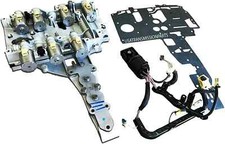
If the engine is clean, the fluid is right and cooler flow is good, look at the valve body. Sonnax's 5R110W valve body layout calls out three bores that affect the converter:
| Valve | Sonnax kit | Symptoms Sonnax lists |
|---|---|---|
| TCC control plunger valve | 36940-01K | Overheating, excess TCC slip, TCC cycling, TCC slip, code 1783, P0741 |
| Converter pressure limit valve (2005 and later) | 36940-06K | Harsh TCC apply, soft TCC apply, TCC codes, TCC slip, TCC lining failure, erratic TCC apply pressure, excess converter pressure |
| Pressure regulator valve (oversized) | 36940-03K | Codes 1744 and 1783, low line pressure and TCC concerns |
Source: Sonnax, "Ford 5R110W Valve Body Layout."
These wear the same way. Oil leaks past a worn valve, the regulated pressure it controls becomes erratic, and the clutch apply goes unstable. Actual slip that cycles on the scan tool while the TCC current command stays steady is how that looks. Sonnax's hydraulics article explains the other direction too: too much pressure into the solenoid regulator gives too much pressure out, which causes early lockup and slow release, and worn seals let charge pressure bleed into the apply circuit, which causes erratic apply. A low line pressure reading makes the regulator valve bore a suspect, because low line pressure means low apply pressure and too little clamp on the clutch.
On a high-mileage TorqShift, a vacuum test of these bores or a remanufactured valve body with them already sleeved is often faster than chasing one valve at a time.
Step 6: Test the TCC solenoid
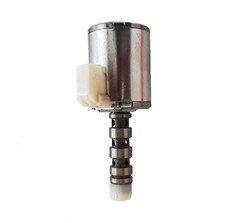
Because the TCC solenoid is directly proportional, it fails in a predictable way. A solenoid valve that sticks or a coil that loses current means lower apply pressure than commanded, so the clutch slips and shudders. Compare the PCM's TCC current with the actual slip. If the command ramps up smoothly to full and actual slip does not come down with it, and line pressure is normal, the solenoid is a strong suspect.
A useful check: the 5R110W solenoid body has other directly proportional solenoids. Transmission Digest lists SSPC-B (overdrive clutch), SSPC-C (intermediate) and SSPC-E (low/reverse) as directly proportional along with the TCC. That means a suspected TCC solenoid can be swapped with a solenoid of the same type to see whether the fault moves. If the TCC problem goes away and a shift problem shows up for the clutch whose solenoid position you used, the solenoid is bad. Replace the solenoid, not the converter.
Two quick checks belong in this step. First, measure the coil: per the ATSG 5R110W manual the TCC solenoid reads 4.1-4.7 ohms at 72 degrees F across solenoid body connector pins 7 and 8. Second, look at the feed. Transmission Digest's Wayne Colonna notes the TCC solenoid is fed through a 0.018-0.021 in. orifice sitting in a recess that collects debris; a partly plugged feed starves apply pressure the same way a weak solenoid does. Clean the orifice before you condemn the solenoid. If the truck has stored P0741 (TCC slippage, per the ATSG code chart) or P1744 along with the shudder, work through our 5R110W P0741 guide as well.
Step 7: When it really is the converter
If everything above checks out and actual slip still hunts around commanded slip, the clutch surface inside the converter is the problem. GEARS compares it to a warped brake rotor: an uneven converter cover or clutch surface vibrates every time the clutch is applied, and the only fix is to pull the transmission. Sonnax's Ed Lee lists some less obvious causes rebuilders see: converter bolts that are too long, or dirt, grease or sealant in the bolt holes, which can dimple the inside of the cover where the clutch seats. A release-oil orifice that is too small in a rebuilt converter also causes lockup shudder, because the oil cannot exit fast enough.
If you replace the converter:
- Fix whatever caused the first one to fail: fluid, cooler flow, valve body bores. Otherwise the new lining fails the same way.
- Match the converter to the truck. The 5R110W used both 6-stud and 8-stud converter covers across its production run, so confirm what the flexplate uses before ordering.
- Flush the cooler and lines, and flow test after the install.
- Check that the bolt holes are clean and use the correct bolt length.
- If the pump was rebuilt, confirm the converter clutch control valve sleeve was not pushed too deep. Transmission Digest documented after-overhaul no-lockup and P0741 on the 5R110W from that sleeve opening the apply circuit to exhaust, and from cooler debris lodging in the TCC feed hole of the solenoid body gasket.
The fix, by cause
| What you found | Fix |
|---|---|
| Misfire or injector codes, low slip during shake | Repair the engine; the converter is fine |
| Wrong, mixed or worn-out fluid | Exchange with the MERCON on the dipstick; road test several lockup cycles |
| Low cooler flow, normal line pressure | Flush lines; replace a restricted cooler |
| Actual slip cycling with a steady TCC command | TCC plunger valve (36940-01K) or converter limit valve (36940-06K), or a remanufactured valve body |
| Low line pressure with TCC slip | Pressure regulator valve bore (36940-03K); check pump |
| Slip does not follow a smooth full command, fault moves on a solenoid swap | TCC solenoid |
| Everything above checks good, slip still hunts | Converter replacement plus cooler flush and flow test |
Shop the part for this fix: Sonnax 5R110W TCC control plunger valve kit (36940-01K)
If the scan data shows the converter clutch cycling or slipping with a steady TCC command, this is the kit Sonnax specifies for a worn TCC control plunger bore. For the converter pressure limit valve kit, solenoids and valve bodies, browse the 5R110W range at CoreTransmissionParts.
See the TCC control plunger valve kit at CoreTransmissionPartsNeed parts for this job?
Our 5R110 parts page has 5R110W TCC solenoids, solenoid kits, valve bodies and coolers, so you can buy the part that matches what the scan data showed. Checkout is on site.
FAQ
What does 5R110W torque converter shudder feel like?
It feels like driving over rumble strips, usually at light throttle between about 40 and 55 mph when the converter clutch applies. It typically goes away with more throttle, when you lift off, or in tow/haul mode, because each of those changes whether the converter clutch is locked. Record TCC commanded and actual slip at that speed to confirm it.
Can an engine misfire feel like converter shudder on a Super Duty?
Yes. When the converter locks, the engine is tied directly to the driveline, so a misfire that was hidden becomes a heavy shake. Check Mode 6 misfire counts and any injector circuit codes first. If TCC actual slip stays low and steady while the truck shakes, the converter is doing its job and the engine is the problem.
Will a fluid change fix 5R110W converter shudder?
It can if the fluid is worn out or the wrong type. The TorqShift was designed for MERCON SP and later moved to MERCON LV, and the dipstick shows which one the truck needs. If the shudder goes away after a fluid change but comes back within a few thousand miles, the converter clutch surface is already damaged.
What valve body problems cause 5R110W TCC shudder?
Sonnax lists wear at the TCC control plunger valve (kit 36940-01K) for TCC slip, cycling, overheating and P0741, and at the converter pressure limit valve (kit 36940-06K) for erratic apply pressure, slip and lining failure. A worn pressure regulator valve bore can also cause low line pressure and TCC concerns.
Can a restricted cooler cause converter shudder?
Yes. Sonnax notes that when TCC release flow drops below about 0.45 gallons per minute, the TCC piston starts dragging on the cover. If a shuddering truck drives fine with the cooler bypassed, the cooler is restricted. Flush or replace it before installing a new converter.
Related guides
- 5R110W Harsh Shift Causes and Fix
- 5R110W Slipping: Causes and Fix
- 5R110W Shift Solenoid Symptoms
- 5R110W Common Problems and Fixes
- Torque Converter Clutch Shudder Diagnosis
Sources
- Transmission Digest, "Ford 5R110W (TorqShift)." Backs the TCC solenoid as a directly proportional three-port solenoid (0-1 amp, 1 amp = maximum pressure) controlling apply and release rates; the PCM inputs used for TCC control; SSPC-B, SSPC-C and SSPC-E being directly proportional; the MERCON SP requirement; and the 30,000-mile fluid change interval. transmissiondigest.com
- Sonnax, "Ford 5R110W Valve Body Layout." Backs the TCC control plunger valve kit (36940-01K), converter pressure limit valve kit (36940-06K) and oversized pressure regulator valve kit (36940-03K) and the symptoms listed for each. sonnax.com
- GEARS magazine (ATRA), Aaron Golas, "Shudder Diagnosis." Backs recording TCC commanded vs. actual slip and TCC solenoid current at the shudder speed, typical lockup slip under about 60 rpm, the three root causes of converter shudder, and using Mode 6 misfire counts to separate engine misfire from converter shudder. gearsmagazine.com
- Sonnax, "Troubleshooting Lockup Issues." Backs the TCC piston dragging on the cover when release flow drops below about 0.45 GPM, and the cooler flow vs. line pressure test for separating pressure problems from restrictions. sonnax.com
- Sonnax, Ed Lee, "Troubleshooting Converters Has Twists and Turns." Backs the cooler-bypass test for a restricted cooler, a too-small release orifice causing lockup shudder, and long converter bolts or debris in the bolt holes dimpling the cover. sonnax.com
- Sonnax, "Hydraulics Fundamentals, Part IV: Converter Clutch Control." Backs the two-path release and apply oil path, regulated apply control, and excess solenoid feed pressure and cross-leakage causing early lockup and erratic apply. sonnax.com
- ATSG, Ford 5R110W (TorqShift) technical manual (2004). Backs the 4.1-4.7 ohm TCC solenoid resistance at pins 7 and 8 and the P0741 TCC slippage code description. ATSG manual (PDF)
- Transmission Digest, Wayne Colonna, "What to do about a Ford 5R110W with no lock up" (November 2024). Backs the 0.018-0.021 in. TCC solenoid feed orifice that plugs with debris and the P1744 excessive slip code. transmissiondigest.com
- Transmission Digest, January 2008 issue tech bulletins. Backs after-overhaul 5R110W no-lockup from a converter clutch control valve sleeve installed too deep and cooler debris in the solenoid body gasket TCC feed hole. transmissiondigest.com
Field case referenced in Step 2: 2004 F-250 6.0L TCC-locked vibration traced to injector connectors (P0267/P0279), Diagnostic Network. Mentioned as a real-world example, not as a primary source.