Most "5R55S specs" pages give you five gear ratios and stop. That's fine for a spec sheet, but it doesn't help when you've got the unit on the bench and need a band adjustment spec, a pump bolt torque, or a line pressure number to check against the gauge. This page puts it all in one place: the ratios and what they mean on the road, the hardware inside the case, the fluid and capacity, Ford's line pressure and stall numbers, and the torque and clearance specs I use at reassembly.
The hard numbers come from Ford's 5R55W/S service information (the diagnosis, servicing and overhaul sections, via Mitchell1), Raybestos Powertrain's 5R55S data, and Sonnax and Transmission Digest for the variant history. Everything is listed at the bottom.

5R55S gear ratios
Raybestos Powertrain lists the 5R55S, 2003-2010, as a five-speed with these ratios:
| Gear | Ratio | Step from previous gear | Engine rpm drop on the upshift |
|---|---|---|---|
| 1st | 3.22:1 | - | - |
| 2nd | 2.29:1 | 1.41 | about 29% |
| 3rd | 1.55:1 | 1.48 | about 32% |
| 4th | 1.00:1 (direct) | 1.55 | about 35% |
| 5th | 0.71:1 (overdrive) | 1.41 | about 29% |
The step and rpm-drop columns are my arithmetic from the published ratios, not a Ford chart. Overall spread (1st divided by 5th) works out to about 4.5:1. Ford's own description explains the name: the "W" in 5R55W stands for wide ratio, and the "S" in 5R55S stands for synchronous shift. The two units share this ratio set.
What the ratios mean on the road
Two things matter in practice. First, the 3-4 shift is the biggest step in the box, about a 35% rpm drop. That's the shift where a weak direct clutch shows up first as a flare, because it has the most engine inertia to pull down. Second, 5th is a 0.71 overdrive. For the same road speed, the engine turns about 29% slower in 5th than in 4th, so an engine at 2,000 rpm in 4th is at roughly 1,420 rpm in 5th. That's good for fuel mileage and bad for towing. At that rpm the converter clutch has to stay locked, and any hill makes the unit hunt between 4th and 5th.
If a customer complains the engine is "revving too high on the highway," check whether the O/D OFF light is on before you do anything else. Ford's diagnosis manual says pressing the transmission control switch on the shifter cancels 5th, applies the coast clutch, and turns on the O/D OFF lamp. 5th comes back every time the ignition is cycled. A flashing O/D OFF lamp is different. Ford says it means a pressure control solenoid circuit fault or a fault in a monitored sensor, so pull codes.
What's inside the case
Per Ford's service information, the 5R55W/S has:
- A 4-element torque converter with a torque converter clutch (TCC).
- Three compound planetary gear sets.
- Three bands: overdrive, intermediate and low/reverse. The overdrive and intermediate bands have external adjusting screws.
- Three multi-plate clutches: coast, direct and forward.
- Two one-way clutches.
- A solenoid body with four on/off shift solenoids (SSA, SSB, SSC, SSD), three variable-force pressure control solenoids (PC-A, PC-B, PC-C) and a PWM TCC solenoid. The TFT sensor is on the same solenoid body.
- A turbine shaft speed (TSS) sensor and an intermediate shaft speed (ISS) sensor. Ford describes the ISS as reading planetary sun gear speed, which the PCM uses to work out pressure requirements.
Ford says the shift solenoids are normally open three-way solenoids that route control pressure to the right elements. The PC solenoids set line pressure and band and clutch apply pressure. The split matters when you diagnose it. A shift solenoid problem usually gives you a wrong or missing gear. A PC solenoid problem gives you all five gears with a bad feel: flares, bumps, or soft or harsh engagements. The 5R55S shift solenoid guide covers which PC solenoid feeds which band and clutch.
Raybestos's clutch pack module for the 5R55W/5R55S (2002-on, RCP96-139) gives you the plate counts. It contains 2 coast/overrun frictions, 5 forward frictions and 5 high/reverse frictions per pack. Their Stage-1 performance module for the 2005-on 5R55S (RCPS-50) is listed as 5 forward, 5 direct and 2 coast. If a kit you're about to install doesn't match those counts, stop and check the application before the drum goes together.
5R55S vs 5R55W vs 5R55N: know which one you have
The ratio set is the same, but the hard parts aren't. Sonnax's variant breakdown:
- 5R55N: 1999-2002 Jaguar S-Type, Lincoln LS and Thunderbird. It has two cast bosses behind the intermediate servo cover and a reverse pressure switch in the solenoid circuit.
- 5R55W: 2002-2003 Explorer and Mountaineer. It has a single PCC pressure port boss and a 24-tooth overdrive sun gear.
- 5R55S: replaced the W in the 2004-2005 trucks and the N in the 2003 Lincolns and Thunderbirds. It has a 38-tooth overdrive sun gear and one PCC boss, and is otherwise close to the W.
Sonnax warns that only a few parts interchange between the N and the W/S, and that most N parts can cause problems if they end up in a W/S unit. The 5R55S also went into the 2005-2010 Mustang.
The front planet is one of those hard-part differences, and it's worth knowing why. Transmission Digest (Ed Lee of Sonnax) documented a 5R55W front planet bearing failure where the center of the bearing cage on the sun-gear side stamped out. Per that article, Ford dropped that front planet and sun gear design when the 5R55S took over. The Ford service part is 2L2Z-7A398-AA. The shop fix, if you catch it before it comes apart, is a thinner RE4F02A bearing shimmed with Sonnax 77406-10 (0.010 in) or 77409-15 (0.015 in) to hold endplay. If you're rebuilding a W and the front planet bearing looks marginal, deal with it now. Our 5R55S identification guide and 5R55S vs 5R55W comparison go deeper on telling them apart.
Fluid, capacity and filters
| Item | Spec |
|---|---|
| Transmission fluid | Motorcraft MERCON V (XT-5-QM or XT-5-DM) |
| Approximate capacity, 5R55W/S (Explorer/Mountaineer) | 12.6 qt (12.0 L) |
| Transfer case, 4WD | 3.0 pt (1.4 L) |
| Transfer case, AWD | 2.6 pt (1.25 L) |
| Level check | Check plug in the pan, TFT at 81-120°F (27-49°C) |
Ford's servicing section calls the capacity approximate and says the correct level is set by the fluid level check procedure, not by the amount of fluid added. It also warns that any fluid other than the one specified could damage the transmission. There's no dipstick. You bring TFT into range on the scan tool, level the vehicle, and pull the check plug with a 3/16 in Allen key; it's right when it drips or runs in a thin stream. Ford also says to install a new converter drain plug every time to prevent leaks, and that the pan gasket is reusable if it passes inspection.
One thing to watch at the parts counter: Ford has renumbered the fluid since this unit was new. Motorcraft's current MERCON V product page lists it as XT-5-QMC (quart), XT-5-5Q3M (5 quart) and XT-5-DMC (55 gallon), and states plainly that it is not to be used where MERCON LV, MERCON ULV or MERCON SP is recommended. Those are the fluids for Ford's later 6-speed and 10-speed units, so a shop that services both needs to keep them apart. Motorcraft's MERCON V data sheet gives the typical viscosity as 7.5 cSt at 100 C and 33.2 cSt at 40 C, with a viscosity index of 205, which is the baseline a 5R55S calibration expects.
For filters, Raybestos lists 515575 for the 2003-2005 5R55N/5R55S and 515578 for the 1999-2002 car-only 5R55N/5R55S. Match by year and vehicle, not by the "5R55" name. The full level-check steps are in our 5R55S fluid type and capacity guide.
Line pressure and stall speed
These are Ford's numbers for the Explorer and Mountaineer. Take them at the line pressure tap. Ford says to do the line pressure test before the stall test, because if pressure is low at stall you'll do more damage running the stall test.
| Engine / range | Idle (psi) | WOT stall (psi) |
|---|---|---|
| 4.0L, P and N | 75-120 | - |
| 4.0L, R | 145-190 | 282-350 |
| 4.0L, D, 3, 2 and 1 | 80-110 | 228-263 |
| 4.6L, P and N | 75-120 | - |
| 4.6L, R | 175-215 | 282-350 |
| 4.6L, D, 3, 2 and 1 | 100-135 | 228-263 |
Stall speed per Ford: 2,557-3,036 rpm for the 4.0L and 2,687-3,150 rpm for the 4.6L. Ford also notes that holding a stall test too long can set codes, so clear them afterward. Ford explains how to check the PC solenoids: turn off PC-A or PC-B and watch the line tap to read the output of the other one, and use the separate pressure control tap to check PC-C. These are Explorer numbers. For a Mustang 5R55S, use the Mustang-specific service information before you condemn a unit on pressure alone.
Torque specs
From the torque table in Ford's 5R55W/S overhaul section. The inch-pound fasteners are where people strip aluminum, so use an inch-pound wrench on them.
| Fastener | Torque |
|---|---|
| Fluid pump housing screws | 18 ft-lb (25 N·m) |
| Extension housing screws | 18 ft-lb (24 N·m) |
| Band adjustment screw locknut | 40 ft-lb (54 N·m) |
| Fluid pan drain plug | 19 ft-lb (26 N·m) |
| Fill plug | 15 ft-lb (20 N·m) |
| Converter adapter plate nuts (to converter and to flexplate) | 28 ft-lb (38 N·m) |
| Cooler fitting-to-case retainer | 35 ft-lb (47 N·m) |
| Cooler tube nut-to-case fitting | 22 ft-lb (30 N·m) |
| Transmission-to-engine bolts | 35 ft-lb (48 N·m) |
| Band adjustment screw | 124 in-lb (14 N·m) |
| Case-to-center support screw | 97 in-lb (11 N·m) |
| Main control (valve body)-to-case screws | 89 in-lb (10 N·m) |
| Separator plate-to-main control bolts | 89 in-lb (10 N·m) |
| Solenoid body bolts | 71 in-lb (8 N·m) |
| Vehicle harness-to-solenoid body screw | 44 in-lb (5 N·m) |
| Speed sensor screws | 124 in-lb (14 N·m) |
| Reverse servo assembly bolts | 97 in-lb (11 N·m) |
| Filter bolts | 89 in-lb (10 N·m) |
| Pan-to-case screws | 97 in-lb (11 N·m) |
| Converter drain plug | 89 in-lb (10 N·m) |
Clearances and band adjustment
Coast clutch: Ford specifies 1.3-2.0 mm (0.051-0.079 in) between the coast clutch retaining ring and the pressure plate. If it's out, change to a different select-fit ring. The direct and forward clutch packs are checked the same way, with a feeler gauge between the retaining ring and pressure plate, and corrected with select-fit rings. Air check each drum at no more than 20 psi, per Ford's warning.
Band adjustment: This is the step I see skipped most on DIY rebuilds. The servo has to be installed first. Then tighten the adjusting screw to spec (124 in-lb per the torque table), back it off exactly two turns, hold it there, and torque a new locknut to 40 ft-lb. Do it for both the overdrive and intermediate bands. Ford's cautions say not to let the screw back out while you tighten the nut. Also, the overdrive band adjusting screw has to be loosened before you pull the pump at teardown. Check the overdrive band apply strut orientation at assembly, because Ford says an incorrectly installed strut will damage the transmission.
Pump endplay: Ford sets input endplay with a selective No. 1 thrust washer. Measure from the gauge bar to the drum bearing surface at two points 180 degrees apart, average them, subtract the 17.78 mm (0.71 in) gauge bar thickness, and pick the washer from Ford's chart. Skipping this measurement is how a fresh rebuild ends up with a bushing or thrust failure a few thousand miles later.
Cooler: Ford requires a new cooler (in-tank, auxiliary or oil-to-air) plus a flushed set of cooler lines on any rebuild or replacement unit. The flow check is about 8 oz (237 ml) in 15 seconds at idle. The 5R55S towing and cooling guide covers the full test.
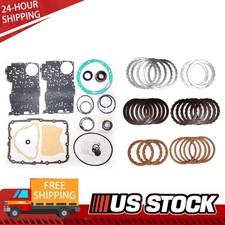
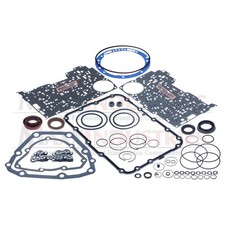
5R55S master rebuild kit with clutches, band, bushings and filter (2002-up)
If the specs above are for a rebuild on your bench, this kit covers the soft parts, frictions, a band, bushings and the filter in one box. Sold by our sister store, CoreTransmissionParts.
Shop the part for this fix →Need just a band, a planetary or a filter? The 5R55S parts collection has them.
Need parts for this job?
Our 5R55 parts page has 5R55S master and overhaul kits by year range, filter and pan gasket kits, solenoid packs and shift kits. Checkout is on site.
FAQ
What are the gear ratios of a 5R55S?
Raybestos Powertrain lists the 5R55S at 3.22 first, 2.29 second, 1.55 third, 1.00 fourth and 0.71 fifth. Fourth is direct drive and fifth is a 0.71 overdrive, so the engine turns about 29% slower in 5th than in 4th at the same road speed. The 5R55W uses the same ratio set.
What is the difference between a 5R55S and a 5R55W?
Ford says the W stands for wide ratio and the S for synchronous shift. Per Sonnax, the 5R55W was used in 2002-2003 Explorers and Mountaineers with a 24-tooth overdrive sun gear, and the 5R55S replaced it around 2004-2005 with a 38-tooth overdrive sun gear. The ratios are the same, but some hard parts are not interchangeable.
How much fluid does a 5R55S hold?
Ford's service information lists about 12.6 qt (12.0 L) of MERCON V for the 5R55W/S in the Explorer and Mountaineer. Ford calls that approximate and says the level must be set with the check plug procedure, with TFT between 81 and 120F, not by counting quarts.
What is the line pressure spec for a 5R55S?
For the Explorer 4.0L, Ford lists 80-110 psi at idle and 228-263 psi at WOT stall in D, 3, 2 and 1, and 145-190 psi at idle and 282-350 psi at stall in Reverse. The 4.6L runs 100-135 psi at idle in the forward ranges. Stall speed is 2,557-3,036 rpm for the 4.0L.
How do you adjust the bands on a 5R55S?
With the servo installed, tighten the overdrive or intermediate band adjusting screw to 124 in-lb, back it off exactly two turns, hold it there, and torque a new locknut to 40 ft-lb. Ford cautions not to let the screw back out while you tighten the nut.
Related guides
- 5R55S Identification Guide
- 5R55S vs 5R55W Differences
- 5R55S Rebuild Cost
- 5R55S Fluid Type and Capacity
- 5R55W/5R55S Servo Pin Bore Wear
Sources
- Raybestos Powertrain, 5R55S transmission page. Backs the 2003-2010 five-speed listing, the 3.22 / 2.29 / 1.55 / 1.00 / 0.71 gear ratios, the RCP96-139 and RCPS-50 clutch pack contents, and the 515575 and 515578 filter applications. raybestospowertrain.com
- Ford service information via Mitchell1, "2002 Automatic Transmissions 5R55W/S Diagnosis." Backs the unit description (4-element converter, 3 planetary sets, 3 bands, 3 clutches, 2 one-way clutches), the W = wide ratio and S = synchronous shift definitions, the solenoid, TSS and ISS descriptions, the O/D OFF switch and lamp behavior, and the line pressure and stall speed tables. Ford/Mitchell diagnosis (PDF)
- Ford service information via Mitchell1, "2002 Automatic Transmissions Servicing - Explorer and Mountaineer." Backs MERCON V (XT-5-QM/XT-5-DM), the 12.6 qt (12.0 L) approximate capacity, the transfer case capacities, the fill-by-procedure note, the new converter drain plug, and the reusable pan gasket. Ford/Mitchell servicing (PDF)
- Ford service information via Mitchell1, "2002 Automatic Transmissions Ford 5R55W/S Overhaul." Backs the torque specification table, the 1.3-2.0 mm coast clutch clearance, the band adjustment procedure (back off two turns, new locknut), the overdrive apply strut caution, and the No. 1 thrust washer endplay procedure. Ford/Mitchell overhaul (PDF)
- Sonnax, "Figuring Out the 5R55 Alphabet." Backs the 5R55N, W and S applications and years, the 24-tooth vs 38-tooth overdrive sun gear, the PCC boss differences, and the interchange warning. sonnax.com
- Transmission Digest, "A Fix for 5R55W Front-Planet Bearing Failure" (Ed Lee, Sonnax). Backs the bearing cage failure, Ford part 2L2Z-7A398-AA, the RE4F02A bearing substitution and the Sonnax 77406-10 / 77409-15 shims. transmissiondigest.com
- Motorcraft (Ford Motor Company), MERCON V Automatic Transmission and Power Steering Fluid product page and Product Typicals data sheet. Backs the current XT-5-QMC, XT-5-5Q3M and XT-5-DMC part numbers, the warning not to use MERCON V where MERCON LV, ULV or SP is recommended, and the 7.5 cSt at 100 C, 33.2 cSt at 40 C and 205 viscosity index typicals. fcsdchemicalsandlubricants.com • data sheet (PDF)