When a 5R55S starts flaring on the 2-3, banging into Reverse or throwing a string of shift solenoid codes, the solenoid pack gets blamed first. Sometimes it deserves it. Just as often the pack is fine and the real problem is a wet connector, a worn bore in the valve body or the case, or a replacement pack that isn't the right one for the year.
This guide covers how the 5R55S (and the 5R55W, which shares its control system) uses its solenoids, which symptoms point at the pack, the Ford part number break between early and late packs, and the replacement procedure. Every number traces to a source at the bottom; my own shop practice is labeled as such.
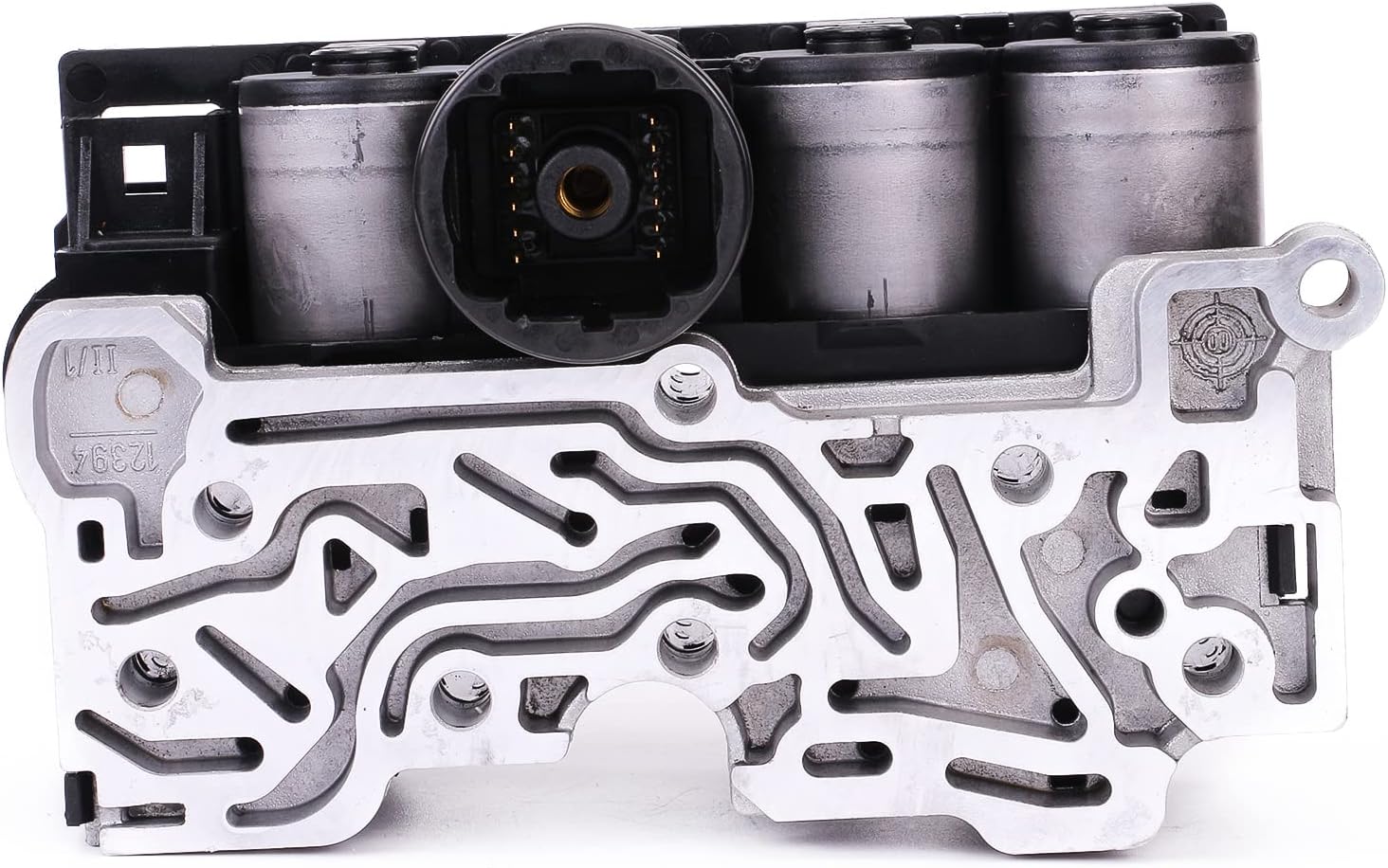
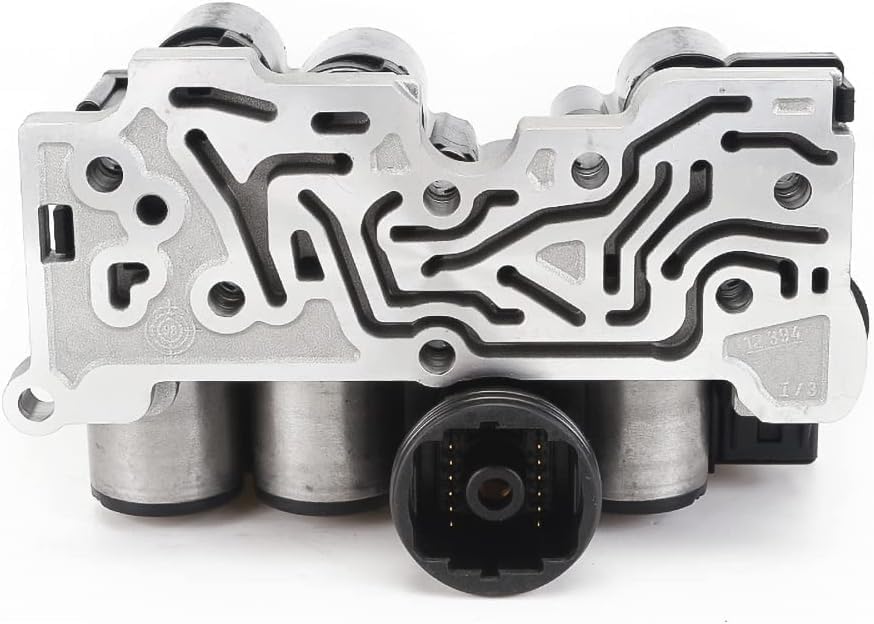
What's in the 5R55S solenoid body
The 5R55W and 5R55S don't use individual shift solenoids you can swap one at a time like a 4R70W. Everything lives in one solenoid body (the "solenoid pack" at the parts counter) that bolts in under the pan with a single harness connector running out the left side of the case. Per Jesse Zacarias's breakdown in Transmission Digest, the pack contains:
- Four on/off shift solenoids (SSA, SSB, SSC and SSD). They don't control shift feel. Their job is to line up the valves in the valve body so the pressure control solenoids can control the rate of apply and release.
- Three variable force solenoids, which Ford names PCA, PCB and PCC. These control how fast clutches and bands come on and go off.
- One PWM solenoid for the torque converter clutch.
That split matters for diagnosis. An on/off shift solenoid that's dead usually gives you a wrong gear, a missing gear or a ratio code. A variable force solenoid that's out of calibration usually gives you a unit that shifts through every gear but feels wrong doing it: flares, bumps, soft or harsh engagements.
What PCA, PCB and PCC each control
ATRA's 2013 seminar material on the 5R55W/S lays out the pressure solenoid jobs:
| Solenoid | What it controls | What you feel when it's off |
|---|---|---|
| PCA (VFS 1) | Mainline boost (with PCB); VFS1 modulator valve. VFS1 pressure applies the intermediate servo in 3rd, and the low/reverse servo in manual 1 and 2. | Line pressure too high or low; 2-3 flare or bind; harsh or soft manual 1-2 |
| PCB (VFS 2) | Mainline boost (with PCA); VFS2 modulator valve; forward and reverse engagement valves. VFS2 directly applies the overdrive servo and the coast clutch. | Harsh or slow forward engagement; 1-2 and 2-3 timing problems; coast clutch complaints |
| PCC (VFS 3) | Reverse pressure modulator and reverse engagement control valves. Directly applies the direct clutch in 4th, 5th and manual 4th. | Reverse engagement bump or delay; 3-4 flare or slip in 4th and 5th |
| TCC (PWM) | Converter clutch apply through the TCC control valve. Sonnax notes a solenoid regulator valve limits this solenoid's feed to about 72 psi. | Shudder, no lockup, or lockup that won't release |
| SSA-SSD (on/off) | Stroke the shift valves and select which clutch or band each pressure solenoid feeds. | Wrong gear, missing gear, incorrect ratio codes |
The third column is my read from the hydraulic functions, not a published chart.
How PCA and PCB work together
PCA and PCB both feed boost passages that push on the main pressure regulator valve. In the later units the boost sleeve has three passages: TV1 (controlled by PCA), TV2 (controlled by PCB), and reverse boost from the manual valve. ATRA describes the PCM commanding the two solenoids opposite each other: when PCA is on the higher-pressure side, PCB goes lower, and vice versa. Both are pulse width modulated through three basic ranges (lower, variable and higher pressure).
Because both solenoids work the same regulator, a small calibration difference in one of them moves mainline a lot.
The 2-3 shift: why the 5R55S is so sensitive
The 1-2 shift in this unit is the same as a 5R55E. The forward clutch is on in every forward gear, and 2nd is forward clutch plus the overdrive band. The 2-3 shift is where it gets hard. To get 3rd, the overdrive band has to release at the same time the intermediate band applies. ATRA's point is that this release-and-apply handoff has to be precise. A slight timing error gives you either a flare (the OD band lets go before the intermediate band grabs) or a tie-up (both are holding at once).
Look at the table again. The overdrive servo is fed by VFS2 (PCB). The intermediate servo in 3rd is fed by VFS1 (PCA). The 2-3 shift is literally one pressure solenoid handing the load to the other. If either one delivers the wrong pressure for a given command, or if either servo leaks, the handoff goes bad. That's why a 2-3 flare on a 5R55S has three usual suspects:
- A solenoid pack that's weak, sticking, or the wrong design for the year.
- Worn servo pin bores in the case bleeding off apply pressure. Ford covered this in TSB 09-12-12 for loss of 2nd, 3rd and 5th with incorrect ratio codes; our servo pin bore guide goes through the measurement and the sleeve repair.
- Valve body wear, specifically the pressure regulator valve and sleeve and the overdrive and intermediate servo control valves and plugs. ATRA calls out worn plugs leaking during engagements and shift timing.
Symptoms that point at the solenoid pack
Complaints where the pack is a real candidate:
- Flare on the 2-3 upshift, especially after a rebuild or a pack replacement. PCA/PCB calibration, or the wrong pack for the year.
- Harsh downshifts. ATRA lists soft flare shifts and harsh downshifts as the majority of the solenoid-related complaints on this unit.
- Slow or harsh engagement into Drive or Reverse. Zacarias notes each engagement should take about two seconds from start to finish (servo/torque phase, then inertia phase), with PCB modulated around 0.5 amp during both forward and reverse engagement. A bang or a long delay into gear suggests PCB or PCC, or the engagement valves they feed.
- Stored codes P0750, P0755, P0760 or P0765 (the SAE generic codes for shift solenoid A, B, C and D circuits), or pressure control solenoid circuit codes. A circuit code on one solenoid with the others clean points at that solenoid or its path through the pack. Ford's 5R55W/S diagnosis tables tell you what the driver will feel: a shorted SSA gives no 4th or 5th and an open one no 1st; a shorted SSB gives no 1st and an open one no 3rd; SSC faults give incorrect gear selection; an SSD circuit fault (P0765) gives no engine braking in the manual gears; and a PC-B short (P0775/P0779) gives low PC-B pressure, limited engine torque and no 2nd or 5th.
- Converter shudder or no lockup with the rest of the unit healthy. TCC solenoid, or the solenoid regulator valve that feeds it.
Before you order a pack: rule these out
1. The connector, especially on 2006-2010 Explorers
If the scan tool shows a whole set of solenoid codes at once, don't believe all of them. Ford issued a service tip (reprinted through Mitchell 1 by Underhood Service) for 2006-2010 Explorer and Mountaineer and 2007-2010 Explorer Sport Trac with the 5R55S, built on or before August 12, 2009. Water from the A/C evaporator drain runs down onto the solenoid body connector on the left side of the transmission. The trucks set a check engine light with DTC P0713 (transmission fluid temperature sensor circuit high) and/or various solenoid body connector-related codes.
Ford's repair: verify the codes, inspect the connector for water or corrosion, clean it thoroughly, apply Motorcraft Electrical Grease or equivalent, and install the patch kit over the connector. If the terminals are eaten, replace the connector or pigtail.
2. Fluid level and condition
The 5R55S has no dipstick, so these units run low more often than people think, and low fluid will make a good solenoid pack act like a bad one. Set the level the Ford way (engine running, Park, TFT in the 80-120°F window, fluid at the level plug) before you judge shift quality. Our filter and pan service guide covers the procedure. Also check what fluid is in it. Sonnax notes that early MERCON V (before May 2005) had problems with solenoid degradation. Ford issued service bulletins, first with an additive package and then a revised fluid in black containers, Motorcraft XT-5-QM.
3. The transmission range sensor
Zacarias makes a point that saves a lot of packs: the PCM decides how to modulate PCA, PCB and PCC during engagement based on what the TR sensor tells it. A bad TR sensor can keep the unit from engaging Drive or Reverse properly even though every solenoid is fine. Watch the TR PID while you move the selector through each range. It should change cleanly and match the lever position every time.
How I test it before replacing it
This is my own sequence, not a Ford procedure:
- Pull codes and freeze frame. Circuit codes are electrical. Ratio codes are often hydraulic or mechanical.
- Look at the connector before anything else, especially on a 2006-2010 Explorer. Unplug it and look for water, green corrosion, pushed-back pins and damaged O-rings.
- Check each solenoid circuit from the connector. Measure resistance at the 16-pin case connector from pin 3, the common feed. Ford's spec is 16-45 ohms for SSA, SSB, SSC and SSD (pins 16, 15, 6 and 5), 9-16 ohms for the TCC solenoid (pin 14) and 3.3-7.5 ohms for each pressure control solenoid. Any solenoid terminal reading under 5 ohms to chassis ground means replacing the solenoid body, per the same Ford procedure. An open or shorted reading, or one well outside the other solenoids of the same type, is a bad circuit inside the pack.
- Road test with the scan tool recording commanded gear, actual gear ratio, the commanded current for PCA, PCB and PCC (these read in amps), TFT and TCC slip. A shift that flares while the commanded values look normal points at the pack's output or the hydraulics, not the PCM.
- Put a line pressure gauge on it if the complaint is shift quality. Ford's diagnosis notes that the line pressure tap verifies PC-A or PC-B output by turning one off while checking the other, and the pressure control tap verifies PC-C. Pressure that doesn't follow throttle, or is far off in one range, tells you whether you're chasing solenoid output or a regulator and valve body problem.
For intermittents: Sonnax replaced the OE ribbon cable in its remanufactured blocks with an integrated circuit board because fatigue failures in that ribbon cable, and loose barbed press-fit connections, are common. An intermittent that comes and goes with heat or bumps while resistance checks good fits that failure. Wiggle-test the connector with the engine running.
Get the right pack: the Ford part number break
This is the mistake that ATRA says makes up a surprising number of their tech calls. The early and late packs look nearly the same and will bolt in, but they don't produce the same pressure from the same command.
| Application | Ford solenoid pack |
|---|---|
| 2002-2003 Ford with 5R55W or 5R55S; 2003 Lincoln with 5R55S | Early design, 1L2Z-7G391-AG |
| 2004-on Ford with 5R55W or 5R55S; 2004-2006 Lincoln with 5R55S | Late design. Original 4L2Z-7G391-AA; updated 9L2Z-7G391-A (Ford recommends only the updated design) |
ATRA tested PCA solenoids from different packs and found a 4 psi difference in output at 0.6 amps. That sounds small, but at the regulator it works out to about 30 psi of mainline pressure, which is plenty to cause a 2-3 flare or harsh downshifts. In nearly every case they looked at, putting in the correct pack for the year fixed it. If you just installed a pack and the unit got worse, check the part number on it against the table before you touch anything else.
Sonnax also warns that the solenoid assembly appears to interchange between the 5R55N, W and S, but the base plates and gasket-integrated filter differ, and mixing them costs you Reverse, TCC apply and solenoid pressure.
Replacing the 5R55S solenoid body
The sequence below follows the Ford service procedure for the 5R55W/S in the Explorer and Mountaineer, published through Mitchell with Ford's illustrations.
- Disconnect the negative battery cable. Raise and support the vehicle.
- Drain the fluid from the pan and the torque converter and drop the pan, following the drain-and-refill procedure.
- Clean the area around the solenoid body harness connector on the case before you disconnect it.
- Loosen the connector bolt and disconnect the solenoid body harness connector. Remove the two bolts holding the shift cable bracket to the side of the transmission, and disconnect the 2-pin reverse pressure switch connector where equipped.
- Remove the eight Torx-head bolts holding the solenoid body and remove it.
- Prime the new pack. Sonnax notes that variable force solenoids ship with a fluid lubricant that drains out during handling. Fill the VFS circuits with fresh MERCON V before installation so they don't start up dry.
- Install two new O-rings on the solenoid body connector. Make sure the connector is fully seated before you tighten its bolt.
- Install the solenoid body and tighten the bolts in Ford's sequence to 71 lb-in (8 Nm). Ford's caution: the solenoid body is damaged if the bolts go past spec.
- Reinstall the pan (16 bolts at 97 lb-in), fill with MERCON V and set the level with the engine running at operating temperature.
- Clear codes and road test. My habit, not a Ford step: I also clear adaptive values after a pack replacement so the PCM isn't correcting for the old pack's output.
Preventing a repeat failure
- Keep the fluid fresh. The solenoids are only as clean as the oil feeding them. On an Explorer that tows or idles a lot, run the 30,000-mile severe-service interval.
- Stop the water on 2006-2010 Explorers even after the codes clear, so the A/C drain can't drip on the connector again.
- Match the pack to the year by Ford part number, keep the original base plate and filter, and don't overtorque the eight bolts.
5R55S shift solenoid block pack (2002-up)
A complete replacement solenoid body for the Explorer, Mountaineer and Mustang 5R55S. Match it to your year using the Ford part number table above. Sold by our sister store, CoreTransmissionParts.
Shop the part for this fix →Chasing a corroded connector instead? The 5R55S parts collection has pigtail repair kits, valve bodies and rebuild kits.
Need parts for this job?
Our 5R55 parts page carries 5R55W/5R55S solenoid packs, valve bodies, filter kits, MERCON V and complete overhaul kits for the Explorer, Mountaineer and Mustang units. Checkout is on site.
FAQ
What are the symptoms of a bad 5R55S shift solenoid?
The most common are a flare on the 2-3 upshift, harsh downshifts, slow or harsh engagement into Drive or Reverse, converter shudder or no lockup, and stored codes P0750, P0755, P0760 or P0765. A dead on/off shift solenoid usually causes a wrong or missing gear, while a pressure control solenoid (PCA, PCB or PCC) usually lets the unit shift through every gear but with poor shift feel.
Can you replace one shift solenoid on a 5R55S?
Not in the normal service sense. The 5R55W and 5R55S use a single solenoid body that contains four on/off shift solenoids, three variable force pressure control solenoids and the TCC solenoid, and Ford services it as one assembly. It bolts in under the pan with eight Torx bolts torqued to 71 lb-in (8 Nm).
Why does my Explorer show every transmission solenoid code at once?
On 2006-2010 Explorer, Mountaineer and 2007-2010 Explorer Sport Trac with the 5R55S built on or before August 12, 2009, Ford found water from the A/C drain running onto the solenoid body connector on the left side of the transmission. It sets P0713 and various connector-related codes. Clean the connector, apply electrical grease and install the patch kit before replacing the pack.
Which solenoid pack fits my 5R55S?
2002-2003 Ford 5R55W/S and 2003 Lincoln 5R55S units take the early pack, Ford 1L2Z-7G391-AG. 2004-on Ford 5R55W/S and 2004-2006 Lincoln 5R55S take the late pack, and Ford recommends only the updated 9L2Z-7G391-A. ATRA found the wrong pack can shift mainline pressure by about 30 psi and cause 2-3 flares.
Why does my 5R55S flare on the 2-3 shift after a new solenoid pack?
The 2-3 shift releases the overdrive band while applying the intermediate band, and those two servos are fed by different pressure control solenoids. ATRA measured a 4 psi difference in PCA output at 0.6 amps between pack designs, which works out to about 30 psi of mainline. Confirm the pack part number matches the model year, then check the servo pin bores and valve body.
Related guides
- Ford 5R55S and 5R55W Transmission Problems
- 5R55W and 5R55S Servo Pin Bore Wear
- 5R55 Harsh and Delayed Shifts
- 5R55S Filter and Pan Service Guide
- 5R55S Fluid Type and Capacity
Sources
- ATRA, 2013 Technical Seminar manual, "Ford 5R55W/S Erratic Transmission Operation" (pp. 112-120). Backs the early and late solenoid pack applications and Ford part numbers 1L2Z-7G391-AG, 4L2Z-7G391-AA and 9L2Z-7G391-A, PCA/PCB/PCC as variable force solenoids with the rest on/off, the TV1/TV2/reverse boost passages, PCA and PCB commanded opposite each other, the VFS1, VFS2 and PCC circuit functions, the 2-3 band handoff, the flare and harsh downshift complaints, the valve body checks, and the 4 psi at 0.6 A / about 30 psi mainline finding. atracom (PDF)
- Jesse Zacarias, "Understanding the 5R55S/W Initial Engagements," Transmission Digest (November 2012). Backs the four on/off shift solenoids, three variable force solenoids and one PWM TCC solenoid, the role of the shift solenoids in aligning valves, PCB modulated at about 0.5 amp during engagement, the roughly two-second engagement, and a bad TR sensor preventing engagement. transmissiondigest.com
- Ford Motor Company service information, "2002 Automatic Transmissions Servicing - Explorer & Mountaineer" (5R55W/S), published by Mitchell Repair Information with Ford illustrations. Backs the solenoid body removal and installation steps, eight Torx bolts, two new connector O-rings, the 2-pin reverse pressure switch connector, the 71 lb-in (8 Nm) solenoid body bolt torque and sequence, the overtorque caution, and 97 lb-in pan bolts. Ford/Mitchell service procedure (PDF)
- Sonnax, "Remanufactured Solenoid Block" 56954K-RRP (5R55W/5R55S). Backs the fatigue failures of the ribbon cable inside the OE circuit assembly, the barbed press-fit connections, and the integrated circuit board replacement; also lists 56954L for 2004-later units. sonnax.com
- Sonnax, "Figuring Out the 5R55 Alphabet." Backs the TCC solenoid regulator valve limiting feed to about 72 psi, early MERCON V (pre-May 2005) solenoid degradation and the revised XT-5-QM fluid, priming VFS circuits with new MERCON V before installation, and base plate and filter differences between the 5R55N, W and S. sonnax.com
- Ford Motor Company service information, "2002 Automatic Transmissions 5R55W/S Diagnosis" (Mitchell reprint). Backs the DTC symptom table for SSA-SSD and PC-B faults, the 16-pin case connector pinout, the solenoid resistance specs (16-45 ohms shift solenoids, 9-16 ohms TCC, 3.3-7.5 ohms PC solenoids), the under-5-ohm short-to-ground rule, and the line pressure and PC-C tap checks. txnj.net/Explorer/Transmission/5R55W-S_DIAGNOSIS.pdf
- Underhood Service, "Tech Tip: Water Intrusion From A/C Drain May Cause DTCs On Ford SUVs" (November 2012, courtesy of Mitchell 1). Backs the 2006-2010 Explorer/Mountaineer and 2007-2010 Sport Trac 5R55S condition built on or before August 12, 2009, DTC P0713 and connector-related codes, the left-side connector location, and the clean, grease and patch kit repair. underhoodservice.com