

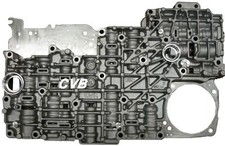
Most 5R55S and 5R55W failures I see on the bench didn't have to happen. The unit went 150,000-plus miles on whatever fluid was in it, nobody ever pulled the converter drain plug, and by the time it started slipping the valve body bores were already chewed up from years of a PWM solenoid cycling against them. None of that is exotic knowledge. It's in Ford's own service manual. Most shops just don't follow it to the letter, because the 5R55 fill procedure is genuinely annoying and skipping steps doesn't bite you for another 50,000 miles.
This is the checklist I actually run on a 5R55S or 5R55W that's crossed 100,000 miles, pulled straight from Ford's 2002 Explorer/Mountaineer service data (which covers the 5R55W/S as one unit), with the known high-mileage failure points layered on top from Sonnax and Transmission Digest. Specs trace to the sources at the bottom.
Know which unit you have first
The W and S share a solenoid body, TCC circuit and valve body layout, but they're not identical, and mixing parts between them causes failures. Per Sonnax: the W has a 24-tooth OD sun gear and ran in '02-'03 Explorers and Mountaineers; the S has a 38-tooth OD sun gear and replaced it for '04-'05 and later. Both have a single case boss for the PCC pressure port - the related 5R55N has two, which is the quickest way to rule out an N. If you're working a 2009-or-later S specifically, note that further down - the valve body casting changed that year.
1. Check the real service interval, not a guess
Ford's interval for the 5R55W/S is 150,000 miles under normal service. That drops to 30,000 miles under what Ford classifies as severe use:
- Temperatures above 90°F (32°C) combined with heavy loads and/or hilly terrain
- Towing a trailer or running a car-top carrier
- Police, taxi, or door-to-door delivery service
- Extreme dusty conditions or off-road use
In practice, almost every Explorer or Mountaineer that tows occasionally or spends real time in stop-and-go city traffic falls under the severe schedule. If the customer doesn't know which bucket they're in, ask about towing and commute type before you quote an interval.
2. Fluid: MERCON V, and set the level correctly - don't just pour and go
Ford specifies MERCON V (XT-5-QM quart / XT-5-DM 55-gallon drum) for the 5R55W/S, full stop. Ford's own caution: using any other fluid type "could result in transmission damage." Total system capacity is listed at about 12.6 quarts (12.0 L), but Ford is explicit that this number is approximate and the correct fluid level has to be set by the check procedure, not by the quantity you add.
That procedure, straight from the service manual:
- Monitor Transmission Fluid Temperature on a scan tool (PID: TFT). Start the engine; idle should be around 650 RPM.
- Run the engine until TFT reads 81-120°F (27-49°C). Level can also be checked above 122°F using this same method.
- With the transmission in Park and engine running, remove the small fluid level indicator plug with a 3/16" Allen key. You'll need to hold the larger drain plug with a wrench while you do this.
- Let it drain about a minute. A thin stream or a drip means the level is correct. Nothing coming out means fluid needs to be added.
- If adding, install a fluid fill tool (Ford 307-437, or the OTC 6604 equivalent) into the pan and add clean ATF through it in small increments - Ford's procedure uses a suction gun to meter roughly a pint at a time - until fluid starts to drip from the level plug hole again.
- Reinstall the level plug with the 3/16" Allen key, holding the drain plug with a wrench while you do it. Check for leaks.
If you're using pressurized fill equipment instead of the hand method, Ford specifically warns to keep it under 1 psi - higher pressure pushes fluid out the vent and it shows up looking like a leak at the torque converter.
3. Pan, filter and magnet - every time, no exceptions
Drain the pan, remove the 16 pan bolts, and pull the pan and gasket. Ford's note says the gasket is reusable if it's not damaged - inspect it before you default to replacing it. The filter is not reusable; it gets discarded and replaced at every service. Clean and inspect the pan magnet while it's apart - what's stuck to it tells you more about the unit's condition than anything else in this checklist. Metal flakes or friction material on the magnet changes everything downstream (see the cooler step below).
Reinstall the pan with new bolts torqued in a crisscross sequence to spec. Overtightening warps the pan rail and you'll be back under the truck for a leak.
4. Don't skip the converter drain
This is the step that gets skipped more than any other, and it's the reason so many "fluid changes" on this transmission barely move the needle. The torque converter has its own drain plug behind an access plug in the bellhousing. A large portion of the unit's total fluid lives in the converter, not the pan - pulling only the pan replaces a fraction of what's actually in the system.
Ford's requirement: install a new converter drain plug every time, specifically to prevent leakage, torqued to spec. Reusing the old plug is a comeback waiting to happen.
5. Backflush the cooler if the magnet or filter told you anything
If you found metal particles, clutch material, or band material in the pan or on the magnet, Ford is direct about what that means: those contaminants are "a major cause of recurring transmission concerns" and have to be removed from the cooler system before the unit goes back in service, not just rinsed out of the pan. That means backflushing the cooler and lines with a proper torque converter/cooler cleaner - clean ATF only, no solvents - circulating a minimum of 5 minutes before blowing the lines out with compressed air. Skip this on a unit that's shedding material and you're feeding contaminated fluid straight back into a freshly serviced transmission.
Separately: Ford's caution also applies whenever a new or remanufactured transmission goes in, or any time the unit's been disassembled to install new parts - a new cooler (in-tank, auxiliary or oil-to-air) gets installed and the lines get cleaned regardless of what the old fluid looked like.
6. 2009-and-later S: check for the whistle TSB
If the customer complains about a whistle noise when hot at an idle, in all gears, and the unit is a 2009-or-later 5R55S, that's Ford TSB 09-21-4 (issued 11/2/2009). The fix is an updated separator plate, identifiable by two small ID holes near the servo bore. Transmission Digest's coverage of the same casting change notes the 2009 valve body casting also revised the worm tracks and reduced the separator-plate hole sizes in the VFS1 and VFS2 circuits - the rough-forging number on the updated casting is RF9L2P 7A101AA. Earlier separator plates and valve bodies are not a direct swap onto the 2009-and-later casting, so don't grab a plate off an '05 parts unit expecting it to fit.
6b. 2006-2010 Explorer, Mountaineer and Sport Trac: inspect the solenoid connector
While the pan is down on a 2006-2010 Explorer or Mountaineer, or a 2007-2010 Sport Trac, pull the 16-pin solenoid body connector on the left side of the case and look at it. Ford TSB 09-22-15 covers trucks built on or before August 12, 2009 that set P0713 and/or solenoid body connector codes because A/C drain water runs down into that connector. The repair is cleaning the connector, applying Motorcraft electrical grease and installing a patch over it; on badly corroded trucks, Transmission Digest documents replacing the harness with Ford repair harness 4L2Z-7C078-DA and cutting the patch from Ford material F65Z-9240-DC (Transmission Digest, Greer). P0713 is the TFT sensor reading -40°F, an open circuit, and Ford lists firm shift feel as the symptom, so a wet connector can pass for a harsh-shifting transmission (Ford 5R55W/S Diagnosis).
7. At high mileage, check the wear points before there's a complaint
This is the step most shops only do reactively, after a shudder or slip code shows up. Sonnax's own technical material on the 5R55 family found that the modulator and control valve bores do most of the wearing on these units, well before anyone notices a drivability complaint - and that the solenoid pack gets blamed for problems that are actually bore wear. Worth a proactive look with the valve body off, especially past 150,000 miles or on a unit that's never had the valve body serviced:
- TCC modulator bore - wears first on this family since it's cycling constantly against the PWM TCC solenoid. Sonnax calls it the best starting point for a quick visual read on overall valve body condition.
- Main regulator bore - also an early wear point, tied to line pressure stability.
- Solenoid feed limit / converter feed limit bores - a known weak spot on the W/S; wear here shows up as TCC engagement issues, gear ratio codes, and overheating, and can also cause front lube failure from reduced converter charge.
- Reverse pressure modulator bore and end plug - leakage here lets solenoid feed and direct clutch apply pressure bleed off, which shows up as slipping or lost 4th/5th gear, burned direct clutches, or a delayed reverse engagement.
Sonnax's recommended check is a wet air test on the bench - leakage around the valves or out the exhaust slots tells you where a bore has opened up. If a bore fails, that's a repair kit (oversized valve and sleeve) or a valve body swap, not a part you can clean and reuse.
While it's apart, don't eyeball the bolt torques. Ford's specs for this unit: solenoid body bolts, 71 in-lb, tightened in the specified sequence - overtightening cracks the solenoid body housing. Valve body bolts go back in with 2 alignment pins first, then torque in Ford's specified crisscross pattern. Both of these get called out repeatedly in Ford's own cause list for comebacks - incorrectly tightened valve body bolts show up as cross-leaks that mimic a worn bore.
| Fastener | Torque |
|---|---|
| Oil pan bolts | 97 in-lb, crisscross sequence |
| Torque converter drain plug (new plug required) | 89 in-lb |
| Transmission drain plug | 19 ft-lb (26 Nm) |
| Solenoid body bolts | 71 in-lb, specified sequence |
| Transmission Range sensor bolts | 89 in-lb, alternating sequence |
| Transmission mount bolts | 66 ft-lb (90 Nm) |
8. Expect an adaptive relearn after service
Post-2002 Ford units run an adaptive shift strategy that compensates for normal wear over time. That's good for drivability but it means a clutch or valve body issue can hide behind the adaptive tables for a while before it surfaces as a code or a firm complaint. After any fluid service, solenoid replacement, or valve body work, expect a short relearn period and don't be surprised if shift feel takes a few miles to settle back to normal.
If you want to force the relearn instead of waiting it out, Transmission Digest's published procedure for the 5R55 family runs in two parts. First, erase Keep Alive Memory with the scan tool, then warm the fluid to 54°C (130°F) on the TFT PID and cycle through 5 P-to-R, 5 D-to-R, 5 R-to-D and 5 N-to-D engagements, 5 seconds apart each. Second, the drive relearn: accelerate moderately from a stop to 80 km/h (50 mph) in 5th gear and hold speed and throttle steady for at least 15 seconds, tap the brake lightly, hold steady for 5 more seconds, then brake to a stop and sit for at least 20 seconds. Repeat that drive cycle a minimum of five times. This is also the point to confirm the overdrive planetary set is correct for the application if the unit was ever rebuilt before you had it: a wrong-ratio OD planet (the same 38-tooth vs. 24-tooth sun gear split covered above) produces gear ratio error codes and harsh shifting that a relearn won't fix, since it isn't an adaptive problem.
My checklist, in order
This is the sequence I actually run - not a verbatim Ford procedure, but it follows Ford's data in order:
- Confirm the unit (W vs S) and the build year, since the 2009 casting change matters for parts.
- Ask about towing, commute type and climate to confirm which service interval applies.
- Drain the pan, pull the 16 bolts, inspect the gasket and the magnet.
- Discard the old filter, install new, reinstall pan with new bolts torqued crisscross to 97 in-lb.
- Pull the converter drain plug, install a new plug, torque to 89 in-lb.
- If the magnet or filter showed metal or friction material, backflush the cooler before refilling.
- Fill with MERCON V using the TFT-and-level-plug procedure - never by volume alone.
- On a 2009+ S with a hot-idle whistle, check for TSB 09-21-4 and the updated separator plate.
- On a 2006-2010 Explorer, Mountaineer or Sport Trac, unplug the solenoid connector and check for A/C drain water and corrosion (TSB 09-22-15).
- Past 150,000 miles, or on any unit with a prior TCC or slip complaint, pull the valve body and wet-test the modulator and feed-limit bores before they cost you a comeback.
- Road test, confirm no leaks, and expect a short relearn.
5R55S Transmission Filter, 2002-2010
Every service on this checklist starts with a new filter - it's never reused. This is the direct-fit filter for 2002-2010 5R55S applications. Sold by our sister store, CoreTransmissionParts.
Shop the part for this fix →Need a pan gasket, solenoid block pack, or a full overhaul kit instead? The 5R55S parts collection has them.
Need parts for this job?
Our 5R55 parts page carries 5R55S and 5R55W filter kits, pan gaskets, fill adapters, valve bodies and solenoid kits for the Explorer, Mountaineer and Mustang units. Checkout is on site.
FAQ
What transmission fluid does a 5R55S take?
MERCON V only, Ford part numbers XT-5-QM (quart) or XT-5-DM (55-gallon drum). Ford's service manual states that using any other fluid type could result in transmission damage. Total system capacity is about 12.6 quarts, but that figure is approximate - the actual fill is set by a level-check procedure through the internal level plug, not by how much fluid you pour in.
How often should a 5R55S transmission fluid be changed?
Ford's normal interval is 150,000 miles. That drops to 30,000 miles under severe use: temperatures over 90°F combined with heavy loads or hilly terrain, trailer towing or a car-top carrier, police/taxi/delivery service, or extreme dust and off-road driving. Most Explorers and Mountaineers that tow or see stop-and-go city driving qualify for the 30,000-mile interval.
Do I need to replace the torque converter drain plug every time?
Yes. Ford's procedure calls for a new torque converter drain plug at every service, torqued to 89 in-lb, specifically to prevent leakage. Skipping the converter drain is also the single biggest reason a 5R55S fluid service barely changes anything - a large share of the total fluid sits in the converter, not the pan.
Why does my 2009-or-later 5R55S whistle at idle when hot?
Ford TSB 09-21-4 (issued 11/2/2009) covers a whistle noise when hot at an idle in all gears on 2009-and-later 5R55S units. The fix is an updated separator plate, identifiable by two small ID holes near the servo bore. The 2009 valve body casting also changed its worm tracks and reduced the VFS1/VFS2 separator-plate hole sizes, so earlier parts are not a direct swap.
Related guides
- 5R55S Filter and Pan Service
- 5R55S Fluid Type and Capacity
- 5R55S Flush vs. Drain and Fill
- 5R55S Valve Body Symptoms
- 5R55S Identification Guide
- 5R55S Torque Converter Lockup Shudder Fix
Sources
- Ford Motor Co. service information via Mitchell1, "2002 Automatic Transmissions Servicing - Explorer & Mountaineer" (5R55W/S). Backs the service intervals (150,000 mi normal / 30,000 mi severe and its four conditions), MERCON V fluid spec (XT-5-QM/XT-5-DM) and no-other-fluid caution, the 12.6 qt approximate capacity and level-check procedure (TFT PID, 81-120°F, 3/16" Allen plug, fill tool 307-437, 1 psi pressurized-fill limit), the 16-bolt pan/filter/magnet service, the new-converter-drain-plug requirement, the cooler backflush procedure and contamination warning, and all torque specs (pan bolts 97 in-lb, converter drain plug 89 in-lb, drain plug 19 ft-lb, solenoid body bolts 71 in-lb, TR sensor 89 in-lb, transmission mount bolts 66 ft-lb) and bolt sequences. Ford/Mitchell servicing manual (PDF)
- Sonnax, "Figuring Out the 5R55 Alphabet." Backs 5R55W vs 5R55S identification (24-tooth vs 38-tooth sun gear, model years, single PCC boss), the TCC modulator, main regulator, solenoid/converter feed limit and reverse pressure modulator bore wear points, and the wet air test method for checking bore condition. sonnax.com
- Jeff Parlee (ValveBody Xpress), "Body of Evidence: Changes to valve body & separator plate," Transmission Digest. Backs TSB 09-21-4 (11/2/2009), the whistle-at-idle complaint, the updated separator plate identification (two ID holes near the servo bore), and the 2009 valve body casting changes (rough-forging number RF9L2P 7A101AA, revised worm tracks, reduced VFS1/VFS2 separator-plate hole sizes). transmissiondigest.com
- Sonnax, "5R55S/W 09-Later Whistle Noise" technical resource. Corroborates TSB 09-21-4's number, date and the updated separator plate fix. sonnax.com
- Transmission Digest / Vehicle Service Pros, "Ironing out Ford 5R55N/S/W clunks and bumps." Backs the forced garage-shift and drive relearn procedure (Keep Alive Memory erase, 54°C/130°F fluid temp, the P-R/D-R/R-D/N-D engagement cycles, and the 80 km/h drive-and-hold cycle), and the wrong-overdrive-planetary-set failure mode (38-tooth vs. 24-tooth sun gear) that a relearn cannot fix. vehicleservicepros.com
- Mike Greer, "Diagnostic Protocol Saves Time, Money," Transmission Digest (January 2015). Backs Ford TSB 09-22-15 (A/C drain water in the 5R55S solenoid body connector, P0713), repair harness 4L2Z-7C078-DA and patch material F65Z-9240-DC. transmissiondigest.com
- Ford Motor Co. service information via Mitchell1, "5R55W/S Diagnosis." Backs the P0713 definition (TFT sensor indicates -40°F, open circuit, firm shift feel). 5R55W/S Diagnosis (PDF)