The 5R55S has a reputation for noise complaints, and the frustrating part is how many of them sound alike from the driver's seat but come from completely different places inside the unit. A whine that climbs with engine RPM gets blamed on the torque converter or the pump almost every time, and in a lot of 2002-and-later Explorers and Mountaineers, that's the wrong call entirely. A clatter or clunk gets blamed on a bad rebuild when it's actually a documented design issue inside the converter itself. ATSG and the Sonnax TASC Force have both published specific, named causes for the noises this platform makes, down to part numbers and torque specs, and this guide sorts them by the exact symptom pattern each one produces, so you're not swapping a converter to fix a bearing or pulling a pump to fix a valve body.
Know which unit you have before you chase parts
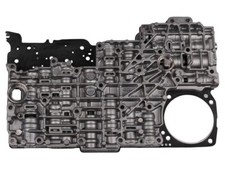
The 5R55S replaced the 5R55W in 2004-2005 Explorer and Mountaineer models, and also replaced the 5R55N in Lincoln and Thunderbird models starting in 2003. The solenoid assembly looks interchangeable across the N, W and S, but the base plate and filter are not, and Sonnax warns that mixing them can cost you reverse, TCC apply, or solenoid pressure entirely [3]. The quickest way to tell W from S without pulling the pan: the W uses a 24-tooth overdrive sun gear and the S uses a 38-tooth sun gear [3]. If you're ordering a valve body specifically, there's a second split to know: units built through 2008 use Ford's F032 casting, while 2009-and-later units use the F035 casting with a revised separator plate, discussed below. These aren't interchangeable, so confirm which one you have before a part shows up that doesn't fit.
Whine source 1: the camshaft synchronizer bearing, mistaken for converter or pump whine
This is the single most misdiagnosed noise on the platform, and ATSG's Mike Souza documented it directly in Transmission Digest. On 2002-and-later Explorer and Mountaineer models, a buzzing or whining noise comes from the bellhousing area and "sounds much like a torque-converter or pump whine." The actual cause has nothing to do with the transmission's internals: it's a failing bearing in the camshaft-position-sensor/synchronizer assembly, caused by a lack of lubrication. The synchronizer's lube hole clogs, cutting off oil to the area between the synchronizer body and shaft, and that area runs dry. The noise gets louder as engine speed increases, which is exactly the pattern that makes techs suspect the pump [1].
The camshaft-position sensor sits on top of the synchronizer at the back of the engine block, centered just in front of the transmission bellhousing, held in by two bolts, and the PCM uses it to control fuel-injector timing. Souza's field check is simple: with the engine running, place a finger on top of the sensor and feel for vibration, then pull the sensor and inspect the synchronizer body for rust or debris in the bore. He notes this noise "has caused countless hours of wasted shop time, from swapping converters to pump replacement," before anyone found the real cause. The fix is R&R of the sensor/synchronizer assembly, easier with the transmission out, using Ford's alignment tool; it must go back in correctly, because it's timed to the engine like a distributor, and getting that wrong hurts engine performance, not just noise. Ford's base part numbers are 6B288 for the camshaft-position sensor and 12A362 for the synchronizer [1].
Whine source 2: pump flow control valve wear
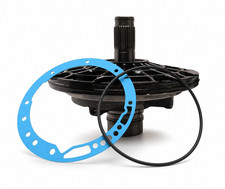
If the whine comes with other pump symptoms, look at the pump before the bellhousing. Sonnax's Pump Flow Control Valve Kit, part 56200-03K, is built for exactly this on the Ford 5R55N, 5R55S and 5R55W. The OE valve's job is to reroute excess line pressure back to the suction side of the pump. When the pump flow control canister and plunger valve wear, the plunger can stick open or leak, and Sonnax lists the resulting symptoms as delayed engagement, no movement until RPM is increased, pump noise, and low line pressure [6]. A whine that's present at idle in Neutral and climbs with RPM, independent of road speed, points here, especially if delayed engagement or a slow 1-2 shift shows up alongside it. The 56200-03K kit uses redesigned, precision-machined parts to eliminate the sticking and wear and supersedes the earlier 56200-02K.
Clunk/clatter source: torque converter piston-to-cover contact
This is the noise most often mistaken for a bad rebuild. Sonnax TASC Force writer Ed Lee, writing in Transmission Digest, documented a sharp increase in clattering-noise complaints on late-model 5R55N/S/W converters, a sound often compared to the old E4OD multi-clutch converters. The sound is metal-to-metal contact, and it disappears completely once the torque converter clutch applies, which is a useful confirmation test on its own [2]. Lee traced it to two contact points inside the converter: the four stands of the clutch pressing against the damper-cushion springs, and the TCC piston's teeth against the mating teeth in the cover. The clutch-stand contact stays stationary under rotation, but the piston-to-cover contact is suspended by six anti-rattle springs and takes an actual impact; the peened wear pattern on those teeth is the physical evidence of where the noise comes from [2]. As the anti-rattle springs weaken with age and heat, drag on the clutch drops off, and the piston has more room to rattle.
One shop quoted in the article built a quick field test: insert an input shaft into the turbine splines, attach a torque wrench, and measure rotational drag. Quoted as read in pound-inches, drag at or above that threshold means the converter probably won't make the noise; below roughly 15 lb-in, the odds of noise climb as the drag drops. A permanent fix documented in the same article came from Steve Barr at Pat's Converters: he removed the 5R55N/S/W damper assembly from the turbine (10 rivets) and replaced it with a damper and piston salvaged from a three-tab AX4S/N converter, which doesn't rely on spline-to-cover contact to prevent rotation. The AX4S/N piston bore was machined to fit the 5R55N/S/W turbine hub, a 0.070-inch carbon friction ring was bonded to the piston, and the cover was machined for a wider clutch surface [2]. The key point for anyone getting a converter rebuilt: this noise can show up even in a rebuilt factory-replacement unit if the original anti-rattle springs and damper assembly are reused rather than replaced, so ask specifically what was done to that area, not just whether the converter was "rebuilt."
| Noise & pattern | Likely source | Fix | Source |
|---|---|---|---|
| Whine/buzz from bellhousing, louder with engine RPM, present even at idle in Park | Camshaft-position-sensor/synchronizer bearing, oil-starved | R&R sensor/synchronizer assembly (Ford parts 6B288 / 12A362) | ATSG / Transmission Digest |
| Whine with delayed engagement, no movement until RPM rises, low line pressure | Worn pump flow control canister/plunger valve | Sonnax Pump Flow Control Valve Kit 56200-03K | Sonnax |
| Clattering/clunking, loudest in Park/Neutral, disappears when TCC applies | TCC piston-to-cover tooth contact, weak anti-rattle springs | Converter rebuild with new anti-rattle springs/damper, or AX4S/N piston swap | Sonnax TASC Force / Transmission Digest |
| Whistle at idle when hot, present in all gears, '09-and-later build | Separator plate VFS1/VFS2 circuit design (pre-TSB) | Updated separator plate per TSB 09-21-4 | Ford TSB / Sonnax |
| Metallic clicking right after a rebuild/reinstall | Flywheel adapter plate misaligned to converter | Realign with Ford Flex Plate Aligner #307-403, torque to 33 lb-ft | Transmission Digest |
| Rattle mainly audible in Neutral | Floating TCC piston (N/W/S shared design) | Inspect/replace TCC piston and modulator valve | Sonnax |
The 2009-and-later whistle: TSB 09-21-4
If your 5R55S is a 2009-or-later build and the complaint is a whistle rather than a whine or clunk, specifically one heard when the transmission is hot and idling, present in every gear, Ford already has a bulletin for it. TSB 09-21-4, dated November 2, 2009, covers exactly this symptom on the 5R55S/W's updated valve body. The fix is a revised separator plate, identifiable by two small ID holes near the servo bore, which reduced the hole sizes in the VFS1 and VFS2 oil circuits [4]. This only applies to the 2009-and-later valve body casting, Ford part F035 with rough forging number RF9L2P 7A101AA; the earlier F032 casting (RF1L2P 7A101GA or RF5L2P 7A101CA) used through 2008 is a different design and isn't covered by this bulletin. Confirm which casting you have before ordering a separator plate or a full valve body, since the two generations aren't interchangeable [5].
Don't overlook installation and alignment noise
Not every noise after a rebuild means a part failed. Transmission Digest describes a metallic clicking noise, similar to a cracked flywheel, that shows up after a 5R55S/W reinstall and is actually caused by the flywheel adapter plate not being properly aligned with the torque converter. Ford's fix uses the Flex Plate Aligner tool, #307-403, to center the adapter plate on the converter pilot before final torque; once aligned, the bolts are tightened to 33 lb-ft, the tool is removed, and the two remaining bolts are tightened [1]. A second alignment reference worth checking: the orange paint dot on the adapter plate should line up closely with the pink dot on the converter, which marks the converter's heavier side. Misaligned dots won't necessarily cause a vibration, but Transmission Digest notes it can lead to premature bushing wear over time. A separate, similar-sounding ticking noise comes from flexing of the separator plate between the engine block and the transmission case, which also changes pitch with engine speed; Ford's fix there is an updated inspection cover with foam insulation (part #2L2Z-7986-AC) that presses on the plate and muffles it [1].
What Ford's own symptom chart says
Ford's 5R55W/S diagnosis has a symptom entry for exactly this complaint, "Noise or Vibration in Forward or Reverse Gears." It starts with the TCC engagement test and a quick test for stored codes, then has you check the oil pump assembly, the low one-way clutch, and the flexplate or adapter plate for damage [7]. That list lines up with the sources above: the pump is the flow-control-valve whine, the adapter plate is the clicking after a reinstall, and the TCC engagement test is how you prove the converter clatter goes away on apply. The low one-way clutch is the one the trade articles do not cover. If the noise is only in 1st or reverse and none of the other patterns fit, it belongs on the list before you condemn the converter.
Diagnostic sequence: work through it in this order
- Characterize the noise first. Continuous tone, or a single impact/clatter? Does the tone track engine RPM even sitting still in Park, or does it only show up moving?
- For a tone at idle that climbs with RPM, check the camshaft-position-sensor/synchronizer area first by hand-feeling for vibration at the sensor, since this is the most commonly misdiagnosed cause on 2002-and-later Explorer/Mountaineer units.
- If the whine comes with delayed engagement or low line pressure, suspect the pump flow control valve before condemning the pump assembly itself.
- For a clatter that disappears the moment the TCC locks up, suspect the converter's internal piston-to-cover contact, and ask your rebuilder what was done to the anti-rattle springs and damper, not just whether it was "rebuilt."
- For a whistle at hot idle in all gears on a 2009-or-later unit, check for TSB 09-21-4 and the updated separator plate before assuming a worn valve body.
- For any clicking noise right after a reinstall, check flywheel-to-converter alignment and torque before assuming a part is defective.
Need parts for this job?
Our 5R55 parts page carries pumps, valve bodies, and solenoid kits across the 5R55N/S/W family. Checkout is on site.
Sonnax Pump Flow Control Valve Kit 56200-03K (5R55S/W)
If your whine comes with delayed engagement or low line pressure, this is the documented fix for the worn pump flow control valve above, not a generic pump swap. Sold by our sister store, CoreTransmissionParts.
Shop the part for this fix →Chasing the TCC rattle, a full valve body, or a complete rebuild kit instead? Browse the full 5R55S parts collection on CoreTransmissionParts.
FAQ
What's the difference between a 5R55S whine and a clunk, and why does it matter?
A whine is a continuous tone tied to something spinning and wearing, like a bearing or a pump valve. A clunk or clatter is an impact noise made by loose parts knocking together, like a converter piston against its cover teeth. The 5R55S has a documented cause for each, and they call for completely different fixes: an internal bearing R&R for one whine, a pump valve kit for another, and a converter rebuild or replacement for the clatter. Treating all three as "the transmission is noisy" leads to swapping the wrong part first.
Why does my 5R55S whine sound like it's coming from the pump or the torque converter when it isn't?
ATSG's Mike Souza documented this exact mix-up in Transmission Digest. On 2002-and-later Explorer and Mountaineer models, a failing bearing in the camshaft-position-sensor/synchronizer assembly sits right at the back of the engine block, just in front of the bellhousing, and produces a buzzing or whining noise that gets louder as engine speed rises. Because of where it sits, it's commonly mistaken for a converter or pump whine, and Souza notes shops have burned hours swapping converters and pumps chasing it before finding the actual bearing.
My rebuilt 5R55S converter still clatters. Is that normal, and is it covered under warranty?
It's a known, documented issue on the 5R55N/S/W platform, not something unique to your unit or your rebuilder. Sonnax TASC Force writer Ed Lee reported that the clatter comes from metal-to-metal contact at two points inside the converter: the clutch stands against the damper-cushion springs, and the TCC piston teeth against the cover teeth, which are only held by six anti-rattle springs. The noise disappears once the torque converter clutch applies. It can appear even in a rebuilt factory-replacement converter if those springs are original or reused, so ask your rebuilder specifically whether the anti-rattle springs and damper assembly were replaced, not just reused.
What is Ford TSB 09-21-4 and does it apply to my 5R55S?
TSB 09-21-4, dated November 2, 2009, covers a whistle noise heard when the transmission is hot at idle, in all gears, on 2009-and-later 5R55S/W valve bodies. The fix is an updated separator plate, identifiable by two small ID holes near the servo bore, which reduced the hole sizes in the VFS1 and VFS2 oil circuits. It only applies to the 2009-and-later valve body (Ford part F035, rough forging RF9L2P 7A101AA); the earlier F032 valve body uses a different casting and isn't affected by this specific bulletin.
Can a clicking noise after a 5R55S rebuild be a bad installation instead of a bad part?
Yes, and it's worth checking before you assume the rebuild itself failed. Transmission Digest describes a metallic clicking noise after a 5R55S/W install that's caused by the flywheel adapter plate not being properly aligned with the torque converter, not by a defective part. Ford's fix uses the Flex Plate Aligner tool (#307-403) to center the adapter plate on the converter pilot before final torque, and the orange paint dot on the adapter plate should align with the pink dot on the converter, marking its heavier side. Confirming correct alignment is a five-minute check that can save a second R&R.
Related guides
- 5R55S TCC Lockup Explained
- 5R55S Torque Converter Shudder
- 5R55S Valve Body Symptoms
- 5R55S Pump Failure Symptoms
- 5R55S Fluid Type and Capacity
Sources
- Mike Souza (ATSG), "Noise? What Noise? Oh, That One," Transmission Digest, published May 1, 2007. Backs the camshaft-position-sensor/synchronizer bearing diagnosis, the oil-starvation mechanism, the bellhousing ticking/flywheel-adapter-plate alignment fix, and the separator-plate flex fix. transmissiondigest.com
- Ed Lee (Sonnax TASC Force), "2002-Up 5R55N/S/W Converter Noise: One Shop's Solution," Transmission Digest, published October 1, 2006. Backs the torque converter clatter diagnosis, the two internal contact points, the drag-test method, and the AX4S/N piston-swap fix. transmissiondigest.com
- Sonnax, "Figuring Out the 5R55 Alphabet" (tech resource). Backs the N/W/S identification differences, the 24-tooth vs. 38-tooth overdrive sun gear distinction, application years, and the TCC slip/rattle failure notes shared across N/W/S. sonnax.com
- Sonnax, "5R55S/W '09-Later Whistle Noise" (tech resource), referencing Ford TSB 09-21-4 (dated 11-02-09). Backs the whistle symptom, the TSB number and date, and the updated separator plate fix. sonnax.com
- Sonnax, "5R55S/W Valve Body Identification" (tech resource). Backs the F032 vs. F035 casting identification, rough forging numbers, and the VFS1/VFS2 separator plate circuit changes. sonnax.com
- Sonnax, Pump Flow Control Valve Kit 56200-03K product page (Ford 5R55N/5R55S/5R55W application). Backs the pump flow control valve's function, wear symptoms, and the kit's fix. sonnax.com
- Ford Motor Co. service information (Mitchell reprint), "5R55W/S Diagnosis," symptom chart entry "Noise Or Vibration In Forward Or Reverse Gears." Backs the TCC engagement test and quick test first, then the oil pump, low one-way clutch and flexplate/adapter plate checks. 5R55W/S Diagnosis (PDF)