A 5R55S that's slow to go into gear, or won't move at all until the RPM climbs, usually gets a valve body or a solenoid pack thrown at it first. Sometimes that's right. A lot of the time the real problem is upstream of all of it, at the pump, and the valve body swap doesn't touch it. The front pump is what turns engine rotation into the line pressure everything else in the transmission depends on, and on this unit it has three specific, well-documented wear points that each produce a slightly different symptom set.
This covers how the 5R55S pump actually fails, how to tell pump wear apart from a valve body or solenoid problem with a gauge instead of a guess, and when a repair kit is enough versus when the pump assembly itself needs to come out. Specs and wear data come from Sonnax's own parts documentation and a published shop diagnostic, listed at the bottom. Where it's shop habit rather than a published procedure, I say so.
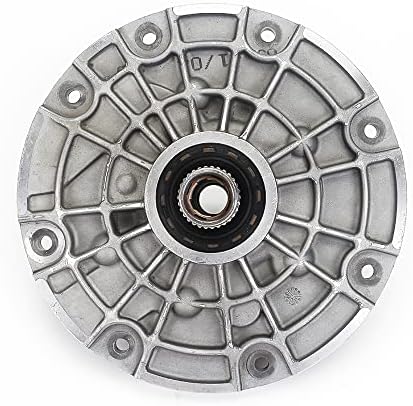
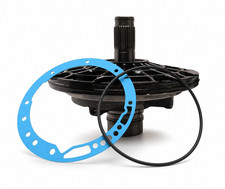

Where this pump is used
The 5R55S went into the 2002-up Ford Explorer and Mercury Mountaineer (4.0L RWD/4WD), the 2003-up Lincoln LS and Aviator, the Thunderbird, and the 2005-up Mustang without Select Shift. It shares most of its hydraulic circuit, including the pump, with the 5R55W, which is why parts and repair kits for both units are almost always sold and documented together. If you're not sure which one is on the bench, Sonnax's write-up on telling the two apart is linked in the related guides below.
Three pump wear points, three different complaints
The front pump on the 5R55S isn't one failure point, it's three, and Sonnax documents each separately because each one produces a slightly different driving complaint.
Pump flow control valve and canister
The flow control valve routes excess line pressure back to the pump's suction side to improve pump efficiency. Sonnax's own description of the failure: "The pump flow control canister and plunger valve wear. The plunger valve can stick open and/or leak. The canister O-ring relaxes, and pressure bleeds past it." Once that happens, the pump can't maintain the line pressure it's supposed to build, no matter how good everything downstream is. Sonnax's repair kit for this (56200-03K) lists the symptoms plainly: delayed engagement, no movement, pump noise, and low line pressure [1].
ATSG has documented the cold-start version of this failure, which shops call morning sickness. A groove wears into the valve sleeve and leaves a ridge, and on a cold first start the plunger shoots toward its light spring and lodges there, stuck open. A leak past the very thin sleeve O-ring at the pump plate does the same thing. Either way, ATSG says a gauge on either pressure tap reads 40 psi or lower, and snapping the throttle open will sometimes free the valve and bring engagement back [7]. If the complaint is no engagement on a cold morning and fine once warm, look here first.
Pressure regulator valve
Behind the flow control valve sits the pressure regulator valve, which sets and holds main line pressure. Sonnax's listing for the replacement part (56947J-77) is direct about the failure mode: "Worn pressure regulator valve allows fluid loss that results in poor line pressure control." The symptom list here is broader than the flow control valve's, because a regulator valve controls pressure in every range, not just at the pump outlet: delayed engagement, soft shifts and poor line rise, harsh shifts, erratic buzz, pressure control out-of-range codes, high line pressure in Reverse, erratic line pressure, and burnt clutches if it goes unaddressed.
Pump cover (bell housing) bushing
The third wear point isn't a valve at all, it's the bushing that supports the pump drive hub and torque converter hub inside the pump cover. Sonnax's part page for the replacement bushing (56001X, which services the 5R55N, 5R55W and 5R55S in the pump cover location) attributes the wear to "excessive hub-to-bushing clearance combined with soft babbitt bushing material," and ties it directly to two symptoms: repeat front seal leakage and worn converter hub. This is the pump complaint that shows up as a wet bell housing and a transmission that keeps needing a new front seal every year, rather than a shift complaint.
Symptoms, mapped to the likely wear point
| What you see | Most likely pump wear point |
|---|---|
| Delayed or no engagement, worse cold | Flow control valve/canister or pressure regulator valve |
| Pump whine or buzz, especially under load | Flow control valve/canister |
| Low line pressure in every range | Flow control valve, pressure regulator valve, or worn bushing bleeding pressure past the hub seal |
| Soft or harsh shifts with pressure control codes, no stored hard fault | Pressure regulator valve |
| Repeat front seal leaks after a known-good seal install | Pump cover (bell housing) bushing |
| Worn or scored torque converter hub at teardown | Pump cover bushing, already run too long |
Confirming it's the pump and not the valve body or PCM
All three pump wear points show up as a line pressure problem, so the gauge is what separates "it's the pump" from "it's the valve body" or "it's the PCM." A published shop diagnostic on a 2003 Lincoln LS 5R55S covering harsh engagements and harsh 1-2 upshifts with no stored codes laid out a clean version of this test. It taps the line pressure port, reads idle pressure in Drive, and compares it to spec: about 100 psi is normal, and a reading near 150 psi points at a PCM control problem on the pressure control solenoids (PCS A and B), not the pump or the mechanical valves behind it. The writeup also amp-clamps each pressure control solenoid individually at the connector (PCS B at pin 1, PCS A at pin 11): normal is roughly 0.75 to 0.98 amps producing low signal pressure at idle, while a PCM-side fault reads closer to 0.23 amps [5].
Ford's own 5R55W/S diagnosis gives the published numbers to compare against: 75-120 psi in Park and Neutral at idle, and 80-110 psi (4.0L) or 100-135 psi (4.6L) in the forward ranges. Ford's results chart for pressure that is low at idle in every range lists low fluid, a faulty filter or filter seal, loose valve body bolts, pump or pump gasket leakage, case leakage, and a faulty valve body or separator plate [8]. Clear the cheap items on that list before you pull the pump.
That test matters here because it tells you where to stop chasing electrical faults. If the PCS amp draw and PID signal match spec and the harness checks out, but line pressure is still low across every range with the filter, pan gasket and valve body bolts already ruled out, you're looking at the pump itself, specifically the flow control valve or the pressure regulator valve behind it. Mode 6 data and the run monitors are worth a look too, since a PCM-side Failure Mode Effects Management condition can produce this exact complaint with zero stored codes, which is part of why these pump-side wear points get mistaken for a PCM or valve body problem so often.
Repair kit or full pump replacement
Not every pump complaint needs a new pump assembly. The flow control valve kit and the pressure regulator valve are both drop-in replacements that go in with the pump cover off and don't require machine work. The bushing is a different story: Sonnax's 56001X is sold as a finish-in-place part specifically because bore diameter and location vary between individual units, and the page warns that a pre-finished aftermarket bushing can cause pump drive hub interference or leakage from installed-I.D. variation. That means the bore has to be machined to the correct size and location after the bushing is pressed in, which is a job for a shop with the tooling to do it right, not a parts-counter swap.
Where a full remanufactured pump assembly earns its price over a kit: the pump body itself is cracked, scored, or warped; the converter hub has worn enough to damage the bushing bore beyond what finish-in-place machining can correct; or the unit has a confirmed whistle noise at hot idle, which Sonnax's own tech bulletin ties to a separator plate update under Ford TSB #09-21-4 on '09-and-later 5R55S/W valve bodies rather than the pump, but is worth ruling out while the pan is already off. If you're already pulling the pump for a bushing or seal job and the core shows any of those three issues, swapping the whole assembly costs less in labor than machining a cover that's going to need the bushing again in another 60,000 miles.
Fluid and fill after the job
The 5R55S and 5R55W run MERCON V and have no dipstick. The fill procedure is to fill the pan until fluid runs out the overflow tube, which is roughly 8 quarts, then drive the vehicle until the fluid reaches about 180 degrees F. That warm-up drops the level in the pan, and the remaining fluid, roughly 4 quarts, gets topped off through the fill tube to bring total system capacity to around 12 quarts. Skipping the warm-up step and just filling to the tube cold is the single most common reason a "properly filled" 5R55S comes back low on the stick-free check.
My diagnostic and repair order
This is shop habit, not a published procedure:
- Pull codes and check fluid condition before touching anything. Burnt fluid with friction material means a clutch or band is already damaged, not just the pump.
- Gauge line pressure in every range at idle. Low across the board, with filter and pan gasket already ruled out, points at the pump circuit.
- Amp-clamp the pressure control solenoids to separate a PCM/PCS problem from a mechanical pump or regulator problem before pulling anything apart.
- Drop the pan and pull the pump. Inspect the flow control canister, plunger, and pressure regulator valve for the wear Sonnax describes before assuming the bushing is the culprit.
- If the bushing bore is worn, decide kit-and-machine versus full remanufactured assembly based on the condition of the pump body and converter hub, not just the bushing alone.
- Reassemble, prime what needs priming, fill with MERCON V using the warm-up-then-top-off method, and road test before calling it done.
Sonnax Pump Flow Control Valve Kit 56200-03K for the 5R55S
The direct fix for delayed engagement, no movement, pump noise and low line pressure caused by a worn flow control canister and plunger. Sold by our sister store, CoreTransmissionParts.
Shop the part for this fix →Need the pressure regulator valve or the bell housing/pump cover bushing instead? The 5R55S parts collection has both.
Need parts for this job?
Our 5R55 parts page carries remanufactured pumps, standalone pumps, and filter and pan gasket kits for the 5R55S and 5R55W, built for the Explorer, Mountaineer, Lincoln and Mustang applications. Checkout is on site.
FAQ
What are the symptoms of a bad 5R55S transmission pump?
Delayed engagement into gear, no movement until RPM comes up, a whining or buzzing noise from the pump area, and low line pressure across every range are the core symptoms Sonnax lists for 5R55S pump wear. Front seal leaks and a wet bell housing point at pump cover bushing wear specifically, not the flow control valve or pressure regulator.
What line pressure should a 5R55S have at idle?
On the related 5R55S-equipped Lincoln LS, Drive at idle should read about 100 psi at the line pressure tap. Readings near 150 psi point at a PCM pressure-control problem rather than the pump itself, while pressure that is low in every range with the filter, pump bolts and case gasket already ruled out points at the pump or the regulator circuit behind it.
Can a 5R55S pump be rebuilt or does it need to be replaced?
The flow control valve, canister and pressure regulator valve are drop-in kit fixes. The pump cover bushing is a finish-in-place part that has to be machined to the correct bore after installation, which is a job for a shop with the tooling. If the pump body, stator support or converter hub itself is worn or scored beyond that, a remanufactured front pump assembly is the more reliable fix.
What fluid and how much does a 5R55S take after a pump job?
MERCON V. These units have no dipstick, so the pan is filled until fluid runs out the overflow tube, which is roughly 8 quarts. The vehicle is then driven until the fluid reaches about 180 degrees F, which drops the pan level, and the remaining fluid is topped off to bring total system capacity to around 12 quarts.
Related guides
- 5R55S Valve Body Symptoms and Testing
- 5R55S No Movement: Diagnosis
- 5R55S Fluid Leak: Common Spots
- 5R55S Fluid Type and Capacity
- 5R55S vs 5R55W Differences
Sources
- Sonnax, Pump Flow Control Valve Kit 56200-03K (Ford 5R55N, 5R55S, 5R55W). Backs the flow control canister/plunger wear description and the delayed engagement, no movement, pump noise and low line pressure symptom list. sonnax.com
- Sonnax, Pressure Regulator Valve 56947J-77 (Ford 5R55W, 5R55S). Backs the pressure regulator wear description and its full symptom list, including pressure control out-of-range codes and burnt clutches. sonnax.com
- Sonnax, Bell Housing/Pump Cover Bushing 56001X (4R44E, 4R55E, 5R44E, 5R55E, 5R55N, 5R55S, 5R55W, A4LD). Backs the hub-to-bushing clearance wear cause, the front seal leakage and converter hub wear symptoms, and the finish-in-place machining requirement. sonnax.com
- Sonnax Tech Resources, "5R55S/W ('09 & Later) Whistle Noise." Backs TSB #09-21-4 and the updated separator plate fix for hot-idle whistle on later valve bodies. sonnax.com
- Vehicle Service Pros, "Easing Harsh Engagements on a Lincoln LS 5R55S." Backs the idle line pressure spec (~100 psi normal, ~150 psi indicating a PCM control problem), the PCS A/B amp-clamp test and pin locations, and the Mode 6/FMEM diagnostic step. vehicleservicepros.com
- Government Fleet (Jasper Engines & Transmissions), "Ford 5R-55N/S/W Fill Procedure." Backs the no-dipstick overflow-tube fill method, the approximately 8-quart pan-only fill, the 180°F warm-up step, and the roughly 12-quart total system capacity. government-fleet.com
- Transmission Digest / ATSG (Mike Souza), "Morning Sickness, Well Sort Of." Backs the cold first-start delayed or no engagement on the 5R55N/W/S, the flow control valve lodging on a ridge worn into its sleeve, the thin sleeve O-ring leak at the pump plate, 40 psi or lower at either pressure tap, and the throttle-snap recovery. transmissiondigest.com
- Ford Motor Co. service information (Mitchell reprint), "5R55W/S Diagnosis." Backs the published idle line pressure specifications (P/N 75-120 psi; D 80-110 psi on the 4.0L and 100-135 psi on the 4.6L) and the results chart for low pressure at idle in all ranges (low fluid, filter or filter seal, loose valve body bolts, pump or pump gasket leakage, case leakage, valve body or separator plate). 5R55W/S Diagnosis (PDF)