"My 5R55S is leaking" covers two different problems that get fixed two completely different ways. One is an actual external leak: fluid dripping somewhere you can see and wipe up. The other is an internal cross-leak inside the valve body, where fluid is bleeding between circuits instead of pooling under the truck, and it shows up as slipping or gear-ratio codes instead of a wet driveway. Mixing the two up is how people replace a pan gasket twice and still have the same complaint. Here is where this transmission actually leaks, where it only looks like it is, and what each one takes to fix.

Rule out the vent overflow before you touch a seal
Before you start pulling parts, confirm the fluid is actually coming from a seal and not out the vent. The 5R55S breathes through a vent tube that routes to the front of the case, and when the transmission runs hot or gets worked hard, towing or stop-and-go in traffic, it can push a small amount of fluid out that vent and onto the front of the bellhousing. From underneath, that looks identical to a leaking front pump seal, and it is the single most common false alarm on this unit. Clean the entire front section with brake cleaner, drive it normally for a few days, and look again before you condemn the seal. If fluid only shows up after hard use and the area is otherwise dry, you are dealing with vent pressure, not a seal, and nothing needs to come apart. The same false alarm shows up right after a fluid service: Ford's 5R55W/S service procedure says to reduce pressurized fill equipment to 1 psi, because higher pressure pushes fluid out of the vent and it "will then appear as a leak coming from the torque converter area" [6].
Pan gasket and filter: the low-pressure leak
If the leak is a slow weep around the bottom of the pan, start here, it is the cheapest and easiest spot to check. The filter and its O-ring seal against the valve body separator plate, and the pan gasket seals the pan to the case. Either one can start seeping after years of heat cycling, and a pan that was overtightened or undertightened on the last service is a common cause of an uneven gasket leak. Ford's spec is 16 pan bolts at 97 lb-in (11 Nm), tightened in a crisscross sequence, and the filter seals go in lubricated with clean ATF [6]. Then set the level at the pan plug with the engine idling in Park and the TFT PID at 80-120°F, per ATRA Technical Bulletin 746 [7]; a unit left overfull will push fluid out the vent and fake a leak all over again. Pull the pan, inspect the gasket surface on the case for warping or old RTV residue, and replace both the filter and gasket as a set rather than reusing one half of a worn pair. For the full pan-drop and refill procedure, including the fluid level check without a dipstick, see our 5R55S filter and pan service guide.
Front pump seal and torque converter: the expensive leak
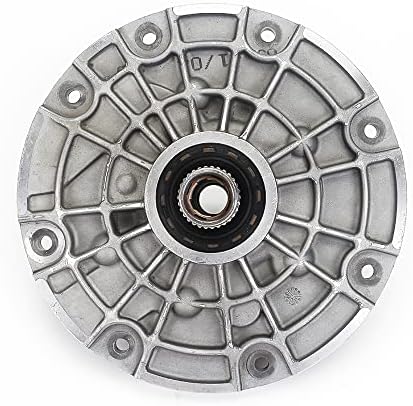
A steady drip from directly behind the engine, right where the bellhousing meets the transmission, usually means the front pump seal. This is also the leak that costs the most to fix, because the pump sits directly behind the torque converter, and there is no way to service it without separating the transmission from the engine and pulling the converter first. Once it's apart, don't just replace the seal and button it back up: inspect the converter hub where it rides inside that seal. A grooved or scored hub will cut a brand new seal just as fast as it wore out the old one, and if that's the case, the seal alone won't hold. If the pump bushing or internal gears show wear beyond the seal lip, replace the whole pump assembly rather than gambling on a seal-only fix that has you back in the same job in another 20,000 miles.
Cooler line fittings
Check both ends: where the steel lines thread into the case, and where they connect at the radiator cooler or an auxiliary cooler if one is installed. These are low-effort checks compared to pulling the transmission, and a weeping fitting or a cracked line is an easy, cheap fix that's worth ruling out before you assume the leak is coming from deeper inside the case. A loose fitting can usually be snugged and rechecked; a line with a stress crack needs to be replaced, not just tightened.
The leak that never reaches the ground: valve-body bore wear
This is the one that trips people up, because it doesn't produce a puddle. Sonnax's technical breakdown of the 5R55W/S treats wear at the TCC modulator bore and the main regulator bore as this transmission's first failure points, followed by wear at the VFS1, VFS2, and VFS3 modulator bores, which reduces clutch and servo apply pressure. As those bores wear, fluid leaks internally across valve-to-bore clearances instead of reaching the circuit it was supposed to pressurize. The practical effect: aerated fluid that throws off the level-plug check, gear-ratio codes, flares on 1-2, 2-3, or 4-5 shifts, or soft clutch engagement, with the transmission otherwise bone dry underneath. Sonnax's same writeup also flags a loose pump canister in its bore as a leak point that shows up specifically on an air test and reduces line pressure, and a worn solenoid manifold gasket (the filter is actually built into that gasket) as a leak path that can mute TCC apply changes in cooler flow. None of these show up as a drip. All of them get misdiagnosed as a bad solenoid or a tired servo before anyone checks the bore wear underneath.
In 2009, Ford changed the 5R55S valve-body casting and separator plate, reducing the hole sizes in the VFS1 and VFS2 oil circuits on the new casting (identifiable by its RF9L2P 7A101AA forging number). Per Transmission Digest's writeup on the change by Sonnax TASC Force member Jeff Parlee, Ford TSB 09-21-4 covers a related hot-idle whistle noise on the 2009-and-up casting, fixed with an updated separator plate carrying two small ID holes near the servo bore. If you're sourcing a replacement valve body or separator plate for a cross-leak repair, confirm your casting year before ordering, since the earlier and 2009-and-up parts are not a guaranteed match.
Servo pin bore wear
The overdrive and intermediate servo pin bores are a well-known wear point on this case, and we cover the diagnosis and the Sonnax sleeve repair (part 56361J-01K) in full in our dedicated 5R55W/5R55S servo pin bore wear guide. The short version for this leak discussion: as the pin bore wears, apply oil leaks past the pin into the barrel area of the case instead of applying the servo cleanly, which Sonnax ties to 1-2, 2-3, and 4-5 flares, gear loss, and OBD codes P0732, P0733, and P0735. Like the valve-body bore wear above, it's an internal leak path, not something you'll find with a flashlight under the truck.
5R55S Overhaul Kit
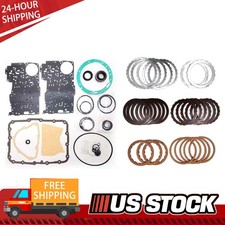
If you're already in the valve body chasing a cross-leak, replace every rubber seal and gasket in the unit at once rather than guessing which one is next to fail.
Check the 5R55S overhaul kit at Gearbox Insider →Use the correct fluid, or you'll be back in here
Ford's own Motorcraft MERCON V product listing specifies this fluid for Ford, Lincoln, and Mercury automatic transmissions that call for MERCON V, which covers the 5R55S. That matters for leak prevention specifically because of what happened with early Mercon V fill on this transmission: Sonnax documents that Mercon V produced before roughly May 2005 degraded the rubber seals on this unit's VFS solenoids, which Ford addressed first with an interim additive package and then with a revised Mercon V formulation carrying Motorcraft part number XT-5-QM. The lesson carries forward past that specific batch: a fluid that doesn't actually meet the Mercon V spec, cheap store-brand "universal" ATF included, can swell or harden rubber seals throughout the transmission, including whichever seal you just paid to replace. Use genuine Motorcraft MERCON V or a fluid explicitly licensed to the MERCON V spec, full stop.
Don't confuse delayed reverse with a leak
A slow or hesitant engagement into reverse feels like something is leaking off hydraulic pressure before it can apply, but on this transmission it's frequently something else. Sonnax's delayed-reverse writeup for the 5R55N/S/W points to a Low/Reverse servo control valve that sticks inside its bore, commonly from contamination introduced if the servo housing was ever cleaned in a hot pressure washer. A stuck valve fills the servo too slowly to produce a crisp reverse engagement, without any fluid actually leaving the system. Check the fluid level and condition first since low fluid will also cause a lazy reverse, but if the fluid's correct and reverse is still slow to take, pull the servo control valve and spring from under its threaded end cap and confirm it moves freely in a clean, dry bore before assuming you have a leak anywhere else in the unit.
Diagnostic order, start to finish
- Clean the whole underside of the transmission and drive it normally for a few days before deciding anything is actually leaking.
- Check for the vent-tube overflow pattern first: fluid at the front of the case only after hard driving or towing, dry otherwise.
- Inspect the pan gasket and filter O-ring seal; this is the cheapest real leak to find and fix.
- Check both ends of the cooler lines, at the case and at the radiator or auxiliary cooler.
- If the front of the bellhousing is steadily wet, suspect the front pump seal, and inspect the converter hub for scoring once it's apart rather than reusing a grooved hub.
- If the outside of the unit is dry but you're seeing gear-ratio codes, flares, or aerated-looking fluid at the level plug, stop chasing external seals and suspect valve-body bore wear or the servo pin bore instead.
- If reverse is slow to engage with correct fluid level, check the Low/Reverse servo control valve for sticking before assuming a leak.
- Confirm the fluid in the unit is genuine Mercon V or a fluid licensed to that spec before closing out any leak repair.
Need parts for this job?
Pan and filter gasket kits, pump assemblies, overhaul kits, and valve bodies for the 5R55S are all on one page.
Shop 5R55S parts →FAQ
Why is there fluid near the front of my 5R55S when the front seal looks dry?
Check the transmission vent before you touch the front seal. The 5R55S vents through a tube that routes to the front of the case, and if the unit runs hot or gets worked hard, it will push a small amount of fluid out that vent into the bellhousing area. That looks exactly like a front pump seal leak from underneath the truck. Clean the whole front section, drive it normally for a few days, and recheck before condemning the seal. If the area stays dry and the leak only shows up after hard driving or towing, you are chasing a vent-pressure issue, not a seal, and no parts need to come off.
Can a 5R55S lose fluid pressure internally without ever dripping on the ground?
Yes, and it is a different repair than an external leak. Sonnax's technical writeup on the 5R55W/S treats wear at the TCC modulator bore, the main regulator bore, and the VFS1/2/3 modulator bores as the units' first failure points: as those bores wear, pressurized fluid leaks internally across circuits instead of reaching the clutch or servo it was meant for. You will not see a puddle. You will see gear-ratio codes, flares between shifts, or soft clutch application, and aerated fluid can make the level-plug check read wrong. That is a valve-body wear problem, not a gasket problem, and it needs a valve body inspection or replacement, not a re-seal.
What does it take to fix a 5R55S front pump seal leak?
More than the seal alone. The pump sits directly behind the torque converter, so reaching it means separating the transmission from the engine and pulling the converter first; there is no seal-from-outside shortcut like you'd get on some units. Once it's apart, inspect the converter hub where it rides in the seal for scoring, since a grooved hub will cut a new seal just as fast as the old one wore out. If the pump bushing or gears show wear beyond the seal itself, replace the pump assembly rather than just the seal so you are not back in there in another 20,000 miles.
Does the transmission fluid itself matter for 5R55S leaks and seal life?
Yes. Ford's own MERCON V product listing specifies this fluid for 5R55-family transmissions, and Sonnax documents a real-world problem with early Mercon V fill (before roughly May 2005) that degraded solenoid seals on this transmission, which Ford addressed first with an interim additive and then with a revised Mercon V formulation carrying part number XT-5-QM. Using the wrong ATF, or a bargain fluid that does not actually meet the Mercon V spec, can swell or harden rubber seals throughout the unit, including the ones you just paid to replace. Stick to genuine Mercon V or a fluid explicitly licensed to that spec.
My 5R55S is slow to go into reverse. Is that a fluid leak?
Not necessarily, and it's worth ruling out before you start chasing seals. Sonnax's delayed-reverse writeup for the 5R55N/S/W points to a Low/Reverse servo control valve that sticks in its bore, often from contamination introduced during a hot pressure wash, and fills the servo too slowly rather than leaking fluid out of the unit. Low fluid level can also cause a slow reverse engagement, so check the level and condition first. If the fluid is correct and full and reverse is still lazy, the servo control valve and its bore are the more likely culprit, not a leak anywhere in the system.
Shop the part for this fix
Pan gaskets, pump bushing and seal repair kits, and overhaul gasket and seal kits specific to the 5R55S are stocked at CoreTransmissionParts.
Shop the 5R55S pump bushing, gasket & seal repair kit at CoreTransmissionParts →Related 5R55S guides
Sources
- Sonnax — "Figuring Out the 5R55 Alphabet," tech resource #195. Backs the 5R55W/5R55S case and solenoid differences, the TCC modulator bore and main regulator bore as the units' first wear points, VFS1/2/3 modulator bore wear reducing clutch and servo pressure, the pump canister leak found on the air test, the solenoid manifold gasket/filter leak path, and the early-Mercon-V (pre-May 2005) solenoid seal degradation issue addressed by Ford's interim additive and the revised XT-5-QM fluid. sonnax.com
- Sonnax — Tool Kit S-56361J-TL / Overdrive & Intermediate Servo Pin Bore Sleeve Kit 56361J-01K product page. Backs the servo pin bore wear symptoms (1-2, 2-3, 4-5 flares; gear loss; band lining failure) and the associated OBD codes P0732, P0733, and P0735 for the 5R55N/S/W. sonnax.com
- Ford Motor Company — Motorcraft MERCON V Automatic Transmission and Power Steering Fluid, official FCSD product listing. Backs the MERCON V specification and part numbers (XT-5-5Q3M, XT-5-DMC, XT-5-QMC) as Ford's recommended fluid for 5R55-family automatic transmissions. fcsdchemicalsandlubricants.com
- Sonnax — "Ford 5R55N/S/W Delayed Reverse," tech resource #336. Backs the Low/Reverse servo control valve sticking in its bore as a documented cause of delayed reverse engagement, separate from any fluid leak, and the contamination risk from pressure-washing the servo housing. sonnax.com
- Transmission Digest — "Valve-Body and Plate Changes for the 5R55S," Jeff Parlee (Sonnax TASC Force), April 1, 2013. Backs the 2009-and-up 5R55S valve-body casting change (forging number RF9L2P 7A101AA), the reduced VFS1/VFS2 separator-plate hole sizes on that casting, and Ford TSB 09-21-4 covering the related hot-idle whistle fix via an updated separator plate. transmissiondigest.com
- Ford service information via Mitchell1 — "2002 Automatic Transmissions Servicing - Explorer and Mountaineer" (5R55W/S). Backs the 1 psi limit for pressurized fill equipment and the vent-fluid-looks-like-converter-leak warning, the 16 pan bolts at 97 lb-in (11 Nm) in a crisscross sequence, and lubricating the filter seals with clean ATF. Ford/Mitchell servicing (PDF)
- ATRA Technical Bulletin 746 — "5R55N, 5R55S and 5R55W: New Rotunda Tool for Checking Fluid Level and Filling Transmissions" (February 2003). Backs the no-dipstick fluid level and fill plug design and the level check at 80-120°F (27-49°C) on the TFT PID with the engine idling in Park. atracom (PDF)