The customer describes it two ways. Either the van shudders and stumbles as it rolls up to a light, or it flat kills the engine when they come to a stop in gear. Both descriptions are the same failure: the torque converter clutch is still holding, and the engine has no way to disconnect from a driveline that has stopped turning.
P0742 is the SAE generic definition for Torque Converter Clutch Circuit Stuck On, and the important word in that string is stuck. This is not an electrical complaint. The controller commanded the clutch off, watched the data, and saw that it did not release. That distinction matters because the electrical version of the same circuit on a 62TE is P2761, TCC solenoid control circuit open, and those two codes send you to two completely different repairs. If you have P0742, an ohmmeter on the solenoid circuit is going to read fine and tell you nothing.
This one is also not on the "drive it until payday" list. A transmission that can stall the engine in gear will do it in the middle of an intersection.
What Actually Holds the Converter Applied
Before you can rank the causes you need to know how many parts are in the chain, and on the 62TE it is more than most techs assume. Start with a hardware fact that changes what you unbolt.
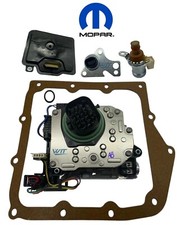
Per Sonnax's 62TE identification data and Jeff Parlee's write-up for Transmission Digest, the 62TE solenoid pack contains six shift solenoids, one line pressure solenoid, a temperature sensor and five pressure switches. The line pressure sensor and the TCC variable force solenoid bolt directly onto the valve body and are not part of the solenoid pack. That means the pack every parts counter wants to sell you for a transmission code contains exactly none of the components that set P0742.
Downstream of that solenoid, Sonnax's 62TE valve body layout identifies four valves in the front of the casting that all touch the converter circuit:
- 102 — TCC Regulator Valve. Controls the release side of the converter, and feeds the cooler circuit once the clutch is applied.
- 103 — TCC Control Valve (with its plunger and sleeve). Meters apply pressure and damps it.
- 104 — TCC Switch Valve. Sonnax lists its wear symptoms as no lockup, torque converter slip codes and, notably, stalling condition.
- 101 — Pressure Regulator Valve. Wear here shows up as erratic TCC apply along with the usual line pressure complaints.
Four valves and one solenoid, any of which can leave the clutch applied. Which is why "replace the TCC solenoid and hope" has a comeback rate on this unit.
Prove It on the Scan Tool Before You Drop the Pan
There is one graph that settles this in a single test drive, and it comes straight out of ATRA's 62TE pattern failure material in Gears. Keith Clark lays it out: monitoring scan data in graphing mode, compare the Input Speed Sensor against engine RPM while the complaint is occurring. On a healthy unit with the converter clutch commanded off, engine RPM and ISS separate as the vehicle slows, because the converter is doing its job as a fluid coupling. On a 62TE with this failure, the ISS trace follows engine RPM while the TCC is commanded off. The two lines stay locked together. That is your confirmation that the clutch is mechanically applied, regardless of what the command says.
Set up the data list this way before you leave the bay:
- Graph engine RPM and Input Speed Sensor RPM on the same scale. These are the two traces that matter.
- Add TCC solenoid duty cycle or TCC command so you can see the exact moment the controller lets go.
- Add transmission fluid temperature. This failure is frequently temperature dependent — it appears once the unit is fully hot and disappears on a cold start — and knowing that ahead of time saves you a wasted road test.
- Record freeze frame data before clearing anything, and duplicate the setting conditions: get above 45 mph on a smooth flat road so the clutch fully applies, then decelerate below 30 mph and watch for the separation that never happens.
ATRA notes this condition shows up with or without codes, which is worth remembering when a customer complains of a stumble and the scan tool is clean. The graph does not care whether a code matured.
The Four Real Causes, In the Order to Check Them
1. The TCC variable force solenoid, stuck mechanically
This is the most common answer and the cheapest one. ATRA identifies the stumbling stop on the 62TE as commonly caused by a mechanically faulty TCC solenoid, and adds the practical part: it can be serviced without removing the unit and can be purchased separately. Mechanically faulty is the key phrase. The winding is fine, the resistance is fine, the command is fine, and the spool inside is hanging up on varnish or debris. No electrical test finds it.
While the pan is down, pull the solenoid's screen and look at it. A restricted TCC solenoid screen cannot vent apply pressure fast enough for the clutch to let go on a quick decel, and it produces exactly this complaint. It is a five dollar part that will send a customer home in a tow truck.
2. Debris in the fluid holding the spool
Look at what came out of the pan before you order anything. Burnt fluid, clutch fiber and metal all get pushed through the hydraulics, and any of it can park a spool valve. If the pan is full of material, a solenoid is a bandage — you are going to be back in this unit. This is also the point where you decide whether you are doing a valve body job or a rebuild, and it is a much better conversation to have now than after the customer has paid for the small repair.
3. TCC regulator valve bore wear (the one a new solenoid will not fix)
This is the cause that turns into a comeback, and Sonnax documents the mechanism precisely. Bore wear at the TCC regulator valve prevents proper hydraulic control of the release and cooler circuits. In Sonnax's words: this pressure feeds to the release side of the torque converter when required, and if pressure is too low, proper release will not occur. That is P0742 described in hydraulic terms. The listed symptoms for the valve include no TCC release, TCC codes, high or low TCC release pressure, excess converter pressure, excess cooler pressure and damaged converter.
The same wear can go the other direction and balloon the converter with excessive release pressure, which is why a unit with a long history of ignored TCC codes deserves a hard look at the converter itself before you reinstall it.
The fix is not a solenoid. Recondition the bore and install the Sonnax oversized TCC regulator valve kit, part number 92835-37K, which requires the F-92835-TL37 reamer and VB-FIX fixture. It covers '95-later units across the 40TE, 41TE, 41AE, 40TES, 41TES, 42LE, 42RLE and 62TE family.
4. TCC control valve bore wear
Sonnax lists TCC control bore wear as the cause of high TCC slip, TCC lining degradation, TCC slip codes and converter apply or release concerns. If your complaint is more shudder-and-stumble than hard stall, this bore is a strong candidate. The repair is the oversized TCC control and plunger valve kit, 92835-33K, which Sonnax states is compatible with all 42LE, 42RLE and 62TE units and includes the control sleeve, control plunger, control valve and dampener plunger.
Vacuum Testing: How to Stop Guessing
If the valve body is out, do not eyeball the bores. Sonnax publishes a 62TE vacuum test guide that maps every critical wear area on both faces of the casting with the test port for each one. The rules that make the readings mean something:
- Test the OE valves in their rest position unless the guide says otherwise. Springs are omitted from the diagrams for clarity, not from your assembly.
- A low vacuum reading indicates wear at that bore. That is the whole interpretation.
- Work the front face for the TCC circuit: pressure regulator (101), TCC regulator (102), TCC control (103) and TCC switch valve (104).
- Test again after reaming and installing the oversized valve. A vacuum test that only runs before the repair tells you what was wrong, not whether you fixed it.
Ten minutes with a vacuum pump is the difference between a repair you warranty confidently and a valve body that comes back.
62TE Solenoid Block, TCC and LPS Sensor Filter Kit, 5-Piece → or browse all transmission solenoids
Fluid, Reassembly and the Relearn
Everything in this circuit is a close-clearance spool valve, so the fluid is not a detail. The 62TE takes ATF+4 built to Chrysler Material Standard MS-9602 and nothing else. Generic multi-vehicle fluid has the wrong friction characteristics for this converter clutch and will produce shudder that looks like a hydraulic fault you already fixed.
Two assembly notes that come out of the same Sonnax and Transmission Digest material and that cost people repeat jobs:
- Route the pack wiring through every clip and trough in the plastic body of the solenoid pack. Parlee's article is explicit that failing to do this results in damaged wiring — and damaged wiring on this harness is how a hydraulic repair turns into a P2761 a month later.
- If you need to identify a bare solenoid, blow compressed air into the open end. Air blocked means normally closed; air out of the holes between the two large O-rings means normally open. On the 62TE the 2/4 and underdrive solenoids are the normally open pair; low/reverse, low clutch, overdrive and direct clutch are normally closed.
After the repair, if engagement quality into Drive is harsh, run ATRA's relearn instead of assuming you left something wrong: monitor the transmission fluid temperature sensor, let it reach 90 degrees F (32 degrees C), drive to 10 mph in Drive, stop, shift to Neutral for three seconds, back to Drive for three seconds, and repeat. The temperature has to stay near 90 degrees F for the learning to continue.
Preventing the Repeat
P0742 is a wear code more than a failure code, and the wear is thermal. Every mile the converter clutch spends slipping instead of applying or releasing cleanly cooks the fluid and the clutch lining, and Sonnax lists overheated fluid and TCC lining right alongside the bore wear symptoms. The prevention list is short and it is all maintenance:
- Change ATF+4 on an interval, not on a symptom. Varnish is what parks the solenoid spool in the first place.
- Replace the converter when the release circuit has been running out of spec. A clutch that has been slipping against a stuck valve is not a core you reuse.
- Fix the cooler flow while you are in there. The TCC regulator valve feeds the cooler circuit once the converter applies, so a restricted cooler and a worn regulator bore feed each other.
- Do not clear the code and hand the keys back. If the stall condition returns in traffic, the customer's next call is not to your shop.
Need parts for this job?
TCC solenoids, solenoid block packs, valve bodies, torque converters, filters, pan kits and full rebuild kits for the Chrysler 62TE, priced for shops and shipped from the USA.
Shop 62TE parts →FAQ
What does P0742 mean on a Chrysler 62TE?
P0742 is the SAE generic definition for Torque Converter Clutch Circuit Stuck On. On a 62TE it means the controller commanded the converter clutch off and the data says it did not release. It is a hydraulic or mechanical complaint, not a wiring complaint. The wiring version of the same circuit is P2761, TCC solenoid control circuit open, and the two point at completely different repairs.
Why does my Town and Country or Journey stall when I come to a stop?
Because the converter clutch is still holding the engine mechanically coupled to a driveline that is stopping. ATRA lists stumbling while coming to a stop as one of the three most common reasons a 62TE ends up in a shop, and it can happen with or without a stored code. If the van stalls in gear at idle, stop driving it, because that same condition can strand you at an intersection.
Is the TCC solenoid part of the 62TE solenoid pack?
No. Sonnax and Transmission Digest both state that the line pressure sensor and the TCC variable force solenoid bolt directly onto the valve body and are not part of the solenoid pack. The pack itself holds six shift solenoids, one line pressure solenoid, a temperature sensor and five pressure switches. Buying a pack for a P0742 gets you none of the parts that set the code.
Can I fix 62TE P0742 without pulling the transmission?
Often, yes. ATRA notes the TCC solenoid can be serviced without removing the unit and can be purchased separately, so a pan drop gets you to the solenoid, its screen and the valve body. What you cannot fix in the vehicle is bore wear at the TCC regulator or TCC control valve, which needs the valve body on a bench for vacuum testing and reaming.
Will a new TCC solenoid fix P0742 every time?
No, and that is the expensive mistake on this code. Sonnax documents that bore wear at the TCC regulator valve prevents proper hydraulic control of the release circuit, and that if release pressure is too low, proper release will not occur. A new solenoid cannot raise release pressure through a worn bore. Vacuum test the valve body before you call the job done.
Sources
- Sonnax — Oversized TCC Regulator Valve Kit 92835-37K product and instruction page. Backs the core mechanism of this article: bore wear at the TCC regulator valve prevents proper hydraulic control of the release and cooler circuits; the release-side pressure feed and the statement that if pressure is too low, proper release will not occur; the converter ballooning risk when release pressure is excessive; the fact that the TCC regulator valve feeds the cooler circuit once the converter is applied; the listed symptoms (no TCC release, TCC codes, high and low TCC release pressure, excess converter and cooler pressure, damaged converter); the fitment across 40TE, 41TE, 41AE, 40TES, 41TES, 42LE, 42RLE and 62TE for '95-later units; and the F-92835-TL37 and VB-FIX tooling requirement. sonnax.com
- Gears Magazine (ATRA) — "Six-Speed Success! 62TE Things To Do To Deliver Them Right The First Time," Keith Clark, August 19, 2022. Backs the diagnostic method and the ranking of causes: stumbling while coming to a stop as one of the three main complaints bringing 62TEs into shops; that it occurs with or without codes; the graphing procedure comparing Input Speed Sensor against engine RPM while the torque converter clutch is commanded off, with the ISS trace following engine RPM as the confirmation; the finding that this is commonly caused by a mechanically faulty TCC solenoid that can be serviced without removing the unit and purchased separately; that the 62TE is fundamentally a 41TE with an underdrive assembly on the countershaft; and the post-repair harsh engagement relearn at 90 degrees F using the 10 mph, Neutral three seconds, Drive three seconds cycle. gearsmagazine.com
- Sonnax — "Chrysler 62TE Vacuum Test Guide," November 5, 2021. Backs the valve body map and the bench procedure: the front-face valve identification numbers used here (101 pressure regulator valve, 102 TCC regulator valve, 103 TCC control valve, 104 TCC switch valve, 105 low/reverse switch valve, 106 solenoid switch valve, 107 blocker valve, 108 low clutch switch valve, 109 manual valve); the TCC switch valve wear symptoms of no lockup, stalling condition and torque converter slip codes; the TCC control plunger sleeve symptoms including converter shudder and failure, TCC deflection and lining failure and cooler restriction; the instruction to test OE valves in rest position; and the rule that a low vacuum reading indicates wear. sonnax.com
- Sonnax — "62TE Solenoid Identification & Connector Pin Out," January 1, 2013. Backs the hardware architecture: the solenoid pack contents (six shift solenoids, one line pressure solenoid, a temperature sensor, five pressure switches); the statement that the line pressure sensor and the TCC variable force solenoid bolt directly onto the valve body and are not part of the pack; the note that all solenoid resistance testing is performed at approximately 70 degrees F; the compressed-air method for separating normally open from normally closed solenoids; and the 23-way case connector pin out, including pin 3 as TCC VFS control and pin 10 as power from the transmission control relay. sonnax.com
- Transmission Digest — "Solenoid-Pack Information for the Chrysler 62TE," Jeff Parlee (Sonnax TASC Force), September 1, 2011. Backs the solenoid identification and the assembly warnings: the named list of the six shift solenoids and which are normally open (2/4 and underdrive) versus normally closed (low/reverse, low clutch, overdrive, direct clutch); the confirmation that the line pressure sensor and TCC variable force solenoid are not part of the pack; the note that the pressure switches match the 604 pack design; the requirement to route pack wiring through every clip and trough in the plastic body or risk damaged wiring; and the application history placing the 62TE first in the 2007 Sebring 3.5L and Pacifica 4.0L, then the 2008 minivans with the 3.8L and 4.0L. transmissiondigest.com
- Sonnax — Oversized TCC Control & Plunger Valve Kit 92835-33K product page. Backs the fourth cause and its repair: TCC control bore wear allowing pressure loss out of the circuit; the associated symptoms of high TCC slip, TCC lining degradation, TCC slip codes, converter apply or release concerns, overheated fluid and reduced fuel economy; the statement that the kit is compatible with all 42LE, 42RLE and 62TE units; the kit contents (control sleeve, control plunger, control valve, dampener plunger); and the F-92835-TL33 and VB-FIX tooling requirement. sonnax.com