P0733 on a 66RFE means the transmission control module commanded 3rd gear and did not get a 3rd gear ratio back. On this six-speed, 3rd is not a direct gear. It is a reduction gear held by two clutches, and one of them is the 4C, the holding clutch that gives these units more 3rd-gear trouble than people expect. If you know which two clutches make 3rd and what else they do in other gears, the code tells you a lot more than "gear 3 incorrect ratio."
The 66RFE is the gas-engine version of the six-speed RFE family. It runs the same gear ratios and clutch layout as the 68RFE behind the Cummins, so the 68RFE service literature applies. Where a fact comes from a sibling unit, I will say so.
Related reading: 66RFE slipping causes and fix and 66RFE speed sensor testing.

How the Module Decides 3rd Is Wrong
There is no 3rd gear sensor. The module works out the ratio by comparing the input speed sensor with the output speed sensor. ATSG's 68RFE technical bulletin lists what the TCM uses those two signals for: the transmission gear ratio, speed ratio error detection, the clutch volume index (CVI) calculation, and converter clutch slip[1]. In 3rd the input shaft should turn 1.41 times faster than the output shaft. Sonnax's apply chart for the 65RFE, 66RFE and 68RFE lists the forward ratios as 3.23, 1.83, 1.41, 1.00, 0.81 and 0.62, with 4.44 reverse[2]. If the measured ratio drifts away from 1.41 while 3rd is commanded, the module sets P0733.
That gives you three ways to get the code:
- A clutch is slipping. Input speed climbs above where it should be for the output speed. This is the usual cause.
- A speed signal is lying. A weak or dropping ISS or OSS signal makes a healthy gear look like the wrong ratio.
- The clutch never fully applied. A hydraulic or solenoid problem means the clutch was never clamped hard enough to hold.
When the module decides the transmission is at risk, it cuts the ground to the transmission control relay and drops all power to the solenoids. ATSG notes that the 68RFE then sits in 4th gear in Drive and 2nd if the lever is moved to 2 or L. On trucks with Electronic Range Select there is no 2nd gear limp-in, because the lever has no 2 or 1 position[1]. A 66RFE that pulls away in 4th with P0733 stored is doing what it was designed to do.
Which Clutches Make 3rd, and Why That Matters
The RFE transmissions do not use bands. Every gear comes from two clutches applied together. ATSG lists the solenoid-controlled elements as the L/R, 2C, 4C, UD and OD clutches, with the reverse clutch applied by the manual valve and line pressure[1]. MOTOR Magazine's original write-up on the 45RFE explained that the "2nd prime" gear was made by applying the underdrive clutch and the 4th clutch together[3]. The six-speed units made that same UD and 4C combination a full-time gear, and it is 3rd at 1.41:1.
Lay the six forward gears out and the pattern is easy to use:
- 1st: UD with L/R and the low sprag
- 2nd: UD + 2C
- 3rd: UD + 4C
- 4th: UD + OD (direct, 1.00)
- 5th: OD + 4C
- 6th: OD + 2C
The 3-4 upshift releases the 4C and applies the OD. Sonnax describes its 4C retaining ring kit as improving 4C to OD shift timing, which is that same 3-4 shift[4]. From this table you can read the code like a diagnostician instead of a parts changer. Transmission Digest's Shift Pointers column makes the same point: when more than one ratio code sets, use the apply chart to find the one component the failing gears share[6].
- P0733 with P0735 (5th ratio). The common element is the 4C clutch. Look at the 4C pack, its piston, the retaining ring and the 4C circuit first.
- P0733 with P0731, P0732 or P0734. The common element is the underdrive clutch, which drives 1st through 4th. Think UD pack, the input drum seals and the UD circuit.
- P0733 alone. The UD clutch also carries 1st, 2nd and 4th, so if it were slipping you would usually see a code in those gears too. A clean 3rd-only code leans toward the 4C side, or toward a problem that only shows up during the 2-3 shift.
Also note when the code set. In that Transmission Digest case, the codes set on coast downshifts, not upshifts, and that pointed straight at a clutch that only works on coast[6]. Freeze frame data on a P0733 will tell you whether it set on the 2-3 upshift, holding 3rd under load, or on a 4-3 kickdown. Each one points somewhere different.
Step One: Clear the Codes That Cause Ratio Codes
Chrysler's diagnostic logic for gear ratio codes starts by sending you elsewhere. If there are any loss of prime (low fluid), line pressure sensor or speed sensor codes, diagnose those first, because they will cause gear ratio codes[6]. Do this before you trust anything else:
- Pull every module code and save the freeze frame. Note fluid temperature, gear commanded and vehicle speed when P0733 set.
- Set the fluid level correctly. The RFE family runs on Mopar ATF+4[1]. A unit that is a quart low can lose prime on a hard turn or a hill and throw ratio codes. Our 66RFE fluid level procedure covers the hot dipstick check.
- Smell and look at the fluid. Burnt ATF+4 with fine friction material says a clutch has already slipped. Clean fluid with a 3rd-only code makes an electrical or hydraulic cause more likely.
- Check the speed sensors. ATSG notes the two RFE speed sensors are the same part and interchange, and that a new one reads about 535 ohms at room temperature[1]. Graph ISS and OSS together on a road test. A signal that drops out for a moment while the other one holds steady will set a ratio code with no mechanical fault at all.
Step Two: Read the 3rd Gear Data on the Scan Tool
With related codes ruled out, drive it and record. Watch these items together:
- Input speed, output speed and calculated ratio. In a healthy 3rd, input rpm divided by output rpm sits at 1.41 and stays there under load. A slipping clutch shows input rpm flaring above that during the 2-3 shift or creeping up under throttle in 3rd.
- Pressure switch states. The RFE solenoid pack carries five pressure switches, one each for L/R, 2C, 4C, UD and OD. MOTOR describes them as a way for the module to catch a pressure loss in a specific clutch circuit[3]. In 3rd, the UD and 4C switches should report pressure.
- Line pressure actual vs desired. If line pressure is low across all gears, you have a supply problem, not a 3rd gear problem.
- CVI values. The module learns how much oil each clutch takes to apply, by timing how long the ratio takes to change[3]. A 4C volume that is high compared to a known-good unit points to excess clearance or a worn pack.
Here is how the data sorts it out. If the 4C switch reports pressure and the ratio still slips, the oil got there and the clutch did not hold. That is a mechanical problem inside the case. If the 4C switch never closes in 3rd, the oil never arrived, so look at the solenoid, the valve body and the 4C feed circuit.
Electrical checks at the case connector
Sonnax's RFE valve body instructions give solenoid resistance at room temperature. Each shift solenoid, including the 4C (pins 10 and 19) and UD (pins 10 and 17), should read about 1.3 ohms. The line pressure solenoid (pins 10 and 12) reads about 4.3 ohms[2]. Check across the case connector first, then at the module end. A good reading at the case and a bad one at the module puts the fault in the harness.
The Causes Behind a 66RFE P0733
1. The 4C return spring retaining ring
This one is specific to the RFE family and it is worth knowing before the unit comes apart. Sonnax states that the 4C return spring retaining ring in the 45RFE, 545RFE, 65RFE, 66RFE and 68RFE is known to come unseated and pop off, which leads to transmission failure[4]. When it lets go, the 4C piston and return spring can no longer keep the pack controlled, and the 4C clutch is half of 3rd gear. Their kit (72978-01K) adds a G-Loc ring that mechanically locks the factory ring in place, plus a .078 in. backing plate ring and a spring pack shim[4]. If you find the ring out of its groove, inspect the 4C frictions and steels closely. The pack has usually taken heat.
2. A worn 4C pack or wrong clearance
The 4C is a holding clutch that works in both 3rd and 5th, so it sees plenty of miles. Clearance is the spec to check. Sonnax gives the 4C clearance specification as .030 to .055 in.[4]. TransGo's 2018 RFE kit instructions list the 68RFE clearances as 4C .030 to .053 in., UD .038 to .068, 2C .038 to .066, OD .030 to .063 and L/R .045 to .081[5]. Sonnax warns against reaching clearance with thinner steel plates, because that cuts the pack's ability to soak up heat[4]. Set it with the correct snap ring instead.
3. The underdrive side
The UD clutch is the other half of 3rd. TransGo flags the factory tapered underdrive snap ring as a part that breaks and pops out, and supplies a heavy-duty flat replacement[5]. On the 66RFE, TransGo also notes the input drum changed between model years. The 2012-13 units use different pressure plates from 2014-up units, and the 2014-up OD frictions are thinner with thicker steels[5]. A previous rebuild that mixed 2012-13 and 2014-up drum parts can leave the clearances wrong in ways that only show under load.
4. Accumulators and the cover plate
Every clutch apply goes through an accumulator, and a leaking accumulator piston or a cracked or flexing cover plate lets apply pressure bleed off. TransGo's kit replaces the accumulator cover plate with a heavy-duty one for this reason[5]. One 66RFE-specific detail: Sonnax's valve body instructions say a 66RFE or 68RFE needs different 2nd and OD accumulator springs from a 45RFE or 545RFE[2]. A valve body swapped in from a five-speed truck without changing the springs will shift wrong from the first drive.
5. Valve body cross-leaks
TransGo describes valve body erosion on high-mileage 68RFE units. Pressure, time and heat flex the channel walls, which scrub the separator plate and erode the aluminum until oil cross-leaks between circuits. They recommend replacing the valve body rather than trying to surface it[5]. A cross-leak that bleeds the 4C or UD feed shows up as slip in 3rd. It gets worse as the fluid gets hot and thin.
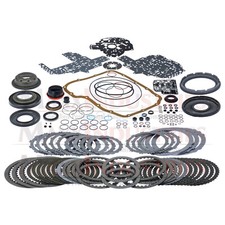
RFE-family friction kit at CoreTransmissionParts
If the 4C or UD pack is burnt, this 1999-2018 RFE-family friction module covers the clutch packs. CoreTransmissionParts lists it under the 68RFE, so match it against your 66RFE year first, because the 2014-up OD pack differs.
View the friction kit →A Fix Order That Saves the Customer Money
- Diagnose loss of prime, line pressure sensor and speed sensor codes first. Fix those and clear everything.
- Correct the fluid level with ATF+4, and note the fluid condition.
- Graph ISS, OSS and the ratio on a road test. A signal dropout is an electrical repair, not a rebuild.
- Check the 4C and UD pressure switch states in 3rd. Switch closed with slip means a mechanical problem inside the case. Switch open means a solenoid, valve body or feed circuit problem.
- Check solenoid resistance at the case connector: about 1.3 ohms for the shift solenoids.
- Pull the pan. Heavy friction material or a broken ring in the pan settles it. The unit is coming out.
- On the bench, check the 4C retaining ring, measure the 4C and UD clearances against spec, inspect the accumulators and cover plate, and air check the circuits.
When it goes back together, follow the torque specs Sonnax gives for the valve body. The six 8 mm valve body-to-case bolts go to 105 in-lb, the solenoid pack to the valve body at 53 in-lb, and the accumulator cover screws at 40 in-lb[2]. Then fill with ATF+4, warm it to about 185 F, run a quick learn, and make 10 to 15 upshift and downshift cycles. Sonnax notes that a 2-3 flare can be normal during the relearn and usually goes away within those cycles[2]. That flare is the shift into 3rd, so finish the relearn before you decide the repair didn't work.
One more road-test note. ATSG says upshifts into 5th and 6th are delayed when fluid is below 40 F or above 240 F[1]. If the truck holds 4th on a cold morning after the repair, that is the strategy, not a new fault.
Chasing a 66RFE P0733?
66RFE master rebuild kits, clutch modules and billet accumulator piston kits, shipped from the USA.
Shop 66RFE parts →FAQ
What does P0733 mean on a 66RFE?
The module commanded 3rd gear and the ratio it calculated from the input and output speed sensors did not match 3rd. On the 66RFE, 3rd is a 1.41:1 reduction made by the underdrive and 4C clutches together. A slipping clutch, a clutch that never fully applied, or a bad speed signal can all set it.
Which clutch usually causes a 66RFE P0733?
Start with the 4C clutch, because it is the clutch 3rd shares only with 5th. If P0735 is also stored, the 4C side is the strong suspect. If 1st, 2nd or 4th ratio codes are stored with it, look at the underdrive clutch instead, since it drives 1st through 4th.
Can a speed sensor cause P0733?
Yes. The ratio is calculated from the input and output speed sensors, so a signal that drops out can make a healthy gear look wrong. Chrysler's logic says to diagnose speed sensor, line pressure sensor and loss of prime codes before a gear ratio code. ATSG notes a new RFE speed sensor reads about 535 ohms at room temperature.
What is the 4C clutch clearance on a 66RFE?
Sonnax gives the 4C clearance specification as .030 to .055 in., and TransGo lists .030 to .053 in. for the RFE six-speed. Set it with the correct snap ring, not thinner steels, so the pack keeps its ability to absorb heat.
Why does my 66RFE stay in 4th after P0733?
When the module decides a fault could damage the transmission, it shuts off power to the solenoids and the hydraulic system defaults to 4th gear in Drive. With the lever in 2 or L it holds 2nd, except on trucks with Electronic Range Select, which have no 2nd gear limp-in.
Browse RFE-family parts →
Sources
- ATSG (Automatic Transmission Service Group) - 68RFE Technical Service Information, 2011. Backs the TCM's use of input and output speed for gear ratio, speed ratio error detection, CVI and TCC slip; both speed sensors interchanging and reading about 535 ohms new; solenoid control of the L/R, 2C, 4C, UD and OD clutches with the reverse clutch applied by the manual valve; limp-in in 4th (Drive) and 2nd (2 or L), and no 2nd gear limp-in with ERS; 5th and 6th delayed below 40 F or above 240 F; and Mopar ATF+4 as the fluid requirement. atsg.biz (PDF)
- Sonnax - CHR145/CHR146 Remanufactured Valve Body Tech & Install Tips (45RFE, 545RFE, 65RFE, 66RFE, 68RFE), 2021. Backs the 65/66/68RFE apply chart ratios (3.23, 1.83, 1.41, 1.00, 0.81, 0.62, reverse 4.44); solenoid resistance (4C pins 10 and 19, UD pins 10 and 17, about 1.3 ohms; line pressure solenoid pins 10 and 12, about 4.3 ohms); 105 in-lb valve body bolts, 53 in-lb solenoid pack and 40 in-lb accumulator cover screws; the different 2nd and OD accumulator springs for 66/68RFE; and the 185 F quick learn, 10-15 shift cycles and normal 2-3 flare during relearn. Sonnax instruction sheet (PDF)
- MOTOR Magazine - "Smart & Savvy" 45RFE feature by Thomas Marcy, June 2000. Backs the 2nd prime gear being made by applying the underdrive and 4th clutches together, the five clutch pressure switches used to detect pressure loss in specific circuits, and the TCM's CVI calculation from timing the gear ratio change. motor.com (PDF)
- Sonnax - 4C Retaining Ring & Shim Kit, part 72978-01K. Backs the 4C return spring retaining ring coming unseated and popping off in the 45RFE, 545RFE, 65RFE, 66RFE and 68RFE; the kit contents (G-Loc ring, .078 in. backing plate ring, spring pack shim); the .030 to .055 in. 4C clearance specification; the warning against using thinner steels to set clearance; and the 4C to OD shift timing. sonnax.com
- TransGo - 45RFE-HD2-A Reprogramming Kit Instructions (45RFE, 545RFE, 65RFE, 66RFE, 68RFE), August 2018. Backs the 68RFE clutch clearances (4C .030-.053, UD .038-.068, 2C .038-.066, OD .030-.063, L/R .045-.081 in.); the tapered underdrive snap ring that breaks and pops out; the heavy-duty accumulator cover plate; the 2012-13 vs 2014-up 66RFE input drum and OD pack differences; and valve body channel erosion and cross-leaks on high-mileage units. TransGo instructions (PDF)
- Transmission Digest - "Shift Pointers: Focused DTCs" by Wayne Colonna (ATSG), December 8, 2023. Backs the Chrysler rule to diagnose loss of prime, line pressure sensor and speed sensor codes first because they cause gear ratio codes, and the method of using the apply chart to find the common component behind multiple ratio codes, including when the codes set. transmissiondigest.com
Shop 66RFE master rebuild kits, clutch modules, valve bodies and solenoid kits, shipped fast from the USA.
Shop 66RFE parts →