The 6R140 has two completely different cooler line connections, and that trips people up more than the actual job does. At the transmission case, the tubes push straight into the housing and get clamped by a bolted hold-down plate — no collar, no quick-connect. At the radiator or auxiliary cooler, it is a quick-connect fitting that needs a dedicated disconnect tool. Ford even issued a bulletin, SSM 46198, after 2017 Super Duty trucks came back leaking from that hold-down plate connection: a new bolt and washer torqued to 25 Nm (18 lb-ft) is the fix. Below is the job broken into both connection types, plus how to tell a line leak from an internal overheat problem before you replace parts that were never bad.
Two connections, two different repairs
Most writeups treat "cooler line replacement" as one generic job. On the 6R140 it is really two jobs stacked together, and knowing which one you are looking at saves a lot of wasted parts-counter trips.
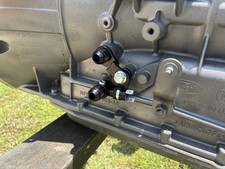
- At the transmission case: the cooler tubes insert directly into bores in the case and are held in place by a bolted hold-down plate, not a snap-in collar. This is the connection Ford's own bulletin addresses.
- At the radiator or auxiliary cooler: the factory lines terminate in a plastic quick-connect fitting. You push the line in to seat it and pull to confirm it locked; getting it back out needs a stepped disconnect tool, not a flat-blade screwdriver or hose-clamp pliers.
A leak at the case end looks like fluid weeping from behind the pan rail or down the bellhousing. A leak at the cooler end usually shows up as fluid on the frame rail or dripping near the radiator support. Trace the fluid trail before you order parts.
| Item | Spec or part number | Notes |
|---|---|---|
| Hold-down plate bolt | Ford W715131-S437 (new) | Use a new bolt, per SSM 46198 |
| Hold-down plate washer | Ford W718565-S437U | Installed between plate and case |
| Hold-down plate torque | 25 Nm (18 lb-ft) | Ford SSM 46198 |
| Quick-connect disconnect tool | 1/2 in. size | Lisle 39960 set lists this size for Super Duty F250/F350/F450 |
| Fluid | MERCON LV only | Ford Component Sales 6R140 spec sheet |
Step 1: Confirm it is actually a line leak
Before anything comes apart, get the truck up, wipe the suspected area dry, and run it until fluid reappears. A fresh leak at a tube fitting looks different from years of grime baked onto a dry connection. Check both ends: the case-side tube and plate, and the quick-connect at the cooler. If you cannot find active seepage at either connection but the truck is still losing fluid or running hot, do not start pulling lines on a guess. An internal problem can mimic an external one, and that distinction matters enough that it gets its own section below.
Step 2: Drain down and get access
- Park level, set the brake, and let the truck cool if it just came off the road. A 6R140 can run well over 200°F.
- Drop the pan or pull the drain plug to bring the fluid level down before you open any line. A full system opened at the cooler lines will dump fluid everywhere, not just drip.
- Identify which end needs the new line or lines: case side, cooler side, or the full run if the line itself is chafed, kinked or corroded through.
Step 3: Disconnect the quick-connect end correctly
Lisle's 39960 Ford Transmission Oil Cooler Line Disconnect Set lists a 1/2 in. end for Ford Super Duty F250, F350 and F450 trucks, separate from the 3/8 in. end used on Explorer, F-150 and Cadillac CTS applications. Push the line slightly into the fitting first, then slide the disconnect tool's stepped collar over the line and into the fitting body to release the internal locking tabs, and pull the line straight out. Do not pry at the fitting with a screwdriver or pick — a cracked plastic fitting body turns a line job into a cooler or radiator job. Corrosion is the usual reason a fitting resists the tool; penetrating oil and a few minutes of patience beats forcing it.
Step 4: Correct the case-side tube and plate the way Ford specifies
This is the connection covered by Ford Special Service Message 46198, written after some 2017 F-Super Duty trucks with the 6.7L engine, built on or before November 3, 2016, came back leaking from the transmission fluid cooler tubes. Ford traced it to poor alignment of the cooler tubes with the cooler tube ports on the transmission, improper hold-down plate alignment, or both.
- Before the hold-down plate goes back on, visually verify that each tube is fully inserted into its port in the transmission case and is not offset to one side of the bore.
- Install the hold-down plate using a new bolt, Ford part W715131-S437, with washer W718565-S437U placed over the bolt between the plate and the transmission.
- Torque the bolt to 25 Nm (18 lb-ft). Ford's bulletin notes this provides proper plate-to-tube alignment and clamping, which is what actually seals the joint — the plate clamps the tube against its bore seal, it is not a threaded fitting.
Even if your truck falls outside the exact 2017 build-date window in the bulletin, the tube-and-plate design and the torque value are the same across 6R140 applications, so the same verification steps apply any time that plate comes off.
Step 5: Refill and set the level hot
MERCON LV is the only fluid Ford specifies for the 6R140, per the Ford Component Sales technical spec sheet, which lists a total system capacity around 4 gallons. A line-only service does not drain the whole system the way a full fluid exchange does, so top off gradually through the dipstick tube, cycle the shifter through the ranges with the engine running to fill the circuits, and set the final level with the fluid hot, not cold. Our 6R140 fluid type and capacity guide has the full refill table by job type if you also dropped the pan.
Road test and then recheck both connections cold. A hold-down plate at the correct 25 Nm will not weep; if it does, the tube was not seated square in the bore before the plate went on, not an undertorqued bolt.
When new lines do not fix the overheat
Replacing leaking lines solves a leak. It does not solve reduced cooler flow caused by something inside the transmission, and treating the two as the same thing wastes a lot of parts. A documented case from Gears Magazine, ATRA's trade publication, makes the point well: a 2011 Ford F450 with a 6R140 and 310,000 miles came in with burnt fluid and was rebuilt with new clutches, steels and a torque converter. Within 10 to 15 miles it overheated again and lost high gear and lockup. A cooler flow test showed flow at less than a quarter of specification, but the valve body checked out clean and a second teardown found nothing obvious. After consulting the ATRA HotLine and air-checking the hydraulic passages, the shop found the actual cause on pump disassembly: a steel sleeve that carries the sealing rings for the PTO gear had spun inside the aluminum pump housing and was partially blocking the converter-out cooler passage. That sleeve only exists on PTO-equipped units; trucks without a PTO do not have this failure mode. The pump body was replaced, but the truck came back about 7,500 miles later with the sleeve spun again, this time alongside a separate problem: the secondary cooling system that cools the EGR gases, transmission fluid, fuel and charge air was low on coolant from a leaking hose, so that circuit was running hot on its own.
Sonnax documents a second, unrelated internal cause worth ruling out: wear in the 6R140's line pressure control bore from what Sonnax calls relentless oscillation of the line pressure control valve. Wear at the balance spool end lets fluid escape, which drives line pressure high and reduces cooler and converter flow enough to cause overheating. Wear at the outboard spool instead diverts converter feed pressure, which drops line pressure and causes soft shifts and burnt clutches rather than overheating. Sonnax's fix is reconditioning the bore and installing its oversized line pressure control valve kit, which recovers normal flow without touching the external lines at all.
The practical takeaway: if you replace both cooler lines, torque the hold-down plate correctly, and the truck still overheats, stop looking at the lines. Pull a cooler flow test, check whether the truck is PTO-equipped, and check the secondary cooling system's coolant level and hoses before you assume the transmission itself needs to come apart again.
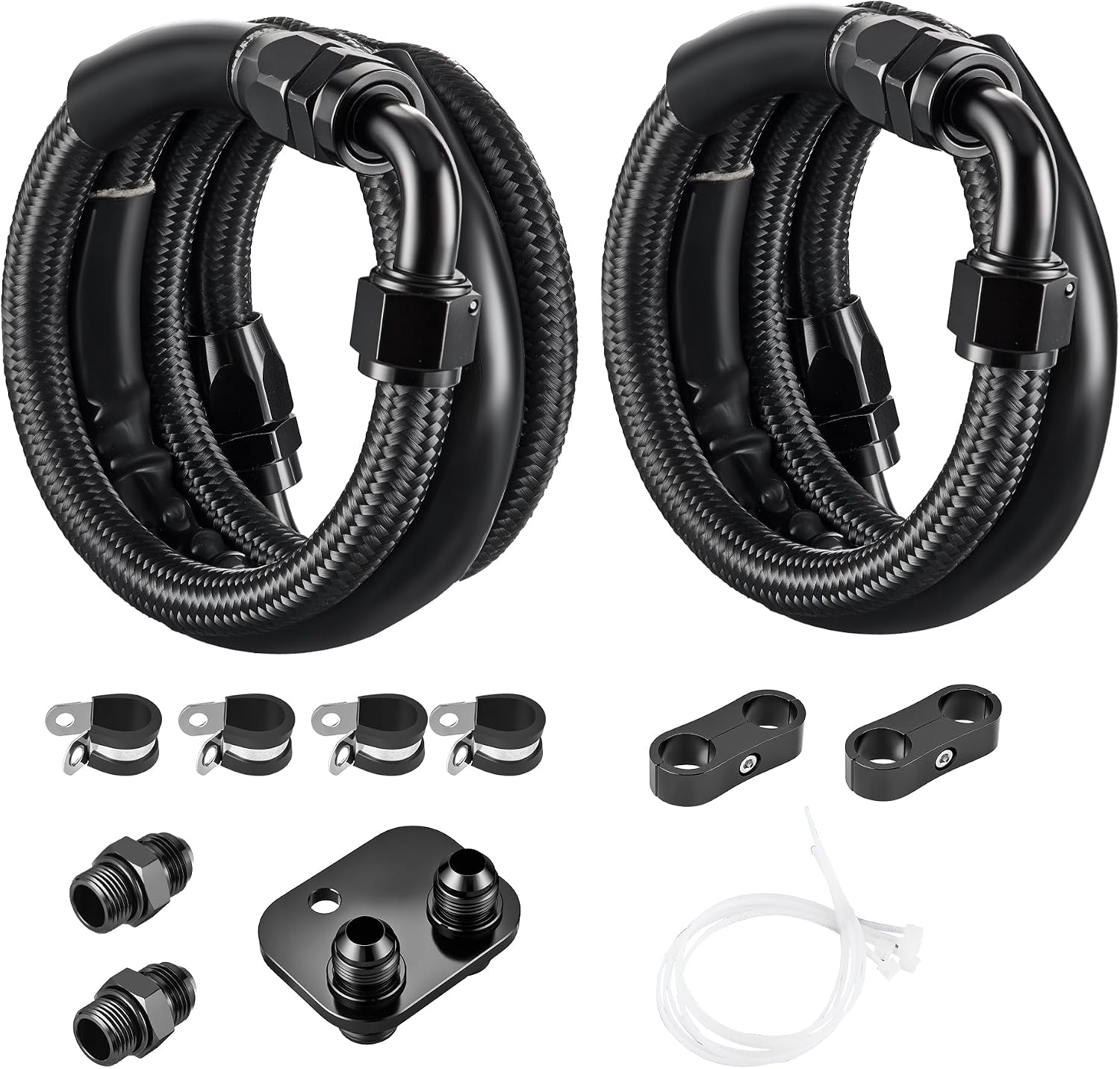
6R140 cooler line kit, 6.7L Powerstroke
Factory-fit replacement cooler lines for the 2011-2019 Super Duty 6R140. Sold by our sister store, CoreTransmissionParts.
Shop 6R140 parts at CoreTransmissionParts →Need parts for this job?
Our 6R140 parts page has the cooler line kit, replacement coolers by year, filter and pan kits, and the valve body and solenoid parts for when the problem turns out to be internal. Checkout is on site.
FAQ
What torque spec does Ford give for the 6R140 cooler tube hold-down plate?
Ford Special Service Message 46198 calls for a new bolt (W715131-S437) with washer (W718565-S437U) installed between the plate and the transmission case, torqued to 25 Nm (18 lb-ft). The bulletin was written for 2017 F-Super Duty trucks with the 6.7L engine built on or before November 3, 2016, but the same tube-and-plate design and torque value apply to the whole 6R140 cooler tube connection at the case.
What tool disconnects the 6R140 transmission cooler line?
At the radiator or auxiliary cooler end, Ford Super Duty trucks use a quick-connect fitting that releases with a dedicated disconnect tool, not pliers or a pick. Lisle's 39960 set lists its 1/2 in. end for Ford Super Duty F250, F350 and F450 trucks. At the transmission case end, the tubes are not a quick-connect; they push into the case bore and are secured by a bolted hold-down plate.
Why did my 6R140 overheat again after I replaced the cooler lines?
A line leak and an internal flow restriction produce the same overheat symptom but need different fixes. A documented ATRA case on a 2011 Ford F450 with a 6R140 found a spun pump sleeve blocking the converter-out cooler passage, a PTO-only failure, plus a leaking hose on the separate secondary cooling system. Sonnax also documents line pressure control bore wear on the 6R140 that reduces cooler and converter flow from inside the valve body. If new lines don't stop the overheat, the cause may be internal, not external.
What fluid goes back in a 6R140 after a cooler line service?
MERCON LV only. Ford Component Sales lists MERCON LV as the specified fluid for the 6R140, with a total system capacity of roughly 4 gallons. Top off through the dipstick tube and set the final level hot, the same way you would after a pan and filter service.
Related guides
- 6R140 Overheating Prevention
- 6R140 Fluid Leak Common Spots
- 6R140 Fluid Type and Capacity
- 6R140 Filter and Pan Service Guide
- Ford 6R140 TorqShift Problems and Service Guide
Sources
- Ford Motor Company, Special Service Message 46198 (hosted by NHTSA). Backs the 2017 F-Super Duty 6.7L build-date window, the poor tube alignment and hold-down plate cause, the new bolt W715131-S437 and washer W718565-S437U, and the 25 Nm (18 lb-ft) torque spec. static.nhtsa.gov (PDF)
- Gears Magazine (ATRA), "Heavy Metal!," December 2017, the 6R140 No Cooler Flow case. Backs the 2011 F450 case details, the cooler flow test reading under a quarter of specification, the spun pump sleeve blocking the converter-out passage on PTO-equipped units, and the separate secondary cooling system hose leak. gearsmagazine.com
- Sonnax, Oversized Line Pressure Control Valve Kit 126740-08K, technical description. Backs the line pressure control bore wear on the 6R140, the balance spool and outboard spool failure modes, and their respective effects on cooler/converter flow and line pressure. sonnax.com
- Lisle Corporation, 39960 Ford Transmission Oil Cooler Line Disconnect Set, product listing. Backs the 1/2 in. tool size for Ford Super Duty F250/F350/F450 versus the 3/8 in. size for other Ford and Cadillac applications. lislecorp.com
- Ford Component Sales, LLC, Ford 6R140 6-Speed Automatic Transmission Technical Specifications. Backs MERCON LV as the specified fluid and the approximately 4-gallon total system capacity. fordcomponentsalesllc.com (PDF)