"My 6R140 is making noise" is not a diagnosis, it's a starting point, and the first fork in the road is whether that noise is a whine or a clunk. Those two words describe two completely different mechanical events. A whine is a continuous tone that comes from something spinning under load and slowly wearing, a bearing, a gear set, or a pump. A clunk is a single, sharp impact noise that happens at a specific transition, a shift, a direction change, a load reversal, and it points at mechanical slack somewhere between the engine and the tire contact patch. Treat them as the same problem and you'll end up pulling a transmission to fix a worn U-joint, or chasing a driveshaft for a noise that's actually coming from the shift cable. This guide sorts both noise types by their real, documented causes on the 6R140 TorqShift 6 platform, including two Ford technical service bulletins most shops never check because they assume "whine" automatically means an internal transmission fault.
Whine vs. clunk: tell them apart in two minutes before you touch anything
Before chasing parts, characterize the noise with the truck sitting still and then on a short road test. With the truck in Park and the engine running, is there a tone present at idle that climbs with RPM? That points at something on the pump or converter side, internal to the transmission. Take it for a short drive with a window down: does the tone track road speed instead, staying steady regardless of engine RPM, and is it present in both drive and coast? That points at the output shaft or wheel-bearing side instead. A clunk gets diagnosed differently: note the exact transition it happens on. A clunk only on the shift from Reverse to Drive, or only on takeoff from a dead stop, or only on throttle-on/throttle-off transitions, is the signature of mechanical slack in the driveline, not a transmission internal failure, and Ford's own diagnostic literature backs that up directly, covered below.
Whine source 1: the converter hub support pump bearing (internal, RPM-tracking)
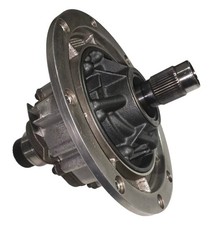
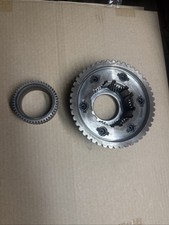
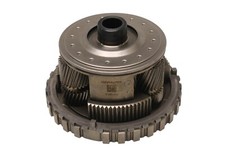
Sonnax documents a known wear point on the 6R140 at the converter hub support pump bearing: the bearing carries an integral seal, and when that seal fails, the unit loses lubrication pressure right at the bearing. As wear progresses, the bearing itself starts producing a high-pitched whine that tracks engine RPM and is present even with the truck sitting still in Park. This is the failure most techs mean when they say "the pump is going out," and it's also the one most often confused with the two Ford TSBs below because all three get reported by the customer as simply "a whine." We cover the full pump-side diagnosis, including the impeller hub wear that often accompanies it and the look-alike failures that mimic it, in our 6R140 pump failure symptoms guide.
Whine source 2: the output shaft bearings (Ford TSB, road-speed-tracking)
Ford's Online Automotive Service Information System bulletin from August 2015 covers a specific, documented whine that is easy to mistake for a pump problem if you don't know to listen for the pattern. The bulletin applies to 2015 F-Super Duty and 2016 Econoline trucks with the TorqShift6 (6R140) built between April 1, 2015 and May 1, 2015, and the described symptom is a "high pitched whine or chirping noise audible at 32 km/h (20 MPH) or below." The critical diagnostic detail is in the next sentence of the bulletin: the noise "follows output shaft speed, can be heard in both drive and coast conditions and does not change pitch during upshifts." That's the opposite pattern from the converter hub pump bearing whine above, which tracks engine RPM, not output shaft speed, and is present at idle in Park. Ford's stated cause is the output shaft bearings, and the fix is to replace both of them, using the labor operations under base code 7A415 from Section 7 of the Service Labor Time Standards manual. If your truck falls outside that specific one-month build window, this bulletin does not apply and the whine has a different cause, but the diagnostic pattern it describes, pitch holding steady through upshifts and tracking output speed rather than engine speed, is a useful test on any 6R140 regardless of build date.
Whine source 3: it isn't even coming from the transmission (Ford TSB 18-2265)
This is the bulletin that sends the most "transmission whine" complaints down the wrong repair path, because the noise is genuinely transmission-related in name only. Ford TSB 18-2265, dated August 29, 2018, covers 2018 F-Super Duty trucks built between January 29, 2018 and July 24, 2018 with a 6R140. The documented symptom is a "howl, flutter and/or whine noise typically in 4th and/or 6th gear" that "appears to be coming from under the dash near the right side of the steering column," and Ford's stated cause is that "noise transferring through the shift cable into the vehicle" is responsible, not a fault inside the transmission case at all. The repair is a shift cable replacement with a damper assembly, part number JC3Z-7E395-C, with labor time published as 1.8 hours if the center console has to come out (operation 182265A) or 1.2 hours if it doesn't (operation 182265B); the two labor operations are not to be combined. This bulletin superseded an earlier version, 18-2155, specifically to add the production fix date once Ford identified when the corrected part started shipping. The diagnostic takeaway: before assuming a 4th/6th gear whine on an affected truck means a transmission teardown, verify the build date falls in that window and confirm the noise is loudest under the dash near the steering column, not down at the transmission tunnel. If both check out, you're replacing a $100-class shift cable, not a $1,000-class pump or valve body.
Clunk source 1: it's probably not the transmission at all
Ford's own driveline diagnosis and testing procedure for its F-Series and Super Duty trucks lists three distinct clunk complaints, and the transmission itself does not appear as a listed cause for any of them. A loud clunk when shifting from Reverse to Drive is attributed to an incorrect axle lubricant level, excessive backlash in the axle, or damaged and worn U-joints. A clunk that occurs as the vehicle starts to move forward following a stop is attributed to a worn driveshaft CV joint or U-joints with excessive play, or a loose axle mount. A clunk during acceleration or the transition from cruise to coast/deceleration is attributed to a damaged or worn CV joint. Ford's prescribed checks follow directly from those causes: check and correct the axle lubricant level and look for excessive backlash, inspect the U-joints for wear or play with the rear wheels chocked and the transmission in Neutral with the engine off (pull and twist the driveshaft to feel for play at each joint), and check for a loose axle mount. None of that work touches the transmission. If a shop pulls a 6R140 pan chasing a Reverse-to-Drive clunk before ruling out axle backlash and U-joint play, they're doing the job in the wrong order.
Clunk-adjacent noise: PTO rattle at idle on PTO-equipped trucks
This one isn't a clunk and typically isn't a fault, but it gets reported as "a knock from the transmission" often enough to cover here. On PTO-equipped Super Duty trucks running the 6R140, a rattle or chatter at idle that quiets down as engine speed increases is a widely reported characteristic rather than damage. A PTO manufacturer's technical white paper explains why: the 6R140 connects the engine to the PTO drive gear through the torque converter's fluid coupling rather than a mechanical clutch, which means the PTO input gear stays loosely loaded while the truck sits still at idle, and that looseness is what lets the gear teeth rattle against their mate. It's still worth a quick check that the PTO mounting bolts are torqued and the gear itself shows no abnormal wear before writing the noise off entirely, but don't chase it as a transmission defect on the strength of the sound alone.
| Noise & pattern | Likely source | Fix | Source |
|---|---|---|---|
| Whine, tracks engine RPM, present at idle in Park | Converter hub support pump bearing (internal) | Replace bearing, seal side toward converter (Sonnax 126202) | Sonnax |
| Whine/chirp at or below 20 mph, tracks output shaft speed, same in drive and coast, steady through upshifts | Output shaft bearings (2015 Super Duty/Econoline build 4/1/15-5/1/15) | Replace both output shaft bearings, labor base 7A415 | Ford TSB (NHTSA-hosted) |
| Howl/flutter/whine in 4th and/or 6th gear, loudest under dash near steering column | Shift cable noise transfer (2018 Super Duty build 1/29/18-7/24/18) | Replace shift cable w/ damper, part JC3Z-7E395-C | Ford TSB 18-2265 (NHTSA-hosted) |
| Clunk on Reverse-to-Drive shift | Axle lube level, axle backlash, or worn U-joints | Check/fill axle lube, inspect U-joints and backlash | Ford driveline diagnosis chart |
| Clunk on takeoff from a stop | Worn CV/U-joints with play, or loose axle mount | Inspect and replace U-joints/driveshaft; check mount | Ford driveline diagnosis chart |
| Rattle/chatter at idle on PTO-equipped trucks, quiets with RPM | PTO gear loosely loaded through fluid-coupling drive | Usually normal; verify PTO mount and gear condition | Muncie Power Products (vendor) |
Diagnostic sequence: how to work through it in order
- Characterize first. Continuous tone or single impact? If it's a tone, does it track engine RPM (even in Park) or road/output speed? If it's an impact, what exact transition triggers it?
- Check build date against both TSBs before opening anything. A whine/chirp at or under 20 mph on a 2015 F-Super Duty or 2016 Econoline built 4/1/15-5/1/15 points at the output shaft bearings per Ford's bulletin. A howl/flutter/whine in 4th or 6th gear on a 2018 F-Super Duty built 1/29/18-7/24/18 points at the shift cable, not the transmission internals.
- Locate the noise physically. Drive slow with a window down. A cable-transfer noise is loudest under the dash near the steering column. An internal pump or output shaft noise is loudest at the transmission tunnel or underneath the truck.
- For a whine that doesn't match either TSB, move to a line pressure check and pump-side inspection; see the dedicated pump failure symptoms guide for that procedure.
- For any clunk, start outside the transmission. Chock the rear wheels, put the transmission in Neutral with the engine off, and pull/twist the driveshaft at each U-joint to feel for play. Check the axle fluid level and look for excessive ring-and-pinion backlash before assuming the transmission is involved.
- If the truck has a PTO and the only complaint is an idle rattle that fades with RPM, verify the PTO mount and gear condition, but don't treat the sound alone as proof of a failure.
Fluid note
None of the noise sources above are caused by using the wrong fluid, but a low or aerated fill can produce a whine of its own from pump cavitation, so rule it out early. The 6R140 runs Motorcraft MERCON LV only; do not use MERCON ULV, which Ford reserves for the 10R140. See our 6R140 fluid type and capacity guide for exact fill quantities and the hot-fill procedure.
Need parts for this job?
Our 6R140 parts page carries pumps, planetaries, sprag clutches, valve bodies, and master rebuild kits for the Super Duty TorqShift 6. Checkout is on site.
6R140 rebuild kits
If a worn pump bearing or planetary has been running long enough to carry metal into the clutch packs, a full rebuild kit covers the rest of the repair in one order. Sold by our sister store, CoreTransmissionParts.
Shop the part for this fix →FAQ
What is the difference between a transmission whine and a clunk on a Ford 6R140?
A whine is a continuous tone that tracks either engine RPM or output/road speed, and it comes from something spinning under load and wearing, such as the converter hub support pump bearing or an output shaft bearing. A clunk is a single, sharp impact noise tied to a specific transition, like shifting from Reverse to Drive or taking off from a stop, and it points to mechanical slack somewhere in the driveline, such as a worn U-joint or excessive axle backlash, rather than a spinning part wearing down.
My 2018 F-250 or F-350 has a whine or flutter under the dash in 4th and 6th gear. Is that the transmission?
Not necessarily. Ford TSB 18-2265 covers 2018 F-Super Duty trucks built between January 29, 2018 and July 24, 2018 with this exact complaint, and the cause is noise transferring through the shift cable into the cabin, not a transmission fault. The fix is a shift cable replacement with a damper assembly (part JC3Z-7E395-C), not a transmission repair. Confirm the build date and that the noise is loudest under the dash near the steering column before assuming the transmission is at fault.
Is a clunk when shifting from Reverse to Drive always a transmission problem on the 6R140?
No. Ford's own driveline diagnosis chart for its Super Duty and F-Series trucks lists a loud clunk on the Reverse-to-Drive shift as a symptom of incorrect axle lubricant level, excessive backlash in the axle, or damaged and worn U-joints, none of which are inside the transmission. The transmission itself is rarely the source of this specific complaint; the rear axle and driveshaft should be checked first.
What causes a 6R140 to whine at low speed but not change pitch during upshifts?
Ford documented this exact pattern in a 2015 bulletin covering certain 2015 F-Super Duty and 2016 Econoline trucks with the TorqShift6: a high-pitched whine or chirping noise at or below 20 mph that follows output shaft speed, is present in both drive and coast, and does not change pitch during upshifts. Ford attributed it to the output shaft bearings and the fix was replacing both of them. A noise that changes pitch with engine RPM instead, and is present even sitting still in Park, points at the pump side rather than the output shaft.
Is PTO rattle at idle on a 6R140 truck something I need to fix?
On PTO-equipped Super Duty trucks with the 6R140, a rattle or chatter at idle that quiets as engine speed increases is a widely reported characteristic of this platform rather than a sign of damage. A PTO manufacturer's white paper explains the mechanism: because the 6R140 connects the engine to the PTO gear through the torque converter's fluid coupling rather than a mechanical clutch, the PTO input gear stays loosely loaded while the truck sits still, which lets it rattle against its mate. It is still worth confirming the PTO mount is tight and the gear itself is not actually worn before writing the noise off.
Related guides
- 6R140 Pump Failure Symptoms and Replacement
- 6R140 3-4 Clutch Failure
- 6R140 TCC Lockup Explained and Diagnosis
- 6R140 Valve Body Wear and Fix
- 6R140 Fluid Type and Capacity
Sources
- Ford Motor Company, Technical Service Bulletin 18-2265, "6R140 - Howl, Flutter And/Or Whine Noise Typically In 4th And/Or 6th Gear" (August 29, 2018), hosted by NHTSA. Backs the 2018 F-Super Duty build window (1/29/18-7/24/18), the shift-cable-transfer cause, the replacement part number JC3Z-7E395-C, and the two labor operations. static.nhtsa.gov
- Ford Motor Company, Online Automotive Service Information System bulletin #45259, "2015 F-Super Duty/2016 Econoline TorqShift6 - High Pitch Whine Or Chirping Noise At Or Below 32 Km/h (20 MPH), Built On 4/1/2015 And Through 5/1/2015" (August 2015), hosted by NHTSA. Backs the build window, the output-shaft-speed noise pattern, and the output shaft bearing replacement fix under base labor code 7A415. static.nhtsa.gov
- Ford Motor Company, F-Series Workshop Manual, Section 205-00, "Driveline - Diagnosis and Testing." Backs the three driveline clunk symptom-to-cause entries (Reverse-to-Drive clunk, takeoff clunk, acceleration/deceleration clunk) and the prescribed U-joint, axle lubricant, and backlash checks. blueovaltrucks.com
- Sonnax, "There's a New Hub In Town" (tech resource, 6R140 impeller hub and converter hub support pump bearing). Backs the pump bearing whine mechanism, the integral seal failure, and replacement part 126202. sonnax.com
- Ford Component Sales, 6R140 6-Speed Automatic Transmission fluid and specifications sheet. Backs the MERCON LV fluid specification referenced in the fluid note. fordcomponentsalesllc.com
- Muncie Power Products, White Paper WP18-02, FR6Q power take-off (mentioned for the PTO gear-rattle mechanism on fluid-coupling-driven PTOs; a PTO manufacturer's technical document, not an independent authority, cited for this one real-world mechanical detail only). munciepower.com