An F-150 with a 6R80 that "shifts weird" can mean six different things, and they do not share a fix. A harsh 1-2 on a cold 2010 is a different animal from a 2016 that drops from 6th to 2nd on the interstate, and both are different from a 2012 that pulls away from a light in 5th with the speedometer reading zero. This guide sorts F-150 6R80 shift complaints by what the driver actually feels, then walks each one to the bulletin, recall or hardware fault behind it. If you want the year-by-year recall map instead, our 6R80 F-150 common problems guide has it.
Before any of this, pull three things: model year, build date off the door tag, and whether the recall calibrations are already in the PCM. Half the shift complaints on these trucks are software or a signal fault on the molded lead frame, and the other half are worn solenoids and valve body bores. The scan tool tells you which half you are in faster than the pan does.

First, sort the complaint
| What the driver feels | Most likely cause on an F-150 | Where to start |
|---|---|---|
| Sudden downshift at speed, rear tires chirp or slide | Speed or range signal dropout on the lead frame | Recall status, then graph OSS and range PIDs |
| Takes off in 5th, speedometer at zero, odometer dashes | Lead frame (2011-2013 built on or before 4/8/2013) | TSB 13-6-8 |
| Harsh 1-2 upshift or 2-1 coast clunk | Calibration, solenoid banding drift, or a pre-2011 design | Software level, then solenoid strategy and adapts |
| Flare or bind-up on 2-3, 3-4, 4-5 | Solenoid output drift or worn clutch regulator bores | Pressure and solenoid testing |
| No Reverse or Neutral going from Manual 1/2 into R while rolling | PCM strategy, 2015-2017 | TSB 20-2060 |
| Firm shifts for days right after a reflash or repair | Adaptive tables reset and relearning | Adaptive Learning Drive Cycle |
Sudden downshifts: the lead frame signal faults
This is the complaint that put F-150 6R80s in front of NHTSA three separate times, and it is the one to rule out first because it is a safety issue and often a no-charge repair.
2011-2014: output shaft speed
The original campaign, NHTSA 16V-248 (Ford 16S19), covered 2011-2012 F-150s built 19 August 2011 through 9 March 2012, along with some 2012 Expeditions, Navigators and Mustangs. Ford's Part 573 report describes an intermittent loss of the output shaft speed (OSS) signal to the PCM that can cause "a temporary, unintended downshift into first gear." Sometimes the signal comes back on its own. Sometimes the truck has to be shut off and restarted.
Ford's chronology for the 2019 expansion (recall 19S07, NHTSA 19V-075) gives the root cause on the original population: an equipment maintenance problem at the lead frame supplier caused solder joint fatigue cracks in the OSS sensor circuit on lead frames produced between 4 August and 1 December 2011. The same document explains something every 6R80 diagnostician should know. By design, a complete loss of the OSS signal sets a code and puts the transmission in 3rd or 5th, depending on what gear it was in. It is the intermittent dropout, where the PCM briefly believes the output shaft stopped, that commands the drop to 1st. That is why these trucks can have a violent downshift with no limp mode and sometimes no stored code.
19V-075 widened the population to 2011-2013 F-150s, and a later campaign covered 2014 trucks. The remedies were PCM calibrations. The software stops the truck from acting on a bad OSS reading. It does not repair a cracked lead frame.
2015-2017: transmission range sensor
The aluminum-body trucks fail the same part in a different way. NHTSA campaign 26V-237 (Ford 26S28), filed 14 April 2026, covers 1,392,935 2015-2017 F-150s built 12 March 2014 through 18 August 2017. Per the Part 573 report, thermal cycling and vibration degrade the electrical connections in the transmission lead frame, and the PCM momentarily sees an incorrect transmission range sensor (TRS) position. Ford states the worst case is an unintended 6-2 downshift. Some trucks show a MIL or wrench light first.
The remedy is a new PCM calibration that gives the control system more time to recognize a failing TRS before it commands the downshift. If the truck stored certain related DTCs before the software went in, the dealer replaces the lead frame under the matching extended warranty program. Record codes before anyone reflashes the truck.
How to prove it on the scan tool
- Put Output Shaft Speed, Turbine Shaft Speed, Transmission Range position, Commanded Gear and an ABS wheel speed on one graph.
- Road test at a steady 40-60 mph. OSS should track wheel speed in a smooth line. A spike to zero while the wheel speeds stay flat is the dropout.
- On a 2015-2017, watch the range PID. Any flicker out of D while the selector has not moved is the TRS fault the recall describes.
- Wiggle the case connector and harness at the bell housing while you watch. If the graph only breaks when you move the harness, fix the harness. If it breaks with the harness still, the fault is inside on the lead frame.
Takes off in 5th gear
Ford TSB 13-6-8 covers 2011-2013 F-150s (and 2011-2014 Mustangs, 2012-2013 Expeditions and Navigators) built on or before 8 April 2013 that engage 5th gear when starting from a stop. The tell is specific: wrench light and/or seat belt minder on, speedometer at zero and dashes in the odometer while driving. The bulletin notes the symptoms may clear after a key cycle and that P0720 and P0722 may or may not be stored.
That combination is the OSS failsafe from the section above. With no output speed, the PCM has no road speed to shift on, so it holds a high gear. The fix in the bulletin is the molded lead frame on the main control, Ford part AL3Z-7G276-A, and the bulletin says in capital letters that shift solenoid replacement is not required. Ford allowed 2.1 hours on the F-150. Do not sell a solenoid kit or valve body for this complaint.
Harsh 1-2 and 2-1 shifts
This is the complaint with the most history. GEARS Magazine's write-up on 6R80 updates explains that early units had harsh 1-2 and 2-1 complaints that Ford first attacked with PCM calibration updates. The hardware fix came for 2011: a one-way clutch in the rear planetary to cushion the 1-2 and soften the 2-1 coastdown. With it, the D clutch applies only until about 3 mph and then releases, and the D/E solenoid (normally high, about 50 mA to apply the D clutch and about 850 mA to release it) is energized at about 3 mph instead of at 2nd gear.
What that means at the counter:
- 2009-2010 F-150 with a harsh 1-2 or 2-1. It does not have the one-way clutch. Get the PCM to the latest calibration first. Some of this is the design and will never feel like a 2011.
- 2011 and later with a harsh 1-2. Look at the solenoid side. Sonnax's tech article on timing-related 6R80 and 6R140 shift issues says a solenoid with slow or overly aggressive output "could easily cause a 1-2 slide or an extremely harsh 1-2 upshift," and that the same solenoid also changes the release rate of the clutch it controls.
- Early and late parts do not cross. GEARS lists the case, C and D support, rear planetary, valve body, lead frame and harness as changed for 2011. A 2011-up valve body will not fix a 2010 truck.
Flares and bind-up on the upshifts
A 2-3 flare, a 4-5 flare, or a bind-up that chirps the tires on a shift is a timing problem between the off-going and on-coming clutch. Sonnax's article lists the usual suspects in order: solenoid calibration or banding loss, slow or aggressive solenoid output, adaptation problems, clutch clearance problems, a worn valve train leaking the clutch control circuit, and solenoid mechanical or flow problems.
The banding point is the one most shops miss. The 6R80 uses variable bleed solenoids that are classified as normally high or normally low and banded 1 through 5. The PCM has to know each solenoid's band and which clutch it controls, which is why replacement valve bodies and solenoid bodies come with a strategy code that must be programmed in. Sonnax reports that solenoids can drift over time, a band 3 reading like a band 5 or a band 1.5, and when that happens the PCM's overlap and adaptive math is wrong from the first shift. Sonnax is blunt about remanufactured valve bodies: install one without updating the PCM to the new solenoid strategy code and you get erratic operation and damage.
On the bench, that turns into a simple order of work:
- Confirm fluid level and condition first. Every 6R80 F-150 takes MERCON LV, set hot through the fill plug. Low fluid makes every flare worse. Our 6R80 fluid guide has the level check.
- Verify the PCM has the correct solenoid strategy code for the valve body that is actually in the truck. A swapped or used valve body with the old code is a common cause.
- Reset adapts and do a full relearn. Sonnax says relearn can sometimes be done in three to five shift cycles when the solenoids are healthy. If the shift will not settle after a proper drive cycle, the solenoids or the bores are the problem.
- Test solenoids on a manifold or flow bench, and check clutch regulator bores for wear before you condemn the clutches.
For more on reading individual solenoid faults, see our 6R80 shift solenoid symptoms guide.
No Reverse from Manual 1 or 2 while rolling
Ford TSB 20-2060 covers a narrow complaint on 2015-2017 F-150s: an intermittent loss of reverse engagement, or a neutral state, when shifting from MANUAL 1 or MANUAL 2 into REVERSE at low speed while the truck is still rolling, with no DTCs. Ford puts it on PCM strategy, and the fix is a reprogram plus the Adaptive Learning Drive Cycle in Workshop Manual section 307-01, 0.9 hours. If the complaint matches that exactly and Reverse is fine from Park, check the software before you pull anything apart.
Firm shifts right after a repair or reflash
Every recall calibration and every valve body job resets the adaptive tables. TSB 20-2060 tells dealers to warn the customer that relearning "may result in firmer than normal upshifts and downshifts for several days." That is normal. Tell the owner before the truck leaves, and do the Ford drive cycle instead of handing back a truck that has never been through its shifts. If it is still harsh after a week of mixed driving, go back to the solenoid and strategy code checks above.
When the hardware really is worn
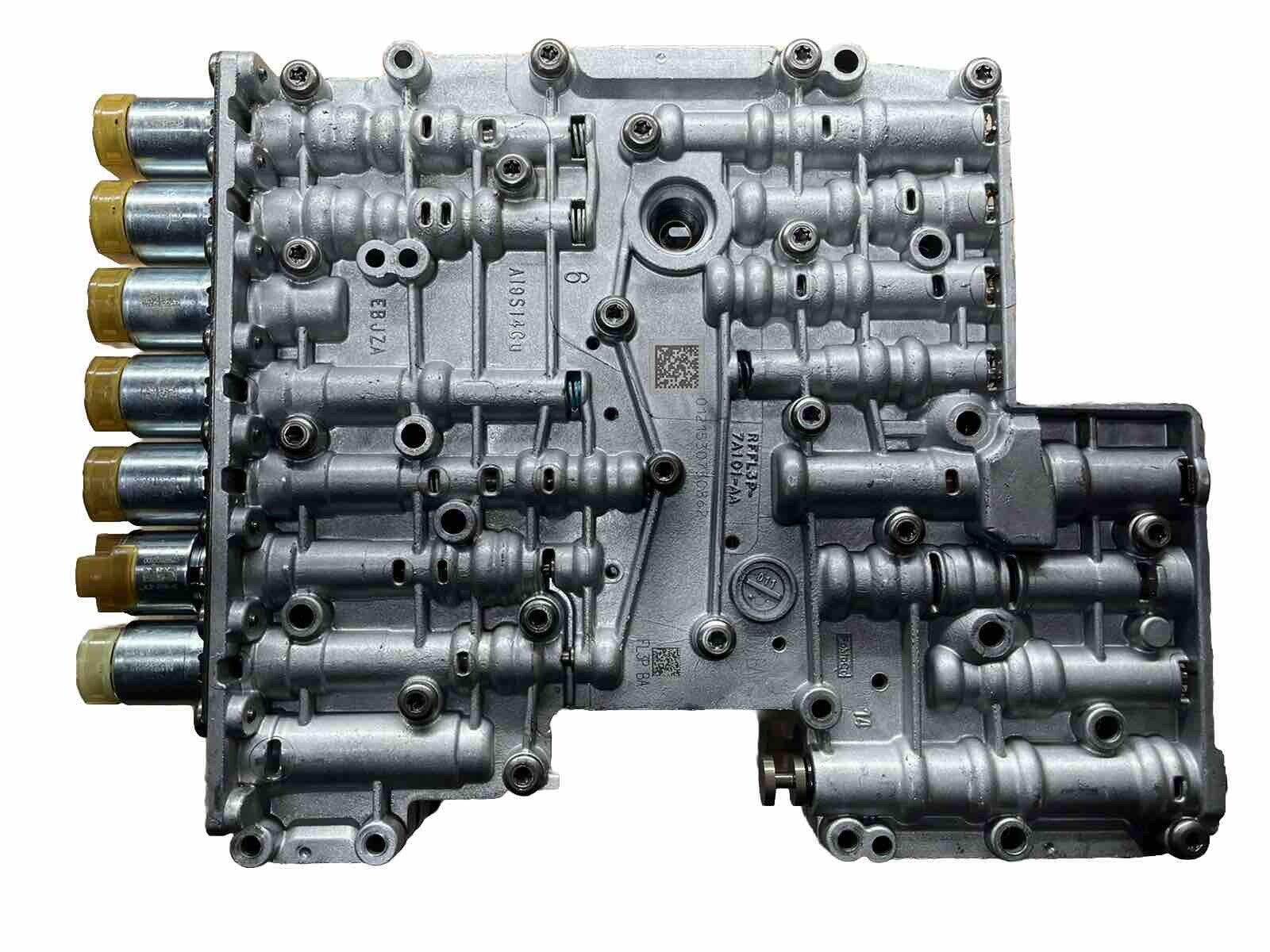
High-mileage towing trucks that pass the signal and software checks usually have valve body wear. Worn bores in the solenoid feed regulator and clutch regulator circuits cause soft, long shifts and flares that get worse hot. A valve body with new solenoids and the correct strategy code fixes most of those. When the frictions are already burned, a valve body alone will not save it, and the job becomes a rebuild. Our 6R80 valve body testing guide covers how to tell which you have.
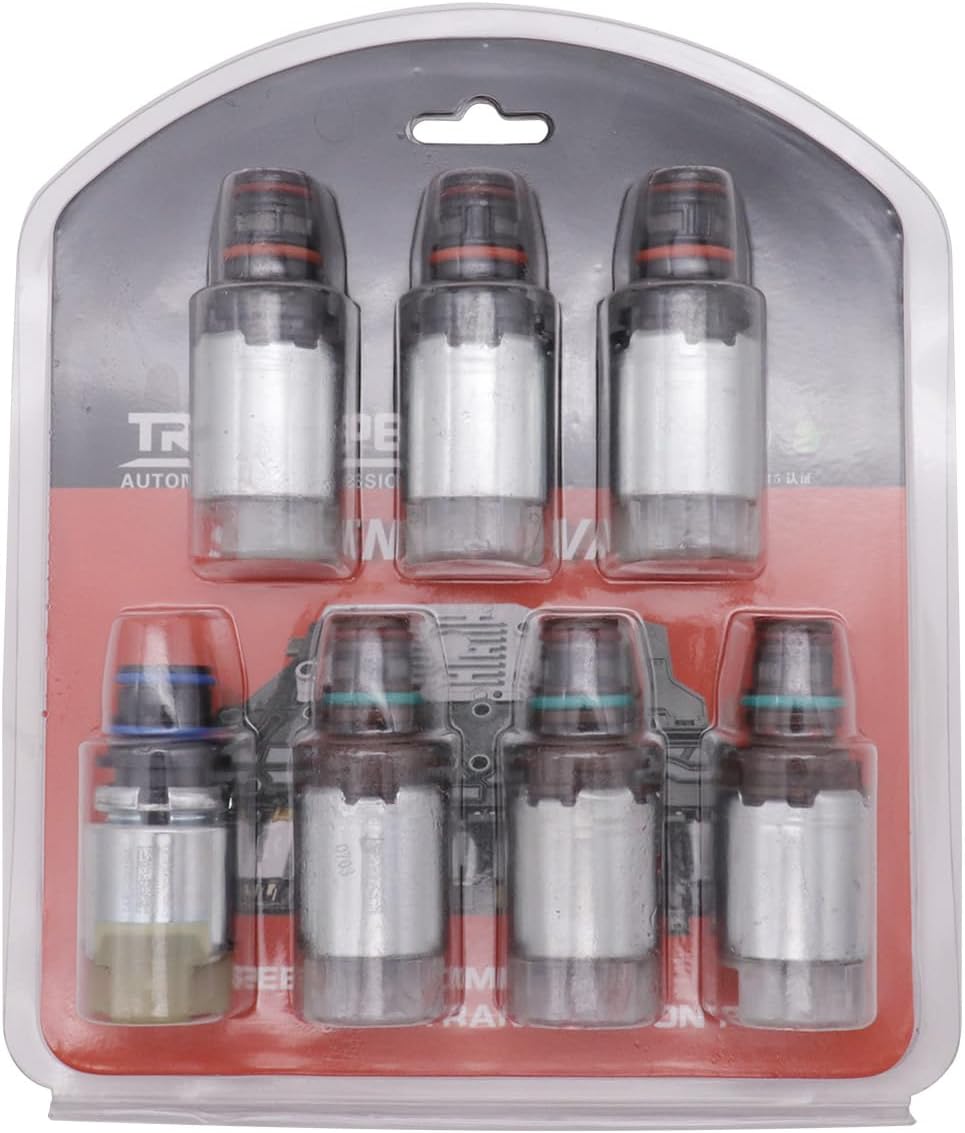
6R80 7-piece solenoid kit, 2007-2014
For 2011-2014 F-150 flares, harsh 1-2 shifts and adapts that will not settle once the signals graph clean. Program the strategy code that comes with the solenoids. Sold by our sister store, CoreTransmissionParts.
Shop the part for this fix →Need a different solenoid? The solenoids collection has the rest of the 6R80 line.
Need parts for this job?
F-150 6R80 lead frame kits, solenoid kits, remanufactured valve bodies by year, rebuild kits and MERCON LV are on our 6R80 parts page, with checkout on site.
FAQ
Why does my F-150 6R80 shift hard from 1st to 2nd?
On 2009-2010 trucks it is partly the design, since the one-way clutch that softens the 1-2 and 2-1 was not added until 2011, so start with the latest PCM calibration. On 2011 and later trucks, a solenoid that has drifted out of its band or a PCM missing the right solenoid strategy code is the usual cause. Reset adapts and do a full relearn before you replace parts.
Why does my F-150 take off in 5th gear?
On 2011-2013 F-150s built on or before 8 April 2013, Ford TSB 13-6-8 traces it to the molded lead frame losing the output speed signal. The speedometer reads zero and the odometer shows dashes while it happens. The fix is lead frame AL3Z-7G276-A, and Ford says the shift solenoids do not need to be replaced.
Why does my F-150 suddenly downshift on the highway?
On 2011-2014 trucks an intermittent output shaft speed signal from the lead frame can command a drop to 1st, covered by recalls 16V-248 and 19V-075. On 2015-2017 trucks a false range sensor signal from the same lead frame can cause up to a 6-2 downshift, covered by recall 26V-237. Check the VIN for open recalls first.
Is it normal for a 6R80 to shift firm after a reflash?
Yes. Ford's TSB 20-2060 warns that after the adaptive tables reset, the transmission may shift firmer than normal for several days while it relearns. Running Ford's Adaptive Learning Drive Cycle shortens that. If it stays harsh after a week of mixed driving, check the solenoids and the strategy code.
Related guides
- 6R80 F150 Common Problems and Fixes
- 6R80 Harsh Shift Causes
- 6R80 Shift Solenoid Symptoms
- 6R80 Valve Body Problems and Testing
- 6R80 P0720: Output Speed Sensor Circuit Fix
Sources
- Ford Motor Company / NHTSA — Part 573 Safety Recall Report 26V-237 (Ford 26S28), submitted 14 April 2026. Backs the 1,392,935 2015-2017 F-150 population, the 12-Mar-2014 to 18-Aug-2017 build range, the lead frame degradation and false TRS signal cause, the 6-2 worst case, the MIL/wrench light warning, the calibration remedy and the conditional lead frame replacement. static.nhtsa.gov (PDF)
- Ford Motor Company / NHTSA — Part 573 Safety Recall Report 16V-248 (Ford 16S19), April 2016, and the 19V-075 (Ford 19S07) chronology, February 2019. Back the 2011-2012 F-150 build range, the intermittent OSS signal and first-gear downshift, the solder joint fatigue crack on lead frames made 4-Aug to 1-Dec-2011, and the 3rd/5th gear failsafe on complete OSS loss. 16V-248 (PDF) · 19V-075 chronology (PDF)
- Ford Motor Company — Technical Service Bulletin 13-6-8, "6R80 Transmission High Gear Engagement From A Stop," June 2013, hosted by NHTSA. Backs the 5th-gear start symptoms, the 8-Apr-2013 build cutoff, P0720/P0722, lead frame AL3Z-7G276-A, the no-solenoids note and the 2.1-hour F-150 labor. static.nhtsa.gov (PDF)
- Ford Motor Company — Technical Service Bulletin 20-2060, March 2020, hosted by NHTSA. Backs the 2015-2017 F-150 Manual 1/2 to Reverse condition, the PCM reprogram and Adaptive Learning Drive Cycle (WSM 307-01), the 0.9-hour allowance and the firmer-shifts-for-several-days relearn note. static.nhtsa.gov (PDF)
- Sonnax — "Troubleshooting Ford 6R80 & 6R140 Timing-Related Shift Issues," November 2019. Backs the variable bleed solenoid NH/NL banding 1-5, banding drift, the solenoid strategy code requirement, the 1-2 slide/harsh 1-2 and flare/bind-up causes, and relearn in three to five shift cycles. sonnax.com
- GEARS Magazine (ATRA) — "Updates to the Ford 6R80." Backs the early harsh 1-2/2-1 complaints, the 2011 one-way clutch fix, the D clutch releasing at about 3 mph, the D/E solenoid current values and the parts that changed for 2011. gearsmagazine.com