When a 6R80 starts shifting badly, "bad shift solenoid" is the first guess, and it is often only half right. This transmission has seven solenoids on one solenoid body, each one runs a specific clutch or pressure circuit, and most of them are variable force units whose output the PCM trims based on a calibration number printed on the solenoid. A solenoid can ohm out perfectly and still be the problem. A brand-new one can cause the problem if it carries the wrong band number. And a stripped planet can set a solenoid code on a truck whose solenoids are fine.
This guide works from what each solenoid does to what the truck does when it fails, then to how to prove it and how to replace it without creating a new complaint. Every Ford and trade source is listed at the bottom.
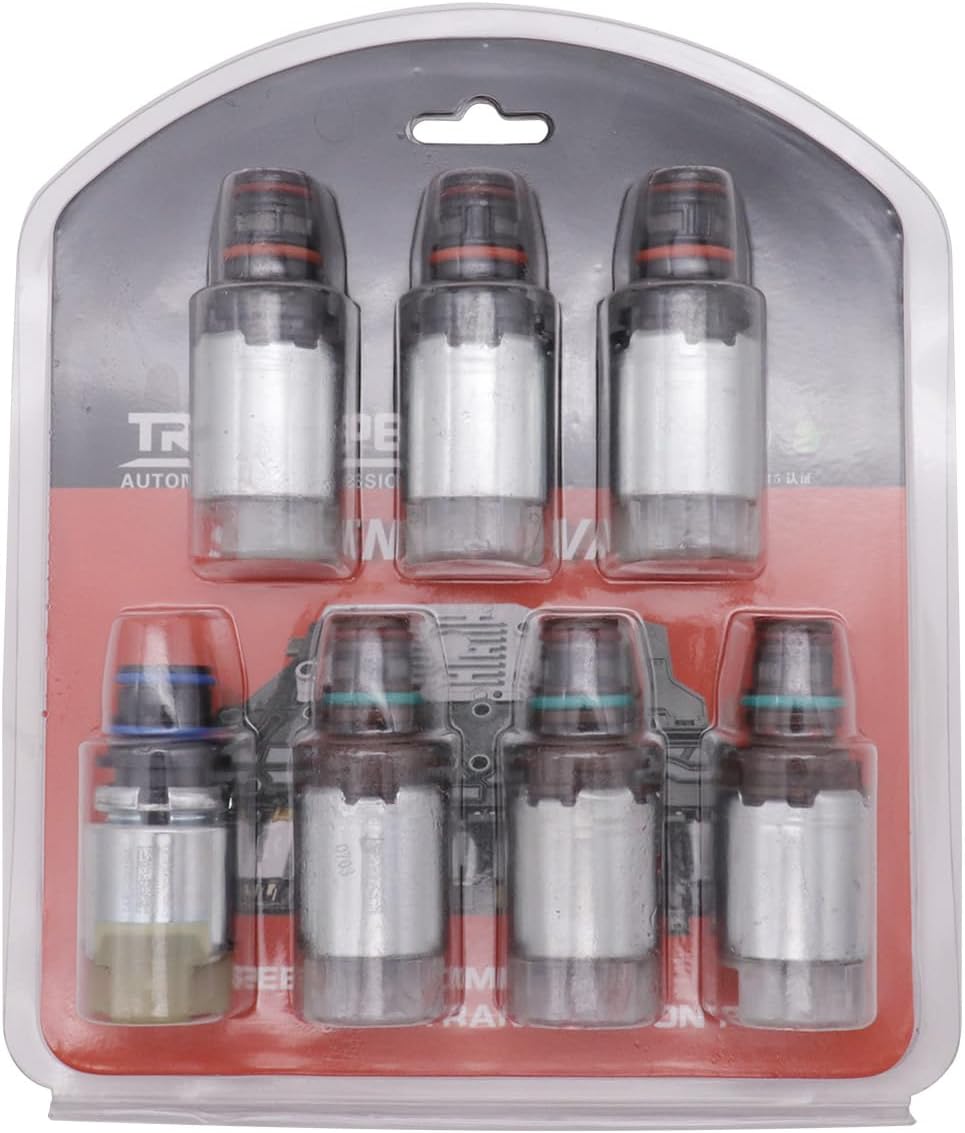
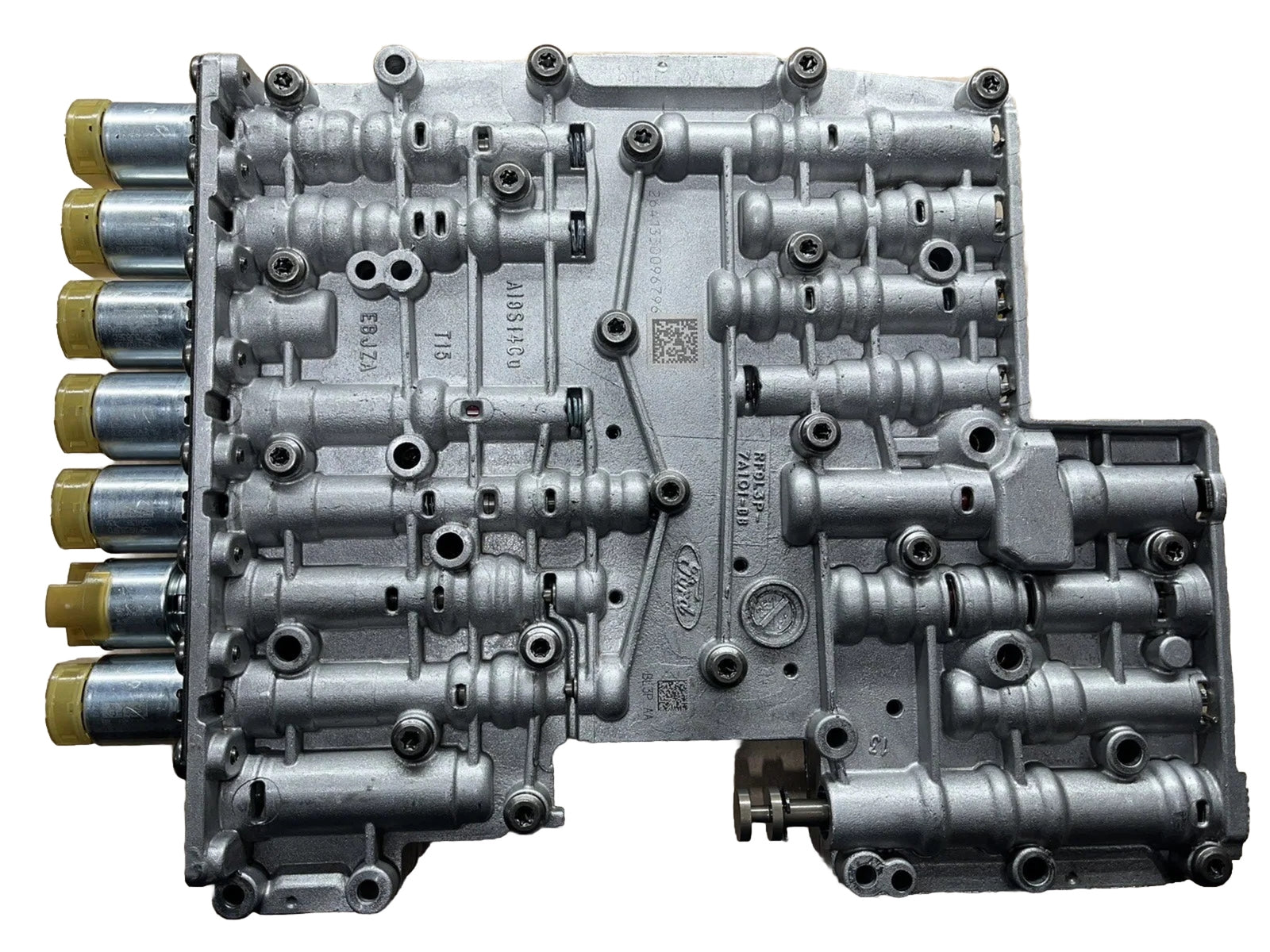
The seven solenoids and what each one controls
The 6R80 is Ford's build of the ZF 6HP26. GEARS Magazine's Lance Wiggins describes it as a valve body with a hard-wired harness and seven solenoids, with the turbine speed, output speed, range and fluid temperature sensors all mounted on the same assembly. Five clutches do all the work, and the letters follow ZF: A is the 1-2-3-4 clutch, B the 3-5-R (direct) clutch, C the 2-6 clutch, D the low/reverse clutch and E the 4-5-6 (overdrive) clutch.
Two things decide how a solenoid fails: which clutch it feeds, and whether it is normally low (off = no pressure) or normally high (off = full pressure). GEARS identifies them by snout color. The brown-snout solenoids are normally vented (VFS 1, 3 and 6, with green and red O-rings). The black-snout solenoids are normally applied (VFS 2, 4 and 5, with orange and red O-rings). The single on/off solenoid, SSE, carries blue O-rings.
| Solenoid | Type | What it runs | Typical symptom when it fails |
|---|---|---|---|
| SSA (VFS 1) | Variable force, normally low, brown | A clutch (1-2-3-4) | Slip or flare in 1st through 4th, soft engagement into Drive |
| SSB (VFS 2) | Variable force, normally high, black | B clutch (3-5-R) | Flare or neutral on the 2-3 and 4-5, soft or missing Reverse; bind-up if pressure stays high |
| SSC (VFS 3) | Variable force, normally low, brown | C clutch (2-6) | Bad 1-2 and 5-6, flare or tie-up on the 2-3 as C releases |
| SSD (VFS 4) | Variable force, normally high, black | Feeds the solenoid multiplex valve: D clutch (low/reverse), or E clutch when SSE is on | Harsh or late Reverse and garage shifts, 4-5-6 complaints |
| LPC (VFS 5) | Variable force, normally high, black | Main regulator (line pressure) | Every shift harsh, or every shift soft and slipping |
| TCC (VFS 6) | Variable force, normally low, brown | Converter clutch | Lockup shudder, TCC slip codes, rpm cycling at cruise |
| SSE | On/off, blue O-rings | Switches the multiplex valve so SSD pressure goes to the E clutch | No 4th, 5th or 6th, often with P0771 |
Two sources back the clutch mapping. Sonnax's installation sheet for its normally-high replacement solenoid labels B as Direct (3-5-R, normally high), A as Forward (1-2-3-4, normally low) and C as Intermediate (2-6, normally low). Sonnax technical specialist Jim Dial uses the same letters in his 6R80 2-3 shift article. The SSD and SSE detail comes from GEARS: in Park and Neutral the PCM gives SSD low current, so it sends high regulated pressure to the solenoid multiplex valve and on to the D clutch regulator and latch valves. In 5th, that same SSD pressure is routed to the E clutch regulator and latch valves. Low current producing high pressure is the normally-high behavior.
Why a failed solenoid does not always look like one
Normally-high solenoids flip the usual logic. When a coil opens or a driver quits, a normally-high solenoid defaults to full pressure. Its clutch applies instead of slipping. So on a truck that has lost 3rd, 5th and Reverse, a dead SSB is the least likely explanation, because a dead SSB would lock the B clutch on. Our 6R80 P0776 guide goes through that case bore by bore.
That default is also what Ford's failsafe uses. Per GEARS, when the PCM loses control it drops to failsafe: 5th gear in D if the failure happened in 5th or 6th, and 3rd for everything else. In 3rd gear failsafe all solenoids are off. SSB sends high pressure to apply the B clutch, the A clutch is applied hydraulically, and the pressure control solenoid gives maximum line pressure. A truck that takes off in 3rd with firm shifts into it and never leaves is usually in failsafe, and that points at power, grounds, the harness or the PCM before any single solenoid.
Also know that the codes lag. GEARS notes that shift error codes set only after the failure happens four consecutive times, and continuous TCC codes after five. An intermittent solenoid can make the truck shift badly for weeks before it stores anything.
Symptoms that point at the solenoids
- One shift is wrong, the others are fine. Match the bad shift to the clutches that change on it. The 2-3 is B applying while C releases, so SSB and SSC are both suspects. The 3-4 is B releasing while E applies, so that involves SSB, SSE and SSD.
- Flare followed by a bang, or a shift that is soft one day and harsh the next. This is the classic sign of a variable force solenoid that has drifted away from its band. The PCM is trimming current for a solenoid that no longer delivers what its number says.
- No 4th, 5th or 6th. The E clutch is not applying. That is SSE, SSD pressure through the multiplex valve, the E clutch itself, or something mechanical behind it.
- Harsh or slow Reverse and harsh garage shifts. Reverse is B plus D, so look at SSB and SSD.
- Everything firm, or everything soft. This points at line pressure: the LPC solenoid, the main regulator bore, or the solenoid pressure regulator valve that feeds all of the solenoids.
- Harsh shifts right after a valve body or solenoid body swap. Usually this is not a failed part. It is a solenoid body strategy that was never programmed. More on that below.
Common codes to expect include the solenoid circuit codes (P0750 for SSA through P0770 for SSE), the "performance or stuck off" codes (P0751, P0756, P0761, P0766 and P0771), and pressure control solenoid codes such as P0776. Circuit codes point at wiring or a coil. Performance codes mean the PCM commanded a solenoid and the ratio or turbine speed did not respond, and that can be hydraulic or mechanical as easily as electrical.
How to prove it before you buy parts
1. Check the strategy and the lead frame first
Read the solenoid body strategy on the scan tool and compare it with the tag on the case. GEARS says it plainly: if the 13-digit strategy etched on the main control does not match what the scan tool shows, the unit may shift harshly until you update it. Then rule out the lead frame. On 2011-2014 trucks, a molded lead frame with output speed sensor dropouts produces hard downshifts and 5th-gear starts that feel like a solenoid problem. Ford TSB 13-6-8 fixes that with lead frame AL3Z-7G276-A and states that the shift solenoids do not need to be replaced for that repair. Our 6R80 P0720 guide covers that test.
2. Read the pan
A pan full of friction material means a clutch is slipping, and a new solenoid will not bring it back. A clean pan points toward the solenoid body and valve body. In the GEARS P0771 case below, the clean pan is what sent the tech to the solenoids.
3. Graph commanded current against solenoid pressure
This is the test that separates an electrical fault from a hydraulic or mechanical one. Record the bad shift with each involved solenoid's amperage and pressure PIDs. Sonnax published real numbers from a 6R80 2-3 upshift. At the start of the shift the C solenoid was at 1.0 A with low pressure, while the normally-high B solenoid had dropped to 0.564 A and was building 14.6 psi. With the shift complete in 3rd, B sat at 0.073 A and close to 50 psi. For a normally-high solenoid, lower current should mean higher pressure. Make sure the scan tool is reading psi and not kPa.
- If the current sweeps correctly but pressure does not follow, the solenoid is sticking mechanically, or its feed or its bore is leaking.
- If the current itself is erratic or pinned, check the connector, the case pins, the internal harness and the PCM driver before you replace any solenoid.
4. Resistance: useful for SSE, less so for the rest
SSE is the one solenoid where an ohmmeter settles a question. Transmission Digest documents that units built before November 4, 2010 use a 10.5 ohm SSE with a tan snout (6L2Z-7G484-AA), and units built after November 3, 2010 use an 18 ohm SSE with a gray snout (AL3Z-7G484-B). The PCM driver is matched to that resistance, so the two are not interchangeable. Both use blue O-rings, so snout color and the resistance reading are how you tell them apart. For the variable force solenoids, resistance only tells you whether the coil is open or shorted. Sonnax's Eric Streed points out that an OE solenoid of about 5 ohms and an aftermarket solenoid of about 6 ohms can both work correctly, because the module controls current, not duty cycle. A good resistance reading does not prove a VFS is healthy.
5. Air check before you blame the solenoid for a missing gear
GEARS published two 6R80 trucks with the same P0771 (shift solenoid E performance, stuck off) and the same complaint, no 4th, 5th or 6th. On a 2014 F-150, the tech confirmed the PCM was switching SSE at about 850 mA on and 50 mA off. The pan was clean, the E clutch air-checked fine and the E clutch valves moved freely, so the tech replaced the valve body with its solenoids and the truck was fixed. A 2015 Transit passed the same checks, but the problem was stripped splines on the rear planet where the 4-5-6 hub engages. They found it by applying air to the A and E clutches together while turning the output shaft by hand, which produced grinding. Run that test before you condemn solenoid E.
Replacing a solenoid without creating a new problem
The 6R80 variable force solenoids are banded. Sonnax's Eric Streed explains that each one is swept on a test bench, its output pressure recorded, and it is assigned band 1 through 5. The bands are about 20 mA wide, and the five together cover roughly an 8 psi window at a given current. On the brown normally-low solenoids, band 5 gives the highest pressure. On the black normally-high solenoids, band 1 gives the highest pressure. GEARS notes the band number sits next to the matrix barcode on the side of the solenoid.
You have two correct ways to replace them:
- Match band and position. Replace each solenoid with one of the same type and band number, in the same location it came out of. Sonnax's aftermarket normally-high solenoid (OE BC3Z-7G383-J) goes further: it can only be used where the OE part is band 1. Then reset keep-alive memory and the shift adaptives.
- Install a full set or a new solenoid body and reprogram. GEARS lays out Ford's procedure: in the scan tool go to Module Programming, then Programmable Parameters, then Transmission. Enter the 12-digit solenoid body identification and the 13-digit solenoid body strategy from the new tag, and put the new tag over the old one on the case. GEARS warns that incorrect solenoid body information can cause transmission damage or driveability problems.
Then drive the relearn. The Ford cycle as GEARS prints it: record and clear codes, warm the unit, check the fluid level, then accelerate moderately in D from a stop to 50 mph so it reaches 6th, and hold steady for at least 15 seconds. Tap the brake lightly while holding speed and throttle for at least five seconds, then stop and wait at least 20 seconds. Repeat that five times and run a self-test. For shift quality, plan to drive more than that. Jim Dial's Sonnax case needed 20 to 25 stop-and-go cycles from 1st up to 6th before a 2-3 flare cleared, after both the B and C solenoids were replaced and adapts reset.
The set-versus-single decision is simple. A single solenoid with a matching band is a fair repair on a low-mileage unit with one clear failure. On a high-mileage truck, or when the pan and scan data point at wear across the solenoid body, replace the whole set or a remanufactured valve body with solenoids and program it. Dial ties many 6R80 comebacks to reused solenoids that had lost their calibration.
6R80 7-piece transmission solenoid kit (OEM AL3P-7G276-AF), 2007-2014
The full solenoid set for 6R80 F-150, Expedition and Mustang units, for when the scan data says the solenoid body is worn and not just one circuit. Program the new strategy and run the relearn. Sold by our sister store, CoreTransmissionParts.
Shop the part for this fix →Need a single solenoid, a TCC solenoid or a later-year kit? The solenoids collection lists the other 6R80 options.
Need parts for this job?
Our 6R80 parts page carries complete solenoid kits, single TCC and pressure control solenoids, lead frames, and remanufactured valve bodies with solenoids already installed. Checkout is on site.
FAQ
What are the symptoms of a bad shift solenoid on a Ford 6R80?
The usual signs are one shift that flares or bangs while the others are fine, shifts that are soft one day and harsh the next, no 4th through 6th, harsh or slow Reverse, or a truck stuck in 3rd or 5th failsafe. Match the bad shift to the clutches involved to find the solenoid. For example, a bad 2-3 involves the B (3-5-R) and C (2-6) solenoids.
How do you test a 6R80 shift solenoid?
Graph each suspect solenoid's commanded amperage and pressure PIDs during the bad shift. If the current sweeps correctly but pressure does not follow, the solenoid or its bore is at fault. If the current is erratic, check the wiring first. Resistance only proves a variable force coil is not open or shorted, but it does identify shift solenoid E: about 10.5 ohms on units built before November 4, 2010 and about 18 ohms after.
Can you replace just one solenoid on a 6R80?
Yes, if the replacement has the same type and band number as the original and goes back in the same position. Then reset keep-alive memory and the adaptives. If you install a full set or a new solenoid body, you have to program the 13-digit strategy and 12-digit ID into the PCM, or the unit may shift harshly.
Why does my 6R80 shift harsh after replacing the solenoids?
Usually the solenoid body strategy was not programmed, the band numbers do not match the originals, or the relearn was not driven. Enter the codes from the solenoid body tag under Module Programming, then drive the Ford relearn cycle. Sonnax documented a case that needed 20 to 25 stop-and-go cycles before a 2-3 flare cleared.
Related guides
- 6R80 P0776: Pressure Control Solenoid B Stuck Off Causes and Fix
- 6R80 Valve Body Problems: Symptoms, How to Test, and Replacement
- 6R80 Common Problems and Fixes
- 6R80 P0730: Incorrect Gear Ratio Causes and Fix
- 6R80 P0700: Transmission Control System Malfunction Causes and Fix
Sources
- Sonnax, Ford 6R80, 6R100, 6R140 Solenoid (NH) Part No. 126421-NHJ installation instructions (03-30-23). Backs the solenoid identification (A = Forward 1-2-3-4 NL, B = Direct 3-5-R NH, C = Intermediate 2-6 NL, LPC NH, TCC NL), the rule that band number and NH/NL type must match the OE solenoid, use only where the OE band is 1, OE part BC3Z-7G383J, reading the band in sunlight, and resetting KAM and adaptives afterward. sonnax.com (PDF)
- GEARS Magazine (ATRA), Lance Wiggins, "Controlling the 6R80," July 2015. Backs the seven-solenoid solenoid body and valve-body-mounted sensors, the 3rd and 5th gear failsafe behavior, the SSD and multiplex valve routing to the D and E clutches, the 13-digit strategy and 12-digit ID, bands 1-5 next to the matrix barcode, the Module Programming procedure, the drive cycle, and codes setting after four (shift) or five (TCC) consecutive failures. atracom.blob.core.windows.net (PDF)
- GEARS Magazine (ATRA), "Updates to the Ford 6R80 Part 2." Backs the snout and O-ring colors (VFS 1, 3, 6 brown, normally vented; VFS 2, 4, 5 black, normally applied; SSE blue O-rings), SSE at about 10.5 vs 18 ohms by build date, and SSD feeding the solenoid multiplex valve through the VFS4 circuit. gearsmagazine.com
- GEARS Magazine (ATRA), "Same Code, NOT The Same Problem! A 6R80 With A Code P0771." Backs the 2014 F-150 and 2015 Transit cases: no 4th-6th, SSE commanded at 850 mA on and 50 mA off, and the stripped rear planet splines found by air-applying the A and E clutches while turning the output shaft. gearsmagazine.com
- Sonnax, Jim Dial, "Troubleshooting Ford 6R80 & 6R140 2-3 Shift Quality Issues." Backs the B (3-5-R, NH) and C (2-6, NL) solenoid roles on the 2-3, the captured amperage and psi values, the psi vs kPa warning, and the 20-25 cycle relearn after replacing both solenoids. sonnax.com
- Sonnax, Eric Streed, "Breaking Down the Basics of Banded Solenoids." Backs the bench banding method, about 20 mA per band and an 8 psi window, band 5 highest on NL and band 1 highest on NH, and the example of 5 vs 6 ohm solenoids both working under amperage control. sonnax.com
- Transmission Digest, "Ford 6R80 shift solenoid 'E' resistance change: How to tell the difference." Backs the 10.5 ohm tan-snout 6L2Z-7G484-AA (built before Nov. 4, 2010) vs the 18 ohm gray-snout AL3Z-7G484-B (built after Nov. 3, 2010), and that they are not interchangeable. transmissiondigest.com
- Ford Motor Company, TSB 13-6-8, 6R80 start in 5th gear / molded lead frame. Backs lead frame AL3Z-7G276-A as the repair and the statement that the shift solenoids do not need to be replaced for it. static.nhtsa.gov (PDF)