The 6R80 is one of the most common light-duty Ford units to come through a shop. It went in F-150s from 2009 on, plus Expeditions, Navigators, Mustangs, Explorers and Transits. It is a sound transmission. It is Ford's licensed build of the ZF 6HP26, and GEARS Magazine traces it back to the 2005 Expedition and Navigator. But it has a short list of failures that show up again and again, and most of them are not hard mechanical breakage. They are electrical faults in the molded lead frame, solenoids that drift out of calibration, and valve body bores that wear until converter and clutch pressures go soft.
This is the list I work from, roughly in order of how often each one turns out to be the real problem. For each one: what the truck does, what causes it, how to confirm it, and what fixes it. Every Ford bulletin and technical source is listed at the bottom.
1. Lead frame and output speed sensor signal loss
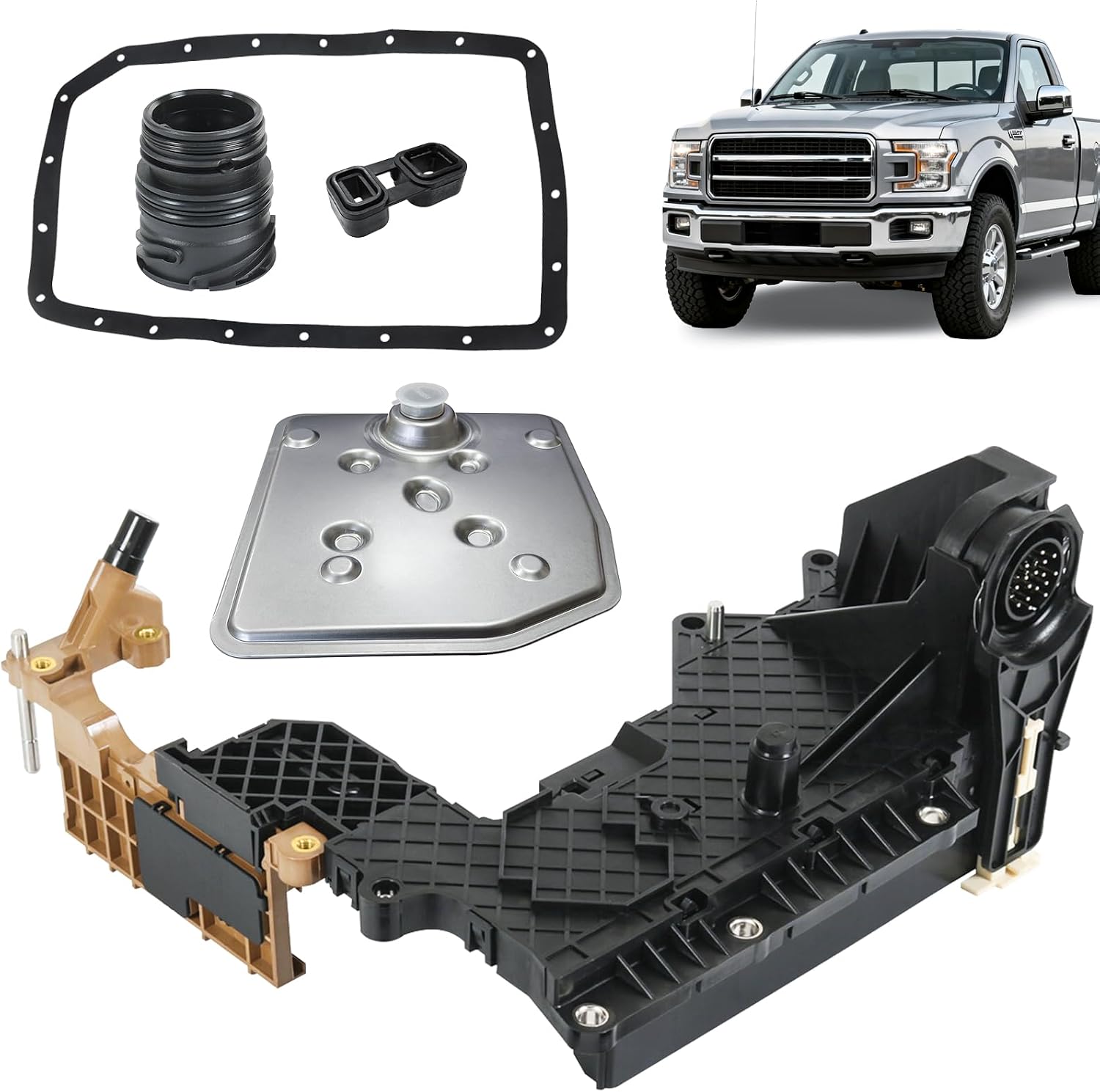
This is the big one on 2011-2014 F-150s. The 6R80 valve body carries what GEARS Magazine calls a Mechatronic control unit, and the molded lead frame on it holds the output shaft speed sensor (OSS), the turbine shaft speed sensor (TSS), the transmission fluid temperature sensor and the transmission range sensor. When the OSS signal drops out, the PCM suddenly thinks the truck has slowed down, and it acts on that.
What the driver reports: a hard, unexpected downshift into first gear at speed. Or the opposite: the truck takes off from a stop in 5th, the speedometer reads zero, and the odometer shows dashes. Ford TSB 13-6-8 describes exactly that 5th-gear-start pattern on 2011-2014 Mustang, 2011-2013 F-150 and 2012-2013 Expedition/Navigator built on or before 4/8/2013. It notes the symptoms may clear after a key cycle and that P0720 and P0722 may or may not be stored.
The recall history: NHTSA campaign 19V-075 (Ford 19S07) covered 1,263,051 2011-2013 F-150s built April 28, 2010 through November 18, 2013. Ford's Part 573 report lists the causes of the intermittent OSS signal as contamination, a power short to ground, connector corrosion, connector pin swaging and incorrect outputs from the sensor itself. The recall remedy was PCM software that stops the unintended downshift and turns on the MIL instead. It did not fix the hardware. A second recall, 24V-444 (Ford 24S37), added 552,188 2014 F-150s built June 17, 2013 through December 23, 2014, and gave them a calibration with an OSS signal plausibility check.
The 2015-2017 F-150 recall: in April 2026 Ford filed NHTSA campaign 26V-237 (Ford 26S28) for 1,392,935 2015-2017 F-150s with the 6-speed built March 12, 2014 through August 18, 2017. This time the failing signal is the transmission range sensor, which sits on the same lead frame. Ford's Part 573 report says thermal cycling and vibration degrade the lead frame connections, so the PCM briefly sees the wrong range position and can command a downshift as far as 6th to 2nd. The remedy is a PCM calibration that gives the control system more time to recognize a failing range sensor, plus a free lead frame for trucks that stored qualifying codes before the update. The filing lists F-150s only, so a 2015-2017 Expedition with the same symptom is a normal paid diagnosis.
The first lead frame recall came earlier. Ford's April 2016 announcement (Ford recall 16S19, filed with NHTSA as 16V-248) covered about 202,000 2011-2012 F-150, 2012 Expedition, Mustang and Navigator vehicles for the same OSS downshift, and warned that the abrupt speed reduction could make the rear tires slide or lock up. Per the 16V-248 Part 573 report, 184,000 of those were US vehicles, Continental Automotive Systems supplied the component, and the remedy on paper was a PCM reprogram; the lead frame itself was replaced under the companion extended-coverage program when OSS codes were present.
Alongside the recall, Customer Satisfaction Program 19N01 extended lead frame coverage to 10 years or 150,000 miles on those 2011-2013 F-150s and 2012-2013 Expedition/Navigators, for trucks that set P0720, P0722, P0731 and/or P1500. That coverage has run out on nearly every truck by now, so this is a customer-paid repair.
How I confirm it: check first that the recall calibration is installed. Then graph Output Shaft Speed against vehicle speed from the ABS on a road test and watch for dropouts to zero while the wheel speeds stay steady. Wiggle the case connector and the harness at the bell housing while you watch. If the OSS drops out while the harness looks good, the fault is inside the pan.
The fix: replace the molded lead frame. TSB 13-6-8 specifies AL3Z-7G276-A and states that the shift solenoids do not need to be replaced for this repair. Ford allowed 2.1 hours on the F-150 and 2.2 on the Mustang. Clean the case connector and inspect the pins while you are in there. A swaged or corroded pin will kill a new lead frame's signal just like it killed the old one's.
2. Solenoids that drift out of calibration
What the driver reports: the 1-2 is late and then slams, or the 2-3 flares one time and binds the next. After an overhaul, the adapts never seem to settle.
The cause: Sonnax technical specialist Jim Dial writes that the 6R80 and 6R140 variable bleed solenoids tend to lose their calibration, or banding, over time. Each solenoid is banded from 1 to 5, both the normally low and normally high types, and the solenoid strategy and solenoid body ID codes tell the PCM what it has. If a band 3 solenoid now behaves like a band 5, the PCM is working from wrong numbers. It watches for a turbine speed drop within a split second of commanding a solenoid, and when the solenoid flow no longer matches the band, the shift timing goes wrong and adaptation cannot catch up. Dial ties a lot of post-overhaul shift complaints on these units to reused solenoids.
How I confirm it: look at the apply chart for the shift that feels wrong. On the 2-3, the 3-5-R (B) clutch applies while the 2-6 (C) clutch releases, so both of those solenoids are suspects. Record the shift on the scan tool and compare the commanded solenoid current and pressure for each one. When the solenoid data is correct, the fault is in the hydraulics or clutch clearance. When the data is erratic, suspect a solenoid.
The fix: replace the solenoid with one of the same band number, or install new solenoids and program the new strategy into the PCM. Then clear adapts and drive the relearn. Dial notes that with correct parts, the relearn can take as few as three to five shift cycles.
One trap on early trucks: Shift Solenoid E is the only on/off solenoid in the unit. According to Transmission Digest, units built before November 4, 2010 use a 10.5 ohm solenoid with a tan snout (6L2Z-7G484-AA), and later units use an 18 ohm solenoid with a gray snout (AL3Z-7G484-B). The two are not interchangeable, so check the snout color before you install one.
3. Valve body bore wear: TCC slip, flares and harsh coast-downs
What the driver reports: a converter clutch slip code, a flare on the shift after lockup, a harsh coast 2-1, or a rough idle only in Reverse.
The cause: Bob Warnke's Sonnax write-up on the ZF6 and 6R60/80 converter circuit is the best explanation I know. Line pressure gets priority, so wear at the main pressure regulator valve bore (OE name SYS.DR-V) takes oil away from converter feed. The converter release regulator (WK-V) sets converter pressure, the bypass clutch control valve (WD-V) switches it, and the solenoid pressure regulator (DR.REO-V) feeds every solenoid, including the TCC solenoid. If that last bore is worn, every solenoid output runs high or low. Warnke's note is that these bores are commonly worn.
How I confirm it: the 6R80 has one case pressure tap, the WK (converter release) port on the driver side of the bell housing, just above the cooler lines. It uses a 10 x 1.00 mm ZF thread and needs an adapter. Use a 100 psi gauge, not a 500 psi one. Warnke's typical readings:
| Condition | Typical WK pressure |
|---|---|
| Engine running, cool | 70-75 psi |
| At operating temperature | About 65-68 psi |
| Shift into Reverse | Brief dip to about 50 psi, then back to 65-75 |
| TCC commanded on | 0-2 psi (0 = full apply; 1.5-2 = controlled slip) |
If WK stays low at idle in Reverse (for example 50-60 psi), the converter clutch is not fully releasing. If WK never climbs above 2-5 psi on a coast 2-1 or a forced 3-2, the shift is happening with the converter still locked, and it will feel harsh. With WK at zero, engine rpm and turbine rpm should match on the scan tool.
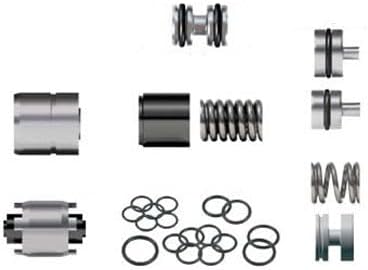
The fix: vacuum test the regulator, converter and solenoid-feed bores, then ream and fit oversized valves or install a remanufactured valve body. On 2009-2014 units without an 053 separator plate, the Sonnax ZF6-6R60-ZIP kit covers the main line, solenoid regulator and clutch control circuits. The 2015-later valve body is different. Sonnax identifies it by the FL3P forgings, so confirm which one you have before ordering valve body parts.
4. Direct (B) clutch bushing wear and burned clutches
What you find: ratio codes, slipping in 3rd and 5th or in Reverse, and a burned direct clutch pack when it comes apart. The 3-5-R clutch is applied in all three of those ranges.
The cause: Sonnax states that the OE direct clutch bushings in 2009-2014 6R80s wear prematurely because of their material composition. The worn bushing lets direct clutch apply pressure escape, which burns the clutch. Replacing only the frictions will not fix it.
The fix: during the rebuild, measure the bushing clearance and replace the bushing. The Sonnax 95030-07 fits units with a 1.337 in. shaft journal and has to be installed with an arbor press. Sonnax warns that a hydraulic press or a driver and hammer will distort the bushing. If a truck comes back with a burned B clutch, check this bushing before you blame the solenoid.
5. Harsh 1-2 and 2-1 shifts, and the 2011 one-way clutch change
Early 6R80s had enough harsh 1-2 and 2-1 complaints that Ford tried PCM calibration updates first. For 2011 it added a one-way clutch to the rear planetary (GEARS Magazine). In 2011-later units, the D clutch applies only until about 3 mph and then releases, and the one-way clutch holds first gear. Solenoid SSD is normally high, so it applies the D clutch at about 50 mA and releases it at about 850 mA.
Two practical results. First, if a 2011-later truck shows a harsh 2-1 at a stop, look at the SSD command and at the one-way clutch itself. Second, the change reached the case, the C and D support, the rear planetary, the valve body, the lead frame and the wiring harness. Pre-2011 and 2011-later parts in those areas do not interchange. Order by model year and case tag, not just "6R80."
6. No Reverse when shifting from Manual 1 or 2 while rolling (2015-2017 F-150)
Ford TSB 20-2060 covers 2015-2017 F-150s that intermittently lose Reverse engagement, or go to Neutral, when shifted from MANUAL 1 or MANUAL 2 into REVERSE while rolling slowly, with no DTCs set. Ford lists the cause as PCM software strategy. The fix is a PCM reprogram and the Adaptive Learning Drive Cycle, with 0.9 hour allowed. If the truck matches that description exactly, check the software level before you pull the valve body.
7. Fluid: the wrong fluid and additives cause problems too
Ford's ATF chart calls for MERCON LV (XT-10-QLVC) in the 6R80, and its by-vehicle chart keeps every 6R80 on LV, including the 2017-2020 F-150 and 2017-2019 Transit rows. MERCON ULV shows up only on the 10R80 rows, so a 6R80 and a 10R80 F-150 need different fluids. Full capacities and the level check are in our 6R80 fluid type and capacity guide. The same Ford chart says in capital letters not to use supplemental transmission fluid additives, treatments or cleaning agents, because they can affect transmission operation. A bottle of shift fix on top of worn solenoid regulator bores just hides the problem until the next adapt cycle.
Watch temperature data too. Transmission Digest documented a 2013 F-150 that read erratic transmission temperature after an overhaul. The PCM and valve body were replaced, and neither fixed it. The real cause was a low/reverse clutch stacked with all .083 in. steels. It was too tight and was burning the frictions directly above the lead frame temperature sensor. With the correct steels, clearance came back to .039-.062 in. and the readings returned to normal.
6R80 lead frame / temperature and range sensor assembly
If the OSS dropouts, 5th-gear starts or P0720/P0722 point to the lead frame (problem #1 above), this is the assembly that holds the sensors. Sold by our sister store, CoreTransmissionParts.
Shop the part for this fix →Chasing a harness or connector fault instead? The wiring and electronics collection has 6R80 harness repair kits and connectors.
Need parts for this job?
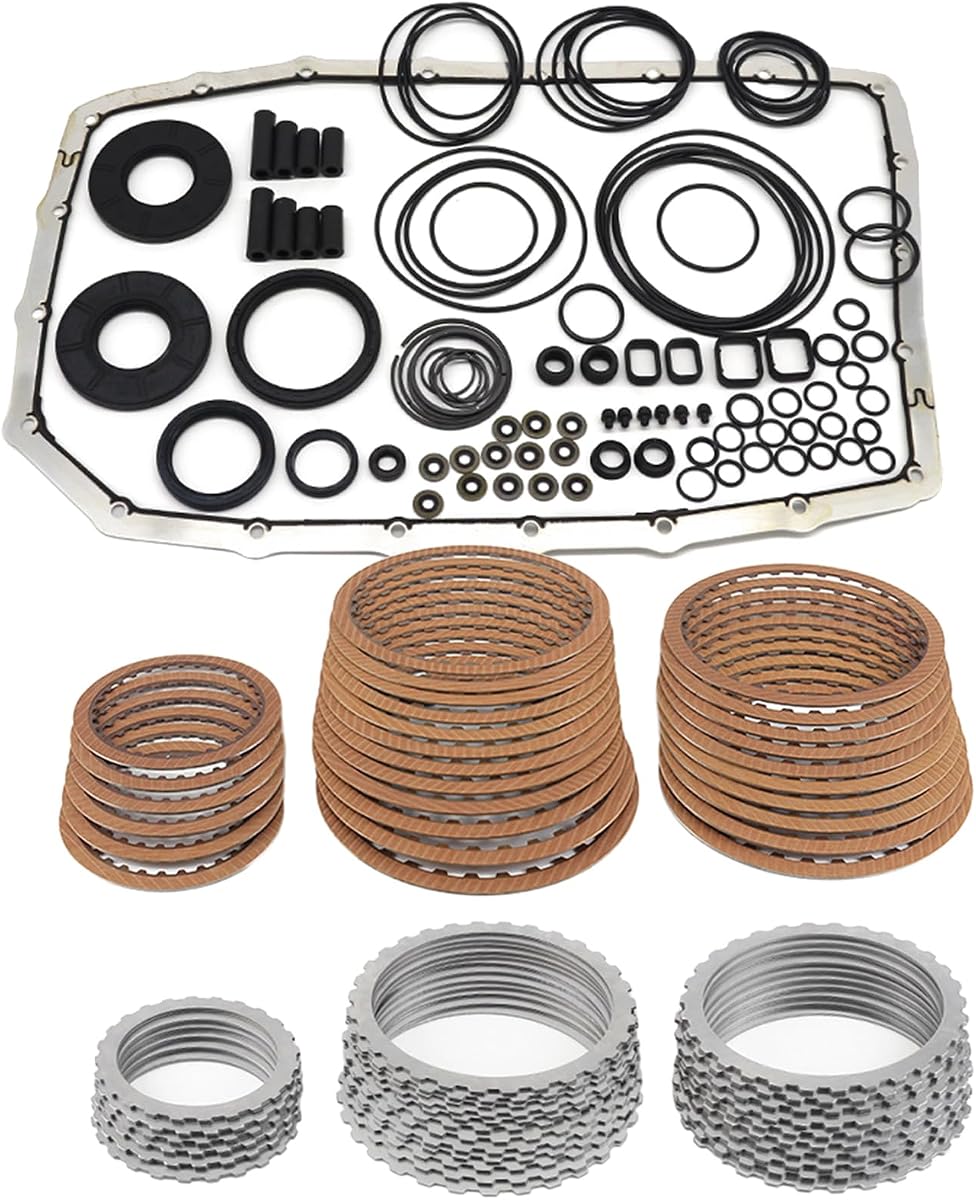
Our 6R80 parts page carries lead frame kits, solenoid kits, remanufactured valve bodies by year, Sonnax Zip kits, master rebuild kits and MERCON LV, with checkout on site.
FAQ
What is the most common 6R80 transmission problem?
On 2011-2014 F-150s it is an intermittent output shaft speed sensor signal from the molded lead frame. It causes a sudden downshift to first, 5th-gear starts, a speedometer reading zero, and codes like P0720 and P0722. Ford issued recalls 19V-075 and 24V-444 to reprogram the PCM, and the hardware fix is a new lead frame.
Is the 6R80 a reliable transmission?
Mechanically it is a strong unit, a licensed version of the ZF 6HP26. Most of its common failures are electrical and hydraulic: the lead frame, solenoids that drift out of calibration, and worn valve body bores. The main hard-part weakness is the direct clutch bushing on 2009-2014 units.
Do you have to replace solenoids when you replace the 6R80 lead frame?
No. Ford TSB 13-6-8 specifies lead frame AL3Z-7G276-A and states that replacing the shift solenoids is not required for that repair. If you do replace solenoids, match the band numbers or program the new solenoid strategy into the PCM.
What fluid does a 6R80 take?
Ford's ATF chart lists MERCON LV (XT-10-QLVC) for the 6R80 in every application, including 2017-2020 F-150s and 2017-2019 Transits. MERCON ULV is for the 10R80 that replaced it, not the 6R80. Ford also warns against supplemental additives or cleaners.
Related guides
- 6R80 P0720: Output Speed Sensor Circuit Fix
- 6R80 P0741: Torque Converter Clutch Fix
- 6R80 Valve Body Wear and Fix
- 6R80 vs. 6R140 Differences
- Ford 6R80 Complete Service Guide
Sources
- NHTSA / Ford Motor Company, Part 573 Safety Recall Report 19V-075 (Ford 19S07), February 11, 2019. Backs the 1,263,051 2011-2013 F-150 population, the April 28, 2010 to November 18, 2013 production range, the unintended downshift to first, the listed causes (contamination, short to ground, connector corrosion, pin swaging, incorrect sensor output) and the PCM reprogramming remedy. static.nhtsa.gov (PDF)
- NHTSA / Ford Motor Company, Part 573 Safety Recall Report 24V-444 (Ford 24S37), June 14, 2024. Backs the 552,188 2014 F-150 population, the June 17, 2013 to December 23, 2014 production range and the OSS signal plausibility check calibration. static.nhtsa.gov (PDF)
- NHTSA / Ford Motor Company, Part 573 Safety Recall Report 26V-237 (Ford 26S28), April 14, 2026. Backs the 1,392,935 2015-2017 F-150 population, the March 12, 2014 to August 18, 2017 build range, the range sensor signal and lead frame degradation cause, the 6-2 downshift and the calibration plus conditional lead frame remedy. static.nhtsa.gov (PDF)
- Ford Motor Company, safety recall announcement, April 27, 2016 (Ford 16S19 / NHTSA 16V-248, hosted by NHTSA). Backs the roughly 202,000 2011-2012 F-150 and 2012 Expedition, Mustang and Navigator vehicles, the OSS lead frame cause and the rear tire slide or lock-up risk. static.nhtsa.gov (PDF)
- NHTSA — Part 573 Safety Recall Report 16V-248 (Ford 16S19), submitted April 25, 2016. Backs the 184,000 US population, the intermittent OSS signal loss and temporary downshift to 1st, Continental Automotive Systems as supplier, and the PCM reprogramming remedy. static.nhtsa.gov (PDF)
- Ford Motor Company, Customer Satisfaction Program 19N01, "Transmission Molded Leadframe Extended Coverage," April 4, 2019 (hosted by NHTSA). Backs the 10 year / 150,000 mile lead frame coverage, the covered F-150 and Expedition/Navigator build ranges and the qualifying DTCs P0720, P0722, P0731 and P1500. static.nhtsa.gov (PDF)
- Ford Motor Company, Technical Service Bulletin 13-6-8, "6R80 Transmission High Gear Engagement From A Stop," June 7, 2013 (hosted by NHTSA). Backs the 5th-gear start, zero speedometer and dashed odometer symptoms, the 4/8/2013 build cutoff, lead frame AL3Z-7G276-A, the no-solenoids-required note and the 2.1 / 2.2 hour labor. static.nhtsa.gov (PDF)
- Ford Motor Company, Technical Service Bulletin 20-2060, "6R80 Transmission - Intermittent No Engagement/Neutral State During Manual Shift to Reverse Events With No DTCs," March 6, 2020 (hosted by NHTSA). Backs the 2015-2017 F-150 condition, the PCM reprogram plus Adaptive Learning Drive Cycle and the 0.9 hour allowance. static.nhtsa.gov (PDF)
- Sonnax, Jim Dial, "Troubleshooting Ford 6R80 & 6R140 Timing-Related Shift Issues," August 15, 2022. Backs variable bleed solenoids losing calibration/banding, bands 1-5 on normally low and normally high solenoids, strategy and body ID programming, the turbine speed drop the PCM watches for, and the 3-5 cycle relearn. sonnax.com
- Sonnax, Bob Warnke, "Six Ways from Sunday: Diagnosing ZF6 & Ford 6R60/80 TC-Related Drivability Concerns," March 23, 2016. Backs the WK tap location and 10 x 1.00 mm thread, the WK pressure values, the six abnormal-WK symptoms, and the SYS.DR-V, WK-V, WD-V and DR.REO-V valve roles. sonnax.com
- Sonnax, "B"/Direct Clutch Bushing 95030-07 product data. Backs the premature OE direct clutch bushing wear in 2009-2014 6R80s, the ratio code and burned clutch results, the 1.337 in. journal fit and the arbor press warning. sonnax.com
- GEARS Magazine (ATRA), David Chalker, "Updates to the Ford 6R80." Backs the ZF 6HP26 origin, the Mechatronic unit carrying the OSS, TSS, TFT and TR sensors, the 2011 one-way clutch addition, the D clutch releasing at about 3 mph, the SSD 50 mA / 850 mA values and the parts affected by the change. gearsmagazine.com
- Transmission Digest, Wayne Colonna, "Ford 6R80 shift solenoid 'E' resistance change: How to tell the difference," April 30, 2024. Backs the 10.5 ohm tan-snout (6L2Z-7G484-AA) and 18 ohm gray-snout (AL3Z-7G484-B) solenoids and the November 4, 2010 build break. transmissiondigest.com
- Transmission Digest, Wayne Colonna, "Ford 6R60/6R80 Erratic Temperature Operation," October 22, 2021. Backs the 2013 F-150 case, the temperature sensor on the lead frame below the low/reverse clutch, and the .039-.062 in. clearance correction. transmissiondigest.com
- Ford Customer Service Division, Motorcraft Automatic Transmission Fluid Charts (by transmission and by vehicle). Back MERCON LV (XT-10-QLVC) for every 6R80 application including 2017-2020 F-150 and 2017-2019 Transit, MERCON ULV only on the 10R80, and the warning against supplemental additives, treatments or cleaners. by transmission (PDF) / by vehicle (PDF)