A harsh shift on a 6R80 almost never means a broken part inside the clutch packs. The 6R80 is Ford's version of the ZF 6HP26, and every shift is a clutch-to-clutch handoff. One clutch releases while another applies, and the PCM times both with variable bleed solenoids. If that timing is off by a few milliseconds, the driver feels a bang, a bind-up or a flare-then-catch. The hard part is that the timing can go wrong in five places: the calibration, the adaptive tables, the solenoids, the valve body bores or the clutch clearances.
This guide works through them in the order a shop should check them, cheapest first. It uses Ford bulletin language, Sonnax valve body research and GEARS Magazine field cases, and every source is listed at the bottom.


Pin down which shift is harsh
"It shifts hard" is not enough to diagnose from. Before you plug in a scan tool, drive the truck with the owner and write down exactly which shift bangs, whether it is an upshift or a downshift, whether it happens cold or hot, and whether it happens under light throttle or only when coasting to a stop. Each clutch handoff involves a different pair of clutches and solenoids, so the shift points you toward the part.
| Harsh event | Clutch handoff | First suspects |
|---|---|---|
| 1-2 upshift | C (2-6) clutch applies | SSC solenoid calibration, C/26 regulator valve |
| 2-3 upshift or 2-3 bind-up | C releases while B (3-5-R) applies | SSC (NL) and SSB (NH) solenoids together, clutch clearance |
| 2-1 coast downshift or bump at a stop | C releases, one-way clutch or D takes over | Calibration on 2009-2010 trucks, converter clutch pressure, adaptive tables |
| Forced 3-2 or 2-1 kickdown | Downshift with the converter clutch releasing | WK (converter release) pressure, TCC solenoid |
| Harsh on every shift and engagement | All | Solenoid pressure regulator valve, main line pressure, wrong solenoid strategy |
The last row matters most. If only one shift is harsh, look at the parts that control that shift. If every shift and the garage engagements are firm, the problem is upstream of all of them. Usually that means the pressure that feeds every solenoid, or a PCM that has been given the wrong solenoid data.
Step 1: Rule out calibration and adaptive learning
Check for a software fix before you touch the valve body. The early 6R80 trucks were known for harsh 1-2 upshifts and 2-1 downshifts. GEARS Magazine's update series notes that Ford first tried to fix those complaints with PCM calibrations. For 2011, Ford then added a one-way clutch to the rear planetary. That change required a new case, C and D support changes, a revised rear planetary, valve body updates, a new molded lead frame and a new harness. On the 2011-later units, the D clutch releases at about 3 mph instead of staying on through all of 1st. GEARS credits the one-way clutch and the new PCM control for reducing the bumpy downshift into 1st that was common on earlier trucks.
Two practical points follow from that. First, a 2009-2010 truck with a harsh 2-1 coast downshift may have no hard fault. Check for open calibration updates with the Ford scan tool before you do anything else. Second, a harsh coast-down bump on a 2011-later truck is not the same design problem, because that truck already has the one-way clutch. Look for a pressure or solenoid fault.
Also check whether the adaptive tables were recently reset, for example after a battery disconnect, a reflash or a valve body swap. Ford's bulletin language is clear on this. TSB 20-2060, a 2015-2017 F-150 6R80 reprogram bulletin, tells the technician to warn the customer about the relearn. After a reset, the adaptive strategy relearns the transmission, and upshifts and downshifts may be firmer than normal for several days. The bulletin also calls for the Adaptive Learning Drive Cycle in Workshop Manual section 307-01 after programming. A truck that went harsh the day after a battery replacement may just need the drive cycle.
The drive cycle GEARS publishes for the 6R80 goes like this. Clear codes, bring the engine to operating temperature and confirm the fluid level. Then, in D, accelerate moderately from a stop to 50 mph so it shifts into 6th, and hold speed and throttle steady for at least 15 seconds. Lightly tap the brake to operate the brake lights, stop, and repeat. GEARS warns that if you skip the drive cycle, the system will not reset properly and you can be left with erratic shifts.
Step 2: Confirm the solenoid strategy matches the valve body
The 6R80 main control carries a 13-digit solenoid body strategy and a 12-digit solenoid body identification. You will find them on the tag on the side of the case, and the 13-digit strategy is also stamped on the valve body casting. Lance Wiggins writes in GEARS that if the strategy etched on the main control does not match what the scan tool shows, you have to update it or the truck may shift harshly. Each solenoid comes in five calibrations, so a large number of combinations is possible.
This is the most common cause of a harsh shift right after a repair. A used valve body, a remanufactured unit or a single swapped solenoid all change the real solenoid behavior. The PCM keeps running the old numbers until someone enters the new ones under Module Programming. Read the tag, compare it to the scan tool, and program it before you diagnose anything else.
Step 3: Solenoids that have drifted off their band
The 6R80 variable bleed solenoids lose their calibration over time. Sonnax technical specialist Jim Dial explains that the PCM watches the drop in turbine speed within milliseconds of commanding a solenoid, and plans every shift around the solenoid's band number. A solenoid that left the factory as a band 3 can drift until it behaves like a band 5 or a band 1.5. At that point the PCM is timing the shift with the wrong data.
The 1-2 and 2-3 shifts show this most clearly. Dial points out that the C/26 clutch regulator valve does not connect to a latch valve. It is positioned only by SSC output and a balance circuit tied to C clutch apply pressure. An aggressive SSC gives a harsh 1-2, and a lazy one gives a 1-2 that slides. Because the same solenoid also controls how fast C releases on the 2-3, the same fault can show up as a 2-3 flare on one shift and a 2-3 bind-up on the next.
Sonnax documented this in a 2-3 case study. During the 2-3, the 3-5-R (B) clutch applies while the 2-6 (C) clutch must release at the same moment. The "C" solenoid is normally low and controls C clutch release. The "B" solenoid is normally high and controls B clutch apply. On the problem truck, the scan data showed the PCM commanding the right current to both solenoids in the right sequence, with B pressure reaching about 50 psi at the end of the shift. The electronics were fine, but the solenoids were not doing what they were told. Replacing both the B and C solenoids, followed by an adaptive reset and a 20-cycle road test, fixed the flare/bind-up. Dial also traces many post-overhaul comebacks to reused solenoids whose calibration had drifted.
How to tell: the harshness moves around. It is worse on some days than others, one shift can alternate between a flare and a bang, and the pan is clean. Our 6R80 shift solenoid guide covers the current-versus-pressure test and band matching. Replace solenoids as a matched set and program the new band data. A single mismatched solenoid can bring the complaint right back.
Step 4: Valve body wear that makes every shift harsh
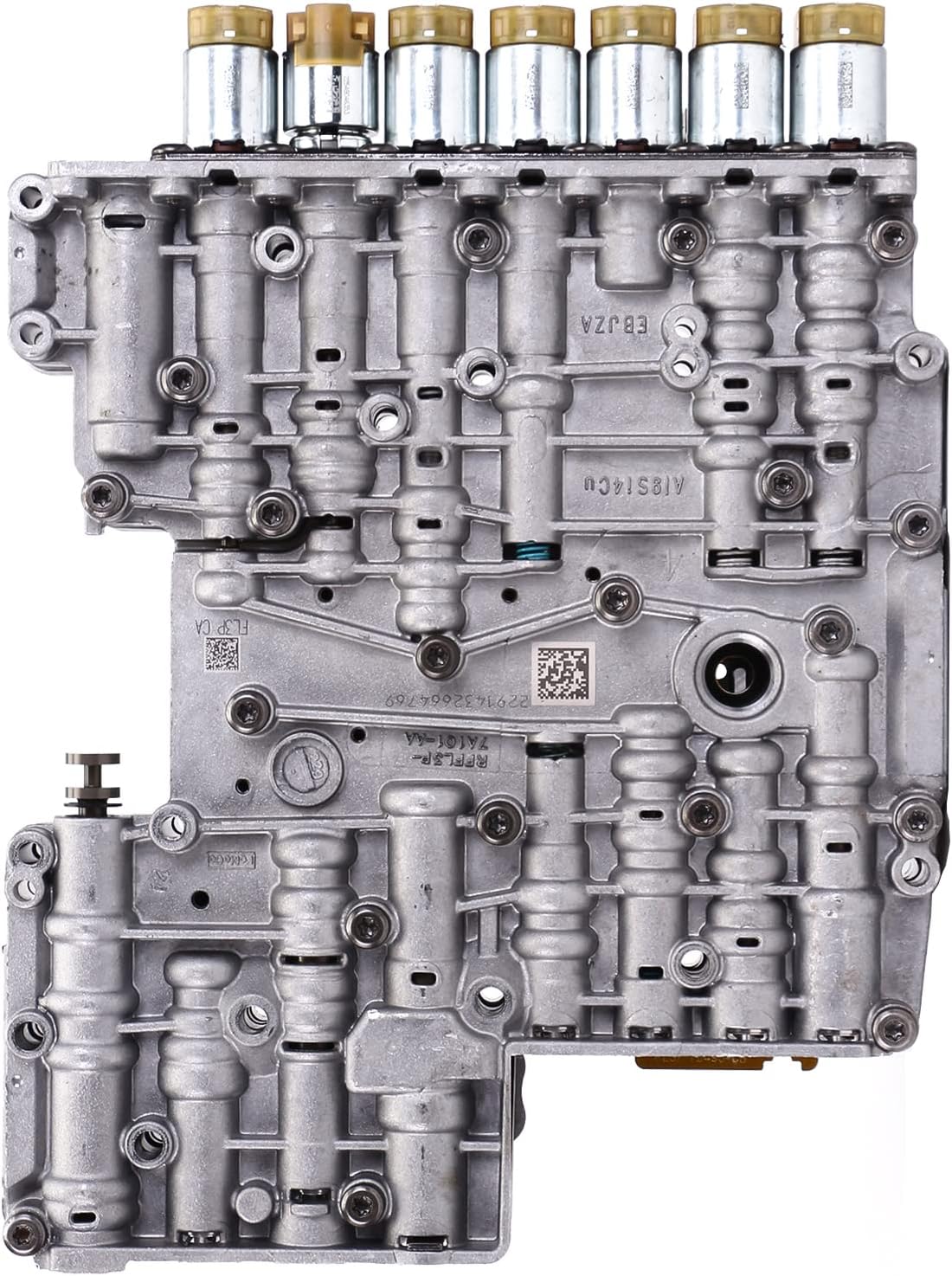
When every shift and engagement is firm, look first at the valve that feeds all the solenoids. In its 6R60/6R80 drivability write-up, Sonnax notes that when the solenoid pressure regulator valve (DR.REO-V) wears, all solenoid output will be either too high or too low. Every clutch then applies too hard or too soft at once, and the PCM's adaptive tables cannot correct for it. Sonnax lists the other bores to check on a harsh-shift unit: the main regulator (SYS.DR-V), the converter release regulator (WK-V) and the bypass clutch control valve (WD-V). Its repair kits are 95740-01K for the pressure regulator, 95740-05K for the WK valve and 95740-13K for bypass clutch control.
Sonnax also calls out a downshift failure that is easy to miss. If WK pressure (the converter clutch release circuit) does not rise beyond about 2 to 5 psi during a 2-1 or forced 3-2 downshift, the converter clutch is still locked during the shift and the downshift feels harsh. A WK valve or a worn TCC solenoid can make a truck bang into 2nd on a kickdown even though every clutch is healthy.
The last item on the Sonnax list is end plugs. The plugs between the shift valves and the solenoids tend to work loose and leak, which lets a circuit bleed down. Sonnax recommends sealing those end plugs as part of any 6R80 valve body job. On a unit you are rebuilding, the fix is to repair the worn bores with oversized valves and seal the end plugs. On a truck that needs to go back out quickly, install a complete valve body with solenoids and program its strategy. Our 6R80 valve body testing guide covers vacuum-testing the bores.
Step 5: Clutch clearance on a rebuilt unit
If the harsh shift started right after an overhaul and the solenoids are new and programmed, measure the clutch packs. Sonnax warns that tightening clutch packs too much can also cause a binding condition. A tight pack needs very little piston travel to apply, so the clutch grabs before the releasing clutch has let go and the shift binds up. Set every pack to the OEM clearance spec, not tighter.
The fix, in order
- Check fluid level and condition first. The 6R80 takes MERCON LV and is checked at the fill plug with the fluid at operating temperature. See our 6R80 fluid guide for the procedure.
- Look for calibration updates and run the adaptive drive cycle, especially after any reset. A firm shift for a few days after a reset is normal behavior, according to Ford.
- Verify the 13-digit strategy and 12-digit ID match what the PCM has. If the valve body or a solenoid was ever changed, this is the first suspect.
- One shift harsh, clean pan, changes from day to day: replace the solenoids as a matched set, program the band data and relearn.
- Every shift and engagement harsh: repair the solenoid pressure regulator, main regulator and end plugs, or install a complete valve body with solenoids.
- Harsh only on kickdown: check WK pressure and the TCC solenoid.
- Harsh right after a rebuild: recheck the clutch clearances against spec.
To prevent it from coming back, do not reuse high-mileage solenoids in a rebuilt unit, program every solenoid body change, and always finish with the drive cycle before the truck goes back to the customer.
Superior STL-6R80 valve body upgrade kit
For a 6R80 whose firm shifts come from the valve body side: Superior's valve body upgrade kit for the 6R60, 6R75, 6R80 and 6R100 family. Install it with a clean valve body and program the solenoid strategy afterward. Sold by our sister store, CoreTransmissionParts.
Shop the part for this fix →Need a complete unit instead? The valve bodies collection lists the other options.
Need parts for this job?
Our 6R80 parts page has matched solenoid sets, Transgo and Sonnax valve body kits, remanufactured valve bodies with solenoids, shift kits and Motorcraft MERCON LV. Checkout is on site.
FAQ
Why does my Ford 6R80 shift hard?
The most common causes are solenoids that have drifted off their calibration band, a solenoid body strategy that does not match the valve body, a worn solenoid pressure regulator valve, and adaptive tables that were recently reset. Early 2009-2010 trucks also had calibration-related harsh 1-2 and 2-1 shifts that Ford addressed with PCM updates.
Is a harsh shift normal after a battery disconnect or reflash?
For a short time, yes. Ford's 6R80 bulletins warn that after the adaptive strategy is reset, the relearn may cause firmer than normal upshifts and downshifts for several days. Running the adaptive drive cycle speeds it up. If it is still harsh after that, look for a real fault.
Can bad solenoids cause a 6R80 to shift harshly without a code?
Yes. A solenoid that has drifted off its band still works electrically, so it may not set a code. It just delivers the wrong pressure for the current the PCM commands. Sonnax documented a 6R80 with a 2-3 flare and bind-up where the electronics were correct and replacing the B and C solenoids fixed it.
Do I need to program anything after replacing the 6R80 valve body?
Yes. Enter the 13-digit solenoid body strategy and 12-digit ID from the tag into the PCM under Module Programming, then complete the transmission drive cycle. GEARS warns that a strategy mismatch can cause harsh shifts, and skipping the drive cycle can leave erratic shifting.
Related guides
- 6R80 Shift Solenoid Symptoms and Replacement
- 6R80 Valve Body Problems and Testing
- 6R80 Valve Body Wear and Fix
- 6R80 Slipping: Causes and Fix
- 6R80 Common Problems and Fixes
Sources
- Sonnax, Jim Dial, "Troubleshooting Ford 6R80 & 6R140 Timing-Related Shift Issues." Backs the PCM timing shifts from turbine speed drop, solenoids drifting from band 3 to band 5 or 1.5, the C/26 regulator valve having no latch valve, the harsh or sliding 1-2 and 2-3 flare/bind-up from SSC output, and comebacks from reused solenoids. sonnax.com
- Sonnax, "Troubleshooting Ford 6R80 & 6R140 2-3 Shift Quality Issues." Backs the B/C clutch handoff on the 2-3, the NL "C" and NH "B" solenoid roles, correct electronics with failed solenoids, the B and C solenoid replacement with adaptive reset and 20-cycle road test, and the warning about clutch packs set too tight. sonnax.com
- Sonnax, "Six Ways From Sunday: Diagnosing ZF6/Ford 6R60/80 TC-Related Drivability Concerns." Backs the harsh 2-1/forced 3-2 when WK pressure stays at 2-5 psi, all solenoid output being off when the solenoid pressure regulator wears, the bores to service, kit numbers 95740-01K, -05K and -13K, and sealing loose end plugs. sonnax.com
- GEARS Magazine (ATRA), Lance Wiggins, "Controlling the 6R80," July 2015. Backs the 13-digit solenoid body strategy and 12-digit ID, harsh shifts from a strategy mismatch, the five calibrations per solenoid, and the 50 mph drive cycle and its warning. atracom.blob.core.windows.net (PDF)
- GEARS Magazine (ATRA), "Updates to the Ford 6R80." Backs the harsh 1-2 and 2-1 complaints on early units, Ford's PCM calibration attempts, the 2011 one-way clutch and related hardware changes, and the D clutch releasing at about 3 mph. gearsmagazine.com
- Ford Motor Company, TSB 20-2060, 2015-2017 F-150 6R80 PCM reprogram. Backs the adaptive relearn causing firmer than normal upshifts and downshifts for several days, and the Adaptive Learning Drive Cycle in WSM section 307-01. static.nhtsa.gov (PDF)